


I first came to Lisbon thinking I could treat the whole region as one compact city break. A week, one hotel, and I would hop out to Sintra, Cascais and the south bank as easily as changing metro lines. After actually staying in different bases across the region over several trips, I learned that where you sleep in Greater Lisbon quietly reshapes your days: what you do after sunset, how early you start for Sintra, whether you swim before breakfast or hear trams outside your window. This guide walks through how I chose my bases, what worked and what did not, and whether it makes sense to sleep only in Lisbon or split your time between the city and another base.
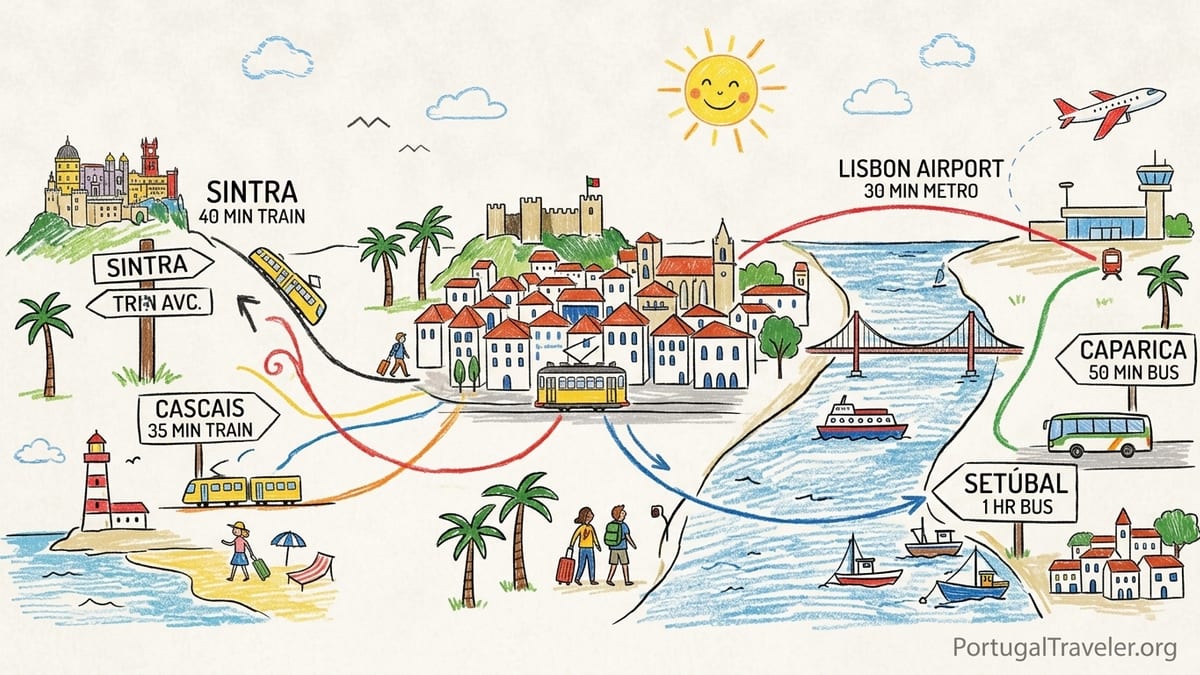
Understanding Distances and Real Travel Times Around Lisbon
On a map, Greater Lisbon looks compact. In practice, your base choice decides whether you spend your holiday walking to dinner or timing trains. Lisbon’s historic core from Baixa to Chiado and Avenida is only about 7 kilometers from the Atlantic coast at Belém, around 30 kilometers from Cascais, about 28 kilometers from Sintra, and roughly 50 kilometers from Setúbal on the southern side of the Tagus. Those numbers sound small, but add in traffic, hills, station walks and queues for tickets, and a simple day trip can easily turn into 2 to 3 hours of transport there and back.
From Lisbon Airport to a central base around Baixa-Chiado, I usually budget 30 to 40 minutes on the metro. The red line runs from the terminal into town, and with one change to the green or blue lines you reach Baixa-Chiado for about 1.90 euros on the 2026 city tariff using the standard contactless or rechargeable ticket system. The metro runs roughly from early morning to around 1 a.m., which makes late arrivals workable without a taxi, although changes feel longer with heavy luggage.
Regional and urban trains connect Lisbon to Cascais and Sintra. The Cascais line from Cais do Sodré runs along the river and takes around 35 to 40 minutes to reach Cascais, with frequent departures and a 2026 return fare around 5.10 euros. The Sintra line from Rossio station is similar in journey time at about 40 minutes, with a one way ticket just over 2.50 euros as checked in late 2026. On paper both are easy, but you still walk from your hotel to the station, navigate crowds, wait for departures and finally connect to local buses or taxis at the other end. That is why base choice matters so much.
To the south, crossings over the Tagus by train or bus are a bit longer. Buses from Lisbon Oriente to Setúbal, for example, are advertised in the 35 to 50 minute range with advance fares sometimes around 3 euros on discount bus operators. In real use from my stays on both sides of the river, you should allow closer to an hour from central Lisbon to actually reach a hotel in Setúbal or the beach at Troia, counting local buses, ferry transfers and some waiting time.
Staying Entirely in Central Lisbon: When It Works Best
On my first week-long visit I booked a single stay in Baixa, a few minutes’ walk from Baixa-Chiado metro. For a classic first trip focused on Lisbon’s neighborhoods, this was still the most efficient base. I could walk in ten minutes from my hotel to Rossio station for the Sintra train, stroll fifteen minutes down to Cais do Sodré for Cascais, and be back at night within sight of Praça do Comércio. Most evenings I simply let the city pull me in, from a last drink in Chiado to a late dessert in Bairro Alto, without checking timetables.
With metro, trams and urban trains converging downtown, central Lisbon is the easiest base for travelers who do not want to rent a car. Airport transfers are straightforward, and public transport covers most of what first-time visitors want to see. A standard metro or bus ticket costs under 2 euros, and day cards or contactless caps keep costs manageable even if you crisscross town several times. For example, after a day trip to Cascais, I routinely took the train back to Cais do Sodré, hopped straight on the metro green line to Baixa-Chiado, and walked uphill to my hotel without ever looking for a taxi.
Hotel choice in central Lisbon has widened since my first stay. Around Baixa and Chiado you now find everything from simple guesthouses under 100 euros a night in low season to polished design hotels well above 250 euros in busy spring and fall weekends. Prices change quickly with demand, but compared with Cascais or Sintra, budget and midrange options are more concentrated and often come with better access to restaurants that stay open late. When I stayed near Avenida, for instance, I could eat at 22:00 without thinking, which was not always true in smaller coastal towns outside peak months.
The main compromise when staying only in central Lisbon is fatigue on repeated day trips. After three long days in a row, Lisbon to Sintra, to Cascais, then across the river for a wine region tour, I found myself spending more time on trains and buses than in cafés or at the beach. If your plan includes more than two full-day excursions out of the city, a split base starts to make more sense.
Using the Atlantic Coast as a Base: Cascais, Estoril and the Western Suburbs
On a later trip I flipped the script and based myself in Cascais for four nights after an initial three in Lisbon. Cascais is linked to Cais do Sodré by the coastal train line that runs roughly every 20 minutes, covering the journey in about 35 to 40 minutes. A return ticket on the 2026 tariff is just over 5 euros, which makes going into Lisbon for a single evening or museum visit perfectly feasible. In practice, I found that doing the round trip more than twice in a row felt like commuting rather than being on holiday.
As a base, Cascais suited my priorities for that part of the trip: running along the sea wall at sunrise, having breakfast facing the marina, swimming at Praia da Conceição before lunch and walking the coastal path toward Boca do Inferno in the afternoon. Parking was also noticeably less stressful than inside Lisbon. My hotel had on-site parking included in the rate, and street parking near the waterfront, while regulated, was still easier to find than a legal space anywhere close to Alfama or Baixa.
For public transport, Cascais has enough infrastructure to work without a car. The station is in the middle of town, no more than a ten minute walk from most hotels and guesthouses. Buses reach Guincho beach and neighboring residential areas, and local taxis and ride-hailing services are widely available for short hops. Restaurants cluster around the old town and the waterfront and stay lively well into the night during spring and summer, with a comfortable mix of seafood houses, wine bars and more casual spots. Outside high season, things quieten, but you can still find open kitchens at 21:00 without planning ahead.
The trade-off is that Cascais is poor as a base for Sintra or the south bank. The romantic palaces of Sintra lie inland and uphill. From Cascais by bus or car you should allow 30 to 40 minutes to Sintra town in light traffic, and the route can choke on weekends. By contrast, the direct Sintra train from Rossio in Lisbon takes around 40 minutes and avoids the hills. On my Cascais stay I tried one Sintra day from the coast and ended up stuck in traffic near Colares, with more time in the car than in the gardens of Monserrate. For this reason I would not combine a heavy Sintra program with a Cascais base unless I was driving very off-peak.
Basing Near Sintra: Magical Days, Logistical Evenings
Sintra is the reason many travelers start thinking about a split base. I have done Sintra both as long single day trips from Lisbon and as a two-night stay in a small guesthouse within walking distance of the historic center. The difference in experience was striking. Staying overnight meant I could visit Pena Palace and the Moorish Castle early, before the first wave of day trippers off the Lisbon trains, and then enjoy the town and nearby coast in the evenings after tour buses rolled back.
The train from Lisbon Rossio to Sintra runs at least twice an hour in normal daytime schedules, with a journey time around 40 minutes and tickets a little over 2.50 euros in late 2026. However, the train only brings you to Sintra station in the lower part of town. From there you still need a bus, tuk-tuk or a fairly steep walk to reach most palaces. When I stayed in Sintra itself, I could walk back to my guesthouse from dinner and did not worry about returning to Lisbon before the last train. I also took a late afternoon tram from Sintra to Praia das Maçãs, a slow but scenic ride out to the Atlantic that made more sense when I knew I was sleeping nearby.
Accommodation in Sintra tends to be in smaller units: historic villas turned into inns, boutique hotels in gardens, and a scattering of apartments. Price-wise, in shoulder seasons I found charming double rooms between 120 and 200 euros per night including breakfast. These were not cheap by Portuguese standards, but they bought atmosphere that would be hard to match in central Lisbon at the same price. Parking is the main constraint. Narrow lanes and limited spaces near the historic center mean that unless your lodging has its own small car park or a reserved spot, you can spend a frustrating half hour circling.
Evenings in Sintra are softer and quieter than in Lisbon. A few restaurants and wine bars stay open, but there is nothing like the dense late-night scene of Bairro Alto or Cais do Sodré. When I stayed overnight, I leaned into that rhythm: long dinners, a glass of port in the garden, and early starts. For travelers who want nightlife every evening, a Sintra base will feel subdued. For those who want to step out of the city and wake up in misty hills for a couple of days, it can be perfect.
South of the Tagus: Almada, Costa da Caparica and Setúbal
My most distinct experience of a two-base trip in the Lisbon region paired a central Lisbon stay with time south of the Tagus. First I took the metro from the airport to Baixa-Chiado and spent three nights in a hotel near Rossio. Then I crossed the river to Almada and later to Setúbal to focus on beaches and seafood. This side of the estuary has a different energy from the north bank: more local, less polished, with immense stretches of sand facing the Atlantic.
Almada sits directly across from Cais do Sodré. You reach it by commuter ferry in around ten minutes, then link to buses or trams toward Costa da Caparica and the beaches south of the city. From my hotel in Baixa, it took about 20 minutes to walk to the ferry terminal, cross the river and connect to the Costa buses, and another 20 to 30 minutes to reach the main town beach depending on traffic. Doing that as a day trip was easy. Staying south of the river, however, made sense when I wanted several days of sand without watching the clock for the last ferry back.
Further south, Setúbal is reachable by bus or train from Lisbon in roughly 45 to 60 minutes under good conditions. Some early morning coach services show as short as 35 minutes on schedules from Oriente station to Setúbal’s bus terminal, with fares from around 3 euros when booked with discount operators. From Setúbal, I walked to the ferry for the Troia peninsula, which adds another 20 minutes of sailing time, then continued on foot or by bike to beaches. Doing all of this repeatedly from a Lisbon hotel would have been tiring and expensive, especially with children. Basing in Setúbal for three nights concentrated the transport costs into arrivals and departures, and left full days free for simple routines.
In terms of infrastructure, Setúbal has a working-port character with a compact center. Parking around my hotel near the main square was much easier than in Lisbon or Sintra, and most evenings I ate within a ten minute walk in family-run seafood places. Prices in restaurants and cafés were quietly lower than in central Lisbon, particularly for house wine and grilled fish. Nightlife is sociable but mostly local, so English menus and craft cocktail bars are rarer than north of the river. For travelers who enjoy feeling like they are in a Portuguese town rather than an international capital, that can be a major plus.
One Base or Two: How to Decide for Your Itinerary
The question I get most often from readers is whether they should keep a single hotel in Lisbon for 5 to 7 nights or split the trip between Lisbon and another base. After trial and error, my rule of thumb is to stay put if you have fewer than five nights and to consider a split if you have a week or more and clear priorities beyond the city itself.
For a four night break focused on Lisbon’s neighborhoods, I now almost always recommend a single base in or near Baixa, Chiado or Avenida. You can cover Alfama, Belém, the riverfront, and squeeze in one long day trip, typically to Sintra, without wasting time packing and unpacking. Airport access remains simple, and you are never more than a metro ride or short walk from dinner. In this pattern, Cascais and the south bank become optional day trips if the weather cooperates.
For a seven to ten night trip that mixes city, palaces and coast, a two-base approach shines. One example that has worked well for me and for readers is four nights in central Lisbon followed by three on the coast at Cascais. Lisbon days cover the core city sights and one Sintra day from Rossio. Then you move to Cascais for sea air, bike rides to Guincho and lazy evenings along the marina, returning into Lisbon once if you miss the city. Another pattern is three nights in Lisbon, two in Sintra, and two south of the river in Setúbal or near Costa da Caparica, especially for travelers visiting between late spring and early autumn when beach time is appealing.
Your willingness to manage transfers should also shape the decision. Changing bases costs at least half a day once you count packing, checkout, train or taxi, check-in and a first orientation walk. As a solo traveler with a small bag, I barely noticed the inconvenience. When I returned as part of a family group with two children and more luggage, we quickly decided to keep one apartment in Lisbon and lengthen day trips instead. The comfort of coming back to the same kitchen and bedrooms outweighed the extra hour on the train from Cascais or the south shore.
Practical Factors: Stations, Parking, Evenings and Prices
Whatever base or combination you choose, a few concrete factors can quietly make or break the stay. Station access is one. In Lisbon, Baixa-Chiado and Rossio metro stations, plus Cais do Sodré and Rossio rail stations, are critical hubs. On my best stays I could walk to at least one of these in under ten minutes, which meant I could leave for Sintra at 08:00 without an extra bus. When I once stayed on a charming hilltop in Graça, the twenty minute downhill walk to Rossio was pleasant in the morning but felt long and tiring after a full day out.
Parking is the second key factor if you rent a car. Central Lisbon’s narrow streets, one-way systems and strict enforcement make driving stressful for visitors. Daily parking charges at hotels around Avenida and Chiado can add 20 to 30 euros to your bill, and street parking is meter-controlled in most central zones. By contrast, in Cascais and Setúbal I was able to find hotels with on-site parking included or at a modest supplement, and street parking away from the tightest centers was still available. In Sintra, you should treat parking as a constraint and book lodging that clearly confirms a space if you plan to drive.
Evening atmosphere and restaurant access are the third pillar. Central Lisbon offers the broadest range: casual tascas, contemporary Portuguese kitchens, international options and bars that stay open into the small hours. Cascais in season has a busy restaurant core near the old town and along the waterfront. Sintra’s evenings are quieter and more romantic, suitable for long dinners and early nights rather than bar-hopping. Setúbal and the south bank towns lean local, with seafood grills and cafés open until late but far fewer international venues. Matching this to your own rhythm is more important than any abstract ranking of neighborhoods.
Prices are the last piece. In 2026, a metro or bus ride in Lisbon costs around 1.90 euros if paid as a single ticket, with day products and passes available if you travel a lot. Urban train returns to Cascais are just over 5 euros, while single fares to Sintra are slightly more than 2.50 euros. Budget to midrange hotel rooms in central Lisbon outside peak festivals can cluster between roughly 120 and 220 euros per night for standard doubles, with outliers in both directions. Comparable comfort in Cascais and Sintra may cost the same or a little more in high summer, but south bank towns like Setúbal often come in modestly cheaper for similar room sizes.
The Takeaway
After using Lisbon, Cascais, Sintra and Setúbal as bases on different trips, my conclusion is simple: there is no single “best” base, only the base that best fits the trip you actually want to have. If your first priority is to wander Lisbon’s hills, hear tram bells and eat late in Bairro Alto, then sleeping in the city and treating the coast and palaces as one or two long excursions is not only workable but ideal. You trade a little time on trains for the pleasure of stepping out every evening straight into the capital’s street life.
If, on the other hand, your mental image of the Lisbon region is more sea and forest than tiled façades, splitting your stay can transform the holiday. A few nights in Sintra let you experience the palaces in soft early light and calm evenings. A spell in Cascais or Setúbal brings early swims, sunset walks along the Atlantic and quieter local restaurants. The modest extra cost and effort of one transfer are often repaid in less daily commuting and fresher, more varied days.
When I think back on my own trips, the most satisfying itineraries were the ones that were honest about what we really wanted. On shorter breaks we stayed put in Lisbon and simply accepted the one slightly tiring Sintra day. On longer stays we built in a second base that matched our mood for the second half of the trip, whether that meant sea air in Cascais or grilled fish on the south bank. Use the examples in this piece as a framework, look honestly at how you like to travel, and let that guide where you choose to sleep in the Lisbon region.
FAQ
Q1. Is it realistic to visit Sintra, Cascais and the south bank while staying only in Lisbon?
It is realistic if you have at least four full days and do not mind early starts. Trains from Rossio to Sintra and from Cais do Sodré to Cascais each take around 40 minutes, and ferries and buses to the south bank can add another 30 to 60 minutes each way. You can do all three as separate day trips, but expect a couple of long transport days.
Q2. How long does it take to get from Lisbon Airport to a central hotel by public transport?
From Lisbon Airport on the red metro line, with one change to the green or blue line, it usually takes about 30 to 40 minutes to reach Baixa-Chiado or Rossio. Trains are frequent and a single ticket costs around 1.90 euros in 2026, but allow extra time if you arrive at a busy hour or need to change at Alameda with luggage.
Q3. If I split my stay, which second base pairs best with central Lisbon?
For a first visit, Cascais is the simplest second base. It is about 35 to 40 minutes by direct urban train from Cais do Sodré, has plenty of hotels, restaurants and sea access, and still allows occasional evening trips back into Lisbon. For travelers more interested in palaces and hiking, Sintra is a good alternative, while Setúbal suits those who want quieter seafood and beach days south of the Tagus.
Q4. Do I need a car to stay in Cascais, Sintra or Setúbal?
You can stay in all three without a car if you choose central accommodations near stations or bus stops. Cascais and Setúbal are both walkable from their stations, and Sintra has local buses and tuk-tuks that connect the palaces. A car becomes helpful if you want to combine smaller beaches, rural restaurants and inland vineyards, but it complicates parking in Lisbon and historic Sintra.
Q5. How much should I budget for daily transport if I base in Lisbon and day trip out?
As a rough guide in 2026, plan for around 10 to 15 euros per person on your heaviest day trip days. A return train to Cascais is just over 5 euros, a return to Sintra a little above that when combined with metro or bus trips, and local buses and trams inside Lisbon add a few euros more. On purely urban days within Lisbon, your transport spending may be closer to 5 to 8 euros if you use metro and buses efficiently.
Q6. Are evenings better in central Lisbon or by the coast?
Evenings in central Lisbon are livelier, with a wide range of bars, music venues and late-opening restaurants in Baixa, Chiado, Bairro Alto and Cais do Sodré. Cascais has a compact but busy evening scene in season, with outdoor terraces and wine bars. Sintra and Setúbal are quieter, with a focus on dinners and relaxed walks rather than bar-hopping. Your preferred pace at night should strongly influence your base choice.
Q7. Is a Sintra overnight worth it if I am already staying in Lisbon?
An overnight in Sintra is worthwhile if you care about experiencing the palaces outside the midday rush. Sleeping there lets you visit Pena Palace and the Moorish Castle early, explore gardens in late afternoon after day trippers leave, and perhaps ride the tram to the coast without worrying about the last train back to Lisbon. If you only want to see one or two main sights, a long day trip from Lisbon still works.
Q8. How early do I need to leave Lisbon for a day trip to Cascais or the beaches?
For Cascais itself, leaving mid morning is fine, as trains from Cais do Sodré run frequently and take about 40 minutes. If you aim for popular beaches like Carcavelos or Guincho on a warm weekend, it pays to be on a train or bus before 10:00 to find space and avoid heavier midday crowds on the coastal road and on the sand.
Q9. Is staying south of the Tagus mainly for summer beach trips?
The south bank is at its best from late spring to early autumn, when long beaches at Costa da Caparica and around Setúbal are warm enough for full days by the sea. Outside those months, you can still enjoy seafood, hiking and quieter towns, but you may prefer to base in Lisbon or Cascais and visit south of the river on occasional day trips rather than centering your whole stay there.
Q10. For a five night stay, is it worth the hassle of changing hotels?
For five nights, changing bases only makes sense if you are very clear about wanting two different experiences, such as city culture followed by seaside rest, and you are comfortable dedicating half a day to the transfer. Many travelers will be happier with one well-chosen base in central Lisbon, plus one substantial day trip to Sintra or Cascais, which keeps logistics simple while still revealing the wider region.