


Most visitors meet Lisbon’s trains only long enough to reach Sintra or Cascais. On a recent trip I set out to do something different: use CP’s Lisbon Urban network as my main way of exploring the wider region, riding the Cascais, Sintra/Azambuja and Sado lines with a tourist train pass and single tickets in my pocket. What follows is not a checklist of sights but a report from the rails themselves: how far you can really get, how often the trains run, what the stations feel like and when the 1 or 3 day Lisbon Travelcard starts to make more sense than paying as you go.
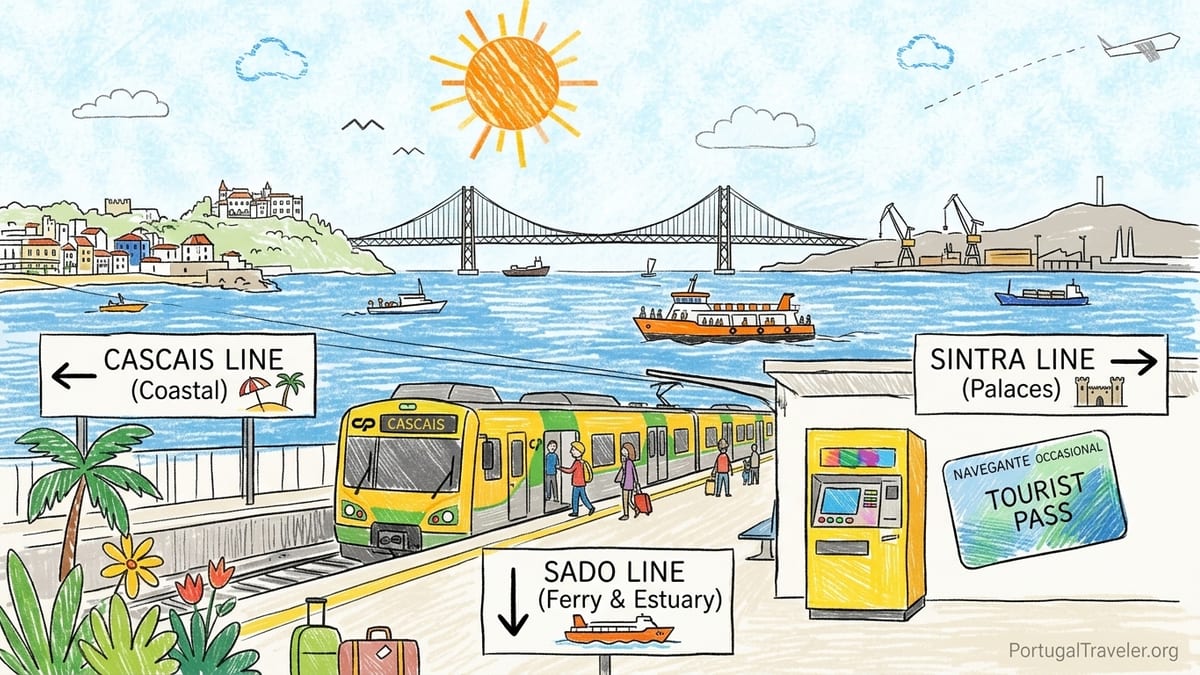
Starting at Cais do Sodré: First Lessons on Tickets and Crowd Patterns
My first morning began at Cais do Sodré, the riverside hub where the green metro line dives under the concourse and the Cascais suburban platforms open directly onto the Tagus. Even before I reached the ticket machines, I was reminded that Lisbon’s railways are built into daily life. Office workers in light jackets, school students with headphones and a few sun-hatted visitors all fed through the same gates, the station clock edging toward 09:00.
For this exploratory trip I decided to test both the CP Tourist train pass and ordinary zonal tickets. At the yellow and blue vending machines I bought a Navegante Occasional card for 0.50 euros, the reloadable cardboard smartcard that CP uses on Lisbon Urban trains. I loaded a 1 day Tourist train pass, currently priced at 6.70 euros for unlimited travel for 24 hours on the Sintra/Azambuja, Cascais and Sado lines, and left a second empty card in my wallet for later single journeys. The machine screens clearly list “Bilhete Turístico” alongside standard zonal tickets, and English is available, though the fare-zone diagrams still require a moment’s thought if you are new to the system.
On the concourse departure boards, Cascais line trains were advertised approximately every 12 minutes toward mid morning. That rhythm is typical of Lisbon’s urban network. Frequency tightens in rush hours, then relaxes slightly late morning and in the afternoon, but it rarely slips to the point where you need to plan around a specific train. What you do need to plan around are crowds. My first train out toward Cascais was already standing room only through Santos and Belém as commuters mixed with cruise ship passengers bound for the seafront. It felt closer to a metro than a leisurely coastal branch.
Those first few stops also taught me something important about using the Rail network as an explorer instead of a commuter. Even with a pass in hand, I hesitated the first time I considered jumping off at Belém for a pastel and a riverside walk, then rejoining later. On CP’s Lisbon Urban lines that is exactly how the system is meant to work. The Tourist pass covers any number of journeys within its validity period, as long as you validate before boarding and stay within the urban network. That flexibility is crucial if you want to use the rails as a hop-on, hop-off framework for a day along the river or out to the suburbs.
The Cascais Line: Coastal Views and Realistic Limits
Leaving Alcântara-Mar, the train hugged the river and then the Atlantic, shallow light flickering across the window glass. Between Belém and Algés, graffiti-scored retaining walls suddenly broke open into boatyards, promenade and glimpses of the 25 de Abril Bridge. As we pushed west, the air inside the carriage cooled slightly whenever the doors opened. It was mid season, not peak summer, yet seats remained scarce until around Carcavelos, a reminder that this line is a backbone for suburban travel as much as a beach shuttle.
From an explorer’s perspective, the Cascais corridor is both generous and finite. The full run from Cais do Sodré to Cascais takes about 40 minutes. With trains a little more than every 10 minutes in the daytime, you can comfortably treat intermediate stops as mini destinations. I stepped off in Parede for a coffee in a backstreet pastelaria, then again in Estoril to walk under the palms by the old casino before catching the next train for the short hop to Cascais itself. The pass made these detours frictionless. Each time I stepped back on, a quick tap at the validator on the platform or near the doors was all that was required.
What you cannot realistically do from this line alone is push much beyond Cascais into the Sintra hills or west to Cabo da Roca without switching to buses or taxis. There is no onward rail from Cascais. If your dream day is multiple coastal villages followed by clifftop viewpoints and inland palaces, the train can only be your spine for the first section. Similarly, staying near an intermediate station like Carcavelos or Oeiras opens up remarkable daily life scenes surfers jogging down to the beach with boards underarm, school groups filling the carriage at 16:00 but it still tethers you to the linear coastal strip. It is an excellent way to live “beside Lisbon” for a few days, less effective if your goal is to range widely in a single outing.
In crowd terms the pattern was clear after several rides at different hours. Morning and late afternoon trains are densely packed between Cais do Sodré and Oeiras, with a little breathing space further west. By late evening, especially outside summer, the carriages were calmer, with small groups of friends heading back into the city. Solo travellers will feel comfortable, but I found that in high season it was worth aiming for trains just after the main rush from Cais do Sodré to avoid the worst crush.
Sintra and the Azambuja Extension: Beyond the Postcard Palaces
For the Sintra/Azambuja line, I began at Rossio station, a short climb from Baixa through the narrow streets. Rossio’s vast stone arches and starry ceiling may be one of Europe’s prettiest urban rail halls, but at 09:30 on a sunny day, the scene on the platforms is practical rather than romantic. Long queues formed at the ticket offices, while the ticket machines ticked steadily through transactions. Here, the advantage of already holding a loaded Navegante card became obvious. With the Tourist pass ready, I bypassed the queues and headed directly to the grey validation pillars at the platform entrance.
The journey up to Sintra takes around 40 minutes. In that time the view outside the window shifts from central apartments and small workshops to clusters of suburban tower blocks, then to lower, greener suburbs as the train approaches the foothills. What interested me on this trip, though, was less the classic city-break dash to Sintra’s historic center and more the sense of how far the same line can take you if you keep riding. Trains alternate between short turns at Sintra and longer services that continue back through Lisbon toward Oriente and then on northeast to Azambuja, knitting together two very different corridors under one timetable.
On one day I rode from Sintra down to Oriente, watching the carriage slowly empty of day trippers at Entrecampos and Sete Rios while local passengers took their place. At Oriente I had lunch in the station food court overlooking the modernist roof, then boarded another Sintra/Azambuja service that continued to Vila Franca de Xira and beyond. By the time we passed Alverca, the urban fabric had thinned, warehouses and fields starting to dominate. The train was quieter, with more people carrying work bags and few visible tourists. The feel was commuting belt, not sightseeing route.
From a practical point of view, this stretch illustrates one of the underused advantages of the Tourist pass. A standard single ticket on the Sintra/Azambuja lines is calculated by fare zones, and longer trips up the valley quickly add up. The Tourist train pass, by contrast, remains valid up to the urban network’s northern limit for unlimited trips within the 24 or 72 hour period. That means curious travellers can reasonably press on past the usual end point without worrying about marginal extra cost. What you will still need to consider is time. Continuing from Lisbon’s central stations to Azambuja takes roughly an hour or a little more, and services are less frequent than the highly trafficked Sintra branch closer to the city.
Last-mile connections along this axis vary. Between Rossio and Queluz, stations are often within residential neighborhoods with buses or frequent suburban streets leading directly away. Past Vila Franca de Xira, the impression is more scattered. Stations can sit beside main roads or industrial sites, with bus links that are designed for local workers rather than visiting explorers. For most travellers, that means the realistic “exploration envelope” by rail lies between Sintra on one side and perhaps Vila Franca de Xira on the other. Beyond that point, without a clear reason to visit a specific town, you may spend more time walking along highways than discovering hidden quarters.
Discovering the Sado Line: Industrial Landscapes and Ferry Connections
The most eye opening part of my experiment came on the Sado line, the often overlooked urban service between Barreiro and Praias do Sado-A via Setúbal. To reach it, I took the blue metro to Terreiro do Paço and then followed signs down to the Soflusa ferry. The wide catamaran that pulled into the pier filled quickly with commuters and students, many carrying CP rail passes clipped to lanyards. In about 20 minutes we crossed the Tagus to Barreiro, where the ferry terminal feeds directly into the railway station complex.
Barreiro station itself is a functional concrete and glass structure, but for a railway enthusiast it holds a certain charm. Historic photographs in the concourse remember the age of long distance trains departing from here before the bridges tied Lisbon’s rail network together. Today, urban electric units rule the platforms. The Sado line train I boarded toward Setúbal had simple, clean interiors, two-by-two seating, and wide doors designed for quick boarding rather than luxury. Off peak, there were plenty of seats, with a mix of school pupils, industrial workers in high-visibility vests and a handful of shoppers.
Schedules on the Sado corridor are looser than on the Sintra or Cascais lines, especially outside commuting peaks. Midday trains typically run roughly every 30 minutes between Barreiro and Praias do Sado-A, with some variation, so it is worth checking the timetable before you set out. The scenery, however, rewards the effort. Between Barreiro and Pinhal Novo the line runs through low-lying commuter suburbs and industrial zones. After crossing toward Setúbal, the view opens onto the Sado estuary, salt flats and distant outlines of the Arrábida hills. Approaching Setúbal, apartment blocks rise again, followed by the port cranes and ferry slips for the Tróia peninsula.
For my test I used the Tourist train pass again, which also covers this line as part of the Lisbon Urban network. That meant I could ride beyond Setúbal to the small terminal at Praias do Sado-A, a stop better known for its industrial surroundings than postcard images. From the platform I could see tank farms, port infrastructure and the shimmer of water beyond. It is not a classic tourist stop, but it underlines how far CP’s “Lisbon” suburban network actually stretches into the wider region. Using only rail and a single ferry connection, I had moved from central Lisbon to a working estuary landscape more than 40 kilometers away without ever boarding a bus.
The practical limits out here are sharper than along the Cascais or Sintra axes. Last-mile options from some Sado line stations are minimal unless you arrange a taxi or know the local bus patterns. Setúbal itself is an exception. The station is within walking distance of the town center and riverfront, and local buses fan out toward the industrial zones and surrounding neighborhoods. From an exploration standpoint, that makes Barreiro, Pinhal Novo and Setúbal realistic day-trip targets by rail, with Praias do Sado-A a curiosity for those fascinated by port geography rather than a must for general visitors.
Pass Versus Single Tickets: When the Tourist Card Wins
After several days of hopping between lines, I began to add up what I would have spent using only ordinary tickets loaded onto my Navegante Occasional card versus travelling on the CP Tourist train pass. On Lisbon Urban trains, pay-as-you-go fares are charged by distance bands that roughly match the fare zones. A short hop across one zone costs significantly less than a long run across many zones, but around the city the prices for each tap with zapping credit on CP urban trains are around 1.90 euros per journey. If you are only planning two or three short round trips in a day, sticking to single tickets can work out cheaper.
On the other hand, the numbers shift quickly once you start chaining together multiple segments. My test day on the Cascais line involved six separate train rides, including intermediate stops in Belém and Estoril. Using pay as you go that sequence would comfortably exceed the cost of a 6.70 euro 1 day Tourist pass. The same was true of the day I rode from Rossio to Sintra, then back down to Oriente, on to Vila Franca de Xira and back to Lisbon. As soon as you cross from a simple out and back pattern into a triangle or loop, the pass begins to look like a bargain as long as you complete all your longer journeys within a 24 hour window.
The 3 day Tourist train pass, at 14.40 euros, suits a different style of trip. This option spreads unlimited travel across 72 consecutive hours. If you expect to take at least three or four substantial rail journeys across those days, perhaps with one day on the coast, another in Sintra and a third exploring Setúbal or Barreiro, the math stays favorable. It also removes the friction of topping up at machines repeatedly. For visitors staying in central Lisbon who intend to make repeated forays into the suburbs, this stability can be more valuable than shaving the last euro off their transport budget.
One important nuance is that the CP Tourist train pass is valid only on the Lisbon Urban train network and not on the metro, trams or most buses. If your plans involve extensive use of Carris trams, buses and the metro as well as CP trains, you may want to compare it with broader 24 hour public transport tickets sold by the metro operator. Those combined tickets include unlimited urban trains on the Sintra/Azambuja, Cascais and Sado lines for a day, alongside metro and Carris services, at a higher price point. My own experience was that on days focused on railway exploration the CP Tourist pass was more cost effective, while on days heavy with tram riding and hill climbing, the all-network 24 hour ticket made more sense.
Stations, Transfers and Last-Mile Realities
Experiencing the network purely through paper timetables would miss one of its defining features: the character of the stations themselves and the ease, or difficulty, of the last stretch between platform and destination. Cais do Sodré feels like a true intermodal hub, with river ferries, metro and suburban trains stacked efficiently. You can step off a train from Cascais and walk onto a ferry to Cacilhas within minutes, or dive into the metro for Baixa. For travellers, that seamlessness makes the Cascais line the easiest introduction to Lisbon’s rail-based day trips.
Rossio, by contrast, is a terminus perched a little above the rest of the city. The tunnel that leads to the suburban tracks curves away under the hills, leaving the platforms high above Praça dos Restauradores. From there, last-mile travel is mostly on foot down into Baixa or up toward Bairro Alto unless you transfer to the nearby metro at Restauradores. That layout is charming if you enjoy steep urban walks and city views, less ideal if you are managing luggage. Oriente, the main modern interchange, sits somewhere between these worlds. It connects easily to the red metro line and long distance trains, and its elevated concourse overlooks the river park, but reaching historic central Lisbon still requires a metro ride or bus.
Out in the suburbs, stations follow a similar pattern. Many, like Carcavelos or Oeiras on the Cascais line, are knitted tightly into small town centers. A few minutes’ walk from the platform brings you to cafes, supermarkets and local buses. Others, particularly on the Sintra/Azambuja extension and parts of the Sado line, sit beside highways or industrial estates with limited pedestrian infrastructure. On my ride to Vila Franca de Xira, I found the station well connected to the riverfront and town center, but stations further along the line felt isolated, reachable mainly by car. This mix matters if you hope to use the trains for serendipitous exploration. Picking stops with compact, walkable centers will reward you more than simply staying on until the end of the line.
The last-mile lesson from several days of riding is clear. If you are relying only on rail and want to explore widely without resorting to taxis, the most realistic territory is a triangle with vertices in Cascais, Sintra and Setúbal, using central Lisbon as your pivot. Within that area, most stations either drop you into walkable neighborhoods or offer short, understandable bus connections. Beyond it, rail may still take you there, but you are likely to spend more time bridging gaps than experiencing places.
The Takeaway
Travelling the Lisbon Region primarily by CP’s urban trains turns familiar day trips into something broader and more flexible. The Cascais line gives you not only beaches and promenades but also glimpses of everyday suburban life stitched along the coast. The Sintra/Azambuja axis extends your mental map of Lisbon beyond palaces to working towns along the Tagus valley. The Sado line, in partnership with the Barreiro ferry, opens an industrial and estuarine landscape that most visitors never see.
Within this web, the CP Tourist train pass is less a tourist gimmick than a practical tool. On days when you are content with a simple round trip, single tickets or zapping credit on a Navegante card will serve. Once you begin stringing together multiple lines and intermediate stops, the 1 or 3 day passes give you the freedom to improvise without recalculating zones before each journey. They also encourage you to push a little further, perhaps staying on past Sete Rios to Vila Franca de Xira or riding that extra stop beyond Setúbal just to see where the line ends.
The main limit is not ticketing or timetables. It is the geography of last-mile transport. Rail alone cannot deliver you to every lookout and secluded cove in the Lisbon Region. Some iconic spots will always require a bus, tram or taxi. Yet if you accept that constraint and plan within it, there is a surprisingly large territory that can be explored comfortably within a few days using only CP’s Lisbon Urban trains. From central Lisbon you can breakfast in Belém, have lunch in Sintra, watch sunset in Cascais and spend the following day among salt flats and ferries in Setúbal, all without ever scanning a bus timetable.
That is the real reward of thinking about the Lisbon Region by train rather than by isolated day trips. The network becomes not just a means to individual sights but a framework for understanding how the city and its satellites fit together. The carriages fill and empty with students, office workers, beachgoers and families, and for a few days you share their rhythms as you trace the rails to the edges of Lisbon’s reach.
FAQ
Q1. What exactly does the CP Lisbon Tourist train pass cover?
It gives unlimited travel for 1 day or 3 consecutive days on CP’s Lisbon Urban trains on the Sintra/Azambuja, Cascais and Sado lines, but does not include metro, trams or most buses.
Q2. When is it better to buy single tickets instead of the Tourist pass?
If you only plan a simple return trip, for example Lisbon to Cascais and back on the same day with no intermediate stops, single zonal tickets or zapping credit usually cost less than a 1 day pass.
Q3. Can I hop on and off freely along the Cascais, Sintra or Sado lines with the pass?
Yes, as long as your pass is valid and you stay within the Lisbon Urban network, you can get off at intermediate stations such as Belém, Carcavelos, Queluz or Barreiro and catch later trains without extra cost.
Q4. How frequently do trains run on these lines during the day?
Cascais and Sintra services are typically very frequent, with trains roughly every 10 to 15 minutes in daytime, while the Sado line usually runs about every 30 minutes outside peak hours.
Q5. How far beyond Lisbon can I realistically explore without using buses or taxis?
Using only CP urban trains you can comfortably reach Cascais on the coast, Sintra in the hills, Setúbal and Praias do Sado-A to the south, and towns like Vila Franca de Xira to the northeast.
Q6. Do I need a different card to load the Tourist pass and normal tickets?
Both use the Navegante Occasional smartcard, which has a small initial cost. You can load a Tourist pass on one card and keep another card for separate pay-as-you-go journeys if you wish.
Q7. Are the trains and stations safe to use at night?
Main stations and trains on the Cascais and Sintra lines stay busy into the evening and generally feel safe, though as in any city it is sensible to keep valuables secure and avoid very empty carriages late at night.
Q8. How easy is it to connect between the Sado line and central Lisbon?
You ride the Sado train to or from Barreiro and then use the Soflusa ferry across the Tagus to Terreiro do Paço in central Lisbon, where metro and buses connect to the rest of the city.
Q9. Can I use the same Tourist pass to ride CP trains in Porto or the Algarve?
The Tourist pass product also exists for other CP urban and regional areas, but each pass is sold and validated for specific regions and days, so you need to buy the appropriate one where you are travelling.
Q10. Is it practical to base myself in a coastal or suburban town and use trains for daily visits to Lisbon?
Yes, many people do this from towns like Cascais, Oeiras, Carcavelos, Sintra or Setúbal, using frequent CP services to commute into Lisbon for sightseeing while returning to quieter bases in the evening.