


On my first proper trip to Lisbon I did what many travelers do: I booked one hotel in the city and tried to cram Sintra, Cascais, Belém, the historic center and a countryside day trip into five hectic days. I came home with beautiful photos and a very clear conviction that I had planned it the wrong way. Since then I have returned to the Lisbon region several times, each visit with a different amount of time: a rushed four-day stopover, a week with friends, and a slower ten-day stay that finally felt like it did the region justice. This article explains how I now think about dividing time between Lisbon city and the wider region, and what four, seven and ten days realistically let you do.
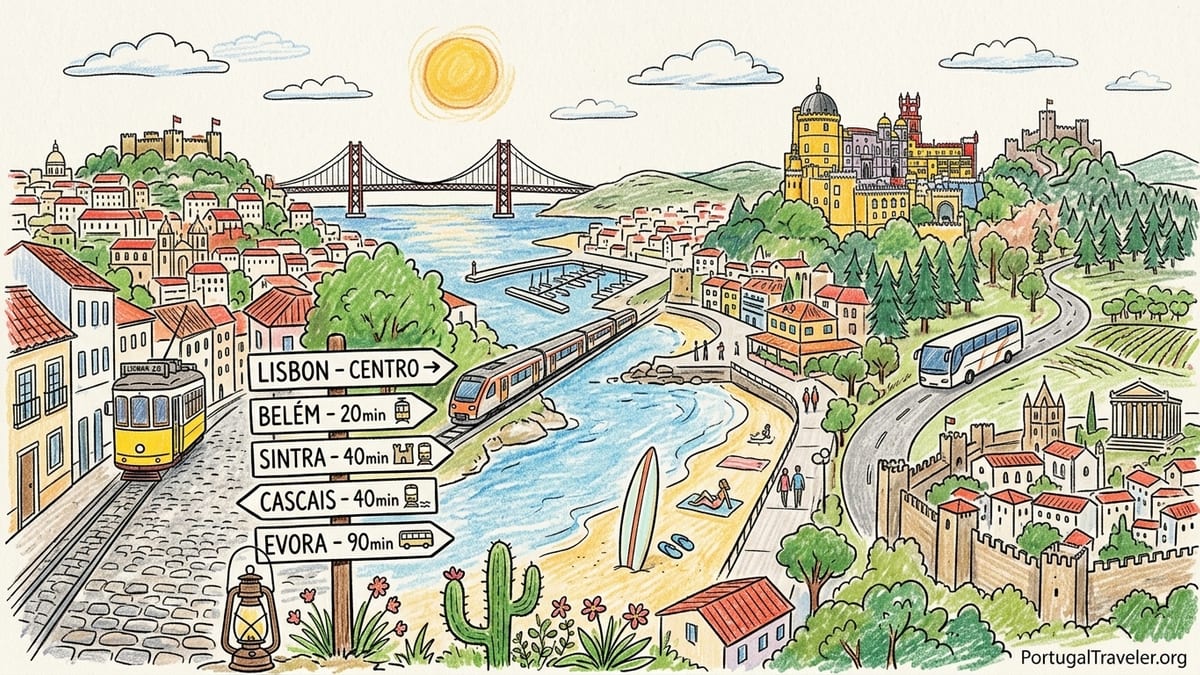
How I Learned to Stop Treating Lisbon as “Just a City Break”
Lisbon looks compact on the map, but the region fans out into very different landscapes: the palaces and forests of Sintra, the Atlantic beaches around Cascais, the cliffs and coves of Arrábida Natural Park near Setúbal, and the wine and cork countryside of the Alentejo around Évora. On my first visit I treated all of this as a string of day trips from one central hotel near Rossio. Every morning started with a train or tram, and every night ended with a tired ride back. It was only when I stayed longer and allowed myself a second base, in Cascais, that I realized how much time I had been losing to backtracking.
Transport is what makes or breaks a Lisbon region itinerary. Inside Lisbon, the metro, trams and buses run on the Navegante system, where a reusable smart card costs about €0.50 and individual metro or bus rides loaded as “zapping” credit are around €1.70 to €1.90 rather than the higher on-board fares. A 24-hour Carris plus Metro pass loaded on that same card costs a little over €7 and covers trams, buses and metro for a full day, which changes the way you can explore. Once you factor in regional trains to Sintra or Cascais and occasional intercity buses, you begin to see the whole area as one connected mesh instead of separate excursions.
My turning point came on a trip where I tried to do Sintra and Cascais as separate day trips from Lisbon. The urban train to Sintra takes about 40 minutes from Rossio and costs only a few euros each way, and the train to Cascais from Cais do Sodré takes a similar time along the Tagus estuary. On paper this made day trips look effortless. In practice I was spending roughly 90 minutes each day just commuting, plus another 30 to 45 minutes walking or taking trams to and from the central stations. Over a four or five day stay that quietly swallowed an entire day of my trip.
Once I recognized that hidden transport day, I began to plan the region in “clusters” instead of excursions. One cluster is central Lisbon and Belém, which you can cover with metro, trams and a riverfront walk. Another is Sintra and its hilltop palaces. A third is the Cascais coast with its boardwalks and surf beaches. A fourth is the southern arc around Setúbal and Arrábida for nature, and a fifth is the inland axis to Évora for Alentejo towns and vineyards. How many days you have simply determines how many of these clusters you can give their own unhurried day without chaining them into one frantic checklist.
What Four Days in the Lisbon Region Really Forces You to Skip
When friends ask if four days is “enough” for Lisbon, I answer that it is enough for Lisbon and one real side trip, but not for all the famous names they have seen in guidebooks. With four nights, after making this mistake myself, I now recommend spending three full days inside Lisbon (including Belém) and one day in either Sintra or Cascais. That usually means saying no to Évora, no to Arrábida, and no to the temptation of squeezing multiple day trips into one stay.
The catch is that four days vanish faster than anyone expects. Your arrival day is rarely a full day. Even if you land in the morning, you will spend at least an hour buying a Navegante occasional card from a metro machine or kiosk, loading a 24-hour pass or zapping balance, and riding the red line into the city. By the time you check in, freshen up and get oriented in the hills around Baixa, Chiado and Alfama, it is late afternoon. I now treat that first half-day as a city stroll, perhaps with a ride on Tram 28 from the less crowded end at Campo de Ourique back into the old town, rather than trying to knock off major sights.
On my four-day stopover I tried to add both Sintra and Cascais. That meant an early train to Sintra, a rush through Pena Palace, the Moorish Castle and the town center, then back to Lisbon, followed by a separate coastal day to Cascais and the Boca do Inferno cliffs. I technically “saw” everything, but I saw it through queues and timetables. The Sintra line can be very crowded in high season mornings, and the palace shuttle buses from the old town up to Pena queue along narrow roads. With only one day in Sintra, I now prioritize one major palace like Pena or Quinta da Regaleira, a walk around the historic center, and leave time for a relaxed lunch instead of chasing every lookout.
The other sacrifice with four days is depth inside Lisbon itself. Belém, with the Jerónimos Monastery and Torre de Belém along the river, easily absorbs most of a day once you factor in tram or bus travel, security lines and a cafe stop at Pastéis de Belém. The historic center deserves at least a day for Alfama alleys, viewpoints like Miradouro da Senhora do Monte, and perhaps a riverfront sunset drink around Cais do Sodré. If you spend one precious day on Sintra, those are your three full days already. Arrábida’s turquoise coves near Setúbal, which you can reach by train plus a short taxi ride, and Évora’s bone chapel and Roman temple, about 90 minutes away by express bus or train, simply cannot fit without everything feeling rushed.
Seven Days: Where the Lisbon Region Itinerary Starts to Breathe
A full week in the Lisbon region is the point where my trips shifted from rushed sightseeing to actual travel. With seven nights, the pattern that has worked best for me is five nights based in central Lisbon and two nights based along the coast, usually in Cascais or a neighboring beach town on the same commuter line. This avoids changing hotels too often while still cutting down repeated train journeys.
On my first seven-night stay I made the mistake of keeping one hotel in Baixa for the entire week and using it as a springboard for everything: Sintra, Cascais, Belém, Évora and even a wine day in the Setúbal Peninsula. Predictably, my “extra” days disappeared into logistics. One morning I misjudged the time needed to get from my hotel to Sete Rios bus station, where many Rede Expressos buses to Évora and beyond depart. Between waiting for a tram that never came, switching to the metro, and finding the correct bay in the terminal, I missed the bus and lost half a day. The bus itself is efficient, about 90 minutes from Lisbon to Évora and often around €12 each way if you buy a standard adult ticket, but that only helps if you build generous margins around departure times.
The next time I had a week, I did it differently. I kept five nights in Lisbon and used three full days for the city and Belém, plus one day for Sintra. Then I took the urban train from Cais do Sodré to Cascais, which takes roughly 40 minutes and costs only a few euros per ticket on the same smart card, and checked into a small guesthouse there for two nights. That single hotel change eliminated an entire day of back-and-forth commuting. Instead of returning to Lisbon after sunset, I could walk the seaside promenade, have dinner at the marina and be back in my room within ten minutes.
With seven days you can also add one countryside day trip without turning your week into a transport marathon. For me that has often been Évora. Some travelers prefer the train from Oriente station, where advance-purchase fares for the roughly 90 minute ride can be in the low teens in euros, especially on slower Intercidades services. Others like the flexibility of a Rede Expressos coach from Sete Rios, which runs multiple times per day. Both options bring you close to the compact historic center, with its Roman temple, cathedral and the famous Chapel of Bones inside Igreja de São Francisco. What I learned is that Évora deserves at least six or seven on-the-ground hours. Anything less feels like a transfer day rather than an excursion, especially in summer heat when you will naturally slow your pace.
The other upgrade that seven days allow is a genuine nature day. Arrábida Natural Park, near Setúbal across the Tagus to the south, is one of the most striking coastal landscapes in mainland Portugal, with limestone hills dropping into coves of pale blue water. On one trip I took a suburban train to Setúbal in around 50 minutes and then used a taxi-hailing app to reach a beach like Praia da Figueirinha or Galápos. That combination is more practical when you are not sacrificing one of your only four days. A week gives you room for one “imperfectly efficient” day like this, where the reward is the landscape rather than a checklist of monuments.
Ten Days: Why a Second Base or Slower Coast Time Finally Makes Sense
Ten days in the Lisbon region is where dividing your stay into two bases really pays off. Instead of treating Cascais or Setúbal as commutes, they become places you temporarily live. The pattern that has worked best for me and for readers of TheTraveler.org is four or five nights in central Lisbon, followed by four or five nights on the coast or in a smaller city, with one day reserved as a pure transport and settling-in day between bases.
On my longest stay so far, I spent five nights near Praça do Comércio, four nights in Cascais and one night in Évora on the way back toward Lisbon’s airport. I used the Lisbon half to dive deeper into neighborhoods I had only skimmed before: a morning in the creative hubs and tile museums of Marvila, a lunch in the Mercado de Campo de Ourique instead of the more touristed Time Out Market, and a slow, almost aimless day in Graça and Mouraria. Because I knew I had almost a week, I could afford to lose an afternoon to a rain shower without the anxiety that I was “wasting” Lisbon.
From my Cascais base I did not feel pressured to schedule each day. One day was simply beach hopping by local bus and on foot between Carcavelos and Guincho, another was devoted to a slow train hop back to Belém for lunch and museum time, returning on a late, uncrowded train. When the wind came up and the water felt too cold for more than a quick dip, I rented a bike on the seafront and cycled the 7 kilometer path toward the wild cliffs. That kind of unstructured day is all but impossible if you treat Cascais as a there-and-back day trip wedged between busy city days.
Ten days also support more ambitious secondary clusters that are poor fits for a short stay. One option I tried was to split time between Lisbon, Cascais and Évora, with four, three and three nights respectively. That meant two hotel changes, which is sufficient to introduce some friction. Each move costs at least half a day once you check out, travel, check in and re-orient. The payoff, however, was waking up inside Évora’s walls to cool morning streets before the day-trippers arrived, sipping coffee in a tiled cafe without a timetable in my head, and visiting the Chapel of Bones right after it opened, before the tour groups arrived from Lisbon around late morning.
The main lesson I took from planning and re-planning that ten-day circuit is that more days do not automatically mean more bases. Ten days can support two bases easily, three if you are disciplined about keeping other days light. But with every new hotel you add, you should mentally mark the adjacent day as partly sacrificed to logistics. In a region like Lisbon’s that is rich in easy day trips, I now lean toward two well-chosen bases and a series of low-stress excursions rather than a string of one- and two-night stands that give me more check-out receipts than memories.
The Invisible Cost of Changing Hotels and Transport Days
One of the quiet mistakes travelers make in the Lisbon region, and that I certainly did, is underestimating what I now call “transport drag.” It is not just the 40 minutes on the train from Lisbon to Sintra or Cascais. It is the 15 minutes walking or tram-riding to Rossio or Cais do Sodré, the 10 minutes buying or reloading tickets on your Navegante card if you misjudge your zapping balance, the 15 minutes waiting on the platform, and the queuing to exit on the other side with hundreds of other day trippers. Add those up and you can easily spend two hours per day on movement before you have set foot in a palace, museum or restaurant.
Changing hotels multiplies transport drag. Each time I shifted base, even when the physical distance was short, it consumed at least half a day. From Lisbon to Cascais I tried both routes: taking the metro from my central hotel to Cais do Sodré and then the coastal train, and taking a rideshare directly from my hotel to my Cascais guesthouse. The former was cheaper and used my existing transport card, but involved stairs and cobbles with luggage. The latter cost significantly more but saved me multiple transfers and gave me a softer arrival. On a ten-day stay I am willing to “spend” that half day and the extra euros once. On a four-day holiday it would feel like a serious trade-off.
Even on day trips, transport days can go wrong. On one Sintra excursion, a signal issue disrupted trains for part of the morning, and substitute buses took over a segment of the line. Because I had built my plan around a timed entry slot for Pena Palace, I ended up watching the clock, wondering if I would forfeit the ticket if I arrived late. On another day a strike reduced tram services to Belém and I simply decided to walk part of the way and adjust my expectations about what I would see. The lesson is simple: in a short four-day trip, even a small disruption can displace a major sight. With seven or ten days, you can slide things around.
Tickets and passes play into this as well. Lisbon’s system encourages you to think day by day, with 24-hour Carris plus Metro passes and flexible zapping credit on a low-cost smart card that is valid for 12 months. It is tempting to wake up and decide “today will be the Belém day” and load the daily pass accordingly. For regional trips, though, planning ahead saves money and stress. Booking a specific Rede Expressos bus to Évora or a CP Intercidades train in advance often secures a better fare and a guaranteed seat, but it locks your day into fixed departure and return windows. Those are fine when you have extra days in hand, but add pressure on a four-day stopover where weather, queues and fatigue can easily throw you off schedule.
The Trap of Trying to Squeeze Every Famous Day Trip into One Short Stay
Lining up the names on the page, it is easy to convince yourself that a four or five day stay can “cover” Lisbon, Belém, Sintra, Cascais and Évora. The travel times look manageable: 30 to 40 minutes by train to Sintra or Cascais, about 90 minutes to Évora by bus or train, less than an hour to Setúbal for Arrábida’s beaches. The trouble is that each of these places deserves a full, long day on its own, and stacking them into a short stay turns your holiday into a sequence of alarms and transfers.
I learned this the hard way on my second visit, when I tried to chain Sintra and Cascais into a single epic day. The plan looked clever: early train to Sintra, tour Pena Palace and the old town, then mid-afternoon train back to Lisbon, walk across to the Cais do Sodré station and ride out to Cascais for a sunset swim and dinner. On the ground it quickly unraveled. The morning queue for the palace shuttle bus in Sintra cost 40 minutes, the palace itself took longer than expected once inside, and by the time I made it back to the station the next direct train to Lisbon was packed to the doors. I arrived in Cascais tired and hungry enough that the sunset might as well have been a streetlamp.
The same temptation appears with Évora. Many travelers see social media posts of the Chapel of Bones, the Roman temple and a vineyard lunch and assume it is a half-day outing. In reality, even with a well-timed 90 minute bus or train from Lisbon, you will want an early start, at least five hours on the ground, and a flexible return to account for heat, crowds and slow restaurant service. On my first attempt I booked a mid-afternoon train back to Lisbon and found myself clock-watching through dessert. The next time I left the return leg open and paid a few euros more for a later seat on the day once I knew how I felt.
The practical lesson I now give readers is this: in four days, pick one serious day trip and do it fully. In seven days, pick two, ideally in opposite directions so you experience both inland and coast. In ten days, you can either add a third or turn one of those locations into an overnight or secondary base. The Lisbon region rewards return visits. The psychological relief of knowing you do not have to “do it all” before you fly home is worth more than one extra stamp in your mental checklist.
The Takeaway
After several trips spread over different lengths of stay, my rule of thumb for the Lisbon region is to plan in clusters, not in famous names, and to budget whole days for movement, not just the headline train times. Four days is essentially a Lisbon city break with one big excursion. Seven days allows you to add the coast and a countryside day without every morning starting at a station. Ten days finally supports a second base, or even a third if you are realistic about losing half days to hotel changes and accept that some days will be for balconies and beaches rather than monuments.
The other consistent lesson is that comfort in Lisbon’s hills and on its trains comes from small, grounded decisions. Buy a reusable transport card on arrival and load it with enough zapping credit or a 24-hour pass for your city days, so you are not forced into paying higher on-board fares. If you know you want to visit Évora or another inland town, check train and bus schedules before fixing your city hotel dates so you are not dragging luggage across Lisbon at dawn. And when the forecast promises a string of sunny days, consider shifting one of your late-trip excursions forward, so that a change in weather does not erase your only chance at the coast.
Most importantly, allow the Lisbon region to feel like a place you may come back to. Leaving Arrábida’s coves or the palaces of Sintra for a future trip is not a failure of planning. It is the natural consequence of treating your time, energy and attention as limited resources. The travelers I meet who seem happiest on their flights home are not the ones who saw the most, but the ones who chose a few areas, stayed long enough to notice the light on the tiles at different times of day, and took at least one day where their only schedule was the tide.
FAQ
Q1. Is four days in Lisbon enough to visit Sintra and Cascais and still see the city?
With four days you can technically visit both Sintra and Cascais, but from experience it makes the trip feel rushed. I now recommend choosing one major day trip, usually Sintra, and spending the other days in Lisbon and Belém so you are not commuting by train almost every morning.
Q2. For a seven-day stay, should I keep one base in Lisbon or add a second base on the coast?
On a week-long trip I prefer five nights in central Lisbon and two nights in Cascais or nearby. That single hotel change cuts down repeated day trips, gives you relaxed evenings by the sea, and still keeps you close enough to Lisbon by train for a flexible return or extra city day if the weather turns.
Q3. When does it make sense to include Évora in a Lisbon region itinerary?
Évora starts to make sense once you have at least seven days. The trip is about 90 minutes each way by bus or train, and you will appreciate having a second quiet morning in Lisbon or along the coast to balance that inland excursion. With ten days, staying one night in Évora can be even more rewarding than a long day trip.
Q4. How many day trips can I realistically plan in ten days without burning out?
In ten days you can comfortably plan three serious day trips or turn one of those destinations into a secondary base for two or three nights. More than three long excursions starts to feel like a transport marathon, especially if you also want lazy mornings, neighborhood wandering and some time by the water.
Q5. Is it worth changing hotels just to be closer to the station for day trips?
If you only have four days, I would not change hotels purely for station access. The time and hassle of packing, checking out and checking in usually cancel out any gain. Once you have seven or ten days, moving once to a coastal base such as Cascais can be worthwhile because it shifts your focus from commuting to actually living near the sea.
Q6. How should I divide my days between Lisbon city and the rest of the region?
My current pattern is roughly two-thirds of the time based in Lisbon and one-third for the wider region. For four days that means focusing on Lisbon and adding only one major day trip. For seven days it becomes around four or five days in the city area and two devoted to coast or countryside. In ten days you can give four or five to Lisbon, four to a coast base, and the rest to a single inland town or flexible days.
Q7. What is the biggest planning mistake travelers make with Lisbon region itineraries?
The most common mistake is trying to tick off every big name in one short stay: Sintra, Cascais, Belém, Évora and sometimes even Arrábida. On the map it looks efficient, but on the ground it means early alarms, multiple train and bus transfers and very little unstructured time in the city itself.
Q8. How much time should I allow on the ground for a Sintra day trip?
Even though the train from central Lisbon to Sintra is only about 40 minutes, you will want almost a full day. By the time you factor in the walk or bus up to palaces like Pena, security queues, touring at least one major site and time for a meal, six to eight hours on the ground pass quickly. I avoid combining Sintra with any other destination on the same day.
Q9. Can I visit Arrábida Natural Park as a day trip without renting a car?
Yes, but it takes more planning. You can ride a suburban train from Lisbon to Setúbal, which takes under an hour, and then use a taxi or rideshare to reach beaches like Figueirinha or Galápos. This works best if you already have a week or more, because the extra time spent on connections is easier to absorb when you are not sacrificing your only city day.
Q10. How far in advance should I book trains or buses for regional day trips?
For short commuter lines to Sintra or Cascais you can simply top up your transport card and go. For longer routes to towns such as Évora it is wise to check schedules and consider booking at least a few days ahead, especially in busy months, so that you have a reserved seat and can build a realistic day around the departure and return times.