


I arrived in the Azores with what I thought was a sensible accommodation plan: four islands in twelve nights, five different hotels, and a promise to myself that I would not spend my whole holiday zipping suitcases. In practice, I ended up with three nights based in São Miguel’s gateway city, two in a countryside house near Furnas, three facing the marina in Horta on Faial, three in a guesthouse on Pico, and a final overnight back in Ponta Delgada for an early flight. That meant unpacking and repacking four full times, plus a one-night “airport stop” that felt more like a layover than a stay. By the last hop I knew exactly which changes were worth the hassle and which I would streamline next time. This article distills that experience into a strategy you can adapt, focusing on how many islands, how many bases per island, and what kind of location works best at the level of the entire archipelago.
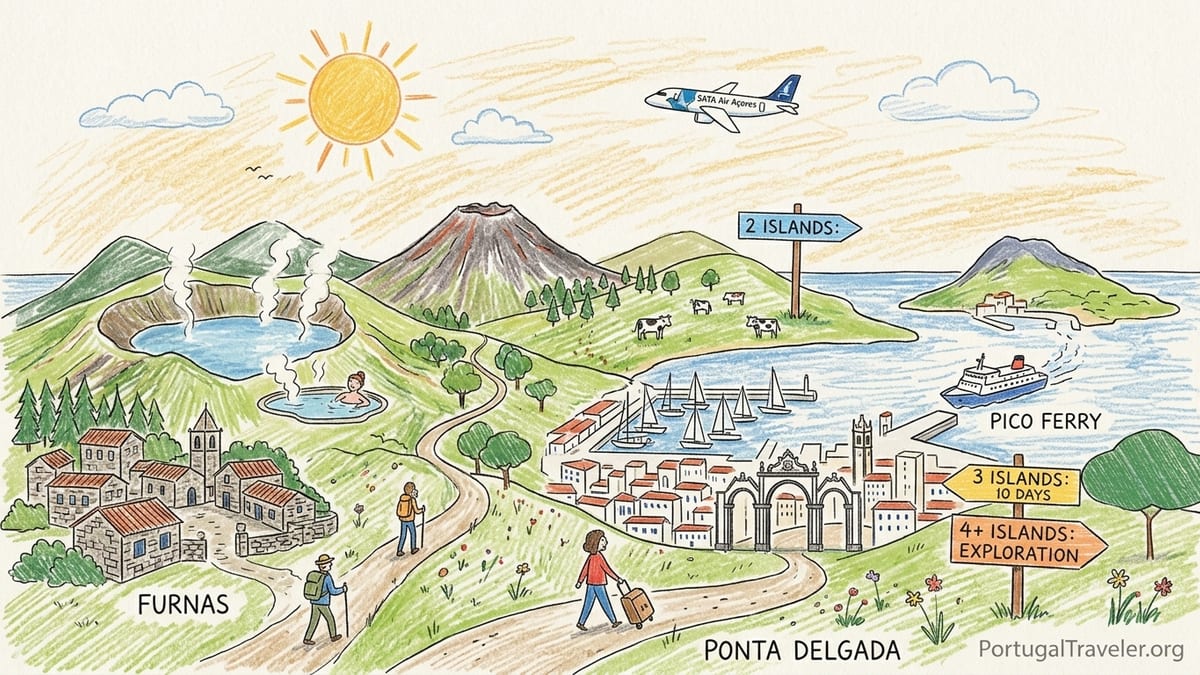
How Many Islands and Bases Make Sense for One Trip
Every Azores itinerary starts with the same constraint: each island is a separate flight or ferry ride, so every island you add usually means another hotel change. Regional carrier SATA Air Açores links the nine islands with short hops that are often around 30 to 60 minutes of flying time, but you still need to factor in getting to the airport, dropping the rental car and passing security. In practice, even a straightforward inter-island flight can eat two to three hours of useful daylight once you include driving, check-in, boarding and picking up another car on arrival.
On my twelve-night trip, four islands and five hotels felt borderline. The days that involved a flight plus a hotel move were noticeably less relaxed than the days spent exploring from a stable base. Talking to other travelers on São Miguel and in the central “Triangle” of Faial, Pico and São Jorge, a pattern emerged: visitors who limited themselves to two islands in a week or three in ten days generally felt they had time to both explore and relax. Those who attempted four or five islands in ten days often described their trip as fascinating but exhausting, with memories dominated by airports and ferry terminals.
For seven nights, a realistic sweet spot is one main island and, if schedules line up, a short side trip to a second island for two or three nights. For example, you might spend four or five nights on São Miguel, with its larger airport and widest choice of accommodation, then fly to Terceira for two or three nights. For ten nights, three islands can work if two of them are close together, such as Faial and Pico, which are linked by a frequent Triangle ferry service that locals routinely use as if it were a bridge. For fourteen nights, three or four islands are reasonable, but only if you accept that each extra island will cost you roughly half a day in transitions.
From a planning perspective, the question is less “How many islands can I technically fit in?” and more “How many days am I willing to give up to check-in lines and luggage trolleys?” Once you understand that trade-off, you can decide where to stay within each island.
Major Gateway City Base: Convenience First on São Miguel and Terceira
The most obvious base type in the Azores is the gateway city. On São Miguel that is Ponta Delgada, home to João Paulo II Airport and the largest concentration of hotels, restaurants and rental-car desks in the archipelago. Terceira has Angra do Heroísmo as a historic city center and Praia da Vitória near Lajes Airport. These urban bases prioritize convenience: short transfers from the airport, reliable access to taxis, and plenty of places open for dinner without worrying about driving narrow rural lanes in the dark.
In my case, starting with three nights in Ponta Delgada worked extremely well. The drive from the airport to a central hotel near the marina took under ten minutes, car rental offices were within walking distance, and there was on-site or nearby parking that allowed us to park the car after dinner. From this base, we reached Sete Cidades in around 40 minutes by road and Lagoa do Fogo in roughly half an hour, which made full-day loops practical without feeling rushed. When early-morning whale watching departed from the harbor, it was a five-minute stroll rather than a pre-dawn drive.
Gateway-city bases also shine when it comes to flight logistics and everyday services. Most hotels near João Paulo II Airport start breakfast early enough for mid-morning departures, and several offer simple solutions for storing bags if your flight leaves later in the day than check-out. In Ponta Delgada, we were able to leave our luggage with the front desk, walk the cobbled streets and have a final lunch before collecting bags and driving the short distance back to the rental-car return. In more remote parts of the islands, that kind of frictionless last day is harder to engineer.
The trade-off is atmosphere and parking stress. Central streets can be tight, public parking fills quickly on weekday evenings, and larger hotels sometimes charge for garage spaces. If you are a nervous driver, the first and last days of your trip may feel more comfortable in a hotel that offers private parking or valet-style access right off a main road. Still, as a first base in the archipelago, a gateway city offers an efficient, low-friction introduction to Azores driving and logistics.
Countryside Houses and Rural Tourism: Space, Silence and Practical Realities
After the bustle of Ponta Delgada, moving to a countryside stay near Furnas on São Miguel felt like a different island. Rural tourism is a formal accommodation category in the Azores, with many converted farmhouses, stone cottages and family estates registered through regional tourism authorities. These properties emphasize space, gardens and a sense of living in the landscape, often with private parking in a courtyard and views over pastures or forested hills. Our base was about ten minutes by car from the Furnas thermal valley, reached by a web of narrow country lanes shared with tractors and the occasional herd of cattle.
From a comfort perspective, the countryside stay was the most relaxing part of the trip. Even in high season the nights were quiet, there was no traffic beyond the occasional neighbor, and mornings began with mist lifting off the hills while we had breakfast on a terrace rather than in a hotel dining room. The house had a washing machine, which was invaluable by the midpoint of a twelve-night journey. Azorean humidity means clothes can take time to dry, but being able to run small loads without hunting for a laundromat saved both money and time.
The trade-offs became obvious after dark. Rural roads are poorly lit, and many smaller restaurants are a 10 to 20 minute drive away, usually involving steep curves or sudden views into deep ravines. Each dinner out required someone to stay fresh to drive home, and there was no option to simply walk out for a late-night drink by the harbor. On one particularly foggy night we skipped a planned restaurant in Furnas and cooked simple food at home rather than tackle the road in low visibility. If your idea of a holiday includes wine or cocktails every evening, or if you are uncomfortable driving unfamiliar roads at night, this matters.
Luggage and packing felt different in the countryside base too. Because we stayed two full nights and spent most of the time in the immediate region, it was easy to fully unpack, organize hiking gear, and dry swimsuits from the thermal pools. That made this base feel more like a temporary home than a pit stop. For trips of ten days or longer, including at least one rural house with laundry facilities can reduce the temptation to overpack, especially if you are moving between islands and juggling baggage allowances on SATA Air Açores flights.
Volcanic and Lake Areas: When a Scenic Base Becomes Inconvenient
Many of the images that draw travelers to the Azores show crater lakes, steaming fumaroles and villages cradled inside volcanic calderas. It is natural to want to stay right beside Sete Cidades on São Miguel, the Furnas valley, or close to the base of Mount Pico on Pico Island. I tried a version of this by spending two nights very close to Furnas, in addition to day visits to Sete Cidades and Lagoa do Fogo while based elsewhere on the island.
Proximity to the volcanic sights did have clear advantages. We were able to walk to the Terra Nostra gardens shortly after opening, soaking in the iron-rich thermal pool before day-trip buses arrived. In the evening, we strolled to the fumaroles by the lake to watch local families uncover cozido stews cooked in the hot earth, something that would have been difficult if we faced a long drive back in the dark. When clouds swept over Pico do Ferro viewpoint above Furnas, we simply tried again an hour later, rather than sacrificing half a day driving across the island twice.
However, staying inside or very near a caldera imposes constraints that guidebooks often gloss over. Village streets are narrow, parking is limited, and most properties have tightly defined arrival times because staff commute in from larger towns. Early departures for flights or inter-island ferries can be stressful, particularly in bad weather. To catch a morning flight from Ponta Delgada, we needed to leave Furnas roughly two hours before check-in closed, allowing time for mountain roads and potential fog. On a clear day that drive is beautiful. In thick mist, the combination of hairpin bends and local drivers who know every turn by heart can feel intimidating.
From a planning point of view, the volcanic and lake areas work best as secondary bases within an island, not as your only point of reference. For example, you might start with three or four nights in Ponta Delgada, then move to Furnas or Sete Cidades for two nights to soak up the atmosphere and repeat favorite walks without long drives. The key is to avoid stacking early flights or intricate ferry connections directly after a stay deep in the mountains. If you crave the drama of sleeping beside a crater lake, give yourself a “buffer night” back near the main airport before departure.
Coastal Accommodation: Balancing Ocean Views and Everyday Needs
Across the Azores there is a wide choice of seaside bases that are not big cities but are still connected enough to offer restaurants, a small harbor and easier driving than deep rural lanes. Examples include village stays along São Miguel’s south coast between Lagoa and Vila Franca do Campo, small hotels facing the waterfront in Praia da Vitória on Terceira, or guesthouses overlooking the harbor in Horta on Faial. My three-night base in Horta, directly opposite the marina, turned out to be the most balanced combination of scenery and practicality on the entire trip.
From a logistics angle, Horta’s harborfront area is about a 15-minute drive from Faial’s airport, and rental-car agencies cluster close to the terminal. Even with a midday arrival from another island, we were checked in and eating a late lunch by the water in time to watch Atlanticoline ferries come and go. Private or hotel-adjacent parking ranged from small courtyard lots to marked street spaces, and while parking was busier on weekends, we never had to leave the car more than a few minutes’ walk away from the front desk.
Coastal bases shine if you want to combine day trips with a sense of being in a lived-in community. We could walk out in the evening to casual restaurants, bakeries and bars without touching the car keys. Whale-watching tours departed from the marina steps away from the hotel, and the ferry across to Pico left from the same waterfront strip, which simplified early departures. Breakfast timing was tailored to these realities: local hotels started serving early enough that guests heading for morning boats could eat comfortably before check-out.
The main watchpoint with coastal stays is storm exposure. The Azores sit in the North Atlantic, and winter or shoulder-season storms can throw heavy rain and strong winds at the west-facing coasts. Seafront rooms bring spray, noise and spectacular cloudscapes, but also the possibility of weather-related delays for small-boat excursions or ferries. If you travel outside peak summer and your plans depend on specific crossings or whale-watching slots, consider booking flexible dates and keeping at least one “spare” day in your coastal base to absorb rescheduling.
Smaller-Island Guesthouses: Intimate, Remote and Limited
Smaller islands like Pico, São Jorge, Flores or Graciosa offer some of the most memorable places to stay in the Azores, often in the form of small guesthouses, village inns or family-run apartments. On Pico I chose a guesthouse within walking distance of the harbor in a small coastal town, with a view across the channel to Faial and a short drive to the wine-growing landscape of lava fields and stone-walled vineyards. The scale of the property was intimate, with fewer than a dozen rooms, a simple breakfast and shared outdoor terraces where guests swapped hiking tips at sunset.
The strengths of this kind of base are obvious from the first evening. Hosts are often a rich source of practical intelligence about ferry schedules, which trails are muddy after rain, and which local restaurants are open on a given night. On Pico, our guesthouse owner checked the next day’s sea conditions for a planned whale-watching trip and suggested shifting to a slightly later departure when the swell was forecast to drop. Parking was free in a small gravel lot beside the house, and luggage had only a short staircase to climb, in contrast to some larger hotels built into steep hillsides.
Constraints emerge from the islands’ limited infrastructure. Flights into Pico, Flores or Corvo are less frequent than those into São Miguel or Terceira, and guesthouse check-in times are often aligned with specific flights or ferries. Breakfast is usually served within a narrow time window, and there may be no formal luggage-storage room if you have a late departure. In our case, the owner was happy to keep bags behind the reception counter for a few hours after check-out, but that goodwill cannot be assumed everywhere. Restaurants may close at irregular times, particularly outside the core summer months, so having a rental car and at least one backup dining option matters.
From a planning perspective, smaller-island guesthouses are best treated as dedicated bases rather than as day-trip targets. Although there are occasional reports of travelers flying or boating to Flores or Pico for a single very long day, the combination of weather-sensitive transport and limited services means that an overnight stay is generally wiser. Two to four nights on a smaller island gives you margin for a washed-out day and lets you explore at local pace. Attempting to string together multiple one- or two-night stays across several small islands amplifies every delay and leaves little room for anything to go wrong.
Is One Base per Island Enough, and When to Split an Island
Whether you should choose one base per island or split your stay into different regions is one of the most important questions in Azores planning. On compact islands like Faial or Terceira, one base is usually sufficient. Driving times are short enough that you can cross the island in under an hour, which makes it practical to return to the same hotel each night without sacrificing too much daylight. In Horta we managed to circle most of Faial, hike around the caldera rim and visit several viewpoints, all while sleeping in the same bed and parking in the same courtyard.
São Miguel is the main exception. It is the largest island and the one most first-time visitors prioritize. Driving from Ponta Delgada to Furnas typically takes about an hour, and reaching Nordeste in the far east takes longer again if you stop at viewpoints. If you base yourself only in the capital, you will find yourself repeating the same central section of road day after day. Splitting your stay between the city and one other region, such as Furnas or the north coast near Ribeira Grande, breaks this pattern and turns long hauls into shorter loops.
My combination of three nights in Ponta Delgada and two near Furnas worked well, but if I were planning again I would consider three nights in the city, three in a rural or coastal base on the north or east of the island, and a final night back in Ponta Delgada before flying out. That pattern allowed enough time to unpack properly in each place while keeping the number of full repacks to two, plus a lighter reorganization for the final overnight. The key is to align your bases with your main days out: if most of your hikes and thermal baths are on the eastern half of São Miguel, it makes sense to sleep there for at least part of the trip.
On smaller islands, splitting only makes sense if your interests are strongly divided between two distant areas. On Pico, for example, a climber intent on summiting Mount Pico might choose one night near the trailhead and the rest near the wine region and harbor, rather than driving back and forth at dawn. Similarly, on São Jorge, hikers sometimes stay one or two nights near the main fajãs on the north coast and the rest closer to the island’s administrative center. However, each extra base introduces another check-in, another round of packing, and more possibility for something to go wrong. Unless the payoff is significant, one well-chosen base per small island is usually the better compromise.
How Many Island Changes Are Too Many in 7, 10 and 14 Days
Looking back at my own route and those of other travelers I met, I would frame the island-change question in terms of “full travel days” rather than simple counts. Every time you switch islands, you lose most of a day to flights or ferries, packing, unpacking and finding your way around a new base. The more often you do that, the more your trip begins to feel like a series of transfers interrupted by brief glimpses of volcanic scenery.
For a seven-day trip, one island change is usually the upper limit if you want to explore without rushing. A workable shape is four nights on São Miguel and three on Terceira, or five nights on São Miguel and two on a nearby smaller island, with one travel day in the middle. That gives you time to settle into both bases, fill the car without repacking constantly, and adjust plans if the weather closes in around a crater lake on one day. Attempting three islands in a week will likely leave you with three or more days dominated by transit.
For ten days, two island changes feel comfortable as long as at least two of the islands are in the same central cluster. A common pattern is four nights on São Miguel, three on Pico and three on Faial, using the frequent short ferry crossings between Pico and Faial almost as if they were bridge commutes. You still have three full days bookended by flights, but four or five days in the middle can be dedicated to the Triangle without airports. Going beyond two island changes in ten days is possible but narrows your margin for weather delays or last-minute schedule changes.
For fourteen days, three island changes are reasonable, but only if you space them to allow at least three nights on each island. Something like five nights on São Miguel, three on Terceira, three on Pico and three on Faial gives you four distinct flavors of the archipelago while preserving time for laundry, slow afternoons and unscripted discoveries. Four or more island changes in two weeks push you close to expedition mode, where the dominant memories may be luggage carousels, boarding calls and rental-car contracts.
In practical terms, the limit is personal. Some travelers genuinely enjoy the rhythm of frequent moves, treating each transfer as part of the adventure. Others find that anything more than three hotel changes in ten days becomes tiring, especially when sharing a room or traveling with children. If you are unsure which camp you fall into, err on the side of fewer islands and more nights per base. The Azores are not going anywhere, and a focused first trip often leads naturally to a second.
The Takeaway
My own Azores accommodation strategy taught me that where you stay is as important as which islands you pick. Four islands and five hotels in twelve nights gave me a broad sense of the archipelago, but the most satisfying days were those anchored by a strong base: a walkable hotel in Ponta Delgada, a countryside house with laundry near Furnas, a harborfront room in Horta, and a family-run guesthouse on Pico. Those bases shaped how easy it was to catch early flights, park the car, wander out for dinner and cope with wet hiking gear.
At an archipelago level, the main decisions are straightforward but far-reaching. Choose how many islands you genuinely have time to visit once you subtract travel days. On each island, decide whether a single base can cover your interests or whether splitting between, say, São Miguel’s city and its thermal valley will save you hours on the road. Weigh major gateway cities against rural calm, dramatic crater rims against airport access, and small-island intimacy against limited services. Practical details such as airport distance, parking, restaurant access, breakfast hours, laundry and luggage storage will quietly shape your days just as much as viewpoints and waterfalls.
If you remember one rule when planning, make it this: every extra island means another full travel day, and every extra base means another full unpack and repack. In a seven-day trip, that reality points toward one or two islands and two or three hotels. In ten to fourteen days, three or four islands and three to four bases can work comfortably. Plan your lodging with the same care you give to hikes and hot springs, and the Azores will reward you with a trip that feels expansive, not exhausting.
FAQ
Q1. Is it realistic to visit several Azores islands as day trips from São Miguel?
In most cases, no. While regional flights connect São Miguel to the other islands, schedules and security procedures mean that even a simple round-trip flight consumes much of a day. Weather can also disrupt services. For meaningful time on another island, it is better to plan at least one or two nights there.
Q2. How many hotel changes are comfortable for a 7-day Azores trip?
For a week, two or three hotels is usually comfortable. For example, you might spend four nights in Ponta Delgada and three nights on Terceira, or five nights in São Miguel split between the city and a countryside base, plus a final airport hotel if you have an early flight.
Q3. Is one base enough on São Miguel, or should I split my stay?
Because São Miguel is the largest island, splitting your stay often makes sense. Many travelers combine a base in Ponta Delgada with a few nights in Furnas or on the north coast to reduce repeated long drives and to enjoy different landscapes without crossing the island every day.
Q4. Do I need a rental car at every base, or can I rely on taxis and tours?
In gateway cities like Ponta Delgada you can manage for a few days with walking tours, taxis and organized excursions. However, for countryside, volcanic and smaller-island bases, a rental car offers far more flexibility, especially when driving back from dinners, reaching trailheads and catching early flights or ferries.
Q5. How early do hotel breakfasts start, and is that a problem for morning flights?
In city and coastal hotels near major airports or ferry ports, breakfast usually starts early enough to accommodate common morning departures. In smaller guesthouses or rural stays, breakfast may start later, so you may need to request an early tray or accept that your first meal will be at the airport.
Q6. Are isolated scenic properties, such as those by crater lakes, worth the extra driving?
They can be, if you value dawn and dusk access to famous viewpoints and thermal springs. The trade-off is more complex driving in the dark, narrower parking options and longer transfers to airports. For many travelers, using these properties as a short secondary base rather than the entire stay strikes the best balance.
Q7. How common are laundry facilities in Azores accommodation?
Larger hotels sometimes offer paid laundry or overnight service, while many rural houses and apartments include a washing machine. Smaller guesthouses often do not have self-service machines but may arrange laundry through local contacts. If you plan a multi-island trip, including at least one base with laundry can simplify packing.
Q8. Is parking difficult in Azores towns and villages?
In city centers like Ponta Delgada or Angra do Heroísmo, parking can be tight at peak times, but many hotels provide private or reserved spaces. In smaller towns and countryside areas, parking is usually easier and often free, though streets and driveways can be narrow. Confirm parking arrangements when booking, especially if you are uncomfortable with tight maneuvers.
Q9. How much time should I allow between returning a rental car and an inter-island flight?
Azores airports are small, but it is still sensible to arrive at least 60 to 90 minutes before departure. That allows time for refueling, car return paperwork and security. Returning the car to an office close to the terminal and staying in a nearby base the night before simplifies the process.
Q10. Does the official Azores tourism system help with choosing where to stay?
Yes. The regional tourism portals provide search tools that list registered accommodation across all nine islands, including hotels, rural tourism properties and guesthouses. Using these official resources helps you see how lodging options cluster by area, which reinforces that choosing islands and base types is central to planning your stay.