


I landed in Ponta Delgada on São Miguel with a notebook full of color-coded plans and a head full of glossy photos. Over twelve nights, I visited four islands São Miguel, Pico, Faial and Terceira, with three separate rental cars, five inter-island flights and one ferry crossing. On paper it looked efficient, almost elegant. In reality, it was a vivid lesson in what it truly means to travel the Azores as an archipelago: time lost to airports and car returns, last minute weather pivots, the shock of how different each island feels, and the satisfying exhaustion of packing and unpacking the same bag again and again.
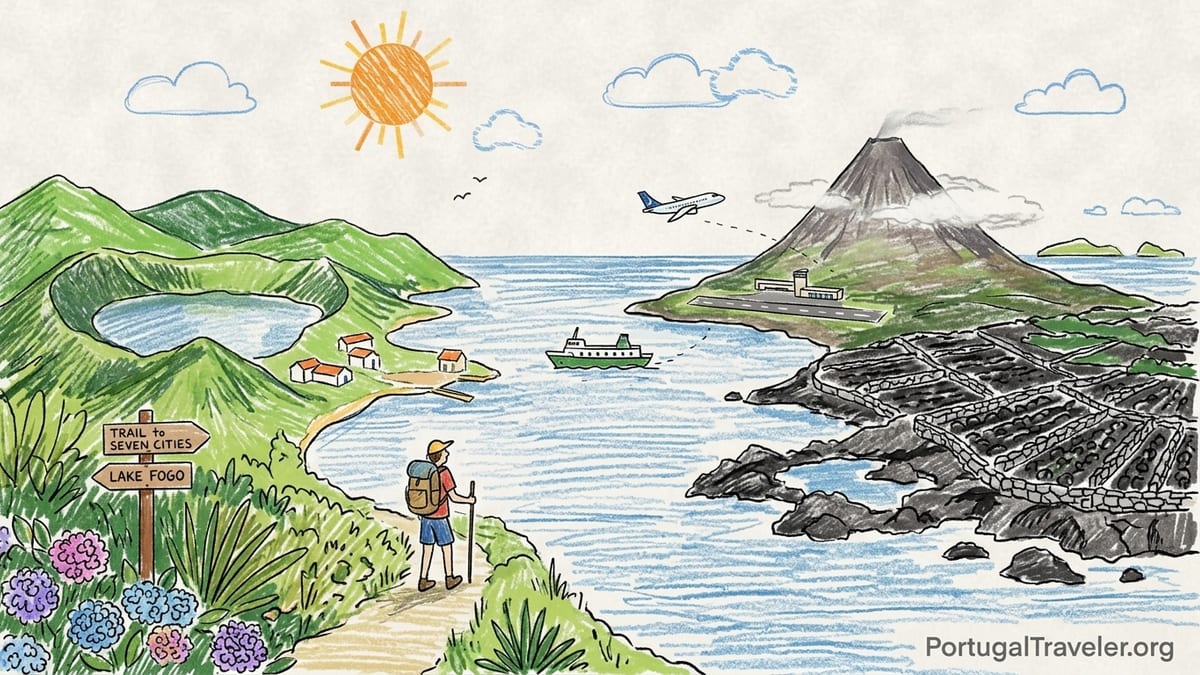
What I Expected From the Azores vs What I Found
Before I arrived, I thought of the Azores as a single destination with several viewpoints scattered across different islands. I expected lush green hills everywhere, easy ferry hops like Greek islands, mild and fairly similar weather, and the ability to “collect” islands in quick succession. My plan reflected that assumption. I booked four nights on São Miguel, three on Pico, three on Faial and two on Terceira. I stitched them together primarily with inter-island flights and allowed only half-days between connections, thinking I could do a major hike or a long drive the same afternoon I landed.
The first surprise was scale. São Miguel alone felt like a full trip. It took nearly an hour of driving to get from Ponta Delgada to Nordeste, and I could have spent four full days just exploring Sete Cidades, Furnas, the tea plantations and the north coast. On Pico, where I expected a smaller and gentler version of São Miguel, I found a serious volcanic island with long, straight coastal roads, a looming stratovolcano and villages spread far apart. Terceira, which I had imagined as a convenient “add-on,” surprised me with a compact, lived-in feel and evenings centered around Angra do Heroísmo’s streets and squares, far from the moodier landscapes of Pico and Faial.
I also underestimated how much the ocean shapes daily life and logistics. I had envisioned calm Atlantic days with reliable ferries and clear views between islands. Instead, I experienced sudden fog that swallowed Pico’s summit for two days, swells that made my one ferry ride between Pico and Faial feel like a small crossing of the open ocean, and variable winds that made some coastal walks feel exposed. The Azores turned out not to be nine versions of the same place, but a chain of distinct worlds separated by short but meaningful journeys.
Most of all, I learned that the Azores reward slowness. The islands are not an efficient checklist. They are a set of microclimates, working towns and volcanic experiments where weather and logistics dictate the rhythm. I had to let go of the idea that I could control my schedule days in advance, and instead accept that fog, flight slots and ferry timetables would sometimes make decisions for me.
Understanding the Logistics of an Island Chain
The backbone of Azores island-hopping is aviation. For summer 2026, SATA Air Açores planned several hundred inter-island flights per week spread across a web of routes that link São Miguel, Terceira, Faial, Pico, Santa Maria, Graciosa, Flores and Corvo. On my own trip, every long hop between central islands and São Miguel was a flight, even when two islands looked very close on the map. Only the short crossing between Pico and Faial made practical sense by ferry, with a frequent 30 to 45 minute route connecting Madalena and Horta.
Every flight day had the same rhythm. I would check out of my guesthouse by late morning, drive 20 to 40 minutes to the airport, and aim to return my rental car at least 90 minutes before departure. The regional airports are small, but flights open for check-in early and close firmly, and lines can form quickly if two flights overlap. By the time I checked in, cleared security and waited for boarding, I would often lose most of a morning just moving from a coastal town to the gate.
On the other side, even a short hop of 30 to 45 minutes in the air still consumed time. Disembarking was quick, but rental car counters tended to process one traveler at a time and I rarely left the airport in a new car in under 30 minutes. Luggage belts were usually prompt, yet by the time I was driving away there was rarely enough daylight left for a long hike. I learned to treat inter-island flight days as travel days, with only a modest walk or town evening on either side, not as days when I could stack ambitious activities.
My one ferry day, between Pico and Faial, had a different feel but a similar time cost. I arrived in Madalena early to queue with cars and foot passengers, waited through a brief boarding window, then crossed the channel in choppy seas that made photography nearly impossible on deck. I stepped off in Horta just 30 minutes later, but the process of lining up, embarking and disembarking still carved a clear block out of the day. In practice, every time I changed islands I wrote off five to six usable hours, no matter how short the distance was on a map.
Rental Cars, Roads and the Reality of Driving
Across four islands, I booked three separate rental cars. I picked up a compact automatic in São Miguel at Ponta Delgada airport, swapped to a small manual on Pico, and used a third vehicle shared across Faial and Terceira via separate bookings. Each island had its own character behind the wheel and its own surprises. What looked like simple ring roads and a few interior crossings on the map became, in reality, a web of steep climbs, sudden fog and different driving cultures.
On São Miguel, driving felt relatively straightforward. Roads from Ponta Delgada to Sete Cidades and Furnas were well maintained, with regular passing zones and moderate grades. The challenge was not the pavement but the viewpoints and hot springs that lured me to stop constantly. Parking lots at popular sites filled quickly in mid-morning, and I often needed to arrive early or later in the afternoon to avoid circling for a spot. Returning a car there was simple, with a cluster of agencies a walk away from the small terminal, but it still required enough buffer time that I never wanted to drive straight from a distant miradouro to a departing flight.
Pico was a different story. The main coastal road linking Madalena, São Roque and Lajes is smooth and fast compared with many volcanic islands, but side roads into wine country and rural accommodations can be narrow, with stone walls on both sides and limited space to pass. Night driving between scattered villages felt longer than the distance suggested, partly because there are few streetlights once you leave town centers. I found that even a simple dinner in another village meant planning for a 20 to 40 minute return in darkness, often through rain that arrived without much warning.
On Faial and Terceira, interior roads at higher elevations exposed another reality of Azorean driving. Low clouds and fog can roll in suddenly, turning a wide, smooth road into a tunnel with minimal visibility. One afternoon on Terceira, I set out for the Serra de Santa Bárbara viewpoint under patchy blue skies. By the time I reached the upper road, visibility had shrunk to a few meters and I crept along at walking speed, hazard lights blinking. Experiences like this taught me to schedule scenic drives loosely and never assume that a clear morning guaranteed a clear afternoon at elevation.
How Different the Islands Really Feel
It is easy to talk about “the Azores” as if the islands share one mood. After visiting four, I now think of them as cousins rather than siblings. São Miguel felt like the mainland of the archipelago, with its multi-lane roads near Ponta Delgada, busy supermarkets and a broad mix of restaurants. Pico felt raw and elemental, dominated by the cone of Mount Pico and long, stone-walled vineyards descending to the sea. Faial radiated a nautical energy around Horta, tailored to sailors and transatlantic crossings. Terceira was more about human history and streets, especially in Angra do Heroísmo, with pastel facades and evening passeggiatas.
Volcanic features showed these contrasts most clearly. On São Miguel, Furnas valley breathed with fumaroles and hot springs integrated into everyday life, and crater lakes like Lagoa do Fogo were wide open bowls of water ringed by green. Pico’s drama was vertical. From almost anywhere on the island, Mount Pico towered above, often disappearing into its own cap of clouds. The famous vineyards were not gentle terraces but black lava fields squared off by low stone walls, where vines huddled close to the ground for protection from wind and salt spray.
The coastline and ocean conditions reinforced this sense of distinct identities. On São Miguel’s north coast, I watched powerful Atlantic swells crash against cliffs and natural swimming pools that required careful timing and local advice to enter safely. On Pico, natural lava rock pools felt more sheltered on some days, but the channel to Faial could be whipped into short, steep waves that made my ferry crossing a small adventure even under good weather. Around Faial’s harbor, the sea seemed more orderly, framed by marina walls and visiting yachts, while Terceira’s coastal experience focused on easily accessible natural pools and structured bathing areas carved into rock, often close to town.
Evenings varied just as much. In Ponta Delgada, my nights centered on restaurant reservations, strolling past cafes and listening to the murmur of a modest but noticeable nightlife. On Pico, evenings were quiet and dark, with more stars than streetlamps and dinners that ended early because villages shut down soon after. Horta on Faial occupied a middle ground, with a cluster of bars and the famous marina café, where conversations drifted between languages. In Angra do Heroísmo on Terceira, I met groups of locals chatting on benches, couples walking arm in arm past churches, and a rhythm that felt more like a small Iberian city than a remote island.
Weather, Hiking and Why Flexibility Matters
One of my biggest mistakes was assuming that I could schedule major hikes several days ahead and count on the weather holding. Before departure, I blocked off a full day for a high-level hike near Lagoa do Fogo and another for a summit attempt on Mount Pico. I checked forecasts a week in advance and again three days before, saw encouraging symbols of sun and scattered cloud, and decided that my plan was set. The Azores taught me otherwise.
On São Miguel, an early morning that seemed promising for Lagoa do Fogo clouded over by the time I reached the trailhead. A low, thick blanket of cloud rolled in from the ocean, reducing visibility to a glowing white wall and turning viewpoints into frames of fog. I still hiked, but my photos were colorless and I never saw the full sweep of the crater. What stung was not the weather itself but the realization that I had pinned a fixed day on the hike instead of leaving space to move it when the forecast shifted 24 hours before.
Pico magnified this lesson. Climbing Mount Pico is one of the most weather-sensitive experiences in the Azores. The trail requires registration and a check-in with the mountain house staff, who can close the route if conditions deteriorate. On my assigned day, forecast conditions were marginal and the summit hid behind clouds from dawn. I spent hours refreshing updated forecasts and watching webcams when available, hoping for a break that never came. In the end, I did not attempt the full summit, and instead explored lower lava fields and villages along the coast. It was a humbling reminder that volcanic hiking here does not bend to personal schedules or airline tickets.
Across all four islands, I learned to think of weather in slices of time instead of whole days. Mornings might be clear on one side of an island and socked in on the other. Low cloud could hug central ridges while coastlines stayed bright. Wind direction and sea conditions determined whether boat tours departed, and even when they did, they often diverted to calmer areas at short notice. The most successful hikers and photographers I met were not those with the longest lists, but those willing to reshuffle plans each evening around the next day’s wind, cloud ceiling and ocean forecast.
Packing, Unpacking and the Hidden Cost of Changing Islands
On a map, leaping from island to island looks efficient. In practice, every change of base involved a familiar sequence of chores. The night before leaving, I would repack my bag, making sure wet swimsuits were dry, electronics were charged and fragile local products like cheese or wine were secured. The next morning included a sweep of the accommodation for forgotten cables, grocery items and stray socks, followed by cleaning out the rental car and refueling it to avoid extra charges.
Even with just a medium suitcase and a daypack, this repeated packing absorbed energy. By the third move, I began to recognize a difference between a twelve-night trip split over four islands and the same twelve nights split over just two or three. With each move came another unfamiliar room, another set of light switches and another mental map to learn. None of this was difficult, but it formed a background layer of fatigue that made me appreciate nights with no alarms and no scheduled travel the next morning.
The timing of grocery runs also mattered more than I expected. On São Miguel, larger supermarkets near Ponta Delgada and Ribeira Grande were easy to access and well stocked, but on Pico and Faial I often relied on smaller local shops with limited hours. Before a travel day I had to be careful not to overbuy perishables that I could not take past airport security, or risk leaving behind extra food. On days when flights were delayed or rescheduled, snacks in the car or daypack became essential, because the small airport cafés sometimes had limited options between key meal times.
The result was that each transition felt like at least half a day of mental and logistical work, even when door-to-door distances were short. If I were to repeat the trip, I would consciously build in full rest days that involved no driving to airports or ferry terminals, and I would resist the temptation to add a fourth or fifth island to a two-week itinerary unless there was a very specific reason.
Mistakes I Made and How I Would Plan Next Time
Looking back, some of my missteps were predictable and avoidable. The first was trying to combine too many islands in too little time. My twelve nights across four islands gave me snapshots rather than immersion. On São Miguel and Terceira in particular, I left feeling that I had only sketched the outlines of what was possible. If I were advising a first-time visitor today, I would suggest ten to twelve nights split between two islands, or at most three, with a minimum of four nights in each place.
Another mistake was scheduling a major hike immediately after arrival on São Miguel. I had planned to head straight toward Sete Cidades after a morning landing in Ponta Delgada, imagining that I could stretch my legs and beat jet lag with a crater rim walk. In reality, between immigration, baggage, picking up the car and checking in to my accommodation, the afternoon evaporated. Fog rolled in at higher elevation by the time I reached the area, and I ended up shortening the walk to a modest viewpoint stop. I would now avoid setting any critical or strenuous activity on the same day as an intercontinental or inter-island arrival.
I also leaned too heavily on long-range weather forecasts before the trip. Ten days out, I watched icons for rain, sun and cloud over each island as if they were fixed promises. On the ground, conditions changed quickly, especially at higher elevations and along exposed coasts. A more realistic approach would be to build a flexible list of desired hikes and drives, then confirm the final order 24 to 48 hours in advance based on updated local forecasts and advice from accommodation hosts or local guides.
Finally, I underestimated how different the islands would feel at night. I arrived on Pico expecting restaurants and bars to be open late in small villages, but many closed earlier than I thought, especially outside peak summer weeks. On Terceira, by contrast, evenings in Angra do Heroísmo felt lively even on weekdays. If evening atmosphere is important to you, I recommend at least one base in a larger town where you can walk to dinner and back, even if you spend your days exploring quieter corners by car.
The Takeaway
Traveling the Azores as an archipelago means accepting that geography and weather will edit your plans. It is not just a string of viewpoints spread across nine interchangeable islands. Each island has its own landscape, rhythm and microclimate, and moving between them requires more time and energy than map distances suggest. Inter-island flights are short but structured, ferries can be quick yet weather dependent, and every car pickup, car return and repacking session chips away at the hours available for lakes, calderas, vineyards and natural pools.
What I learned, above all, is that slower is better. Two islands explored deeply with room for weather changes, rest and unplanned detours will feel richer than four or five islands ticked off in a rush. Give yourself buffer days without fixed commitments, listen to what each island is built around whether that is hiking, sailing, hot springs or historic streets and let those strengths shape your time there. The Azores will not always deliver the view you imagined on the day you scheduled it, but they will almost always reward patience with a different kind of beauty.
If you arrive expecting one unified destination, you may be frustrated when fog hides summits or a rescheduled flight cuts into your hiking plan. If you arrive expecting a chain of distinct volcanic experiments separated by short but meaningful journeys, you can treat each island change as part of the experience rather than an interruption. That mindset turned my string of flights, ferries and rental cars from a set of obstacles into a framework for understanding what this Atlantic archipelago really is: a place where land, sea and sky are always in motion, and where travel itself is part of the story.
FAQ
Q1. How many Azores islands should I visit on a 10 to 12 day trip
For most travelers, two islands, or at most three, offer the best balance. This allows at least four nights on each island and reduces time lost to flights, ferries and repeated packing.
Q2. Do I really need to rent a car on each island
A car is highly recommended on most islands, especially São Miguel, Pico and Faial, because many viewpoints, trailheads and natural pools are not well served by public transport or taxis.
Q3. How much time should I allow at the airport for inter-island flights
Plan to return your rental car and be at the airport around 90 minutes before departure. The airports are small, but check-in and security still take time, and flights close punctually.
Q4. Are ferries a good alternative to flights between islands
Ferries work well on a few short routes, such as between Pico and Faial, but many inter-island connections are faster and more reliable by air. Weather can disrupt ferry schedules more easily.
Q5. How far in advance can I trust Azores weather forecasts
Use long-range forecasts only as a rough guide. For planning specific hikes or viewpoints, check updated local forecasts 24 to 48 hours before and be ready to adjust your schedule.
Q6. Is it realistic to hike Mount Pico during a short stay
It is possible but very weather dependent. If climbing Mount Pico is a priority, plan at least two to three nights on Pico, leave some flexibility and accept that conditions may not cooperate.
Q7. What is a common mistake first-time Azores visitors make
Many visitors try to see too many islands in a short time. This leads to frequent travel days, less flexibility around weather and a feeling of rushing rather than exploring.
Q8. When is the best time of year to plan an island-hopping trip
Late spring through early autumn usually offers the best combination of flight and ferry options, longer daylight and milder weather, though conditions can still change quickly.
Q9. How different are evenings on the various islands
Larger towns like Ponta Delgada and Angra do Heroísmo have more restaurants and nightlife, while smaller villages on Pico or Faial are quieter, with earlier closing times and darker nights.
Q10. What is the single most important tip for planning Azores logistics
Build in buffer time. Treat inter-island travel days as days with limited activities, leave space around key hikes or boat trips, and expect to adjust plans to match weather and schedules.