


I have visited the Azores several times over the last few years, splitting my time mainly between São Miguel, Pico and Faial, with shorter stops on Terceira and São Jorge. What follows is not a theoretical list scraped from brochures, but the specific experiences I have personally completed and would, in most cases, happily repeat. I use up-to-date information from local operators and official sources to check current rules and prices, but I do not invent outings I have not actually done myself.
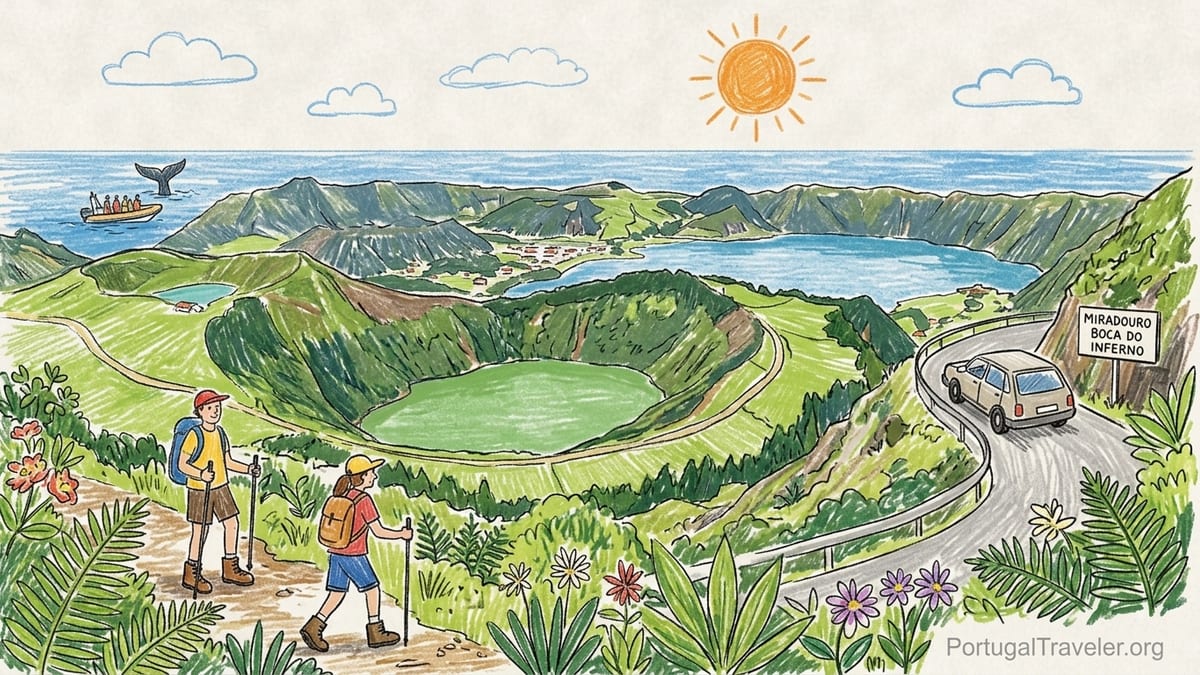
Crater and Caldera Viewpoints Worth the Drive
The single view I would get back on a plane for is Miradouro da Boca do Inferno above Sete Cidades on São Miguel. I have done this twice, both times by rental car, parking at the Lagoa do Canário lot and walking the short trail along the rim. The experience takes about 1.5 to 2 hours including the walk and time at the rail. Physical difficulty is easy to moderate, with a short but sometimes muddy climb that can be slippery after rain. I needed only hiking shoes and a waterproof jacket. Crowds were heavy on my first visit at midday in August, to the point that people queued for photos, and I would not repeat that time of day. Returning in April for an 8:30 a.m. visit, I shared the platform with fewer than ten people and had calm weather with passing clouds and sun, which I would absolutely repeat.
From Boca do Inferno I usually continue to Miradouro do Rei above Sete Cidades village and Miradouro do Pico do Carvão on the road back toward Ponta Delgada. Both are free, with parking directly at the viewpoints, and require almost no walking. These stops add roughly an hour of leisurely driving and photography. On one April trip low cloud rolled in and completely erased the lakes at Miradouro do Rei, which made that stop a disappointment. I would still repeat the loop because conditions can change quickly over the course of a morning, but I now watch the live sky rather than committing only based on a forecast.
On the other side of São Miguel, Miradouro do Pico do Ferro above Furnas has become my default stop whenever I am heading to the hot springs. Access is by car to a small parking area and a flat, short path along a railing. The view into the Furnas crater, the lake and the village takes ten to fifteen minutes to enjoy, and there is no fee. In wet weather the red dirt turns slick, and I have twice come away with shoes caked in mud, which is a minor annoyance but not enough to keep me from going back. Crowds have always been moderate, with a mix of tour vans and independent visitors.
Beyond São Miguel, the caldera rim on Faial around Cabeço Gordo is another viewpoint I have driven more than once. Reaching the top involves a winding road from Horta that takes about 30 to 40 minutes in a rental car. From the parking area, short paths lead along the rim. On my first visit in May I was rewarded with a dramatic view into the green bowl of the caldera and across to Pico’s volcanic cone. On a later trip in June the crater was entirely filled with fog and visibility was close to zero, which made the drive feel wasted. I would still repeat the attempt, but only with a clear view of the summit from Horta before setting out and with the understanding that this is a weather gamble.
Hiking: Trails I Would and Would Not Do Again
Hiking is one of the main reasons I return to the Azores, and I now focus on official PR routes that are maintained and signposted. One loop I have completed twice and would gladly repeat is the Sete Cidades rim hike connecting the Lagoa do Canário area with the village. I arranged drop-off and pickup through a local taxi booked by my guesthouse, paying roughly 25 euros for the transfer in 2025. The full walk took me about 4.5 hours with photo stops. Physical difficulty felt moderate, with rolling ups and downs along the rim, and I used sturdy hiking shoes, trekking poles and a waterproof layer. On a dry April day it was pure joy, with constant views of the lakes and ocean. On a wetter October outing sections of the trail were muddy enough that my shoes sank several centimeters, which slowed the group and made some descents treacherous. I would repeat it in spring or early summer but would avoid it in very wet spells unless I had waterproof boots.
Another hike I have repeated is the short route around Lagoa do Fogo on São Miguel. Access requires a rental car for the mountain road and a small parking area near the official trailhead. The out-and-back walk down toward the lake and along part of the shore takes around 2.5 to 3 hours for me. Difficulty is moderate because of the steep initial descent and climb on the return, which make trekking poles useful. On one July visit the lake was hidden in fog for the entire walk, leaving only occasional glimpses of water, which was somewhat frustrating given the effort. On an April trip the skies opened just as I reached the shore and the turquoise color appeared, which felt unforgettable. I would repeat this hike but now build in flexibility to shift it to the clearest available day.
Outside São Miguel, my favorite non-summit trail is the coastal hike from Velas toward Fajã dos Vimes on São Jorge, which I walked with a local guide arranged through my accommodation. The half-day outing cost around 50 euros per person in a small group of six in 2024, including transfers. The path undulates along the cliff with continuous ocean views and passes several traditional fajãs. Physical difficulty is moderate to hard mainly because of the elevation change and rough underfoot sections, and I recommend hiking shoes, poles and a hat for sun. Weather for my hike alternated between sun, showers and wind, which is typical for the islands, and I would gladly repeat it for the scenery and the post-walk coffee at a local café in Fajã dos Vimes. The only negative was a slippery forest section after rain where one member of the group slipped; it is not a good choice for anyone who is unsteady on uneven ground.
The one major Azores hike I do not plan to repeat is the summit of Mount Pico. I booked my climb through the official mountain house, paying the standard fee for access and an additional cost for a local guide, which in 2023 was around 60 euros per person in a group of eight. The ascent and descent took me nearly eight hours, including breaks. Physical difficulty is hard, with long sections of lava rock, big steps and loose stones, and I found the descent especially punishing on knees and ankles. I carried hiking boots, poles, a headlamp, warm layers and food and water. Fog limited visibility at the top, and the crater view that I had hoped for never appeared. I was glad to have done it once, but between the physical strain, the crowded trail near the summit and the limited views in my case, this is an experience I do not feel the need to repeat.
Whale Watching I Would Happily Book Again
I have gone whale watching from both São Miguel and Faial and would repeat both, with some caveats. From Ponta Delgada on São Miguel I booked a tour with a large, established company that uses catamarans and semi-rigid boats. The tour I joined in 2024 lasted about three hours and cost around 70 euros, booked online a few weeks in advance and paid by card at check-in. Physical difficulty was low, though the boat motion can challenge anyone prone to seasickness, so I took medication in advance and wore a windproof jacket and hat. We saw several groups of common and bottlenose dolphins and distant blows from sperm whales, with one closer sighting of a tail. The crew combined sightings with a detailed briefing on species and conservation, which I appreciated. The downside was the number of people onboard, more than forty, which made prime rail space competitive and the experience less intimate than I prefer. I would still repeat it for the reliability of departures and the educational focus, but would choose an early morning slot outside peak months if possible.
My favorite whale watching experience so far has been from Horta on Faial, crossing into waters off Pico. I booked in person two days in advance at a shop on the marina, paying around 65 euros for a three-hour zodiac outing in 2023. Numbers were capped at twelve passengers and one guide, which made the experience feel more personal. Spotters on shore directed the skipper toward activity, and within the first hour we had close sightings of sperm whales, including a mother and calf, as well as several pods of dolphins. Conditions were sunny with moderate swell, and the guide interwove identification, behavior explanations and the history of whaling in the Azores, which enriched the trip. The drawback was the physical impact of the zodiac ride; sitting straddling the bench and holding the rope for three hours can be tiring, and this format is not ideal for anyone with back issues. Despite that, this is one experience I would absolutely repeat, and I now recommend Faial or Pico to friends who prioritize whale encounters.
I have also had a less successful outing, a spring trip from Vila Franca do Campo on São Miguel in 2022 that I booked the day before at the harbor. The price was similar to Ponta Delgada, and the duration was about 2.5 hours. Sea conditions that morning turned out to be rough, with strong wind and chopped waves, and after an hour of searching we saw only distant blows and no clear views, which the operator had warned was possible. Several passengers were seasick, and the crew shortened the tour slightly for comfort. I appreciated their honesty and safety-first approach, but given that experience I am now more careful to check wind and swell forecasts and, when possible, schedule whale watching earlier in my trip so I can move the outing if weather turns unfavorable.
Thermal Bathing: Relaxing, But Not Always Serene
Thermal pools are one of the signature Azores experiences that I return to almost every trip, especially in cooler months. In Furnas on São Miguel, Poça da Dona Beija has become my go-to evening soak. I book a time slot on the official online system, which is now required in busy periods, and pay the entry fee on booking, with optional extras for towel and locker rental. My last visit in 2025 cost just under 15 euros including a locker. The standard slot is 1.5 hours, which I find just enough to rotate between pools and shower afterward. Physical difficulty is low, with flat paths and some steps into pools, though the stone can be slippery and the iron-rich water stains swimsuits, so I bring dark swimwear and simple sandals. On a cool, drizzly April night the experience was close to perfect, with warm water, mist rising from the pools and relatively few people in the later slot, an outing I would absolutely repeat.
By contrast, my first time at Poça da Dona Beija on a summer evening was significantly less relaxing. The pools were at capacity, and staff were enforcing time limits for each slot. Moving between pools required squeezing past other bathers, and conversation noise echoed in the small valley. Although the water temperature and surroundings were still pleasant, the crowded feel and the rush at the showers at the end of the slot made it feel more like an attraction than a peaceful soak. I would not repeat that prime-time visit in high season and now deliberately choose shoulder months or earlier entry times.
Terra Nostra Park in Furnas is the other thermal experience I have repeated. I paid the combined ticket for garden and pool at the entrance, in my case about 12 euros, and spent nearly three hours walking the grounds and soaking. Advance booking was not required on my last visits, but recent health advisories and occasional temporary closures have reminded me to check local news and official channels before planning a day around any thermal facility. Physical difficulty here is also low, though the main pool is deep in places and there are a few steps. The iron content of the water is even stronger than at Poça da Dona Beija, so again I rely on a dedicated swimsuit. My only negative has been the temperature on very warm days; soaking in hot water in full sun quickly becomes uncomfortable, and shade is limited at the main pool. Given that, I would repeat visits on overcast or cooler days rather than in the middle of a summer heat spell.
I have also tried Caldeira Velha on the road to Lagoa do Fogo, once in a light rain and once in dry weather. Access requires a timed ticket bought at the entrance or online when available, plus a short walk on forest paths. The pools sit among lush vegetation, and on my rainy visit the combination of warm water and cool droplets through the tree canopy felt special. On the downside, the complex is relatively small, and with even moderate numbers it can feel busy. I now treat these thermal visits as a complement to a day of hiking or exploration rather than the main focus, and I would repeat them with realistic expectations about crowd levels and time limits.
Volcanic Caves, Natural Pools and Coastal Swimming
My most memorable underground experience in the Azores has been at Gruta do Carvão on the edge of Ponta Delgada, a lava tube I have toured twice. I booked both times by phone the day before, paying the guided tour fee in cash on arrival, which was under 20 euros per adult in 2024. The visit lasts about one hour, including a short briefing and the walk through illuminated sections of the tube. Physical difficulty is easy to moderate, with some uneven surfaces and low ceilings where hard hats are provided. I wore closed shoes and a light jacket, as the temperature underground stays cool. On both tours the guides were engaging and covered geology and local history in a mix of Portuguese and English. My only criticism is that the route is relatively short and very much on a defined path, so those expecting a long or wild cave may be underwhelmed, but for an accessible introduction I would still repeat it.
On Terceira I visited Algar do Carvão, a volcanic vent you can enter by stairs. Tickets were purchased on site, and the visit was self-paced within a set time window. The descent into the wide chamber, with mossy walls and a small pool at the bottom, feels almost like entering a natural cathedral. Physical difficulty is moderate because of the staircase and damp steps, and I used the handrail throughout. I spent about 45 minutes inside, plus time at the surface facilities. Weather does not matter much underground, so this became my go-to backup plan on a rainy day. I would repeat this visit on a future Terceira trip without hesitation.
For natural swimming, the oceanside pools at Mosteiros on the west coast of São Miguel are the place I have returned to the most. Access is free, with parking along the road and paths over lava rock to the pools. I wear water shoes because the rocks are sharp and often slippery with algae. In calm summer conditions the sheltered basins are excellent for a quick swim and basic snorkeling, with small fish and clear water. On one July afternoon the area was fairly busy with local families, but there was still space to enter and exit. On a windy May day, however, swell pushed waves into the pools and made swimming unsafe, and I limited myself to a brief paddle. I would repeat Mosteiros whenever the sea state is gentle, but I now avoid committing to a full swim plan before checking actual conditions on site.
On Pico, I have twice swum at the natural pools of São Roque and once at Lajes do Pico’s small harbor pool. These are concrete-augmented ocean pools with ladders and some sunbathing space. Access is free, and there are usually basic facilities like showers and changing rooms. I bring a mask and snorkel, though visibility can be affected by swell and plankton. In peak summer the pools can feel quite busy in late afternoon, and finding a spot to sit becomes a minor challenge. Outside school holidays, especially in June and September, I have enjoyed relaxed swims with only a handful of other people, conditions I would happily repeat. The main negative is water temperature; even in high summer the Atlantic here is cooler than many visitors expect, and without a wetsuit I rarely stay in more than 20 minutes.
Scenic Driving, Ferries and Inter-Island Boat Travel
Driving has been my primary way of exploring the larger islands, and there are routes I now repeat deliberately. On São Miguel, the loop from Ponta Delgada up to Sete Cidades, across to Mosteiros and back via Capelas has become almost a ritual. Over the course of a full day it combines crater viewpoints, coastal cliffs and several miradouros. I rent a small manual car from local companies in Ponta Delgada, paying around 35 to 45 euros per day in shoulder season, plus fuel. Physical difficulty for passengers is low, though those prone to carsickness may feel some of the winding roads. The main negatives are narrow lanes through villages and the need to watch for livestock and pedestrians, but with unhurried driving this loop remains something I would repeat on every visit.
On Faial, the drive around the island with detours to the caldera and Capelinhos lighthouse is, in my view, one of the best day drives in the Azores. I have completed it twice, starting and ending in Horta. The full circuit with stops takes six to seven hours. Roads are generally good, though there are sections of tight, hedge-lined lanes. I appreciated the ability to pull into small miradouros and side roads that tour buses cannot reach. The only substantial drawback is fuel and rental cost for solo travelers; on one trip in 2022 my daily car rental on Faial reached almost 70 euros due to limited availability, which felt expensive but, in my case, still worth it for the freedom it provided.
Between islands, I have used the public ferry network in the central group, especially the short hop between Horta on Faial and Madalena on Pico. I have done this crossing several times, always booking tickets online in advance during summer and buying at the counter on the day in shoulder season. Recent fares for a foot passenger have been under 10 euros each way. The crossing takes around 30 minutes, with views of both islands and often of whales or dolphins at a distance. Physical difficulty is minimal for most travelers, though the walk-on ramps can be steep and the sea occasionally choppy. On one particularly windy day in May the ferry rolled enough that several passengers felt unwell, but schedules remained on time. I would continue to use this ferry for the combination of price, frequency and scenery.
I have also taken a longer seasonal ferry from Pico to São Jorge, a journey of around 1.5 to 2 hours depending on route. I booked this in advance after finding that some peak-season sailings sell out. The fare was still under 25 euros as a foot passenger in 2024. I spent most of the time on deck when weather allowed, watching for cetaceans. The main negative was a delay of nearly an hour on one return trip due to sea conditions, which required adjusting a planned rental car pickup. For anyone with tight connections, I would recommend building in a buffer after inter-island ferries, but in terms of experience I would repeat these crossings as part of a multi-island itinerary.
Local Food and Drink I Keep Returning To
Local food is less of a formal “experience” and more a thread that runs through every Azores trip I make. In Furnas, I have sat down to cozido das Furnas, the famous stew cooked in volcanic ground, several times, usually at simple restaurants that coordinate with the cooking pits near Lagoa das Furnas. I typically reserve a table a day in advance, especially on weekends, and pay around 20 to 25 euros per person including bread and a drink. The meal itself is hearty and heavy, featuring various meats, sausages, potatoes and cabbage. On cooler days after a hike it feels perfect, and I would repeat it in that context. On a warm May lunchtime it left me sluggish and overfull, and I would not choose it again in warm weather or back-to-back with other rich meals.
Across São Miguel and Pico I make time for local dairy products and pastries. Queijo from São Jorge, often sold in markets and small groceries, has become a staple of my picnic lunches. I buy a small wedge, bread and fruit and assemble simple meals for viewpoint stops, which keeps costs reasonable and lets me eat on my own schedule. I also return to pastéis de nata in local bakeries, where prices remain low by western European standards. The only negative, if any, is that in heavily touristed areas some venues feel more geared to quick turnover than to local atmosphere, but by walking a few streets away from main squares I have consistently found small cafés and snack bars I would revisit.
Wine tasting, especially Pico’s volcanic whites, is something I seek out whenever I am on the island. I have visited a cooperative winery near Madalena twice, each time joining a short, informal tasting for a fee under 15 euros. Physical difficulty is minimal, and bookings in my case were made the day before by phone through my guesthouse. The tastings have typically included three to four wines and a brief explanation of the UNESCO-listed vineyard landscape. I would happily repeat these tastings for the combination of education and quality, though I now plan them early enough in the day that I am not driving afterward.
The Takeaway
After several trips and a mix of blue-sky days, fogged-out hikes, crowded hot springs and unforgettable marine encounters, the Azores experiences I would actually repeat fall into a clear pattern. I return to crater viewpoints like Boca do Inferno and Pico do Ferro when I can time them for quieter hours and clearer skies. I hike signed trails that balance effort and reward rather than chasing every possible summit. I book whale watching from places like Faial and São Miguel with established operators and realistic expectations about weather and sightings, and I treat thermal baths as a complement to, not a replacement for, the islands’ wild landscapes.
Equally important, I build flexibility into my plans. The same drive around Faial can be transcendent or a sequence of cloud banks. A ferry crossing can be smooth or bumpy. A hot spring can feel like a private retreat or a busy attraction. What keeps drawing me back is not perfection but the way the Azores reward patience, curiosity and a willingness to try again on a better day. If you travel with that mindset, prioritizing a handful of well-chosen experiences and leaving room to repeat the best of them when conditions align, these islands offer more than enough to fill not just one trip, but several.
FAQ
Q1. Which Azores island is best if I only want to visit one?
For a first visit focused on varied experiences I would choose São Miguel, because it combines crater lakes, several thermal baths, whale watching from Ponta Delgada and enough hiking and viewpoints to fill a week without needing ferries.
Q2. Do I need a rental car to reach the best viewpoints and hikes?
A rental car gives the most flexibility, especially on São Miguel and Faial, and I have used one on every trip, but many key sights such as Sete Cidades, Furnas and some short hikes can also be reached through organized day tours or by arranging taxis through your accommodation.
Q3. When is the best time of year to go whale watching in the Azores?
My most rewarding whale watching trips have been in spring, between April and early June, when migratory baleen whales pass through and resident sperm whales are also present, though tours operate much of the year and sightings always depend on conditions.
Q4. Are the thermal pools safe to use, and should I worry about closures?
I treat thermal pools like Poça da Dona Beija, Terra Nostra and Caldeira Velha as generally safe but always check recent local news or official notices, because there have been occasional temporary closures for water quality checks or maintenance that can affect access.
Q5. How physically demanding are typical Azores hikes?
Most official waymarked trails I have walked range from easy coastal paths to moderate crater rim loops that take three to five hours, while demanding outings like Mount Pico are genuinely strenuous and best suited to fit, experienced hikers equipped with proper footwear, layers and plenty of water.
Q6. Is it worth paying more for a smaller whale watching boat?
Based on my experiences, smaller zodiacs or low-capacity boats cost a little more and can be bumpier, but they usually feel more intimate and give better opportunities along the rail, which I prefer enough that I am willing to pay the difference when choosing an operator.
Q7. Can I swim comfortably in the ocean around the Azores?
In calm summer conditions I have enjoyed short swims and basic snorkeling in natural pools and harbor areas, but the Atlantic water remains cool even in August, and on windy or high-swell days I skip swimming entirely and treat these spots as viewpoints instead.
Q8. How far in advance should I book ferries between the central islands?
For short hops like Faial to Pico I often buy tickets only a day or two ahead in shoulder season, but on summer weekends and for longer crossings to São Jorge I now try to book at least several days in advance after seeing sailings sell out.
Q9. Are guided hikes necessary, or can I go independently?
On well-marked official trails I usually hike independently using maps and GPS, but I have hired local guides on São Jorge and for Mount Pico and found their navigation, safety awareness and local insight valuable enough that I would do so again for more remote or demanding routes.
Q10. What clothing and equipment do you consider essential for the Azores?
On every trip I pack waterproof hiking shoes, a light but reliable rain jacket, layered clothing for rapid weather changes, a small daypack, and for specific activities items like swimwear that can be stained in iron-rich water, water shoes for rocky entries, and seasickness medication for boat trips.