


Island hopping in the Azores sounds effortless on paper. Tourism brochures talk about a neat network of regional flights and boats, with arrows sketched casually between São Miguel, Terceira, Pico, Faial, São Jorge, Flores and tiny Corvo. In reality, stitching these routes together means dealing with weather, limited schedules, tight luggage rules and the nagging fear of missing your flight home. Over several recent trips, I tested both ferries and SATA Air Açores flights between the islands, logging prices, connection times and what actually happened on the day. This guide is built from those real journeys, so you can plan your own route with eyes wide open.
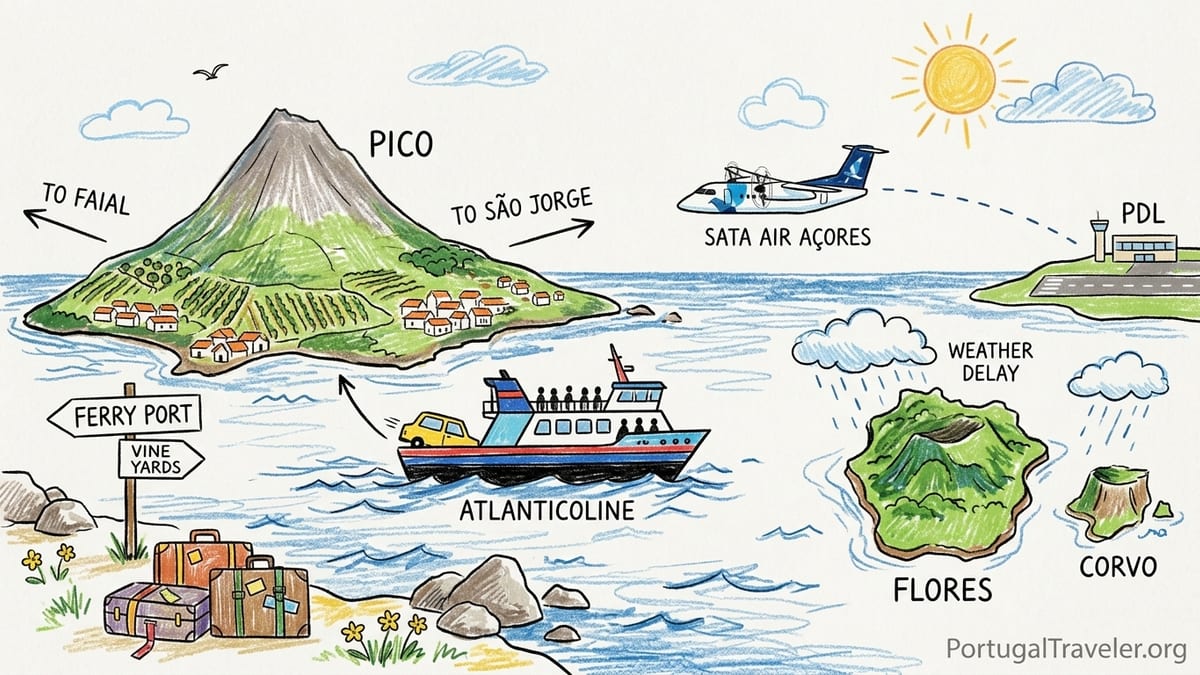
How Inter-Island Travel Really Works in the Azores
On the map, the Azores splits into three groups. The Eastern Group is São Miguel and Santa Maria, the Central Group is Terceira, Graciosa, São Jorge, Pico and Faial, and the Western Group is Flores and Corvo. That geography decides almost everything about how you move. Within each group, ferries run some or all year. To cross between groups you fly on SATA Air Açores, the regional arm of Azores Airlines, because there is no regular ferry linking, for example, São Miguel with Pico or Terceira with Flores.
Official tourism material still says inter-island travel is possible by both regional flights and boats, which is technically true. Atlanticoline now runs year-round ferries on the triangle of Faial–Pico, Faial–Pico–São Jorge and on the Flores–Corvo link, with additional seasonal routes that extend to Terceira and Graciosa from roughly May to late September, depending on the year and exact timetable. Outside that window, the Central Group shrinks to a reliable triangle; the Eastern Group relies entirely on flights, and the Western Group becomes a two-island microcosm held together by a small boat across a very exposed channel.
In practice, this means a summer itinerary can lean heavily on ferries in the Central Group, sometimes chaining Horta–Madalena–São Roque–Velas in a single day. In winter the same plan collapses into SATA flights, often with a connection at Ponta Delgada or Terceira, and far fewer daily options. On my own trips I saw both sides: a breezy, almost commuter-style hop between Faial and Pico in July, and a tense, weather-watched flight out to Flores in shoulder season where half the morning vanished into delay updates.
Price-wise, ferries are still the budget backbone. A foot passenger ticket on the short Horta–Madalena crossing in 2026 typically starts in the single digits in euros, while longer seasonal legs in the Central Group can run into the tens of euros each way, depending on route and date. By contrast, one-way SATA Air Açores tickets between islands usually start somewhere around a few dozen euros and rise with demand, fare class and how late you book. Every time I compared, the ferry was significantly cheaper, but the question was never just price. It was: how much of the day will I lose, and can weather steal this connection from me entirely?
The Central Group by Ferry: Faial, Pico and São Jorge
My most instructive island-hopping days happened in the Central Group. I based myself in Horta on Faial, with the pastel houses and yacht masts around the harbour, and treated Pico and São Jorge as strings on a triangle. Atlanticoline’s Horta–Madalena ferry on the Blue Line is the workhorse crossing here, around twenty-five minutes on the water in decent weather, with multiple departures most days in summer and a trimmed schedule in winter. I booked a July morning crossing as a walk-on passenger for under 10 euros, paying online by card and receiving a PDF ticket to show on my phone.
Check-in for the ferry was as simple as walking into Horta’s terminal about thirty minutes before departure. There was no formal baggage drop for foot passengers; I kept my 10-kilogram duffel with me, rolled it up the gangway and parked it beside me on the passenger deck. Vehicles line up separately outside the terminal and reverse onto the ferry, but if you are not bringing a car your only real task is to be in the right queue when the previous sailing has unloaded. I watched locals wheel supermarket trolleys straight aboard, which tells you everything about how informal the luggage situation is compared with flying.
On another day I stretched that triangle. I took a midday sailing from Madalena on Pico across to São Roque further up Pico’s north coast, and then continued with the same vessel on to Velas on São Jorge as part of a Green Line route that operates seasonally between May and September. The total ticket cost, booked in advance for a specific date, came out at a few tens of euros. The booking engine showed each leg separately, with clear notes that these routes only operate within the summer timetable block, which matters if you are trying to replicate this in October or March.
What surprised me most was how much or how little of the day these crossings consumed, depending on how I arranged accommodation. On the Faial–Pico hop I left my Horta guesthouse at 8:30, walked down to the harbour in under fifteen minutes, and stepped off in Madalena just before 9:30. By 10:00 I was already checking into a Pico vineyard cottage that had agreed to store my bag until the room was ready. The entire island transfer, door to door, had taken about ninety minutes of usable time. By contrast, the longer Pico–São Jorge leg required an early-morning taxi to São Roque, a cautious pre-boarding wait because of forecast swell, and a somewhat queasy hour and a half on rougher water. I reached my Velas accommodation just before lunchtime, but mentally had written off the morning to logistics.
Western Extremes: Flores and Corvo by Boat and Plane
The Western Group is where the Azores remind you they sit in the middle of the Atlantic. Flores and Corvo feel remote even compared with São Jorge. My route out there began with a SATA Air Açores flight from Ponta Delgada on São Miguel to Flores, because there is no ferry link between the Eastern or Central groups and Flores. I booked this domestic sector as part of an Azores Air Pass style itinerary through Azores Airlines, bundling several inter-island legs together which kept the total slightly cheaper than buying standalone one-ways. The Ponta Delgada–Flores sector priced in the low three figures in euros when booked a couple of months in advance during a shoulder season month.
Baggage on SATA Air Açores follows Azores Airlines rules for inter-island trips: one checked bag up to 23 kilograms on most standard fares, with fees for additional or overweight baggage. Cabin baggage is limited by size and weight, broadly in the eight-kilogram range for economy on the small turboprops that serve the islands. I checked one medium suitcase and carried a backpack aboard. Check-in opened two hours before departure at Ponta Delgada; I arrived a little before that to allow for occasional queues at security and to deal with the ticketing desk because my booking involved multiple islands.
The scheduled flight time from Ponta Delgada to Flores is around one hour and forty minutes, but my actual departure was held on the ground for nearly another hour because of low cloud at Flores’ short runway. Announcements were calm but vague, which is typical: staff wait for updated weather before confirming any delay or cancellation. In total, the transfer from my São Miguel hotel to my Flores guesthouse took most of the day: taxi to the airport mid-morning, check-in and delay, flight early afternoon, then a short shuttle from Flores airport into Santa Cruz. It was close to 16:00 when I finally set my bag down in the room.
From Flores to Corvo, the story changes back to boats. Atlanticoline operates a year-round Flores–Corvo service, but the vessel used and the frequency depend heavily on season and sea conditions. I booked a mid-morning crossing as a foot passenger for a fare that again sat in the low two-digit euro range, with a return ticket costing only slightly more than a single. The booking process was straightforward through the operator’s site, though for shoulder-season dates the published timetable came with warnings about possible last-minute changes. On the day, the sea was moderate, and the small ferry rocked and dipped in ways that made most passengers grip their seats.
Luggage here was again wonderfully easy. I boarded with the same backpack and small case, no weighing, no measuring, only a casual glance at the size. Some of the local workers had crates of supplies bound for Corvo. We arrived within about forty-five minutes. The tiny harbour sits below the village, and my guesthouse host met me on the quay in a small car, a reminder that in somewhere as small as Corvo, transfers are often informal. The risk, of course, is the weather: locals and other travellers in town shared recent stories of boats cancelled for two or three days in a row when wind and swell made the crossing unsafe. In that scenario, your only way out is to wait. Living that possibility, even on a calm day, shaped how much buffer time I kept before my flight back east.
Flying the Network: SATA Air Açores in the Central and Eastern Groups
Not every Central Group combination is efficient by ferry, especially outside summer. To test the difference, I flew a sequence that many visitors consider: São Miguel to Terceira, then on to Pico, then back to São Miguel. Each leg was booked as a separate sector on SATA Air Açores, partly because my dates fell on the edges of timetables and partly to compare prices. São Miguel’s main airport at Ponta Delgada and Terceira’s Lajes airport act as central hubs, with multiple daily puddle-jumper flights in high season.
Ponta Delgada to Terceira is under forty minutes in the air. I took a mid-morning flight, paying just under 70 euros for a basic economy fare booked about six weeks in advance. Check-in opened two hours beforehand. With no checked bags on this leg, I breezed through security and sat at the small domestic gate area with a coffee. Boarding was called about half an hour before departure, with passengers walking across the tarmac to the Dash-8 turboprop that is the workhorse of the fleet. The flight itself was smooth, but what mattered was how much of the day it occupied. From hotel checkout in Ponta Delgada at 8:30 to checking into my Angra do Heroísmo guesthouse around 11:30, the transfer soaked up about three hours in total.
The Terceira to Pico flight was more instructive. Scheduled again for late morning, it cost around the same as the São Miguel–Terceira leg. On the day, strong crosswinds at Pico triggered a rolling delay. We boarded about forty minutes late, then briefly held on the runway before the captain accepted a narrow weather window. Some passengers chatting in the aisle mentioned previous trips where the flight had been turned back to Terceira, which is not uncommon on the smaller islands when wind or visibility deteriorate during the short hop. I landed in Pico around ninety minutes after the original arrival time, and by the time I had my checked bag and picked up the rental car outside the terminal, the early afternoon was already gone.
Flying back from Pico to São Miguel three days later illustrated a different kind of risk. The flight was scheduled ahead of my evening transatlantic departure from Ponta Delgada, but I deliberately left a full day’s margin between them. That choice felt wise: a combination of morning fog over Pico and a late-arriving inbound aircraft meant we left almost two hours behind schedule. SATA staff proactively rebooked a couple of passengers with tight international connections, but the stress in the boarding queue was palpable. In my case, I landed mid-afternoon with hours to spare, yet the day had effectively become a travel day despite the short flying time.
Ferries vs Flights: Luggage, Stress and Lost Time
After moving through the network by both sea and air, three differences mattered more than anything: how luggage was handled, how stressful the process felt, and how much of the day vanished into logistics. Ferries won on luggage every time. Walking onto an Atlanticoline vessel with a backpack and small case felt like boarding a commuter train. There were no scales, no cabin baggage templates, no anxiety about liquid limits. Even on the car ferries, staff were relaxed about where you stowed your bags as long as emergency exits stayed clear. That looseness is part of island life and a gift to travellers, especially anyone with camera gear, groceries, or an oddly shaped hiking pack.
Flights, on the other hand, demanded more discipline. At Ponta Delgada and Terceira, cabin baggage was sometimes weighed, especially when flights were busy or operated by the smaller turboprops. Exceeding the allowance meant on-the-spot fees for checked or overweight baggage. The upside was that once your bag was tagged to the next island, you did not have to drag it through terminals and gangways. Still, I saw several travellers re-packing on the floor to move heavy items into checked bags, a stressful prelude to a hop that officially lasts less than an hour.
In terms of stress, ferries felt gentler, but only when seas were calm. On the Faial–Pico hop, locals read newspapers and schoolchildren dozed as if on a bus. On the longer Pico–São Jorge sailing in moderate swell, people scanned the horizon, and a few quietly gripped paper sick bags. However, delays were generally transparent: if weather closed the harbour, departures simply did not appear on the board that morning. With flights, delays often unfolded in increments as crews waited for updated conditions at destination airports, which made it harder to know whether to relax with a coffee or start worrying about missed connections.
Time lost was the critical factor. A simple Faial–Pico ferry, with accommodation within walking distance of both ports, cost me about ninety minutes door to door. A São Miguel–Terceira flight with a taxi on each end took around three hours, despite the flight itself being under forty minutes. The Ponta Delgada–Flores run effectively consumed a full day because of weather delay and the longer flying time. When planning an itinerary, I now mentally round ferry days in the Central Group down and flight days everywhere else up. If the timetable claims a midday Funchal–Ponta Delgada arrival followed by an afternoon SATA hop to another island, for example, I treat that as optimistic rather than guaranteed.
Weather, Cancellations and Why the Central Triangle Feels Different
Every local I spoke to about island hopping eventually shrugged and said some version of the same phrase: in the Azores, the weather decides. The difference between the Central triangle and the rest of the archipelago is not that weather is better there. It is that the distances are shorter, the crossings more sheltered, and there are usually multiple sailings or flights per day in high season. That density builds resilience into your plans. If an early Faial–Pico ferry is cancelled, there might be another at midday. If a mid-morning Terceira–Pico flight cannot land, it may try again later when winds ease.
In contrast, routes that bridge groups, or reach the Western islands, often run only once per day or on specific weekdays. I met a couple in Santa Cruz das Flores who had seen their flight back to São Miguel cancelled outright because of low cloud and strong winds. The replacement departure was scheduled for the following afternoon. Their international flight home from Lisbon had to be rebooked, and two extra nights of lodging were arranged in Flores and São Miguel. They had left only one full day buffer between Flores and their Lisbon connection, which proved insufficient when the Atlantic flexed its muscles.
Ferries are cancelled in heavy seas or when wind direction makes harbour approaches unsafe. Locals told me that winter sailings to São Jorge are often disrupted several days in a row. In those periods, the only alternative is to fly, and even those flights can suffer diversions or go-arounds. This is why the Central triangle behaves differently: because Faial, Pico and São Jorge sit close together and are tied by both year-round ferries and regular flights, your odds of getting off one and onto another island within a day are much higher, even in shoulder seasons.
The other quiet factor is infrastructure at the ports and airports. Horta, Madalena and Velas all have small but functional terminals you can cross on foot in minutes. By comparison, Ponta Delgada’s airport handles both domestic and transatlantic traffic, with longer queues at security and more layers of check-in. I noticed that even when my SATA flight to another island departed on time, the experience there felt more like “airport mode,” with its inherent waiting and formalities. That psychological drag is part of why the ferry-centric days in the Central Group felt more relaxed, even when the sea was a little rough.
Building a Practical Island-Hopping Plan
After testing several combinations, I would now build most Azores itineraries around one of two backbones. The first is a flight into Ponta Delgada on São Miguel, a stay of several nights there, then a single inter-island flight to the Central Group, followed by a few days moving among Faial, Pico and São Jorge on ferries. The second is to skip São Miguel entirely on some trips and fly straight to Horta or Pico from mainland Portugal, turning the entire holiday into a triangle of ferries and short island drives that never touches an airport again until your return.
On one trip, for example, I flew Lisbon to Ponta Delgada on an evening Azores Airlines service, overnighted near the harbour, then took a midday SATA hop to Horta the next day. That Horta-bound flight cost just under 100 euros when booked as part of a multi-leg ticket. I spent three nights on Faial, using one day for a Faial–Pico day trip by ferry and another for the island’s own caldera and Capelinhos landscapes. From there I ferried to Pico, stayed four nights, then caught the seasonal ferry to São Jorge, where I spent three nights focused on hiking and fajã villages.
Transfers between islands in that Central Group phase usually took less than half a day, leaving big chunks for actual exploration. My longest logistics stretch was the return. I chose to fly from São Jorge back to Terceira on a morning SATA flight and then connect to Lisbon late that afternoon. Even with on-time operations, almost the entire day went to taxis, check-ins, security, short flights and another boarding queue. If I had needed to connect further on to North America, I would have added an overnight in Lisbon or Ponta Delgada as a buffer.
The pattern that emerged is that ferries shape slow, dense itineraries where you really get to know two or three islands, while flights make sense when you want to sample distant groups at the cost of more dead travel time. Trying to hit four or five islands in ten days by chaining multiple flights and ferries sounds adventurous. On the ground it means a suitcase that never quite gets unpacked and a brain that never fully switches out of transfer mode. Every traveller’s tolerance is different, but my firm conclusion was simple: fewer islands, more days each, and generous buffers around the flights that matter most.
When to Fly, When to Ferry, and How Much Buffer to Leave
Choosing between flights and ferries in the Azores is less about romance and more about risk management. Ferries make sense when you are within the Central or Western groups, you have flexible dates, and you are not chasing a tight onward connection. If you are moving between Faial and Pico, or extending from Pico to São Jorge in summer, take the boat unless you have significant mobility issues or get badly seasick. The crossings are short, luggage is easy, tickets are inexpensive, and there is usually more than one daily option in peak months.
Flights make sense when you are crossing between groups, visiting Flores or Corvo, travelling in shoulder or low season when ferry schedules thin out, or trying to cover more than three islands in a single trip. They also make sense when the forecast looks marginal and you want the best odds of movement. A plane can sometimes land in conditions that close a harbour, and vice versa, but in my experience the airline is more likely to add extra sections or shuffle aircraft than the ferry company is to conjure a new sailing out of nowhere.
For buffer time before an international departure, my own rule hardened with each trip. If your long-haul flight home leaves from Ponta Delgada, be on São Miguel at least one full day beforehand, preferably two if you are coming from Flores, Corvo or any itinerary involving multiple domestic flights. If your transatlantic sector leaves from Lisbon or Porto, arrive on the mainland at least the night before. I have seen too many Western-islands flights scratched by weather on the very day tourists needed to leave.
Even within the Central Group, treat ferries as if they were flights when it comes to same-day international connections. Do not plan to take a morning Faial–Pico ferry, for instance, then the afternoon Pico–Ponta Delgada flight, and finally a same-day evening transatlantic flight. On paper, the timetable might align. In reality, all it takes is a swell that delays the ferry by an hour, or a fog bank over Pico that holds the flight, and your carefully stacked dominoes tumble. Instead, think of the final twenty-four to forty-eight hours of your trip as a weather buffer, a period reserved for the island you are flying out of, where last-minute adjustments are inconveniences rather than disasters.
FAQ
Q1. Is it really possible to island hop the Azores using only ferries?
In summer you can move entirely by ferry within the Central Group and between Flores and Corvo, but crossings between the Eastern, Central and Western groups still require flights.
Q2. How far in advance should I book SATA Air Açores inter-island flights?
For peak months like July and August, booking several weeks or even a couple of months ahead is wise to secure good times and lower fares, especially on routes to Flores and Pico.
Q3. Are ferry tickets in the Azores cheaper than flights?
Yes. Short ferries such as Faial–Pico usually cost under 10 euros one way for foot passengers, while inter-island flights more often start in the dozens of euros per sector.
Q4. How early should I arrive at the ferry terminal before departure?
For most Atlanticoline services, arriving about 30 to 45 minutes before departure is enough for foot passengers, though vehicle drivers should allow extra time for boarding formalities.
Q5. Do ferries in the Azores check or weigh luggage?
In practice, foot-passenger luggage is rarely weighed or measured. You carry bags on board yourself, and staff mainly care about safe storage and clear access routes.
Q6. How strict are SATA Air Açores flights about cabin baggage?
Cabin baggage is subject to size and weight limits, roughly around 8 kilograms for economy. On busier flights staff may weigh bags and charge fees if you exceed the allowance.
Q7. What happens if my inter-island flight is cancelled due to weather?
The airline will rebook you on the next available flight, but that may be later the same day or even the next day, so you may need to adjust hotel and onward flight plans.
Q8. Is the Flores–Corvo ferry safe for people who get seasick?
The route is considered safe but can be rough because it crosses open Atlantic water. If you suffer from seasickness, bring medication and be prepared for choppy conditions.
Q9. Can I rely on same-day connections between islands and my international flight?
It is risky. Weather can delay or cancel both ferries and flights, so keeping at least one full buffer day on the island of departure is much safer.
Q10. How many islands can I realistically visit in a 10-day Azores trip?
A relaxed plan is two or three islands, such as São Miguel plus two in the Central Group, which leaves enough time for weather hiccups and still feels like a holiday.