


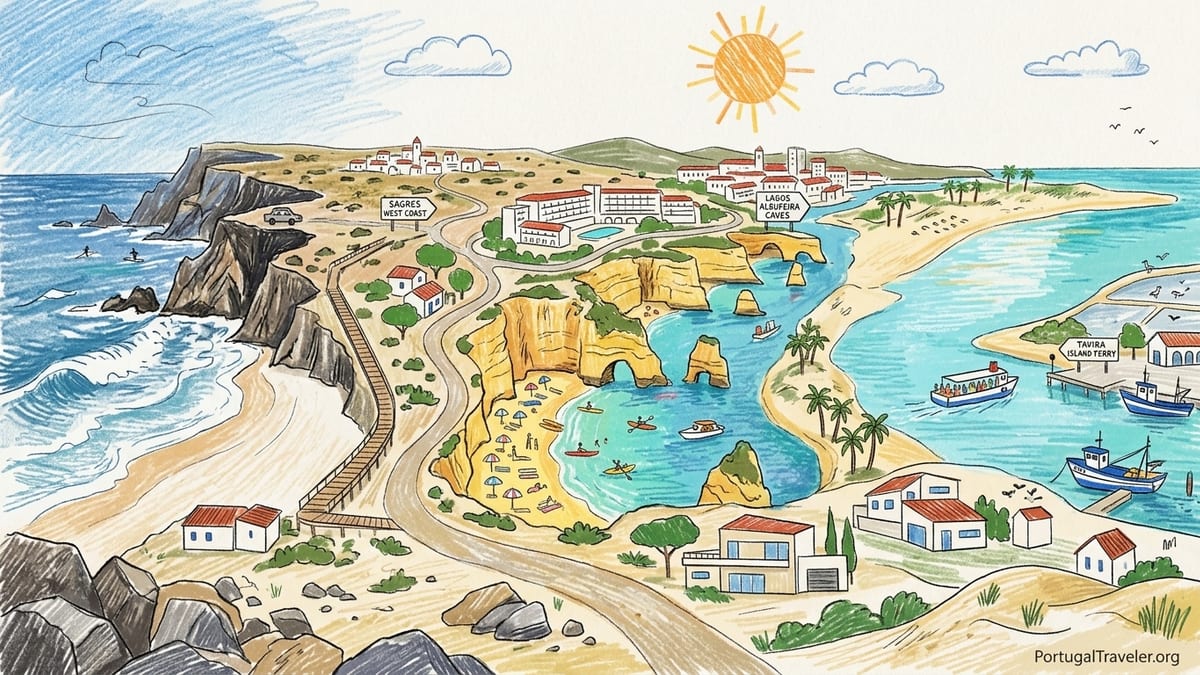
On my first long trip through the Algarve, I made what felt like a risky choice. Instead of picking one coastal town and staying put, I split my time between the far western Costa Vicentina, the crowded golden-cliff coast between Lagos and Faro, and the quieter, flatter beaches of the eastern Algarve around Tavira and the Ria Formosa. By the end of the journey I realised I had not just visited three sets of towns. I had experienced three almost separate regions, each with its own rhythm, weather, water and way of travelling. If you are trying to decide where to base yourself in the Algarve, understanding how these three coastlines feel in real life matters more than drawing neat lines on a map.
How the Three Algarves Reveal Themselves on Arrival
Driving into the western Algarve along the Costa Vicentina, I remember watching the landscape widen. The road climbed onto a scrubby plateau, eucalyptus scent in the air, the sea a horizontal strip of silver in the distance. The houses grew sparser and the cars dustier. By the time I rolled into a village above Praia da Bordeira, the Atlantic wind was thudding against the car doors and the sky felt enormous. It was clear that this was not the sun-lounger Algarve from the brochures, but something wilder and more exposed.
Arriving in central Algarve after that felt almost like switching countries. As I drove from Lagos towards Carvoeiro and Albufeira, the road dipped and twisted, and suddenly the coast broke into limestone cliffs and resort clusters. The beaches shrank but grew more theatrical, hidden in pockets between golden headlands and sea-carved arches. Car parks were full of hire cars, there were boat touts selling cave tours, and wide promenades behind the sand. This was the Algarve of postcards and package holidays, with all the infrastructure and crowds that come with it.
In the east, the shift was subtler but just as real. As I approached Tavira from Faro, the land flattened again, the horizon opened and saltpans appeared beside the road, dotted with wading birds. The ocean retreated behind the barrier islands of the Ria Formosa, so instead of driving straight to a beach car park, I was following signs to ferry piers. My first proper beach afternoon there did not begin with walking down cliffs, but with a short boat ride from Olhão through the lagoon to Armona Island, past fishermen mending nets at the harbour. The whole experience felt softer, calmer and more local.
These three first impressions never really faded. They coloured every beach day, every evening walk and every drive. The west coast stayed raw and elemental. The Lagos to Faro strip stayed dramatic and busy. The eastern Algarve stayed gentle, sandy and slightly slower. If you choose where to stay without considering that emotional backdrop, you risk ending up in the wrong Algarve for the kind of trip you actually want.
Sea, Sand and Wind: What It Feels Like on the Beach
On the western coast, the Atlantic is not background decoration. It is the main character. Walking down the long wooden walkway to Praia da Bordeira above Carrapateira, I had to lean into the northerly wind that locals sometimes call the nortada. The sand blew in low sheets along the vast open bay, and the surf thundered in heavy lines. There were a few families at the calmer river mouth, but out on the main beach it was mostly wet-suited surfers and people in windbreakers in the shoulder season. The water was noticeably colder here than anywhere else I swam in the Algarve, especially from spring into summer, when coastal upwelling keeps the west coast sea temperatures several degrees below the south coast.
At Arrifana, another west-coast favourite built into a steep amphitheatre of dark cliffs, I watched beginner surfers battle whitewater that would have terrified most casual swimmers. Even on moderate days the waves had weight and the currents tugged hard. When the wind died and the sun came out, the place was breathtaking, but it always felt like an Atlantic beach first and a sunbathing spot second. For travellers who dream of easy bobbing in warm, clear water, the western Algarve can be a shock.
The central Algarve beaches between Lagos and Albufeira feel completely different underfoot. At Praia Dona Ana, Camilo or Porto de Mós near Lagos, the sea is still the Atlantic, but the south-facing orientation and shelter of the cliffs usually mean smaller waves and noticeably warmer water than the west coast in the same week. I remember stepping from a shaded cliff stairway onto a compact cove and finding the water calm enough for children to splash near the shore while kayaks and cave-tour boats came and went beyond the swim line. On busy days, the sea can feel like a shared swimming pool ringed by cliffs, with paddleboards, inflatables and snorkellers all packed into the same turquoise surface.
East of Faro, the Algarve softens again. In Tavira I took the small seasonal train across the marshes to Praia do Barril, then walked out to a beach that ran as far as I could see in both directions, almost ruler straight. There were gentle, rolling waves but no cliffs, just low dunes and a wide band of fine sand. On another day, cruising from Olhão through the Ria Formosa to Culatra and Armona islands, the water inside the lagoon was almost glassy, sheltered by the barrier islands. When we crossed to the ocean side to swim, the sea was warmer than in the west and the waves were usually friendly and shallow for long distances, ideal for families and less confident swimmers.
How You Actually Get to the Beach
The mechanics of simply reaching the sand can change the whole feel of a holiday, and this is one of the most striking differences between the three Algarves. On the west coast, road access is usually simple but often ends with some effort on foot. The car parks for beaches like Bordeira or Amado sit behind dunes or on cliff edges, sometimes along narrow roads with passing places. From there you walk along wooden boardwalks or sandy tracks, sometimes descending steep paths without much shade. I remember carrying a picnic and a surfboard down to Amado and feeling every step on the way back up in the afternoon wind.
In the central Algarve, the coast is more vertical and the paths more engineered. At Praia do Camilo near Lagos, the experience is defined by the long staircase that zigzags from the clifftop restaurant to the coves below. Carvoeiro, Benagil and many smaller coves are similar. You park as close as you can, then follow a combination of paved paths, miradouros and steep steps. Boat and kayak tours leave straight from central beaches like Lagos’s Batata or Portimão’s Praia da Rocha, which means you can go from hotel room to kayak without ever driving if you pick your base carefully.
In the east, getting to the beach is often part of the adventure. Around Faro, Olhão and Tavira, the true ocean beaches mostly sit on barrier islands behind the Ria Formosa lagoon. At Olhão, I joined locals and day trippers at the pier for a regular boat service out through the channels to Armona and Culatra Islands. Standard shared cruises around the lagoon with stops on the islands often cost around 25 euros per adult for half a day as of 2024, and the public ferries for straightforward transport to the islands are cheaper, aimed at residents as much as tourists. Near Tavira, the shuttle trains and boats to Ilha de Tavira and Praia do Barril create a ritual out of each beach day: you check the timetable, queue under the pine trees, and watch the town slide away behind you as the marshes and dunes approach.
This difference in access has knock-on effects. On the west coast, the need to walk and the lack of mass transport keep the beaches feeling emptier, especially outside peak summer weekends. In the central Algarve, prominent car parks and short, obvious paths concentrate visitors and make the cliffs feel busier than the region as a whole. In the east, the reliance on boats and small trains filters the crowd by schedule; beaches can feel almost deserted in the early morning and early evening when fewer crossings run.
Staying There: Hotels, Apartments and Evening Atmosphere
My west-coast nights were mostly quiet ones. Places like Aljezur or the small villages around Carrapateira and Vila do Bispo are dotted with modest guesthouses, surf hostels and a few design-forward boutique hotels, but very few large resorts. I stayed once in a simple whitewashed guesthouse on a side street in Sagres where the main nightlife was a single bar with surfboards stacked outside and a handful of restaurants serving grilled fish, burgers and vegetarian bowls. After dark the loudest sounds were often the wind and distant waves. It was a world built for early starts, hikes and surf sessions, not bar crawls.
Central Algarve is the opposite end of the spectrum. In and around Lagos, Portimão, Albufeira and Vilamoura, large hotels and apartment complexes line the main beaches and roads. I remember staying in a mid-range hotel just behind Praia da Rocha where the balcony looked directly onto a strip of neon bars, sports pubs and late-opening clubs. In Lagos’s historic centre the feel was softer but still lively, with tapas bars, rooftop terraces and live music venues pushing noise well past midnight in high season. Restaurant choice here is widest, from sushi to steak houses and fine-dining tasting menus, but so are the crowds and queues, especially in July and August.
The eastern Algarve sits somewhere in between. Tavira’s centre felt almost like a small inland town that just happened to have a river and a beach train. I stayed in a converted townhouse with a shady courtyard instead of a resort complex, and most evenings ended with a stroll over the Roman bridge, listening to low-key buskers and choosing between simple seafood restaurants along the riverfront. In Olhão, the focus was the covered market and the waterfront promenade, with plenty of local cafés that filled early and emptied early. There are resort-style properties near Monte Gordo and on some of the islands, but in general the east feels less built-up than the Lagos to Albufeira corridor and keeps more of a year-round local community.
These differences in accommodation stock show up in price and planning. In central Algarve, you will find everything from budget hostels to five-star resorts with spas, rooftop pools and children’s clubs, but you pay a premium to stay directly on the famous cliffs in peak months. On the west coast, excellent small guesthouses and apartments can be relatively better value but often require a car for beach and restaurant access. In the east, hotels in Tavira or Olhão town often undercut similar-quality properties in Lagos or Albufeira, especially outside school holidays, at the price of needing to factor in boat or train costs and time for each beach day.
Movement, Crowds and Car Dependence
If you want to understand how the three Algarves really feel, look at how people move. On the Costa Vicentina and the western Algarve, a car is almost essential unless you are happy to limit yourself to one town and two or three nearby beaches. Buses exist but are infrequent outside summer, and the distances between villages and beaches like Amado, Bordeira, Arrifana or Monte Clérigo are too big to walk comfortably, especially with surfboards or children. Many visitors stay in Sagres, Aljezur or Vila do Bispo and plan each day by checking surf forecasts and then driving 10 to 30 minutes to find the right balance of wind and swell.
In the central strip from Lagos to Faro, public transport and walkability improve considerably but depend on where you base yourself. The regional train connects towns like Lagos, Portimão, Albufeira, Loulé (for Vilamoura) and Faro along the coast. I have taken it between Lagos and Portimão as a simple, cheap way to hop between towns without driving. Local buses and taxis fill some of the gaps, and in compact places like Lagos or Carvoeiro you can happily spend several days without a car, walking from accommodation to town beach to restaurant. However, if you want to explore harder-to-reach coves or quieter stretches between the main resorts, a car still opens up far more possibilities.
In the east, car dependence becomes more nuanced. The railway continues from Faro through Olhão and Tavira to Vila Real de Santo António on the Spanish border, and these towns themselves are walkable. I based myself in Tavira for several nights and used the local boat and small train to access the island beaches without ever moving the car. The trade-off is that many of the prettiest ocean beaches require a coordinated combination of town, harbour, boat and walking; you are not simply pulling off the road at the next cove. For some travellers this feels wonderfully liberating, a gentle rhythm of ferries and strolls. For others, especially with small children and big bags of gear, the process can become frustrating.
Crowds track closely with this transport picture. Central Algarve’s famous beaches fill quickly in summer precisely because they combine easy road access, nearby accommodation and abundant services. The west stays quieter because it is harder to reach and is exposed to weather that deters casual day trippers. The east can feel full at ferry terminals around late morning in August, but once you walk ten minutes down a long island beach, the crowd thins out dramatically and you can usually find generous personal space.
Families, Nightlife Seekers and Budget Travelers: Who Fits Where
For families, the differences between the three parts of the Algarve are not theoretical. They shape everything from nap schedules to how sandy you end up. In the west, the combination of wind, waves and longer walks to the beach make it better suited to families with older children who enjoy boogie-boarding or surfing and do not mind getting windswept. I remember watching a family at Amado in early June pack up after only an hour because the gusts were covering their picnic with sand and the water was too cold for their toddlers, even in short wetsuits. A few sheltered corners like Mareta in Sagres or the river side of Bordeira can work well, but you need to choose spots day by day.
Central Algarve is the most flexible for a wide range of ages, especially if you pick a base carefully. Cliff-backed coves near Lagos often have limited shade, steep access and can get crowded, which can be testing with buggies. On the other hand, broader beaches like Meia Praia in Lagos or Praia da Rocha in Portimão offer easy access, long flat stretches of sand, lifeguards in season and plenty of cafés right on the promenade. In Albufeira and Vilamoura, resort infrastructure means kids’ clubs, waterparks and organised excursions are never far away, though some parents find the nightlife and party crowd around certain strips a downside.
In the east, I met many Portuguese and Spanish families with younger children. The gentle slope and warmer water on the island beaches near Tavira and Olhão, combined with the fun of boat or train rides, make days feel like small adventures without the drama of big Atlantic waves. However, you have to be comfortable with the idea that if a child melts down or you forget something in the room, you cannot simply walk back in five minutes; you may need to wait for the next boat. This suits patient, slow-travel styles better than tightly packed itineraries.
For nightlife, central Algarve is the clear leader. Albufeira’s strip and old town, Portimão’s bars above Praia da Rocha, and Lagos’s backpacker scene all offer late nights, bar-hopping and clubbing, especially from June to September. Western Algarve has a handful of busy surf bars in Sagres and some live music in Lagos that blur the line between central and west, but most villages go quiet by midnight. Eastern Algarve’s evenings are more about riverside dinners, small bars and summer festivals in squares than raucous nightlife, with some livelier beachfront scenes in Monte Gordo and along the Spanish border.
On budget, the picture is mixed. Central Algarve can be the most expensive in high season because demand for famous spots is so intense. I have seen mid-range hotels in Lagos and Albufeira double their shoulder-season rates in August. Western Algarve accommodation often stays better value, but eating out can feel similar in price to other parts of the region, especially in isolated villages with limited competition. Eastern Algarve towns like Tavira and Olhão tend to offer slightly better value across accommodation and dining outside the busiest school-holiday weeks, and market-fresh seafood in local restaurants can be relatively affordable for its quality compared with central resort towns.
Choosing the Right Algarve for Your Trip
If all you looked at were glossy photos of cliffs and turquoise bays, you might think the Algarve is a single coherent destination. After driving and swimming my way from the Costa Vicentina to Tavira, I no longer see it that way. Western, central and eastern Algarve are three related but distinct experiences, and which one suits you depends heavily on the kind of holiday you are planning rather than any objective ranking of beauty.
For a trip centred on surfing, hiking, dramatic scenery and quiet nights, I would personally choose the western Algarve every time. I would base myself in or near Sagres, Aljezur or one of the small villages inside the Costa Vicentina natural park, rent a car, and spend my days chasing the right combination of swell and shelter, or walking clifftop trails that run above near-empty beaches. I would accept colder water, stronger wind and basic nightlife as the price of empty horizons and the feeling that I am at the edge of a continent.
If I were planning a first-time Algarve trip with friends who want a bit of everything, including dramatic beaches, easy swimming, varied restaurants and some nightlife, I would start with central Algarve between Lagos and Albufeira. I would look for accommodation within walking distance of a broad beach like Meia Praia or Praia da Rocha to reduce car dependence, then rent a car for targeted day trips to more intimate coves or quieter west-coast beaches when the wind and surf align. I would expect crowds, higher prices in peak weeks and more organised tourism, but also appreciate the convenience.
For a slower trip with more of a local feel, especially as a couple or with younger children, I would lean towards the eastern Algarve. I would choose Tavira or Olhão as a base, plan lazy days that begin with a walk to the pier or train and continue with hours on long, flat beaches where the waves are gentle and the water a little warmer, then come back for quiet evenings along the riverfront. I would not pick the east if I wanted surf or nightlife, but I would choose it without hesitation for calm swims, birdwatching in the Ria Formosa, and days that slide by almost unnoticed.
The most important lesson from experiencing all three is that there is no universal “best” Algarve, only a best match for each trip. Before you book, picture yourself on a specific day: are you leaning into the Atlantic wind on a wild headland, descending steps to a crowded but spectacular cliff cove, or stepping off a small boat onto a wide, flat island beach? The image that makes you impatient to get on a plane will usually point you to the right part of this remarkably varied coast.
FAQ
Q1. Is the water really colder on the western Algarve than in the rest of the region?
Yes, the water along the Costa Vicentina and the west coast of the Algarve is usually several degrees colder, especially from spring into summer, because of Atlantic exposure and upwelling currents. The south-facing central and eastern coasts typically feel noticeably warmer in the same week.
Q2. Do I need a car to enjoy the western Algarve properly?
In practice, yes. While a few buses run between larger towns, most west-coast beaches sit several kilometres from the nearest village and are not well served by public transport, so having a car makes a big difference to how many places you can reach and how flexible you can be with wind and swell.
Q3. Can I manage without a car in central Algarve around Lagos and Albufeira?
It is possible if you pick your base carefully. Towns like Lagos and Portimão have train stations, local buses and walkable centres, and you can join organised boat trips to nearby caves and beaches. However, a car makes it far easier to escape the busiest spots and discover quieter coves.
Q4. How do I get to the beaches in the eastern Algarve near Tavira and Olhão?
Most of the best ocean beaches in the east are on barrier islands, so you usually reach them by a short boat or a small train. From Tavira there is a seasonal train and boats to Ilha de Tavira and Praia do Barril, and from Olhão regular boats connect the town to islands like Armona and Culatra.
Q5. Which part of the Algarve is best for families with small children?
For very young children, many parents prefer the central or eastern Algarve. Central Algarve offers broad, supervised beaches with easy access and lots of facilities, while the eastern Algarve combines gentler waves and warmer water with the fun of boat or train rides to long, flat island beaches.
Q6. Where should I stay if I want both surf and some nightlife?
Lagos and Sagres are good compromises. Lagos, on the border between west and central Algarve, has bars and restaurants plus access by car to both mellow south-coast beaches and the surfier west coast. Sagres has a smaller but lively surf-town atmosphere with several bars and restaurants.
Q7. Is the eastern Algarve really quieter and more local than the central strip?
In general, yes. Towns like Tavira and Olhão have strong year-round communities, less high-rise development and fewer large package resorts than the Lagos to Albufeira corridor, which gives the east a more local, small-town feel outside the busiest summer weeks.
Q8. Are prices significantly different between western, central and eastern Algarve?
Central Algarve, especially Lagos, Albufeira, Vilamoura and Portimão, is usually the most expensive in peak season for seafront accommodation and some activities. Western Algarve often has better-value small guesthouses, and eastern Algarve towns like Tavira and Olhão can be slightly cheaper overall outside school holidays, though individual prices vary by property and date.
Q9. Which part of the Algarve has the most dramatic scenery?
All three have beautiful stretches, but in different ways. The west has wild Atlantic cliffs and huge, empty beaches, central Algarve is famous for golden limestone coves and arches, and the east offers wide, flat sands, saltpans and the island-dotted Ria Formosa lagoon.
Q10. If I only have four or five days, should I try to visit all three areas?
With less than a week it is usually better to choose one base, or at most two, that match your priorities. Splitting a short trip between west, central and east can eat up time in transfers and leave you feeling like you only skimmed each area rather than settling into its particular rhythm.