


Driving across Portugal’s Algarve sounds simple on a map: one region, a neat strip along the south coast, a main toll motorway and a slower local road. My actual journey from the Spanish border to the wild cliffs of the west coast was far messier, and far more instructive. This is what it really felt like to pick up a rental car, learn the roads, misjudge distances, circle for parking and finally understand where a car is essential and where it simply gathers dust in a hotel lot.
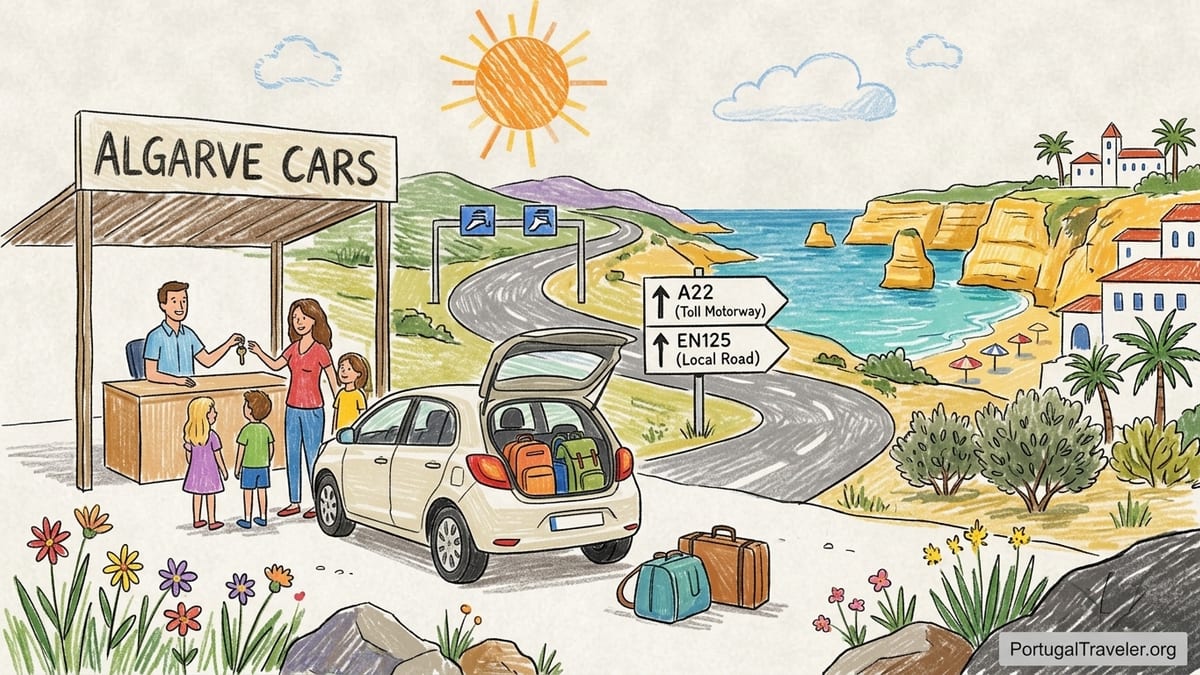
Picking Up the Car and First Impressions of Driving in Portugal
I started at Faro Airport, which is the main gateway to the Algarve and where most visitors will first meet Portuguese road rules. At the arrivals hall, the rental desks are split between international brands such as Europcar, Hertz and Sixt and local outfits that shuttle you to off-airport lots. I booked a compact automatic through one of the big brands, mainly because I knew I would hit plenty of roundabouts and hills and did not want to stall a manual in summer traffic. Automatic cars are noticeably more expensive and not as widely available as manuals, so I reserved several weeks in advance to avoid being handed whatever was left on the lot.
At the desk I was offered the usual ladder of insurance choices. The basic package carried a relatively high excess for damage or theft, often in the range of four figures in euros, and the agent pushed a full “super CDW” that reduced liability to near zero. After a quick mental calculation about unfamiliar roads, tight village streets and the stories I had heard about small knocks in parking garages, I paid for the extra coverage. It felt expensive at the counter, but being able to ignore every minor scrape and stone chip for the rest of the week turned out to be a relief, especially when squeezing into narrow spaces in Lagos and Sagres.
Luggage space mattered more than I expected. My compact hatchback had room for two medium suitcases and a couple of backpacks in the covered boot, but anything more would have been visible through the windows. Because I knew I would stop at viewpoints and beaches with all my belongings on board, I was glad everything could be hidden from sight. I chose a full-to-full fuel policy, meaning I collected the car with a full tank and had to return it the same way. This avoids the high refuelling fees some companies charge on pre-purchase fuel options and made it easy to monitor consumption as I crossed the region.
Leaving Faro Airport is a gentle introduction to driving in Portugal. Signs are clear, drivers are generally patient and the roundabouts operate in a straightforward way, with priority to vehicles already inside the circle. What surprised me most in the first thirty minutes was how quickly you are forced to make choices between the fast toll motorway, the A22, and the slower local EN125. One leads you efficiently along the spine of the Algarve; the other drags you through towns and commercial strips where a ten kilometre stretch can easily add twenty minutes or more.
Understanding the A22 and EN125: The Algarve’s Two Spines
The A22 is the main east-west artery of the Algarve, officially a toll motorway and officially not free-flowing if you hesitate about exits as I did. From Faro Airport I joined the A22 toward the east first, just to get my bearings on an empty stretch. The tarmac was smooth, the signage modern and the traffic reasonably light outside of peak August weekends. The speed limit on most of the A22 is 120 kilometres per hour, but I found that cruising at around 110 kept me in rhythm with local traffic and left a comfortable margin for unfamiliar exits.
The toll system in the Algarve relies heavily on electronic gantries rather than traditional booths. My rental car came pre-equipped with an electronic transponder. The agent explained that each time I passed a gantry the system recorded the plate and the charge would be added to my rental bill. Daily toll costs added up more than I expected once I started hopping between towns: it was still affordable, but enough that I thought carefully about which stretches were worth paying for. Without a transponder, visitors have to register their plate or pay later at shops and service points, which sounded like unnecessary extra admin for a week-long trip.
In contrast, the EN125 is the old national road that runs roughly parallel to the A22, connecting towns like Tavira, Faro, Albufeira, Portimão and Lagos. On the map it looks like a scenic coastal route. In reality, significant sections feel like a busy suburban highway lined with car dealerships, garden centres and retail parks. Speed limits bounce between 50, 70 and 90 kilometres per hour, and I lost count of the roundabouts. On one early stretch between Faro and Albufeira, what would have been about a 35 minute drive on the A22 took closer to an hour and a quarter on the EN125, once traffic lights, slow trucks and queues to enter town centres were factored in.
My first realisation was that the A22 is invaluable for longer hops, especially if you are crossing half the region in a day. The EN125 is best when you need to access specific towns or are in no rush and want to see the everyday Algarve, not just beaches and cliffs. On several days I mixed the two without planning particularly well, which led to unnecessary backtracking and a few frustrating merges where the EN125 narrows suddenly, forcing everyone into a slow crawl before fanning back out.
From the Eastern Border to Faro: Slow Coastal Detours and First Mistakes
My trip began near Vila Real de Santo António, near the Spanish border, where I had spent a couple of nights without a car. When I finally picked up the rental in Faro and doubled back east, it felt like I was retracing my steps in fast-forward. The A22 from Faro to the junction for Tavira takes roughly 25 to 30 minutes in normal traffic. From there, dropping down to the town and its island beaches involves a slower, smaller road that winds through roundabouts and residential areas. The whole Faro to Tavira town journey took me about 45 minutes of driving.
From Tavira I tried the more coastal option toward Cacela Velha and Manta Rota. On the map, these spots appear to be just a few minutes apart, and distance-wise they are: often just five to ten kilometres between them. In practice, I found myself creeping along at 30 to 50 kilometres per hour behind local traffic, slowing for pedestrian crossings and occasionally missing poorly marked turns to beach car parks. One short leg from Tavira to Cacela Velha, which looked like a fifteen minute stretch, ate more like forty minutes door to door once I had parked, walked to the viewpoint and returned to the car.
My first major miscalculation came with parking at Manta Rota in the late morning. By around 11:00 the main car park closest to the beach access was full. Marshals waved cars into overspill areas farther back, which meant a longer walk under a hot sun and added time getting in and out. I circled for at least fifteen minutes before accepting a space on a dusty side street. The beach itself was lovely, but the total time from leaving Tavira, finding parking, walking to the shore and finally swimming easily reached two hours, not the casual half-hour hop I had imagined glancing at the map.
Refuelling in the eastern Algarve turned out to be simple but not always cheap. Petrol stations sit regularly along both the EN125 and near major junctions of the A22, often attached to supermarkets or small cafés. Prices fluctuated noticeably between stations, so when I first filled up near Tavira I realised I could have saved a visible amount per litre by continuing a few kilometres toward a hypermarket station. For the rest of the trip I tried to combine fuel stops with supermarket runs in larger towns, where prices tended to be a bit lower and access easier than at tiny local forecourts on narrow streets.
Central Algarve: Where the Car Helps and Where It Just Sleeps
From Tavira I turned west and followed the A22 toward the central Algarve, exiting for Albufeira and then continuing later toward Portimão and Lagos. Faro to Albufeira on the A22 is about 35 to 40 minutes of straightforward motorway driving, and the exit roads quickly drop you into busy resort strips. Here the car was a mixed blessing. It gave me the freedom to detour inland for a long lunch in a quieter village square, but once I reached my hotel near Albufeira’s old town, the car became more of a liability than an asset.
Parking near the old town was tight and often paid by the hour. On my first evening I insisted on driving from the hotel to the historic centre, a distance of barely a couple of kilometres. By the time I had navigated one-way streets, found a multi-level car park, queued to take a ticket and then walked back up the hill to the viewpoint, I had spent at least half an hour on logistics that a ten-minute walk or a short taxi ride would have entirely avoided. For the next two nights, the car largely sat unused in the hotel’s underground garage while I explored on foot and used local taxis after dinner.
The EN125 between Albufeira, Portimão and Lagos was one of the most stop-start sections of the whole trip. Drive times between each of these hubs can be just 30 to 40 minutes if traffic flows, but the presence of frequent roundabouts, merging lanes and commercial zones means that at popular times, such as late afternoon in high season, these short hops swell significantly. On one day I left Albufeira after a late breakfast, intending to reach Lagos in time for a leisurely lunch. I stayed on the EN125 to “see more” instead of paying tolls on the A22. Between slow trucks, traffic lights and a couple of poorly timed wrong turns into service roads, I arrived in Lagos closer to 14:30, hungry and mildly exasperated.
Once in Lagos, the pattern repeated. The car was essential for reaching beaches like Praia do Camilo and Praia Dona Ana early enough to find parking, but it became dead weight in the historic centre. I spent one long evening circling the ring road above the marina while searching for a free street space that never materialised, eventually surrendering to a paid car park and walking back twenty minutes into town. The lesson was clear: in compact old towns, book accommodation that either includes parking within walking distance of restaurants, or choose a central base where you can ignore the car entirely for a day or two.
The Western Algarve and Costa Vicentina: Rewarding Slower Roads
West of Lagos, the character of driving in the Algarve changes noticeably. The A22 ends near Lagos, and the journey out toward Sagres and the Costa Vicentina natural park becomes more about national and municipal roads threading through low hills and small villages. From Lagos to Sagres, the main route via the N125-10 and N268 takes around 35 to 40 minutes of actual driving in light traffic. It feels slower because the landscape opens out, speed limits drop near every settlement and you start getting caught behind campervans and surf vans heading for the same beaches.
I based myself in Sagres for a couple of nights and used the car each day to explore the west coast beaches such as Praia do Beliche, Praia do Amado and Praia da Bordeira. These drives were where the car felt most valuable. Public transport options in this western section are limited, and the distances between villages and beaches are too great for comfortable walking in the heat. The roads are generally in good condition but narrower, with occasional unmarked edges and sharp curves near cliff tops. I drove more cautiously here, often at 60 to 70 kilometres per hour even when signs allowed higher speeds, simply because the views were distracting and occasional livestock or cyclists appeared with little warning.
On one day I made what seemed like a modest plan on paper: Sagres to Praia do Amado for a morning surf lesson, then lunch in Carrapateira, then an afternoon walk at Praia da Bordeira before returning to Sagres for sunset at Cabo de São Vicente. The map suggested a compact loop. In practice, Sagres to Amado took about 35 minutes over a mix of main and local roads. Parking near the beach was already filling by 09:30, and I only just squeezed into a sloping gravel space. After surfing, the short drive to Carrapateira involved waiting for a line of rental campervans to negotiate a series of tight bends. Lunch stretched longer than planned, finding parking again near Bordeira chewed up another twenty minutes, and the walk from the clifftop car park down toward the beach and back added more time. By the time I returned to Sagres for sunset, the full “loop” day had taken nearly ten hours out and back for what looked like a small cluster of pins on the map.
Yet here, the slower roads genuinely added to the experience. Pull-outs and lay-bys offered sweeping views over dune systems and remote coves that would be impossible to visit without a car. Occasional detours down rougher tracks were rewarded with almost empty viewpoints. If I had skipped the car and relied on organised tours, I would have seen fewer beaches and had less flexibility with timing, particularly at sunrise and sunset, when light on the cliffs was at its best.
Navigation Mistakes, Night Driving and When “Close” Eats Half a Day
Despite using offline maps on my phone and the rental car’s basic built-in navigation, I still made several wrong turns. The most common mistake involved missing exits at large roundabouts where multiple roads branched off within a short distance. On the EN125 near Portimão, for instance, I once exited one roundabout too early and ended up in an industrial estate. Doubling back cost me only ten minutes, but later, near Lagos, a similar mistake sent me down toward a marina access road that dead-ended at a security barrier. In Algarve towns, wrong turns rarely mean getting lost in wilderness; they mean weaving through extra suburban blocks and waiting at more traffic lights.
Driving after dark was another area where my optimism at the planning stage met reality. Within cities and larger towns, lighting is adequate and roads are busy, but some rural sections between villages in the west felt much more isolated. One evening I left Sagres later than planned after dinner and had to make a twilight drive back from a viewpoint with rapidly fading light and minimal street illumination. Headlights from oncoming cars occasionally felt harsh on narrow roads, and I kept my speed well below the posted limits. While it was manageable, I noted that scheduling drives so that rural stretches happened during full daylight would have made for a more relaxed experience.
The biggest “looks close but eats the day” example came when I combined a beach stop with a clifftop walk and lunch near Lagos. The distance between Lagos town, Praia do Camilo, Ponta da Piedade and back to town appears minimal on any map, just a few kilometres. I drove from central Lagos to Praia do Camilo mid-morning, hoping to grab a spot in the small clifftop car park. It was already full. I circled side streets and improvised parking nooks for nearly twenty minutes before fitting into a tight downhill space bordered by low walls and other cars parked with little margin. The walk down and up the long staircase to the beach, a swim, photos at the viewpoint and a quick drink at a café absorbed almost three hours.
From there I decided to hop to a nearby viewpoint at Ponta da Piedade before returning the car to town for lunch. Once again the main car park was unofficially full, with cars forming informal rows on dusty ground. Threading into a gap required a three-point turn between campervans. By the time I had walked the cliffs, returned and eased my way back to the main road, traffic flows into Lagos were thick. A short distance of maybe three kilometres turned into another 25 minutes of driving. In total, a plan that had looked like a neat morning circuit of “a couple of viewpoints” spilled well into mid-afternoon, reminding me that in the Algarve, parking and access time can easily match or exceed pure driving time.
What I Would Do Differently Next Time: A Smarter Algarve Route
Looking back over my end-to-end drive, the pattern of mistakes is obvious. I underestimated how much time urban driving and parking would consume, I tried to cram too many stops into single days and I chose accommodations where the car was either unnecessary or irritating to use. If I were to repeat the Algarve by car, I would design the route more simply and cut down on backtracking between the same hubs and beaches.
Next time I would still pick up the car at Faro Airport, as the process was straightforward and it avoids the cost and time of getting into the city and then back out. From there I would drive east on the A22 for just one night in or near Tavira, focusing on a single beach or island rather than hopping between several. I would aim to park once early in the morning, enjoy the day and then drive back to the hotel, not trying to string multiple beaches into a single east-coast day.
From Tavira I would take the A22 past Faro straight to the Lagos area, using the toll road for speed and skipping Albufeira and Portimão entirely on this trip. Those towns can justify their own dedicated stay, but in my case they mostly served as waypoints that fragmented my time. Around Lagos I would choose accommodation with guaranteed on-site parking within walking distance of restaurants in the old town, and I would commit to using the car only for early morning or late afternoon beach runs, such as to Praia do Camilo or Meia Praia, leaving the rest of the day car-free in town.
For the west, I would base myself for at least three nights either in Sagres or in one of the villages along the Costa Vicentina and focus the bulk of my driving there. The car is genuinely irreplaceable in this region if you want to see multiple beaches like Amado, Bordeira and Arrifana on your own schedule. I would plan no more than two main stops per day, accept that access roads are slower and intentionally avoid any long rural stretches after sunset. Then, on the final day, I would return to Faro using the A22 almost the entire way, building in only a single lunch stop along the EN125 near one town of interest instead of zigzagging on and off repeatedly.
This simplified route trades the desire to “see everything” for a calmer mix of driving and staying put. It respects the realities of Algarve roads, from toll gantries and roundabouts to overflowing beach car parks, and it recognises that a car is a powerful tool in the right places and an unnecessary burden in others. Most importantly, it would leave more time for what the car is meant to deliver you to in the first place: long swims, slow lunches and cliff-top sunsets, rather than extra laps of the same congested roundabout.
FAQ
Q1. Do I really need a car to explore the Algarve end to end?
For an east-to-west trip that includes smaller beaches and the Costa Vicentina, a car is extremely helpful, especially in the west where public transport is limited.
Q2. Is it difficult to drive on the A22 and EN125 as a visitor?
The A22 is straightforward and feels like a modern European motorway, while the EN125 is busier, slower and more demanding due to frequent roundabouts and changing speed limits.
Q3. How should I handle tolls on the A22 in a rental car?
The simplest option is to accept a car with an electronic transponder so tolls are charged automatically to your rental bill without extra administration.
Q4. Are parking problems really that bad near Algarve beaches?
In peak season and late mornings, popular beaches near towns like Lagos and Albufeira often have full main car parks, pushing drivers into overspill areas or long walks.
Q5. Where is a rental car least useful in the Algarve?
In compact old towns such as central Albufeira or Lagos, the car often sits unused while walking or short taxi rides are easier for evenings and dinners.
Q6. Which stretches are worth paying A22 tolls for?
Longer hops like Faro to Lagos or Tavira to Lagos are where the A22 saves significant time compared with the EN125, especially if you want to avoid slow town traffic.
Q7. Is it safe to drive on secondary roads on the west coast?
Secondary roads in the Costa Vicentina are generally in good condition but narrower and less lit, so careful daytime driving at moderate speeds is advisable.
Q8. How much extra time should I allow for parking at popular sights?
At busy beaches and viewpoints, it is sensible to allow at least 20 to 30 minutes to navigate, find a space and walk from the car to the actual access point.
Q9. Can I rely on phone navigation everywhere in the Algarve?
Phone navigation works well on main roads, but downloading offline maps is wise, as coverage can be patchy on some rural stretches of the west coast.
Q10. What is the biggest planning mistake first-time drivers in the Algarve make?
Many visitors underestimate how parking, roundabouts and short detours can turn a quick hop between “nearby” places into a half-day outing.