

When I finally landed in Faro for my ten-day Algarve trip, I thought I knew exactly what awaited me: golden coves that all looked a bit like the Instagram pictures of Lagos, easy coastal drives, and evenings wandering pretty old towns by the sea. I picked up a compact rental car at Faro Airport, drove west to a small guesthouse outside Lagos, and assumed I would simply hop between beaches each day. Within 48 hours, those assumptions had mostly fallen apart. The Algarve turned out to be bigger, wilder, windier and more varied than I expected, and moving across its west, central, east and inland areas forced me to completely rethink how to plan time here.
How I Structured the Trip (And What I Misjudged)
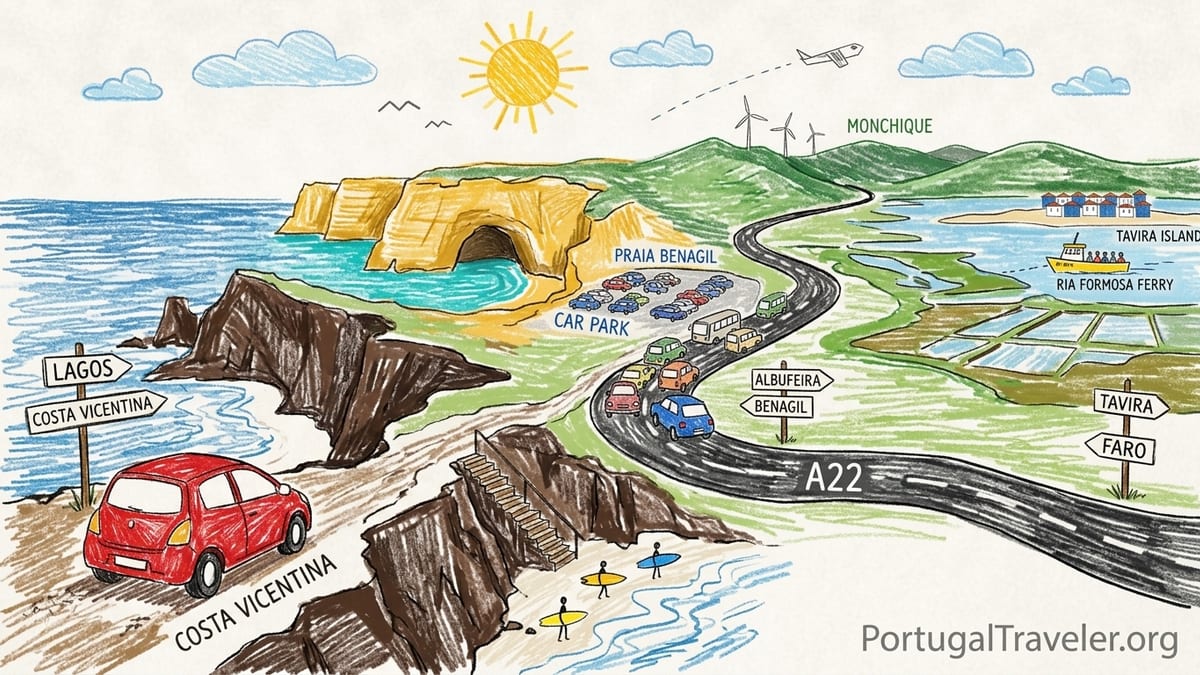
I split my stay into three main bases: four nights near Lagos to explore the western Algarve and Costa Vicentina, three nights in a central stretch between Carvoeiro and Albufeira to see the classic golden cliffs, and three nights in Tavira in the eastern Algarve for the Ria Formosa lagoons and quieter beaches. I also set aside a day to drive up into the Monchique hills from the west. On paper, it looked balanced: coast to coast, some inland time, and never more than about 90 minutes’ drive between beds. In reality, I underestimated distances, road timings and just how draining summer traffic and parking can be along this coastline.
Driving out of Faro Airport, the first surprise came quickly. The main A22 motorway that runs along the Algarve is now toll free, which makes crossing the region much simpler by car compared with older guides that still warn about electronic toll systems. Once I joined the A22 and then dropped south toward Lagos, the drive felt fast and modern, but I also realised something important about the region’s scale. From Faro to Lagos took around an hour without stops, and the scenery changed from flat, dry hinterland to cliffy coastline much more gradually than I expected. This was not a compact resort strip but an entire district with its own inland villages, working towns and long rural gaps between the famous beaches.
My biggest early mistake was assuming I could treat the Algarve like a small Greek island, using one base for everything. After the first two days, when I tried to drive from my guesthouse near Lagos all the way up to a Costa Vicentina beach and then over to a central cove in one long loop, I spent more time in the car than on the sand. Distances that looked short on the map became slow once I left the A22 and followed twisting local roads toward the coast. Even in late spring, parking around the most photographed beaches was already tight by mid-morning, which taught me that moving bases along the coast was not overkill but almost essential if you want to see more than a small slice without turning your holiday into a driving project.
I did at least make one decision that I would repeat exactly: renting a compact car instead of relying solely on public transport. There are regional trains linking Lagos, Faro and Vila Real de Santo António in the east, plus Vamus Algarve buses that connect Faro with resort towns and some beaches. Schedules, however, thin out in the evenings, and even when services run every hour or so, they often drop you in town rather than right at a beach car park or clifftop trailhead. Having a small car meant I could follow my curiosity when I saw a brown sign for a miradouro or a tiny praia, pull into a dirt lot and walk down to the water without worrying about a bus back. I quickly understood why so many visitors make the same choice.
First Impressions of the West: Costa Vicentina and Around Lagos
The west was my first base, and it completely rewired my idea of what the Algarve looks and feels like. From Lagos, I drove north and west onto the Costa Vicentina, where the protected coastline stretches up toward Alentejo. Here, the beaches sit at the bottom of steep cliffs, reached by long wooden staircases or sandy paths, and the Atlantic feels fully exposed. On one morning at an open north-facing beach, the air temperature hovered around twenty-five degrees Celsius, but the water felt closer to eighteen. I watched wetsuited surfers glide into clean, powerful waves while most swimmers stayed waist deep at best. The famous Algarve sunshine was there, yet the experience felt much more like an Atlantic road trip than a sheltered Mediterranean escape.
Parking on this western stretch was a mix of ease and frustration. For some beaches, a paved road led to a clifftop lot with decent space for cars but little shade. Others had rough dirt access tracks with potholes that made me grateful I had chosen a small car rather than a low sports model. By mid-morning in early summer, many of these lots were already close to full, and I saw more than one driver circling or improvising spaces on verges that were clearly meant to stay clear. Local authorities have tightened parking enforcement in parts of the Costa Vicentina, particularly for campervans and overnight stays, so treating every dirt patch as a free campsite is no longer tolerated. Seeing temporary barriers and signs reminded me that this is a protected natural park, not a free-for-all surf campground.
On one ambitious day, I tried to visit three beaches in the west before dinner in Lagos. I started early with a coffee in town, then drove north to a wild beach favored by surfers, climbed back up and crossed inland to another bay by noon, and finally attempted to swing back toward a smaller cove closer to Sagres in late afternoon. By the third stop, the wind had picked up, parking near the viewpoint was jammed and the combination of sun, salt and stairs made the prospect of another descent far less appealing. That day taught me that on the Atlantic side, two beaches is usually the comfortable maximum if you want to actually swim, eat and sit in the sand rather than tick names off a list.
Nights in and around Lagos also challenged my assumptions. I imagined a small, sleepy historic town, but the compact center becomes very lively after dark in peak season, with busy bars, live music and queues at the most popular restaurants. Walking from the old town walls toward the marina, I saw menus in several languages and heard English, French and German mingled with Portuguese. It was not unpleasant, but it felt far from the quiet fishing-town atmosphere often implied by older guidebook photos. My guesthouse sat a short drive away in a residential area, which spared me the late-night noise but required a careful approach to evening parking. Street spots filled quickly after 8 pm, so I learned to either arrive before the dinner rush and leave the car a bit farther out, or accept that I would pay for a secure car park near the center on the busiest nights.
The Classic Central Algarve: Golden Cliffs and Car-Based Days
Moving from the wild west to the central Algarve felt like stepping into the official tourism posters. I based myself between Carvoeiro and Albufeira, where the coastline turns into a succession of golden limestone cliffs and sheltered coves. These are the beaches that dominate social media: arches, sea caves, boat trips beneath overhangs, and water in every shade of turquoise and deep blue. Driving in from the A22, I passed large supermarkets, waterparks and villa developments, which made this section feel more clearly built around tourism. At the same time, I quickly saw that the infrastructure here comes with trade-offs, especially in peak months.
Central Algarve roads are generally straightforward: wide, signposted, and only occasionally narrow as you descend into older villages. The challenge is volume. Even in the shoulder season, roundabouts near big resorts and shopping centers slowed down with rental cars and airport transfer vans. Several popular coves sit at the end of one-way lanes that drop steeply toward clifftop parking. Arriving before 9:30 am usually meant I found a spot within a few minutes. Arriving after 11:00 am on a sunny day, I sometimes joined a slow-moving queue of cars inching toward full car parks, with attendants waving drivers around as spaces freed. After two such mornings, I started planning central beach days like appointments, leaving my accommodation immediately after breakfast.
Here I made one of my worst planning mistakes: I treated central Algarve beaches as if they were all small variations on Lagos coves, so I lined up several in the same day. In practice, each one demanded more time and effort than expected. Reaching the sand might mean descending a long staircase. Moving to a clifftop viewpoint required walking exposed trails, and boat trips to famous sea caves or coastal segments added another hour or two in the sun. After trying to squeeze in four major coves plus a short coastal walk in one day, I ended up with barely half an hour on each sand, no time to linger at a restaurant, and the uncomfortable feeling of chasing photos rather than experiences. If I repeated the trip, I would give central Algarve at least four full days and limit myself to two substantial stops per day: one beach and one short coastal walk or boat trip.
Restaurant experiences here reflected the region’s dual identity: everyday Portuguese staples alongside menus built for visitors. In a small town square behind the cliffs, I paid just under ten euros for a lunch menu that included grilled fish of the day, salad, bread and a coffee, and I ate surrounded by locals on their break. Down by a busy beach car park later the same afternoon, another restaurant offered generous seafood cataplana and cocktails at prices closer to what I would expect in a western European capital. Neither felt like a trap, but it was clear that proximity to the most photographed views carried a premium. I learned to walk two or three streets back from a viewpoint before choosing a place to eat, which usually resulted in quieter rooms, more Portuguese spoken at tables and more reasonable bills.
One pleasant surprise in the central Algarve was how well evenings worked once I accepted the crowds as part of the experience. After the daytime heat, coastal towns filled with families strolling the promenades, children playing near carousels, and buskers performing in small squares. Parking could be tense, but I found that using one of the larger paid lots or multi-storey garages near the center removed that stress. I would park once around 7 pm, wander through old streets glazed with warm light, maybe catch the sunset from a clifftop, then return late to a car that had sat under some degree of security all evening. Compared with looping side streets searching for a free space, those few euros for structured parking felt like money well spent.
East to Ria Formosa: Ferries, Flat Light and Quieter Towns
From the central Algarve, I pushed east to Tavira, a town often described as more traditional and less resort-driven than its western counterparts. The drive on the A22 felt smooth and quick, and the landscape flattened into salt pans, fruit orchards and low wetlands as I approached the Ria Formosa lagoon system. This side of the region is defined by barrier islands, tidal channels and long sandy banks rather than cliffs. Here, reaching the best beaches often involves a short train or ferry ride from the mainland, which changed the rhythm of my days entirely.
On my first full morning, I walked from Tavira’s town center toward the small train that crosses the Ria Formosa to Praia do Barril. The ride was short, just a few minutes, with open carriages trundling through the dunes. At the beach, the Atlantic felt slightly gentler than on the Costa Vicentina, though still fresh, and the sand stretched for what felt like endless kilometres. There were designated walkways across the dunes, clear signage about protected areas, and a cluster of cafes and restaurants in the old tuna-fishing buildings near the shore. I had expected a wild, unserviced stretch of coast, but even in a protected park, infrastructure was present and well-managed. The surprise here was not roughness but the blend of low-key tourism and environmental rules.
Boat access is central to the eastern Algarve experience. From Olhão and Faro, ferries and private shuttle boats fan out toward islands like Armona, Culatra and Farol in the Ria Formosa. Timetables vary by season, with more frequent services in summer and during holiday periods, and tickets for public ferries are usually only a few euros each way. Private water taxis cost more but allow you to set your own departure time and land on quieter sections of the islands. Planning beach days here meant thinking not just about tide and sun, but also last return boats. On one occasion, I misread the schedule and arrived back at the pier to see the public ferry departing, which left me two choices: wait over an hour for the next one or share a more expensive taxi boat with other stranded day trippers. We opted for the latter, and the experience taught me to double-check schedules before leaving the mainland.
Roads in the east felt less hurried than around the central resorts. Driving between Faro, Olhão and Tavira, I passed low-rise suburban neighborhoods, small industrial areas, markets and wide salt flats shimmering in the heat. Traffic thickened only around town entries and roundabouts near retail parks. Parking by the waterfront areas was competitive in midsummer, especially in Olhão and Tavira on market days, but I could often find a space a little inland and walk ten minutes to the pier or riverfront. The main challenge here was heat rather than congestion. July and August afternoons in the eastern Algarve can feel extremely hot and still, with less Atlantic breeze than on the western headlands, so walking from car to quay or across the islands without shade demanded water, hats and more patience than I showed at first.
What impressed me most about the eastern Algarve was how different it felt from the Lagos and central cliffscape. Tavira’s historic center, with its white churches, Roman bridge and tiled houses, felt like a lived-in town first and a resort second. Evenings unfolded more slowly, with locals chatting in small squares and families enjoying gelato by the river. Restaurant prices were not dramatically lower than in the west, but menus leaned more toward regional dishes and fresh seafood with fewer burger-and-pizza boards outside. If I had to pick one area that deserved a longer stay than I gave it, it would be this stretch from Faro to Vila Real de Santo António. Three nights felt like an introduction rather than a full visit.
Into the Hills: Monchique and Inland Detours
One of my goals for the trip was to see at least a taste of the inland Algarve, so I devoted a day to driving up into the Monchique hills from my base near Lagos. The change in temperature and atmosphere happened quickly. Leaving the coastal plain, the road climbed in switchbacks through eucalyptus groves and small settlements where chickens wandered across side streets. The air cooled a few degrees and carried the scent of pine and damp earth rather than salt and sunscreen. It was not remote wilderness, but it felt far from the beach clubs and marinas below.
Reaching viewpoints above Monchique rewarded the drive. From a popular miradouro, I could see much of the southern Algarve spread out below, the sea a faint line at the horizon. The road itself was in good condition, with occasional narrow segments where I had to squeeze past oncoming traffic. Parking at lookouts and in Monchique town was straightforward compared with coastal hot spots. I found spaces along main streets and small lots with minimal competition, which made this one of the most relaxing driving days of the trip. If anything, I wished I had booked one inland night in a rural guesthouse to break the pattern of always sleeping by the coast.
What surprised me about inland Algarve life was how self-contained it felt. In small towns and villages, cafes were full of locals, menus rarely displayed outside in multiple languages, and opening hours followed local rhythms rather than beach tourist demand. Lunch might finish a little earlier, and some shops closed for part of the afternoon. I stopped at a simple restaurant where the daily special, a hearty pork and bean stew with bread and coffee, cost less than half of what I had paid for a seafood lunch by the central cliffs two days earlier. This was not a region frozen in time, but it still moved at a different speed from the coast.
In planning terms, the lesson from Monchique was that adding even a short inland detour gives needed contrast to an Algarve itinerary that might otherwise blur into consecutive beach days. It also showed me that renting a car opens up this variety in a way that public transport struggles to match. Buses reach some inland towns, but frequencies are limited outside school commuter periods, and planning a round trip by timetable can take more effort than many visitors want to invest. By contrast, my one inland day required only a full tank, a downloaded map and the willingness to drive slowly and pull over at viewpoints without a strict schedule.
Roads, Parking, Public Transport and Seasonal Realities
After ten days of driving across the Algarve, I came away with a much clearer picture of how the region actually feels on the road. The A22 motorway is the backbone, running toll free from near Lagos in the west across to the Spanish border, and it makes long east-west journeys relatively quick. However, almost every worthwhile coastal area requires leaving the motorway for smaller EN roads and local lanes, where speeds drop, tractors appear, and summer rental-car convoys build up behind cautious drivers. Distances that seem short on a map, such as from a central resort to a remote cove or from Lagos to a Costa Vicentina viewpoint, will often take longer than navigation apps suggest once high-season traffic and parking hunts are factored in.
Parking was my single biggest source of daily stress and the area where I made the most mistakes. At major cliffside sights and central resort beaches, free spaces near the entrance fill first, then roadside shoulders begin to attract haphazard rows of vehicles. In some protected areas on the Costa Vicentina, authorities have reacted by fencing off sensitive dunes and placing clear no-parking signs, and enforcement has increased for overnight stays. I saw a few cars and campervans being asked to move or being ticketed near lanes that had previously been informal camping spots. In more urban areas like Lagos, Portimão or Albufeira, municipal lots and underground car parks absorbed much of the pressure, but only if you accepted the small daily cost. By the middle of the trip, my rule of thumb became simple: for popular daytime beaches, arrive as early as possible; for packed evenings in town centers, pay for structured parking and enjoy the night without circling.
For travelers not renting a car, current public transport does make an Algarve trip possible, but it shapes where and how you move. The regional train line connects Lagos, Portimão, Faro, Tavira and Vila Real de Santo António, with services running more frequently in daytime hours and taking around one and a half to two hours from end to end. From Faro Airport, local buses connect the terminal with the city bus and train stations, where Vamus Algarve buses fan out toward Lagos, Albufeira and other towns, and express routes link the main hubs. However, departures taper off in the evening, and there is no late-night cross-region train or bus after midnight. Several travelers I spoke with had arrived on late flights and found themselves choosing between an expensive taxi all the way to Lagos or an overnight near Faro.
Seasonal services also shaped my experience, particularly in the east. Ferry and boat shuttle frequencies between Faro or Olhão and the Ria Formosa islands rise substantially in late spring and summer, allowing mid-morning and afternoon departures and late-afternoon returns. In shoulder seasons, there can be longer gaps, and public ferries may run only a few times per day. Coastal boat tours from Vilamoura, Albufeira, Portimão and Lagos cluster their departures in daylight hours, with extra sailings at the height of summer. Before my trip I skimmed older blogs that listed specific departure times and prices, but once on the ground I discovered timetables and fares had been updated. The most reliable way to plan turned out to be checking schedules locally the day before or asking my accommodation hosts for current information.
What Surprised, What Disappointed, and How I Would Restructure the Trip
Looking back, several aspects of the Algarve surprised me in the best way. The variety of landscapes within short drives impressed me most: raw Atlantic power on the Costa Vicentina, theatrical limestone cliffs and arches in the central Algarve, wide dune-backed sands and lagoons in the east, and cool green hill views around Monchique. I expected beautiful beaches, but not such a clear sense of moving through distinct subregions, each with its own light, wind and pace. I was also struck by how quickly I could step away from heavily touristed strips into quiet residential streets or inland villages, simply by driving a few kilometres or walking two blocks off the main front.
Disappointments were more about my planning than the region itself. I regretted underestimating the time I needed in the east and inland. Tavira and the Ria Formosa islands would easily justify five days for a mix of island beaches, wetland walks and town exploration, yet I gave them only three nights. My romantic idea of hopping between multiple beaches per day also did not survive contact with reality. By trying to “collect” coves and viewpoints, especially in the central Algarve, I created rushed days that blurred together and left me more tired than sun-satisfied. The Atlantic water temperature, especially in the west, also required a mental adjustment. I had imagined bath-warm seas; instead, I adapted to short, refreshing dips rather than long, lazy swims.
If I could restructure the same ten days, I would keep the idea of staying in multiple bases but shift the balance and pace. I would start with three nights in the central Algarve to get the classic cliff and cove experience, focusing on one big beach and one clifftop walk per day. From there, I would move west for three or four nights, but I would limit myself to two beaches on the Costa Vicentina, one day around Sagres and Cabo de São Vicente, and one flexible day to wander Lagos itself without driving. Finally, I would devote at least three nights, preferably four, to the eastern Algarve based in Tavira or Olhão, adding full days on the islands, one low-key day in Faro’s old town and lagoonfront, and perhaps a border detour to Vila Real de Santo António. Somewhere in the middle, I would insert at least one overnight in Monchique or another inland guesthouse instead of a rushed day trip.
With that structure, the driving would still be significant, but each relocation would serve a clear purpose, and I would waste fewer hours shuttling back and forth over the same sections of road. More importantly, I would accept the Algarve for what it is in 2026: not a single beach town, but a wide and varied coastal district that asks you to choose where you want to slow down rather than trying to “do it all.” The official tourism materials talk about the region as a blend of wild Costa Vicentina beaches, golden-cliff coves, Ria Formosa islands, historic towns and Monchique’s hills, and after crossing all of those, I would agree. The trick is not to squeeze each of them into a day, but to decide which combination matches the trip you actually want.
The Takeaway
By the time I returned my rental car to Faro Airport and watched the departure boards flicker with flights to northern Europe, I no longer thought of the Algarve as a single, easily summed-up destination. It felt more like a collection of overlapping trips. One traveler might spend an entire week surfing and hiking along the Costa Vicentina without ever seeing the famous caves of the central coast. Another might base themselves entirely in Tavira, moving between island beaches and quiet evenings by the river. Someone else might never leave the golden amphitheatres between Carvoeiro and Albufeira and still feel fully satisfied.
What I learned, above all, is that good Algarve planning starts with honesty about your priorities and energy. If you love long drives, cool Atlantic dips and big landscapes, weight your time toward the west and inland hills. If you crave restaurant choice, dramatic cliffs and short strolls from hotel to beach, center yourself between Lagos and Albufeira and venture out in small doses. If you want a calmer rhythm, boats and softer light, stay longer in the east and treat islands, not roads, as your connectors. In every case, be realistic about how many places you can appreciate in a day, plan for earlier starts to beat parking pressure, and allow at least one day in each base simply to wander on foot without chasing any particular sight.
The Algarve is no longer the lightly developed coastline of decades-old brochures, yet it still offers pockets of quiet and wildness if you look beyond the headlines and plan for its real distances, winds and water. Driving from one end to the other, across beaches, hills and lagoons, taught me that the most rewarding Algarve trips are not those that cover the most names, but those that choose a few corners and linger in them long enough for the sea, the light and the daily rhythms to sink in.
FAQ
Q1. Do I really need to rent a car to explore more than one part of the Algarve?
It is possible to cross the Algarve by regional train and Vamus Algarve buses, but services thin out in the evenings and rarely drop you right at remote beaches or viewpoints. If you want to combine the Costa Vicentina, central cliffs, Ria Formosa islands and an inland day in one trip, a small rental car makes logistics far easier and opens up quiet stretches that are hard to reach on public transport alone.
Q2. How long does it actually take to drive across the Algarve from west to east?
Driving on the A22 motorway from the Lagos area to the eastern border near Vila Real de Santo António usually takes around one hour and thirty minutes without major traffic. However, you should add extra time whenever you leave the motorway for coastal roads, town centers or beach access lanes, where roundabouts, slower local traffic and parking searches can easily turn a short hop into an hour-long journey.
Q3. Is summer parking really that difficult at the main Algarve beaches?
At the most popular coves and viewpoints, especially in July and August, free spaces near the cliffs often fill by mid-morning, and informal roadside parking is increasingly restricted or ticketed in protected areas. Municipal lots and underground car parks in larger towns help in the evenings, but for daytime coastal visits in high season, arriving early and accepting occasional paid parking are both important for a smoother experience.
Q4. How cold is the Atlantic water in the Algarve, especially on the Costa Vicentina?
The Atlantic along the Algarve, particularly on the exposed west coast, usually feels fresh rather than warm in summer, with temperatures often in the upper teens to low twenties Celsius. Many surfers wear wetsuits, and casual swimmers often prefer short dips rather than long sessions in the water, especially when strong winds and larger waves accompany cooler currents on the Costa Vicentina.
Q5. What is the biggest itinerary mistake first-time visitors make?
One of the most common mistakes is trying to “do” the entire Algarve from a single base in just a few days, driving long distances daily to tick off famous beaches. This often leads to more time in the car than on the sand and rushed stops at each spot. A better approach is to choose two or three bases along the coast, accept slower days, and limit yourself to one or two substantial visits per day so each place has time to breathe.
Q6. How different are the central Algarve beaches from those in the east and west?
Central Algarve beaches between roughly Lagos and Albufeira are dominated by golden limestone cliffs, arches and pocket coves reached by staircases and short trails. In the west, especially on the Costa Vicentina, the coast feels wilder and more open, with big Atlantic swells and tall, rugged headlands. In the east, around Tavira and the Ria Formosa, long sandy island beaches and lagoons replace cliffs, and access often involves short train or ferry rides from the mainland.
Q7. Are there current restrictions on campervans and wild parking along the Costa Vicentina?
Recent seasons have seen tighter rules on overnight parking and informal camping along the Costa Vicentina, particularly near dunes and protected viewpoints. Some former ad hoc parking areas are now fenced, signed or monitored, and fines for ignoring restrictions have become more common. Official campsites and designated motorhome areas remain the safest options if you plan to sleep in a vehicle while exploring this stretch of coast.
Q8. How many days should I spend in the eastern Algarve and Ria Formosa?
If you want to visit at least two different islands in the Ria Formosa, explore a historic town like Tavira, and have one slower day in Faro or by the salt pans, plan for a minimum of three nights and ideally four or five. This allows time for ferries or boat shuttles, tidal variations, and simply enjoying quieter evenings by the riverfront without cramming your schedule.
Q9. Is it worth adding an inland overnight in Monchique or other hill towns?
Spending at least one night inland adds welcome contrast to a coastline-focused itinerary. Around Monchique, temperatures are usually a little cooler, the views stretch across the entire southern Algarve, and village life follows local rhythms rather than beach traffic. An overnight stay also avoids rushing the winding drive back to the coast and lets you experience hill towns at sunset and early morning, when they are at their most peaceful.
Q10. How would you split a 10-day Algarve trip based on this experience?
After driving the region, I would now suggest three nights in the central Algarve for classic cliffs and coves, three or four nights in the west for Costa Vicentina landscapes and time in and around Lagos, and at least three nights in the east based in Tavira or Olhão for Ria Formosa islands and quieter towns. If possible, I would convert one coastal night into an inland stay around Monchique to round out the experience.