


I have crossed Portugal by car from the Minho green hills near Braga down to the cliffs of the western Algarve, looped between Lisbon and Porto on the A1, and threaded through interior roads in the Alentejo and the Beiras. What follows is not a theoretical guide but exactly what it felt like to pick up rental cars, navigate the mixed toll system, choose between motorways and backroads, find fuel and parking, and live with a car in big cities where you might not always want one.
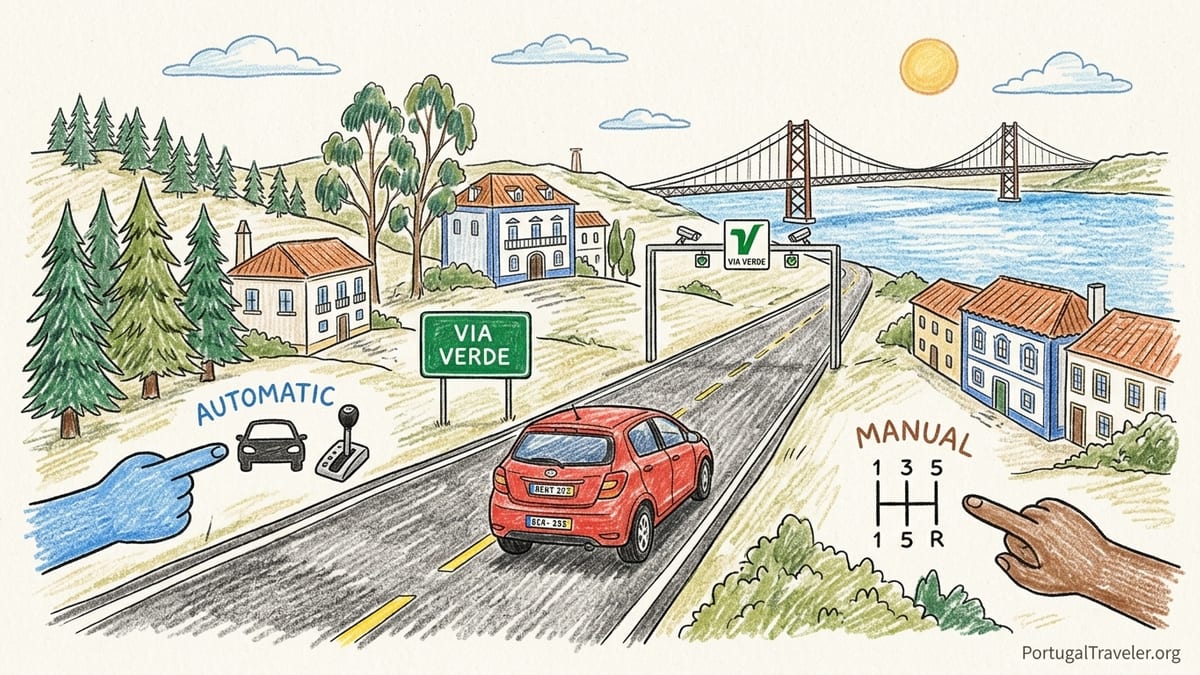
Picking up the rental car and choosing automatic vs manual
On my first long Portugal road trip I collected a compact manual from Lisbon Airport, landing in late morning and following the stream of travelers toward the car hire desks in the arrivals hall. The main international brands were all there alongside Portuguese outfits, and almost every counter queue split neatly between people who had booked the cheaper manuals and those hoping an automatic would materialize. At the time, manuals were still the default in Portugal and automatic fleets were smaller, so I watched more than one traveler told that an automatic request was “on request only” and subject to availability at pick up.
In later years, as automatics became more common, I started reserving them on trips with long driving days or lots of city traffic. Even then, booking well in advance mattered. In Faro one August, I arrived to find my automatic economy car had been “upgraded” to a mid-size SUV because the smaller automatics were gone. In Porto, a friend who had not reserved early was offered a manual or a significantly more expensive automatic from a premium category. The lesson was clear: if you cannot drive a manual, treat an automatic reservation in Portugal as something to secure months ahead, especially in summer or around Easter and public holidays.
From a driving perspective, Portugal is forgiving enough that confident drivers can happily choose manuals, particularly for coastal and interior routes where traffic eases. The clutch work becomes more tiring around Lisbon and Porto, where ring roads tangle and rush-hour queues build on feeder roads to bridges and tunnels. On my north south runs, the balance that worked best was an automatic for itineraries with multiple city stops and tight timing, and a manual when I was mostly freewheeling between rural guesthouses, surf towns and villages where parking spots are smaller and fuel consumption matters more.
At pickup, rental agents almost always raised the topic of tolls and tried to add the Via Verde electronic device or a toll package. Since 2023, fleets operating on Portuguese plates typically come pre-equipped with transponders that can be activated for a daily fee plus tolls, which the agency settles and then charges back after the trip. The upsell can feel pushy at the desk, but on trips where I knew I would take tolled motorways regularly, activating that device at pickup proved worth the trouble.
Understanding Portugal’s mixed toll system from behind the wheel
Driving out of Lisbon on the A1 toward Porto, my first encounter with Portugal’s toll complexity felt straightforward. Traditional toll plazas appeared at intervals, with pink or blue signed lanes for cash and bank cards and green-labeled “Via Verde” lanes that locals shot through at motorway speed. At a booth I could pay using coins or a standard debit or credit card, then merge back into traffic. It felt familiar to anyone used to continental European toll roads.
The confusion began when I diverted onto ex-SCUT corridors, converted some years back from shadow-toll to user-pays. These stretches, which include parts of the A22 in the Algarve, the A23 crossing the interior or portions of the A24 and A25, have no physical toll booths. Instead, gantries with cameras and sensors read the vehicle license plate or transponder as you drive underneath. For a car with a Via Verde tag correctly linked to a valid payment method, nothing extra needs to be done and charges appear later. Without that, drivers in foreign-plated vehicles are expected to use systems such as Via Verde Visitors, Easytoll, Tollcard or related visitor products, which tie a license plate to a bank card or to prepaid credit and are recognized by the electronic gantries.
On a trip in a Spanish-registered car entering the Algarve, I stopped at an Easytoll welcome point near the border on the A22, pulled into the signed lane, inserted my bank card and waited while a camera captured the plate. A receipt stated that for the next 30 days, tolls on electronic-only roads would be charged automatically to that card. It made the onward drive toward Lagos almost frictionless. In contrast, before these visitor systems existed, I drove a French-plated car under the same gantries and had to later queue in a post office in Lagos to pay the outstanding tolls, which only became available in the system after a couple of days. Missing that window risked administrative penalties, and several locals warned me about fines appearing weeks or months later at a foreign address.
With rental cars on Portuguese plates, the easiest approach on repeated crossings of electronic sections has been renting a Via Verde device or activating the one already fitted to the car. On a Braga to Algarve run that used the A3, A1 and A2 motorways, I watched green-lane queues glide forward at every plaza while cash lines jammed with trucks and visitors unsure which lane to choose. My toll invoice later showed around 60 euros in tolls for that full-crossing weekend including coastal detours, which felt acceptable for the time saved. By comparison, when I stubbornly refused the transponder one year and tried to stay on cash lanes only, I still ended up passing electronic-only stretches around Porto and needing to go online or find a CTT post office to settle amounts I could not see in real time.
Motorways vs secondary roads on a north south crossing
Covering Portugal from north to south is deceptive on the map. The direct Lisbon Porto corridor along the A1 is only around three hours of driving in good traffic, and from Lisbon to Faro on the A2 and A22 is another two and a half hours or so. On one ambitious day I drove from the Minho region near Viana do Castelo to Lagos in the western Algarve in roughly seven and a half hours behind the wheel, including service-area fuel stops on the A3 near Braga, coffee on the A1 close to Leiria and a brief stretch of congestion on the A2 north of the Alentejo plains. That distance feels entirely manageable in one day if you split the time between drivers, keep snacks in the car and accept the flow of tolls on the account.
The tradeoff is what you miss by sticking to motorways. When I cut inland from Coimbra onto the EN17 and later the EN231 toward Serra da Estrela, the road narrowed and twisted along river valleys lined with eucalyptus and pine. Speeds dropped to village pace as I passed tractors and local traffic. In return I gained small-town bakeries in places like Seia and epic viewpoints near Lagoa Comprida, none of which I would have reached at 120 km/h on the motorway ribbon toward Lisbon. Similarly, taking the N2 between Vila Real and Lamego instead of the A24 turned a routine transfer into a sequence of hairpins above the Douro, where I pulled into lay-bys to watch terraces fold down to the river.
North south, the biggest time sink on national roads tends to be the string of roundabouts and retail strips that hug the outskirts of towns. Coming south from Porto along the coastal N109 toward Figueira da Foz, the posted speed limit swung between 50 and 90 km/h with each roundabout. Onward to Nazaré and Peniche, I learned to treat the national road network as a scenic layer that worked best for shorter hops between coastal villages or inland wine towns, and to concede that for long north south pushes, the tolled A1 and A2 were incomparable. My favorite pattern eventually became a fast motorway run between major regions, then a slow loop on secondaries for local exploring.
The sensation of the drive itself changes with region. North of Coimbra, motorways often carry heavier truck traffic, especially on workdays, and the weather is cooler and wetter in winter, which made me cautious passing in spray. South of the Tagus, the A2 straightens across flat Alentejo landscapes where service areas are farther apart and summer heat can be intense. On those stretches I paid more attention to fuel levels and water bottles than to speed-camera warnings, especially on late afternoon runs when the sun sat low and glare bounced off the windshield.
Fuel, service areas and the rhythm of long driving days
On a typical north south crossing I would stop for fuel every two to three hundred kilometers, which aligned with Portugal’s motorway service areas. These areas varied from compact fuel-only stations to larger complexes with cafeterias, bakeries and small supermarkets. Prices on the motorways skewed higher than in towns, which encouraged me to fill up in places like Torres Novas or Setúbal when I happened to leave the A1 or A2 near larger retail zones. Over several trips the difference between refueling mostly on motorways and mostly in town stations amounted to a noticeable sum, enough to fund an extra restaurant meal or two.
Fuel types were straightforward to navigate. Diesel pumps carried clear labeling and were common, since many rental cars, especially larger classes, were diesel-powered. Unleaded 95 and 98 octane were available almost everywhere, and paying with international bank cards was rarely a problem on the main corridors. Self-service was the norm, with occasional attended pumps in more rural cooperatives. The main adjustment as a visitor was simply remembering that full-service in Portugal is not as common as in some neighboring countries, and that you might need to enter the shop with the pump number rather than pay at-pump.
On motorways, scheduled breaks aligned naturally with service areas around cities. Heading south from Porto, I often stopped near Mealhada or Coimbra for a coffee and pastel de nata, joining long-distance truckers and families stretching their legs. The facilities were clean but functional, oriented more to transit than leisure. If I wanted a more atmospheric pause, I would exit the motorway entirely and look for a town square café, then rejoin the motorway later. That slightly increased the day’s driving time but made the journey feel less anonymous.
Long days behind the wheel also revealed how much the country’s compact size could trick me into over-planning. It is perfectly possible to drive from Lisbon to the Algarve, check into a hotel and still have late afternoon on the beach. It is also technically possible to wake up in Porto, lunch in Lisbon and dine in Tavira on the same day. In practice, the cumulative fatigue of toll plazas, overtakes, city traffic at each end and the navigation demands of unfamiliar roads meant that my most satisfying days limited driving to four or five hours and left the rest for walking those cities once the car was parked.
Parking, old town access and ZTL style restrictions
Portugal does not use the Italian term ZTL on street signs, but some city centers have comparable restricted areas and low emission schemes. In Lisbon, for example, central axes such as the Baixa and parts of Avenida da Liberdade operate reduced emission zones, with restrictions on older, more polluting vehicles and camera-enforced entry points. As a visitor in a modern rental car, I rarely ran afoul of emission standards, but I did encounter automatic bollards and license-plate recognition controlling access to historic quarters, especially around the castle hill and in parts of Alfama.
On one early visit I tried to drive my rental hatchback into Alfama to get closer to a guesthouse. The satnav cheerfully sent me up a narrow cobbled lane only to meet a retractable bollard at the top, with a sign indicating access for residents and authorized vehicles only. Without a hotel-issued code or card, I had no legal way through and had to reverse carefully between parked scooters while impatient taxis lined up behind. I learned quickly that in Lisbon it is often best to park in a public underground lot near Restauradores, Martim Moniz or Santa Apolónia, then walk or take a tram into the medieval streets.
Porto presented similar challenges in the steep streets between Ribeira and the cathedral. There, some small alleys are technically drivable but make little practical sense to attempt in a modern compact, especially when tourist foot traffic is heavy. I started leaving the car in multi story car parks near Trindade or Aliados, or in park-and-ride facilities tied to the metro, then approached the riverfront and the wine lodges of Vila Nova de Gaia on foot or by tram. On days when I stayed entirely within the old town, the car remained locked and unused in the garage, accruing nightly parking fees but sparing me the stress of tight turns and blind junctions.
Smaller towns were more forgiving, but even there, respect for local rules mattered. In Évora, protected by medieval walls, I encountered signed resident-only sectors and time-limited street parking managed by local enforcement. Rather than risk a ticket, I used a large paid surface lot outside the walls and walked in through the stone gates. In Óbidos, another walled town, external lots near the base of the hill kept the interior lanes largely free of non-resident cars. The pattern repeated across historic Portugal: park outside, then enjoy the old stones on foot.
Where the car transformed the trip, and where it sat unused
The clearest payoff for having a car in Portugal came in regions where public transport thins out. Driving the Alentejo plains between Évora, Monsaraz and Vila Viçosa, I stitched together hilltop castles, marble towns and lakeside viewpoints that would have taken days by bus. On one November trip, I began the morning at a farm stay near Arraiolos, detoured to cromlech sites near Almendres, lunched in Évora and still reached Monsaraz in time for sunset over the Alqueva reservoir. Without a car, that sequence would have required tight bus schedules and taxis, if it was possible at all.
Along the west coast between Peniche, Nazaré and Figueira da Foz, the car allowed me to chase changing swells and winds. When a surf forecast looked better near Baleal than in Nazaré’s north beach, I could pivot in an hour rather than commit to one village. South of Lisbon, the same freedom played out in the Arrábida Natural Park, where I drove sinuous roads between Sesimbra, Portinho da Arrábida and Azeitão, stopping at viewpoints whenever the sea cliffs opened.
In contrast, there were stretches where the rental car became an expensive suitcase locker. During a three night stay in central Lisbon, the car remained in an underground garage each day while I moved through the city by metro, tram and on foot. The neighborhoods I wanted to explore Bairro Alto, Príncipe Real, Mouraria, Belém along the river were all better served by public transport and walking. The same was true for central days in Porto, where the irregular lanes and frequent one way systems made me leave the key in my pocket and favor the tram across the Dom Luís I bridge, the funicular down to Ribeira and my own two feet up and down the hills.
I noticed the same pattern in the Algarve when I based myself for several days in Lagos and then again in Tavira. For day trips to Sagres, the Monchique hills or Cacela Velha, the car was invaluable and cut journey times sharply compared with buses. But for lazy beach days in Meia Praia or evenings in the old town, the car simply occupied a hotel spot while I walked to restaurants and waterfront bars. The trick over multiple trips was to cluster car intensive segments together and then return the car before immersing fully into urban stays, instead of paying parking and daily rental for a vehicle mostly sitting still.
How long the drives really felt in practice
On paper, the drive times between major Portuguese cities look short. Lisbon to Porto in about three hours on the A1, Porto to Braga in under an hour, Lisbon to Faro in a bit over two hours on the A2 and A22. In real conditions, particularly in busy seasons, each of those legs felt roughly half an hour longer once I accounted for leaving city centers, picking up or dropping off rentals, encountering roadworks or slowing for heavy rain.
For example, on a July trip from Porto to Lisbon, I left a garage near Trindade at 9 a.m., joined the VCI ring road in moderate congestion, then finally reached the A1 heading south. A coffee and restroom stop near Aveiro added twenty minutes. Another short fuel stop near Leiria added ten more. I parked in central Lisbon around 1 p.m., almost four hours after turning the key, without any major incident along the way. That rhythm repeated often enough that I now mentally budget four hours for a comfortable Porto Lisbon transfer with breaks rather than the theoretical three.
The north south crossing from Porto to Lagos in one go, largely on motorways, took me close to seven hours of driving plus nearly an hour in total of service station stops and toll transitions. It was achievable in a single day and still left time for a sunset walk along the cliffs, but I arrived with shoulders tight and attention frayed from lane changes, speed checks and gusts over the Alentejo ridges. On later itineraries, I learned to break that journey overnight around Lisbon or the Alentejo to arrive fresher.
Shorter regional hops felt much more relaxed. Lisbon to Évora, around ninety minutes on the A6, left ample time for lunch in the praça and an afternoon of museums. Porto to the Douro wine villages around Pinhão, even taking slower N roads after Vila Real, slotted comfortably into a half day and still allowed winery visits. The impression that remained strongest after multiple trips was that Portugal’s scale invites combination days if needed, but the most rewarding experiences came when I refused to stack more than three or four hours of driving in a single day.
The Takeaway
Driving across Portugal stitched the country together for me in a way trains and buses never quite managed. A rental car turned scattered surf breaks, hill towns and countryside inns into a coherent itinerary, especially in regions where public transport is thin. Yet the same car became dead weight in dense historic centers, where underground garages, reduced emission rules and narrow medieval streets made leaving it parked the only sane option.
If there is a single practical lesson from these road trips, it is to understand Portugal’s toll ecosystem before you turn the key. A Via Verde enabled rental or a correctly set up visitor product such as Via Verde Visitors or Easytoll can turn ex-SCUT corridors and long motorway stretches into a smooth part of the journey instead of a lingering worry about unpaid gantries. Pair this with realistic expectations about driving times, fuel stops and parking constraints, and Portugal’s roads become an enjoyable part of the trip rather than a logistical hurdle.
Plan to use the motorways when you need to cross distance, then slow down on national and regional roads to savor landscapes, villages and coastlines. Base yourself in cities without a car whenever you can, and book automatics early if you need them. Do that, and driving from the eucalyptus valleys of the north to the warm cliffs of the Algarve starts to feel less like threading a maze of toll classes and restrictions, and more like what it truly is at its best: a continuous, ever changing view out of the windscreen that connects almost every corner of the country.
FAQ
Q1. Do I really need a car for a Portugal road trip, or can I rely on trains and buses?
For major city links like Lisbon to Porto or Faro, trains and buses work well, but a car becomes valuable for reaching rural Alentejo, the Douro backroads, small surf towns and hilltop villages that have infrequent public transport.
Q2. Is it essential to book an automatic rental car in advance in Portugal?
Yes if you cannot drive a manual, you should reserve an automatic well ahead of your trip, especially for summer and holiday periods, because fleets still have more manuals and last minute automatic options can be limited or costly.
Q3. How complicated is Portugal’s toll system for foreign visitors driving rental cars?
Portugal has a mix of traditional toll booths and electronic only sections, but if you activate the Via Verde device offered by your rental company or use a visitor product like Via Verde Visitors or Easytoll with a foreign plated car, the tolls are handled automatically and you avoid chasing payments later.
Q4. How long does it actually take to drive between Lisbon and Porto?
The signposted motorway time is around three hours, but by the time you leave city centers, navigate ring roads and take one or two short breaks, most drivers will find it closer to three and a half to four hours in real conditions.
Q5. Are Portugal’s secondary roads safe and worth using instead of motorways?
Secondary roads are generally safe if you drive attentively and respect speed limits, and they are very rewarding around areas like the Douro, Serra da Estrela and the west coast, though they are slower and pass through villages, roundabouts and occasional tight bends.
Q6. What should I know about parking in historic centers like Lisbon, Porto and Évora?
In historic centers you often find resident only zones, narrow streets and access controls, so it is usually better to park in official garages or lots at the edge of the old town and continue on foot or by public transport rather than trying to drive to your door.
Q7. Is fuel expensive and are motorway service areas good places to stop?
Fuel at motorway service areas tends to cost more than in town stations, but service areas are convenient for restrooms, coffee and short breaks, so many drivers mix both, planning at least some refueling stops in larger towns to keep overall costs down.
Q8. Are there low emission or restricted traffic zones like Italian ZTLs in Portuguese cities?
Yes, particularly in Lisbon and some historic quarters, where reduced emission or access controlled zones use cameras, bollards or license plate recognition, so it is important to observe signs and follow hotel or local guidance about where you may legally drive.
Q9. When does a rental car feel unnecessary on a Portugal itinerary?
A car often sits unused in central Lisbon and Porto, and sometimes in resort towns when you stay put, so if your plan includes several days focused on one city, it can be smarter to return the car and rely on public transport and walking there.
Q10. What is a realistic maximum daily driving time on a Portugal road trip?
Although you can cover long distances in a day, most travelers find that planning no more than three to five hours of actual driving, plus breaks, keeps the trip enjoyable and leaves enough time to explore each destination on foot.