


On my first trip across Portugal I tried to see almost everything in one go, traveling from the green north to the dry south in just over two weeks. I changed bases too often, underestimated distances on regional roads, and booked some hotels in the wrong neighborhoods, but I also found quiet hill towns, empty Atlantic beaches, and train rides that cost less than lunch. This guide is the trip report I wish I had read before I planned my route.
How I Structured My First Route Across Portugal
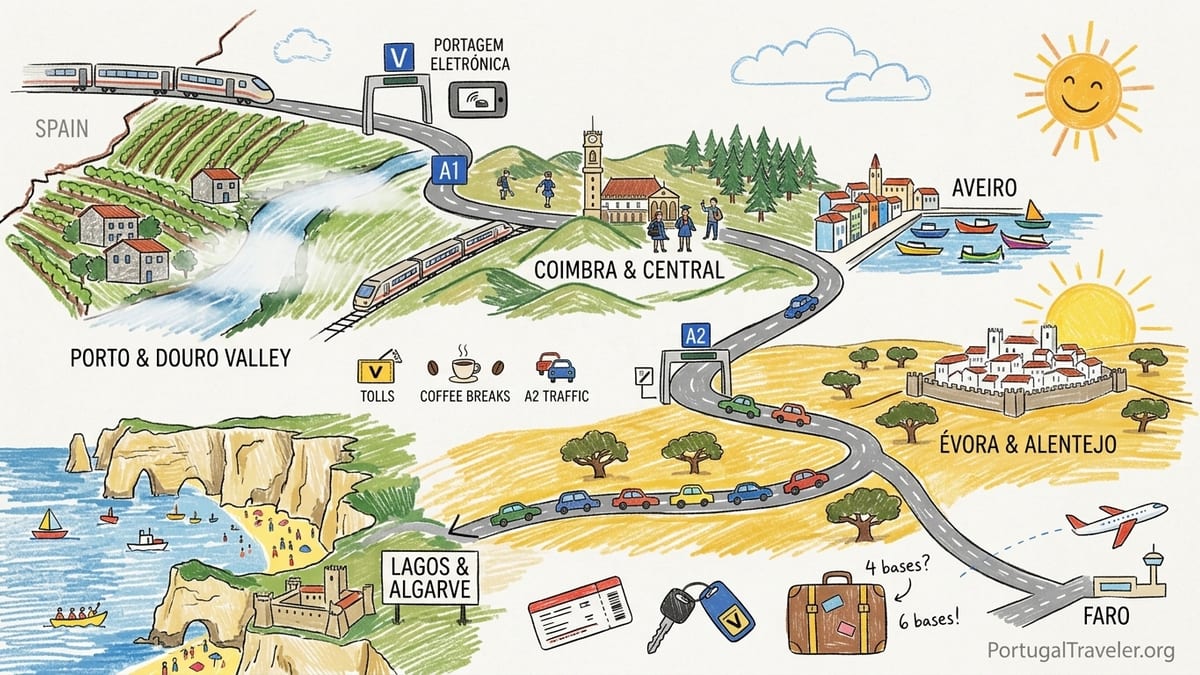
I entered Portugal from Spain by train, crossing into the north and starting in Porto before moving gradually south. From there I followed a rough line: Porto and the Douro, then inland to central Portugal, back out to Lisbon, across into rural Alentejo, and finally down to the Algarve before flying out of Faro. In total I used six bases: Porto, a small town in the Douro Valley, Coimbra in central Portugal, Lisbon, Évora in Alentejo, and Lagos in the Algarve. In hindsight that was one base too many for a two-week trip and it left some places feeling rushed.
The longest travel day was the jump from Porto to Évora, which I did by rental car with stops in Aveiro and Coimbra. That looked manageable on a map but absorbed most of a full day once I accounted for toll roads, coffee breaks, and getting slightly lost on an unsigned roundabout outside Évora. The most relaxing segment was the train ride between Porto and Lisbon, where I could watch the countryside slide past without thinking about toll transponders or speed limits.
If I were planning this as a main trip for a first-time visitor, I would choose four bases instead of six: Porto or nearby Vila Nova de Gaia in the north, Coimbra or another central town, Lisbon, and then one coastal town in either Alentejo or the Algarve. My actual route taught me that unpacking your suitcase fewer times matters almost as much as which towns you pick. It also made clear that crossing the whole country on one trip is absolutely possible, but you need to be realistic about how different the regions feel in terms of climate, food, driving style, and crowds.
The other big thing I learned is that distances in Portugal are deceptive. On a map, Porto to Faro looks like a simple journey down a compact country, but once you factor in city traffic, toll plazas on the A1 and A2, and slower secondary roads, it is a long day. The reality of the route shaped my impressions of each region as much as the destinations themselves.
North to South: How Portugal Changes As You Move
Starting in the north was like arriving in a different country than the one I left in the Algarve. Around Porto, the landscape is lush and terraced, with green hills, granite houses, and vineyards marching down to the Douro River. Morning mist hangs low over the water, especially in spring, and even in summer the evenings felt cool enough for a light jacket. Cafés serve hearty dishes with plenty of meat and stews, and the wine lists are thick with Douro reds and crisp Vinho Verde.
As I moved into central Portugal around Coimbra, things became softer and a little more Mediterranean. The hills turned to rolling countryside, forests of eucalyptus and pine, and university life gave the city a different, more student-driven rhythm. This felt like a useful bridge between the industrious, wine-focused north and the urbane, cosmopolitan feel of Lisbon. It was also here that I realized how underrated central Portugal is as a base. Trains from Porto and Lisbon meet here, and it gives you easy access to places like Aveiro on the coast and the nearby Schist Villages inland without the prices or crowds of the big two cities.
By the time I reached Alentejo the scenery had shifted dramatically. The greens turned to gold and brown, cork oaks dotted wide open plains, and the sky suddenly looked bigger. Towns like Évora, where I based myself, sit on low rises with whitewashed houses that radiate heat in the middle of the day. Here, the timing of your day becomes more like southern Spain: long lunches, afternoons indoors, and evenings that start later with slow dinners on shaded terraces. The food leans heavier on pork, bread stews, and olive oil, and wine menus highlight full-bodied reds from the region.
In the Algarve, particularly around Lagos where I ended my trip, the air smelled of salt again and I swapped wide inland skies for limestone cliffs and tight coastal paths. Crowds thickened in the historic center and at famous beaches like Praia Dona Ana, but ten minutes along the coast trail I could still find coves with only a handful of people. The shock here was not only the number of visitors compared to inland regions, but also the visible shift toward a more international crowd, with English prominent on menus and in the accents around me. It felt like a different gear of Portugal compared with the quieter, more Portuguese everyday life I saw in the north and center.
Using Trains, Buses, and Rental Cars Across the Country
Before this trip I assumed I would do everything by train, but I quickly learned that while Portuguese trains are reliable on the main axes, a car or bus is often more practical for the interior and for cross-country detours. I started with the train from Porto’s Campanhã station toward Lisbon, which took about three hours on an intercity service. I booked online in advance and paid roughly what a simple lunch for two would cost in Lisbon. Seats were assigned, the ride was smooth, and the announcement screens made it easy to see upcoming stops, even for a first-timer.
Once I wanted to reach smaller Douro Valley villages and a few hill towns in central Portugal, I picked up a rental car at Porto Airport. The check-in staff strongly encouraged me to add the electronic toll device that sits on the windshield, which turned out to be essential. Many northern motorways use electronic-only tolls without staffed booths, and the device automatically logged tolls that the rental company later billed to my credit card with a small service fee. Without that, I would have had to pre-register the license plate or carefully avoid certain roads I did not fully understand on the map.
On the A1 from Porto toward Lisbon and then the A2 toward the Algarve, tolls added up more quickly than I expected. Over a week of mixed motorway and regional roads I paid the equivalent of a couple of good dinners in tolls. This made me rethink my original plan to do long back-and-forth drives. If I were to repeat the trip, I would cluster my driving days, pick up the car only when I left Lisbon, and drop it before entering a final city base. Navigating big-city traffic in Porto and Lisbon was easily the least enjoyable part of the trip and parking garages in the center charged rates comparable to a mid-range restaurant meal for a full day.
Buses filled in gaps where trains or driving felt inefficient. From Évora to smaller Alentejo towns, regional buses connected places like Monsaraz and Estremoz, though with limited frequency. Schedules worked best when I planned around them, treating bus days as single-focus excursions rather than trying to combine too many stops. These rides also underscored how sparsely populated parts of the interior can feel compared with the coastal hubs. A nearly empty bus rolling past fields and cork oaks was a very different experience than a crowded suburban train heading into Lisbon at rush hour.
Choosing Bases and Where I Got the Timing Wrong
The biggest lesson from my route was that I tried to collect too many bases in not enough time. In Porto I spent three nights, which felt right. I had time to explore both sides of the Douro, visit a cellar in Vila Nova de Gaia, and take a day trip by train up the valley as far as Peso da Régua without feeling rushed. Lisbon, where I also stayed three nights, felt slightly compressed but workable, especially because I kept day trips minimal and focused on neighborhoods rather than ticking off every major sight.
Where I misjudged the timing was central Portugal and Alentejo. I gave Coimbra only one full day and used it mainly as a stopover, yet I left wishing I had two or three nights there instead of in Lisbon. The old university, the riverfront, and nearby towns like Aveiro and Figueira da Foz on the coast could easily fill a slower stretch of the itinerary. Similarly, Évora in Alentejo became one of my favorite places but I had only two nights. The combination of whitewashed streets, Roman ruins, and easy drives to wineries and medieval villages like Monsaraz made it a region that deserved more time than the Algarve resorts where I ended my trip.
The Algarve was the opposite: I based in Lagos for four nights, expecting to settle in and relax. The beaches were indeed beautiful, but I underestimated both the crowds and how similar many of the coastal towns felt once I visited a few. Day trips to Sagres in the far west and to quieter beaches east of Lagos helped, yet by the third full day I found myself repeating the same routines. If I had taken one night from the Algarve and moved it to Alentejo or central Portugal, the whole trip would have felt more balanced and less skewed toward the most touristy corner of the country.
My other base mistake was booking all city-center hotels. In Porto and Lisbon this kept me within walking distance of most sights, but it also meant dealing with noise on narrow streets at night and parking headaches. Later in the trip, when I chose a small guesthouse just outside Évora’s walls with free parking and a short walk into the center, I realized how much easier that setup would have been in the bigger cities. First-time visitors should be realistic about whether they actually need a balcony overlooking a main square or whether a quieter backstreet ten minutes away will make for a better night’s sleep and a calmer start to each day.
Hotels, Food, and What Daily Costs Actually Felt Like
Across the country I mixed small hotels and family-run guesthouses, usually booking modern three-star equivalents with breakfast included. In Porto I paid a mid-range nightly rate for a compact but renovated room in a historic building near São Bento station. In Évora and Lagos, similar prices got me larger rooms, pools, and on-site parking. Lisbon was slightly more expensive for comparable quality. Overall, it felt like my accommodation budget stretched furthest in central Portugal and Alentejo and shortest in the capital and the Algarve coast.
Breakfasts were typically generous, with strong coffee, fresh bread, pastries, cheese, and cold cuts. This made it easy to keep lunch costs light, especially on driving days. A simple lunch of soup, a main dish like grilled sardines or pork, and a glass of house wine in a neighborhood restaurant in Coimbra or Évora came to surprisingly modest amounts, even after a coffee. In tourist-heavy parts of the Algarve and central Lisbon, menus were noticeably higher, particularly for seafood platters and waterfront venues, but it was still possible to find reasonably priced daily specials if I stepped a few streets away from postcard views.
One of the clearest regional differences appeared on dinner menus. In the north around Porto, I saw rich dishes like francesinha, slow-cooked meats, and hearty stews, and portions were large. In central Portugal there was a bit more balance, with grilled fish appearing more often and vegetable sides getting a little more attention. In Alentejo, the cuisine emphasized bread stews like açorda, black pork, and dishes flavored with coriander and garlic, often served in clay pots. By the time I reached the Algarve, the focus tilted strongly back to seafood, with cataplana stews, grilled whole fish, and shellfish stands lining some harborfronts.
From a budgeting perspective, the single biggest surprise was how affordable public transport could be compared with driving. A reserved seat on a mainline train between Porto and Lisbon cost less than my rental car fuel and tolls for a similar distance. On the other hand, driving allowed multipoint days that simply would not have been possible by train or bus. The sweet spot seemed to be mixing a rail backbone for long hauls with selective car rentals around regions like the Douro and Alentejo, instead of defaulting to one mode for the entire trip.
Weather, Crowds, and Coast Versus Inland
I traveled in the shoulder season, when the weather was generally mild but the differences between north and south were still pronounced. In Porto and the Douro, mornings often started with low cloud cover and even a bit of drizzle. Temperatures stayed comfortable for walking during the day and dropped enough at night that a light jacket or sweater was useful. Moving south to Lisbon, the skies cleared and days became warmer, especially on sun-exposed hills like those around Castelo de São Jorge.
In Alentejo the heat became the organizing principle of each day. Even outside peak summer, the midday sun around Évora felt significantly stronger than in the north. Streets emptied for a few hours early in the afternoon, and most of the life shifted to early morning and late evening. Travelers sensitive to heat should factor this into their route planning and consider scheduling Alentejo and Algarve segments for spring or autumn, leaving the height of summer for the windier Atlantic coast or the north around Minho and the Douro.
Crowds followed a similar gradient. Porto and Lisbon were busy but manageable, with peak pressure points around major viewpoints, tram lines, and famous pastry shops. Central Portugal felt markedly calmer. In Coimbra’s backstreets and in smaller inland towns, I often felt like one of only a handful of visitors. This made museum visits, café stops, and even simple walks along the riverfront feel more relaxed. By contrast, the Algarve, especially Lagos, had streets and beaches that felt more like a long-running festival, with live music, high-season bar culture, and densely packed sands at popular beaches.
The coast versus inland comparison was perhaps the most important takeaway. Coastal Portugal, particularly around the Algarve and the Lisbon area, delivered the archetypal sun-and-sea holiday, but it also came with higher prices, busier restaurants, and more internationalized menus. Inland, in Alentejo and parts of central Portugal, the pace of life slowed, English was less dominant, and daily routines felt more tied to local rhythms and the agricultural calendar. For a first trip, I would strongly recommend including at least one inland base instead of spending the entire itinerary along the coast.
Route Planning Mistakes and What I Would Do Differently
Looking back, my biggest planning mistake was treating Portugal like a compact country where you can comfortably see it all in two weeks without trade-offs. On paper, distances are short. In practice, travel days are more tiring than the map suggests, especially with toll systems, unfamiliar road rules, and city traffic. I tried to combine a north-to-south traverse with in-depth experiences in five distinct regions and ended up shortchanging the center and Alentejo to squeeze in extra beach time at the end.
The second mistake was underestimating how distinct each region feels. I assumed that a couple of days in Porto and Lisbon plus a week in the Algarve would give me a representative picture of Portugal. It was only after I stayed in Coimbra and Évora that I felt I had glimpsed something closer to the country’s internal variety. If I had known this earlier, I would have shifted time from the Algarve to central Portugal, adding a base in a smaller inland town or a coastal village between Porto and Lisbon instead of treating that stretch mainly as a transit corridor.
On a practical level, I also misjudged how far in advance I needed to book certain things. Long-distance trains around weekends, centrally located hotels in Lisbon and Porto, and smaller boutique stays in the Douro often filled early. When I checked availability only a few weeks in advance, I found good options but not necessarily the characterful riverside or vineyard stays I had hoped for. In contrast, rental cars were easier to secure on shorter notice, but picking one up in the middle of a big city added stress that could have been avoided by collecting it from an airport or edge-of-town location.
If I were advising another traveler planning a first cross-country route today, I would suggest choosing at most four bases and building the trip around train-friendly hubs first, then layering car days where needed. For example: begin in Porto, move to Coimbra or another central town, then Lisbon, then finish in either Évora or a single Algarve base, not both. Accept that you will miss some famous places on this first trip and lean into the depth of experience in fewer locations. Portugal rewards repeat visits, and my own itinerary convinced me that it is better to leave wanting more than to arrive home with blurred memories of too many check-ins and rushed days.
FAQ
Q1. Is it better to travel across Portugal by train or by car on a first trip?
For main routes between cities, trains are comfortable and good value, especially between Porto, Coimbra, and Lisbon. A car becomes more useful in regions like the Douro Valley, Alentejo, and parts of the Algarve where trains are less frequent or do not reach smaller towns. On my trip, using trains for long distances and renting a car only for regional exploring felt like the most efficient balance.
Q2. How many bases should I plan for a two-week Portugal itinerary?
I used six bases and found that to be too many. For about two weeks, four bases are enough to see a lot without constant packing and unpacking. A realistic structure could be Porto, a central Portugal town like Coimbra, Lisbon, and then either Alentejo or the Algarve as a final base.
Q3. Do I need an electronic toll device when driving in Portugal?
On my trip the electronic toll device offered by the rental company was very helpful. Several motorways use electronic-only tolls, and the device automatically registered charges that were later billed through the rental agency. Without it, you have to manage toll payment separately and may need to avoid some roads, which complicates route planning.
Q4. Is central Portugal worth including if I already have Porto and Lisbon on my route?
Yes, central Portugal felt like one of the most underrated parts of my trip. Staying in Coimbra gave me access to a historic university city, quieter streets, and easy train and bus links to smaller towns and the coast. It also broke up the journey between Porto and Lisbon in a way that made travel days shorter and more relaxed.
Q5. How did daily food and drink costs compare between regions?
Inland areas like central Portugal and Alentejo generally felt more affordable for everyday meals than Lisbon and the Algarve coast. A simple lunch with a main dish and a glass of house wine in Coimbra or Évora often cost less than in central Lisbon or at a beachfront restaurant in Lagos. Dinner prices rose with location and view, especially at popular coastal spots.
Q6. What time of year felt best for traveling across the whole country?
I traveled in a shoulder season and found it a good compromise. The north was cool and occasionally damp, Lisbon was comfortably warm, and Alentejo and the Algarve were hot but manageable. In peak summer, heat and crowds in the south would likely be intense, while winters can be rainy in the north. Spring and early autumn strike a good balance for a north-to-south itinerary.
Q7. How crowded did the Algarve feel compared with inland regions?
The Algarve, especially Lagos and its nearby beaches, felt much busier and more international than inland regions. Streets and sands were crowded, and English dominated in many restaurants and bars. In contrast, places like Évora and smaller central towns were calmer, with more Portuguese spoken and daily life moving at a slower pace.
Q8. Is it necessary to book trains and hotels in advance?
For long-distance trains on busy days, I was glad I booked in advance so I could choose seat times and classes. Central hotels in Porto, Lisbon, and the Douro also benefited from early booking, as the most atmospheric properties filled quickly. For inland guesthouses and some Algarve stays, I found reasonable availability closer to arrival, but booking ahead still provided better choice.
Q9. Should I prioritize the coast or inland regions on a first visit?
My trip convinced me that including both is ideal. The coast, especially the Algarve and areas near Lisbon, delivers dramatic cliffs, beaches, and seafood, but it also brings more crowds and internationalization. Inland regions like Alentejo and central Portugal offer quieter towns, different food traditions, and a slower rhythm. Skipping the interior entirely would have left my understanding of Portugal incomplete.
Q10. What was your biggest lesson from traveling across Portugal for the first time?
The main lesson was that Portugal is more varied than it looks on a map and that trying to see everything in one trip leads to rushed days and shallow impressions. Choosing fewer bases, mixing trains and selective car rentals, and giving more time to central Portugal and Alentejo would have made my route stronger. It is a country that rewards going slow rather than racing from beach to city to vineyard.