


I arrived in Portugal assuming trains would handle the cities and a rental car would be essential everywhere else. Two multi-week trips later, including drives along the Algarve, train hops between Lisbon and Porto, and coach detours into the interior, my view is more complicated. Both car and rail worked brilliantly in some situations and poorly in others. What follows is not a theoretical comparison but what actually happened when I tried both across the country, from toll booths on the A2 to quiet regional stations in the Alentejo.
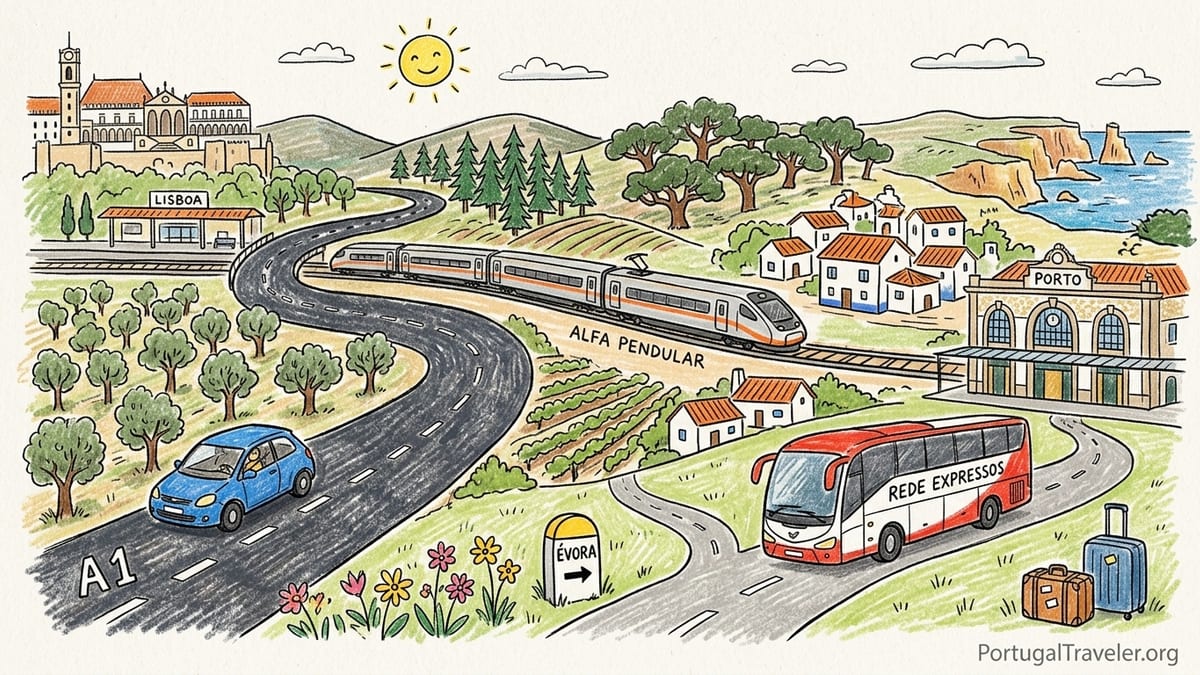
How Portugal’s Trains, Coaches and Roads Fit Together
To understand whether a car or train works better, it helps to see how Portugal’s transport network is actually laid out. The backbone of rail is the main north south line between Lisbon and Porto, with intercity and high speed Alfa Pendular services linking key cities such as Coimbra, Aveiro, Braga and Faro. From these hubs, slower regional lines branch out to towns like Évora, Beja and Guarda, although some routes are infrequent and a few areas have no rail at all.
Alongside the trains, an extensive intercity coach network steps in. Companies such as Rede Expressos and FlixBus operate routes that fill many of rail’s gaps, reaching inland cities like Castelo Branco or Portalegre, and coastal communities where tracks never went. On paper this means you can cross much of the country without driving, provided you are comfortable with fixed schedules and occasional changes.
The road system adds a third layer. Portugal has modern motorways labeled with an “A,” such as the A1 between Lisbon and Porto or the A2 from Lisbon to the Algarve. Many of these roads use electronic tolls or mixed systems with ticket barriers. Alongside them run older national roads without tolls, often slower but more scenic. For me, the practical question was not whether infrastructure existed, but where each mode matched the rhythm and style of the trip I wanted.
On my first visit I tried to avoid renting a car at all, relying on trains and coaches between the big cities. On the second, I flipped the script and collected a rental at Lisbon Airport, using rail only when it clearly made more sense. The contrast between those two approaches explains why my final recommendation is different depending on where in Portugal you are heading.
Lisbon to Porto and the Big City Triangle
The most obvious test was the classic Lisbon to Porto journey. By train, I booked a standard Alfa Pendular ticket with CP, Portugal’s national rail operator, from Lisboa Santa Apolónia to Porto Campanhã. When I checked fares, advance standard class tickets on this route commonly started around 25 to 35 euros one way, with journey times of roughly two hours and forty minutes. I paid in that range, boarding in central Lisbon and stepping off just outside central Porto without thinking about fuel, tolls or parking.
On a later trip I drove the same corridor. Leaving Lisbon in a compact manual from a major rental brand, I headed north on the A1. The motorway was fast and well maintained but came with layered costs. Estimates based on the official toll simulator for the A1 put Lisbon to Porto tolls in the region of 20 euros for a standard car, depending on entry and exit points, and my own bill landed close to that. Add fuel, which in recent years has often hovered around 1.7 to 2 euros per litre for petrol, and even with decent mileage the out of pocket cost for one or two people quickly overtook the train.
Time was another factor. Pure driving time between Lisbon and Porto is around three hours in light traffic, but that assumes no delays entering or exiting the cities. On my weekday run, morning congestion leaving Lisbon and a slow final approach into Porto stretched the trip closer to three and a half hours. Door to door it was still competitive, but only if I valued having the car ready to explore side trips along the way, such as detouring to Aveiro’s canals or the monastery at Alcobaça.
For straightforward city to city travel between Lisbon, Porto and Coimbra, trains won convincingly for me. The combination of direct central stations, reasonable fares, the ability to read or work, and zero parking hassle made rail the obvious choice. If your Portugal itinerary is essentially a big city triangle, possibly with day trips that tour operators or regional trains can handle, renting a car only for this leg does not make much sense.
Algarve Reality: Trains, Coaches and the Freedom of a Car
The Algarve, Portugal’s southern beach region, was where I felt the limits of rail most clearly. There is a coastal train line linking Lagos, Portimão, Albufeira and Faro, and on my first trip I used it to hop between resort towns. Fares for regional trains on this line were modest, often around 4 to 8 euros for short hops booked on the day. Trains were generally on time, though off season frequencies were not high, and some stations sat inland from the beaches.
This mattered in Albufeira, where Albufeira-Ferreiras station is several kilometres from the main hotel strip. After arriving by train from Lagos, I had to queue for a taxi, then ride down to the coast, adding roughly 15 euros to the door to door cost and another layer of logistics. For travelers staying near stations, rail can still work, but many resorts are clustered along cliffs and coves that feel poorly served by tracks.
On my second Algarve visit I rented a car in Faro and drove west. Daily rental rates fluctuate, but checking major aggregators for shoulder season dates, I saw compact manual cars sometimes quoted from around 20 to 40 euros per day when booked in advance, before insurance extras. I paid a similar mid-range rate, added a partial collision damage waiver, and accepted the fuel policy that required returning the car with a full tank.
Driving gave me a kind of freedom that rail never matched here. I could visit lesser known beaches like Praia da Marinha at sunrise, then continue on to Carvoeiro and Ferragudo without worrying about timetables. Parking near beaches was mixed. In some places I found free gravel lots behind the dunes; in others, like central Lagos in summer, on-street parking either required paid meters or meant circling narrow streets. Even so, the ability to carry beach gear, groceries and luggage in the boot, and to leave when the weather changed, made the car feel worth both the fuel and the small Algarve tolls on stretches of the A22, which uses an electronic system.
Into the Interior: Évora, Alentejo and Small Town Decisions
Portugal’s interior is where the car-versus-train question becomes most interesting. Take Évora in the Alentejo. There is a direct rail connection from Lisbon, and I used it once on a day trip. Travel time was around one hour and thirty minutes on an intercity service from Lisboa Oriente to Évora. Buying in advance, I secured a ticket for roughly 15 to 20 euros one way. The station is within walking distance of the walled historic center, and for a focused city visit this worked well.
However, on a later trip I wanted to reach smaller spots beyond Évora, including the hilltop village of Monsaraz near the Spanish border and wine estates outside the city. Here the absence of frequent public transport became obvious. Regional buses left from Évora’s coach terminal, with a handful of daily departures to some villages, but timings were not well aligned with a relaxed day of sightseeing. I opted for a rental car from a local agency in Évora, picking it up after arriving by train from Lisbon.
That mixed approach, train into a hub then local car rental for the surrounding countryside, turned out to be one of the most efficient combinations of my entire Portugal experience. I avoided driving under Lisbon’s heavier traffic and complex junctions, but gained enough autonomy to reach places such as the lakes around Alqueva or quiet cork forests outside Reguengos de Monsaraz. Road quality in the Alentejo was generally good, with wide national roads and little congestion, which kept stress levels low despite occasional slow tractors or level crossings.
In other interior regions, such as the Serra da Estrela mountains or certain parts of Trás-os-Montes in the north, coaches and occasional regional trains exist, but schedules can be sparse outside school and commuter peaks. For anyone planning a route that strings together several villages and viewpoints in a single day, a car made a significant difference for me in both time and spontaneity.
Counting the Real Costs: Rental, Tolls, Fuel and Rail Fares
Cost comparisons between car and train in Portugal depend heavily on how many people are traveling. When I moved solo between Lisbon and Porto by rail, the train was cheaper than a rental car almost every time. A one way high speed ticket booked a week or more in advance might cost 25 to 35 euros, with no extras. By contrast, a day’s car rental, insurance top-up, estimated tolls on the A1 and fuel together could easily reach 80 to 120 euros for that same single journey.
As soon as I traveled with two or three people, the equation shifted. Splitting that 80 to 120 euros three ways brought the per person cost closer to what we would have paid individually on the train, especially when we combined multiple legs in one rental period. For example, over four days we used a single compact car to go from Lisbon to Nazaré, then to Coimbra, Buçaco Forest and finally Porto. Because we were paying one rental and one set of tolls for three people, the daily cost per person became reasonable, while the train would have required separate tickets for each segment.
Tolls were a learning curve. Portugal uses a mix of traditional ticket-based booths and fully electronic systems that read license plates or devices as you pass. On the A2 and A1 I collected tickets and paid by card at barriers. On parts of the A22 in the Algarve, however, tolls were electronic only. My rental company registered the car, and a few weeks later a modest additional charge appeared on my credit card itemized as tolls plus a small service fee. Had I driven my own foreign car, I would have needed to activate an electronic device or register the plate at the border, something visitors should plan for.
Rail fares were easier to predict. CP offers discounted advance tickets on many intercity and Alfa Pendular services, and I consistently saw lower prices when searching one to two weeks ahead compared with same-day purchase. Regional trains were usually fixed price and affordable, especially for short distances. Occasionally, I found coach tickets that undercut both rail and car, particularly on less busy days between cities like Porto and Braga or Lisbon and Évora. The trade-off was that coach stations were sometimes less central than main railway stations.
Luggage, Comfort and Stress: How It Felt, Not Just What It Cost
Money was only part of the story. Luggage shaped my feelings about each mode just as much. On my rail-focused trip I traveled with a medium suitcase and a backpack. Boarding intercity trains in Lisbon or Porto was straightforward, with low steps and luggage racks near the doors. On older regional trains, I had to lift the suitcase up steeper steps, and overhead racks were tight. At busy times, finding a safe spot for a large suitcase without blocking the aisle required some negotiation with fellow passengers.
In the car, luggage was never a problem. Two suitcases and three daypacks disappeared into the boot of a compact hatchback, leaving the rear seats uncluttered. This made a big difference on the Algarve, where we kept beach towels, snorkels and a small cooler in the car for the entire week. The trade-off came when staying in historic centers with tight streets. In central Porto, our guesthouse had no parking, which meant threading the car through narrow lanes, unloading bags on a double-parked quick stop, then driving to a paid parking garage that charged a daily rate on top of our other costs.
Stress varied with context. Driving out of Lisbon Airport onto the ring roads felt demanding at first, with several fast lanes and quick decisions at junctions. Once clear of the metropolitan area, cruising on the A2 or A1 was calm and simple. Night driving on unlit rural roads required more focus, especially where GPS directions sent me onto very narrow lanes bounded by stone walls. For some travelers, that kind of driving will be part of the adventure. Others may prefer the predictable environment of a train carriage, even if it means planning more carefully.
On rail journeys, the main stress I encountered was around connections. In Coimbra, I had a tight change from a regional train to an Alfa Pendular service to Porto. A minor delay on the inbound train made the platform swap more rushed than I liked. Still, once on board, the ride was smooth, seating was comfortable, and onboard announcements were clear. Overall, rail felt lower stress than driving in cities, but driving felt lower stress than juggling multiple regional train or bus connections into smaller towns.
Where a Mixed Approach Worked Best
The more I traveled, the more I found that no single mode was ideal for an entire Portugal itinerary. The mixed patterns that worked best for me shared a few themes. The first was using rail or coach to cover the long intercity spines, then renting cars locally for shorter segments. For example, I once took a fast train from Lisbon to Porto, spent several car-free days exploring on foot and using the city’s metro, then rented a car in Porto just for a loop through the Douro Valley and northern countryside.
Another successful pattern started with Lisbon to Évora by train, as mentioned earlier, followed by a three day car rental from Évora to roam the Alentejo. Returning the car in Évora and riding rail back to Lisbon saved both money and stress compared with driving into the capital at rush hour and paying for inner city parking. For the Algarve, one option is to arrive by train or coach in Faro, pick up a car there for a coastal circuit, then either drop it back in Faro or, if the rental terms allow, return it in Lisbon or Porto at the end of the trip.
These mixed strategies also helped in managing toll and electronic payment issues. By limiting my motorway driving to specific regions and days, I reduced the number of toll systems I had to deal with and kept unexpected charges lower. In many cases, I found I could use toll-free national roads for part of a route without adding excessive time, reserving the motorways for long stretches where higher speeds made a clear difference.
Crucially, combining modes meant I could match the transport to the experience. When I wanted to linger over river viewpoints and stop at vineyards on impulse, such as in the Douro, a car was essential. When I simply needed to get from central Porto back to Lisbon on a busy Sunday afternoon, the train let me sit back, watch the landscape and arrive without worrying about tiredness behind the wheel.
The Takeaway
After trying both car and train across Portugal, my answer to “Which is better?” depends more on the shape of the trip than on any single factor. For a first-time visitor focusing on Lisbon, Porto and maybe Coimbra, I would recommend relying mainly on trains and intercity coaches. The mainline rail services between these cities are frequent, relatively fast and fairly priced, with central stations and no toll or parking complications. You can add local tours or short regional train rides for day trips to places like Sintra from Lisbon or Braga from Porto without needing your own vehicle.
If your itinerary leans heavily toward the Algarve’s spread-out beaches, the Alentejo’s villages, the Douro’s vineyards or mountain areas with patchier public transport, a rental car becomes more compelling, especially for two or more travelers sharing the costs. The car will almost certainly cost more than a single rail ticket, but can become competitive per person when the expenses are split and several legs are combined in a single rental period. The bonus is the flexibility to change plans with the weather, chase lesser known viewpoints and carry luggage without worrying about space on trains or coaches.
In between, a mixed approach often delivers the best of both worlds. Use rail or coaches for long, busy intercity stretches into or out of major hubs, then rent cars locally for a few targeted days of exploring the countryside. That structure let me avoid the highest stress driving environments while still unlocking remote corners that felt unreachable on public transport alone. It also simplified toll management by concentrating motorway use into defined windows.
Ultimately, the choice in Portugal is less about a universal verdict and more about asking where you will spend most of your time. If your days are city heavy and your nights are in well-connected hubs, choose the train. If your plans are pinned to small towns, beaches beyond the rail line and countryside vistas, choose the car. And if your map shows a little of both, consider doing what I ended up doing: ride the rails where they shine, drive where they are absent, and treat Portugal’s overlapping networks as complementary tools rather than competing options.
FAQ
Q1. Is it cheaper to travel around Portugal by train or rental car?
For solo travelers, long intercity trips by train are usually cheaper than renting a car once fuel, tolls and parking are included. For two or three people sharing a vehicle and combining several legs into one rental, costs can become similar or tilt in favor of the car, especially in regions where public transport would require multiple tickets and connections.
Q2. Do I need a car to explore the Algarve properly?
You can visit major Algarve towns like Faro, Lagos and Portimão by train or coach, but a car makes it much easier to reach scattered beaches, smaller coves and inland villages. If your main goal is to move between larger resorts and you are happy to stay near train or bus routes, rail and coaches can work. For more spontaneous, beach-hopping days, a rental car is often the more practical choice.
Q3. How difficult are Portugal’s toll roads for foreign drivers?
Traditional toll roads with ticket booths are straightforward, as you collect a ticket and pay by card when exiting. Electronic-only toll sections require a bit more preparation, since charges are recorded automatically and billed later, sometimes via your rental company with a service fee. Checking how your rental provider handles toll registration and charges before you drive avoids surprises after the trip.
Q4. Are trains in Portugal reliable enough for tight schedules?
On main intercity routes between cities such as Lisbon, Porto, Coimbra and Faro, trains are generally reliable and punctual enough for most travel plans. I still avoid planning very tight connections, especially when using regional feeder trains, because minor delays can happen. Building some buffer time around critical connections or flights is sensible, just as it would be in most European countries.
Q5. Is parking a big problem in Portuguese cities?
In historic centers such as Lisbon’s Alfama, central Porto or older districts in Coimbra, on-street parking is limited and streets are narrow. Many visitors either choose accommodation with parking included or budget for secure paid garages on the edge of the old town and walk in. Outside dense historic cores, and in modern suburbs or retail areas, parking tends to be easier and often cheaper or free.
Q6. Can I rely only on coaches instead of renting a car?
In many cases, yes. Intercity coach operators link a wide range of towns and cities, including some places with limited rail service. If you are comfortable planning around fixed schedules and occasionally walking or taking local taxis from coach stations to your accommodation, you can cross much of Portugal by coach alone. Where coaches are infrequent, however, a car may still offer a more flexible and time-efficient option.
Q7. When is it worth doing a mixed train-and-car itinerary?
A mixed approach works best when your route includes both large cities and remote areas. For example, taking the train from Lisbon to Porto, spending a few days car-free, then renting a car in Porto for the Douro Valley allows you to avoid big city driving while still reaching vineyards and viewpoints that are hard to access by public transport. The same logic applies to Lisbon and the Alentejo or Lisbon and the Algarve.
Q8. How far in advance should I book train tickets in Portugal?
For intercity and high speed services on busy routes, looking one to two weeks ahead often reveals discounted advance fares compared with buying on the day. Regional trains generally do not require much advance planning, as they usually have fixed prices and open seating. During peak holiday periods, booking earlier provides both better prices and peace of mind.
Q9. Is driving in rural Portugal stressful for foreign visitors?
Away from major cities, driving in rural Portugal often feels calm, with light traffic and well-maintained roads. The main challenges come from occasional narrow village streets, unlit roads at night and unfamiliar signage. Taking your time, avoiding tight night schedules and using updated navigation reduces stress significantly. Compared with dense urban traffic, many drivers find rural sections the most relaxing part of their road trip.
Q10. If I only have one week in Portugal, should I rent a car?
If your week focuses on Lisbon and Porto with perhaps one or two organized day trips, you can comfortably skip the car and rely on trains and coaches. If your week is centered on the Algarve or a combination of cities and countryside, a short rental of three to four days in the middle of the itinerary can add flexibility without dominating your budget or creating unnecessary stress at the beginning and end of the trip.