


On my first trip to Portugal I tried to see everything in ten days and spent far too much time on trains, packing bags and hunting for rental car offices. Only on later visits did I learn how much the country opens up when you slow down, keep bases to a minimum and accept that each extra block of days changes the entire character of the trip. This guide walks through how I now think about dividing 7, 10 or 14 days across Portugal, grounded in real journeys between regions rather than theoretical itineraries.
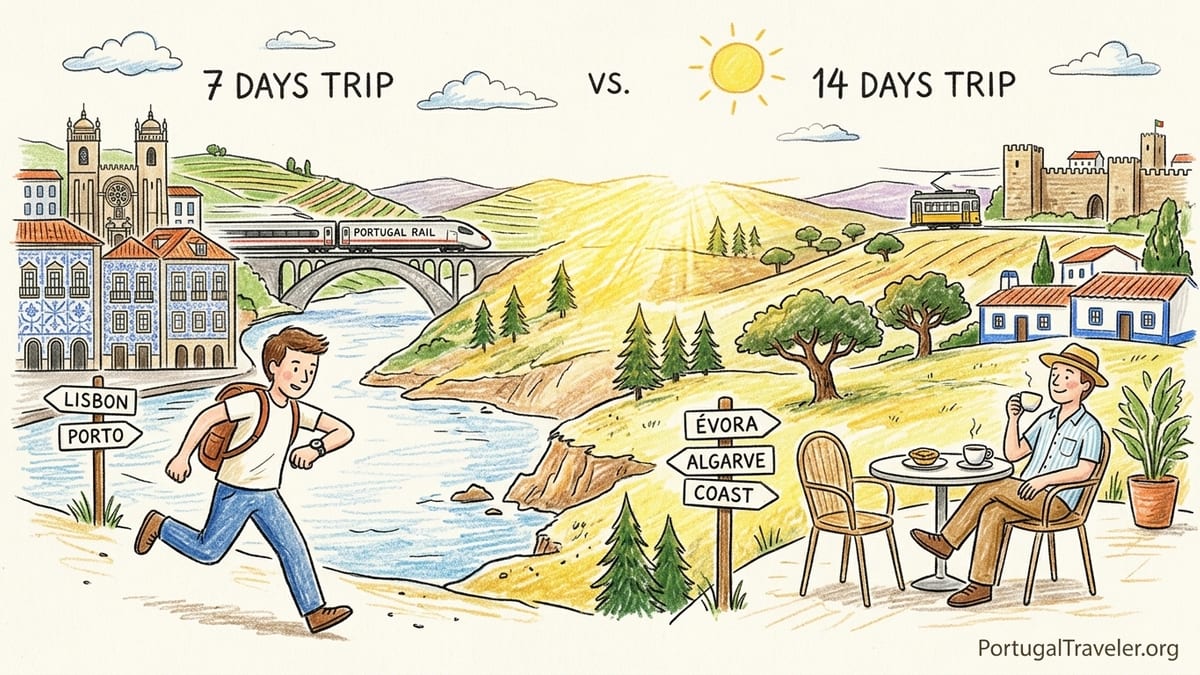
How Trip Length Shapes Your Portugal Experience
The average stay in Portuguese tourist accommodation is only a few nights, yet leisure visitors from key markets often stay around a week or a little longer. That statistic matches what I have felt on the ground: seven days is the tipping point between a rushed city break and a meaningful look at the country. Once you cross into ten and then fourteen days, your choices stop being about cramming in highlights and start being about how much travel time you are willing to tolerate in exchange for variety.
Portugal looks small on the map, but Lisbon to Porto is still roughly 300 kilometers. On the fastest Alfa Pendular trains, that trip takes about 2 hours 40 minutes, while the slower Intercidades trains sit closer to 3 hours 15 minutes. That is efficient for a north south hop, but you still lose most of a morning when you factor in packing, checkout, station time and settling into your next hotel. After repeating that transfer several times, I began to treat every base change as a half day of my vacation, which completely altered how I divided a one or two week trip.
When you only have seven days, losing two of them to hotel changes is painful. With ten days, you can justify three bases if the connections are straightforward. At fourteen days you can spread the moves out, stay longer in each place and add a slower region such as the Alentejo or the Douro without feeling like you are constantly in transit. The key is matching your ambition to the trip length and understanding what you will actually sacrifice each time you add another dot on the map.
Portugal also rewards repeat visitors. On my first visit, I put almost all my time into Lisbon and Porto with a quick dash to Sintra. On a later ten day trip I added the Algarve and paid the price in long transport days. On a fourteen day return I finally slowed down in the Alentejo, wandered smaller northern towns and realized that stretching the trip allowed the country’s quieter side to come into focus. Thinking in layers like this is how I now plan for different durations.
What a 7 Day Portugal Trip Really Allows (And What It Does Not)
Most travelers I meet landing in Lisbon with a week to spare want to see Lisbon, Sintra, Porto and the Douro Valley, and maybe even the Algarve. I tried a version of that once in seven days and ended up with a blur of tiled train stations and hotel lobbies. The first hard lesson is that a one week Portugal trip essentially forces you to choose between staying anchored in the central north of the country or making a fast dash down to the Algarve, but not both in a relaxed way.
On one early seven day itinerary I spent four nights based in Lisbon and three in Porto. The transfer between the two was on a morning Alfa Pendular that cost just under 35 euros in second class when bought a few weeks in advance, with dynamic pricing nudging it higher closer to departure. By the time I had packed, left my apartment in the Bairro Alto, taken the metro to Lisbon Oriente, ridden the train to Porto Campanhã and checked into a guesthouse in the Cedofeita neighborhood, it was already mid afternoon. That single hotel change consumed at least five usable sightseeing hours.
With only seven days, two bases is the practical maximum if you want any depth. In Lisbon, that might mean using the city as a hub. One day could go to Sintra using the frequent suburban trains from Rossio Station, with the understanding that visiting both Pena Palace and Quinta da Regaleira in a single day means choosing quick lunches and a late train back. Another afternoon could go to Belém for Jerónimos Monastery and the riverside promenade. You will feel busy but not frantic. What you will not realistically do on a seven day trip that splits time between Lisbon and Porto is add a full day in the Douro Valley, because that becomes a very long out and back journey that eats another day in transit.
The other constraint is recovery time. Transatlantic flights from the United States often arrive in Lisbon early in the morning. On that first jet lagged day many travelers only have energy for a gentle walk through the Baixa and an early dinner in the Chiado. Lose another half day to the Lisbon Porto transfer and you are effectively planning an entire country around five and a half real sightseeing days. That is why, when friends ask me for a seven day Portugal plan, I nudge them toward picking one main region and its satellites instead of slicing the week three ways. You can always return and build on that foundation with a longer trip later.
How 10 Days Open Up Multiple Regions Without Total Burnout
Extending a Portugal trip from seven to ten days sounds modest on paper, but those extra three days completely change what is feasible. On my second visit, I had ten days and used that flexibility to add the Algarve. The itinerary looked glorious in my spreadsheet: Lisbon, Porto, a taste of the Douro and beach time in Lagos. On the ground it meant three separate long distance transfers and four different beds. By day eight I knew I had crossed the threshold between pleasantly busy and over scheduled.
Getting from Lisbon to the Algarve is straightforward in theory. Alfa Pendular and Intercidades trains run from Lisbon Oriente down to Faro in about three hours. Tickets for these long distance services can be as low as around 15 to 20 euros when bought in advance, rising closer to 30 or slightly more for flexible fares, with promotional discounts often available through the national rail operator. I took a mid morning Alfa Pendular, arrived in Faro just after lunch, then connected to a slower regional train to Lagos that added another hour and a half. Including the wait on the platform and the walk from Lagos station to my hotel near Praia Dona Ana, the journey consumed almost six hours.
In a ten day framework, I learned to treat each of those moves as a conscious tradeoff. To fit Lisbon, Porto and the Algarve, I ended up assigning three nights to Lisbon, three to Porto and four to Lagos. The reality behind those numbers was that my full days in each place were closer to two and a half and two and a half and three. The half days vanished into station transfers and checkouts. I still remember rushing through São Bento station’s azulejo panels in Porto because I had a mid morning train to catch south. I also remember arriving in Lagos exhausted on what should have been a relaxed beach afternoon.
The lesson from that ten day experiment was not to avoid multi region trips, but to be ruthless about what gets cut. If you want to combine the north, center and Algarve in a single ten day loop, something has to give. In my case, that meant skipping an overnight in the Douro Valley and experiencing it as a day trip by train from Porto, using the scenic Linha do Douro as far as Peso da Régua and then continuing by boat. It also meant choosing neighborhoods in each city that minimized local transport headaches, such as staying near Cais do Sodré in Lisbon for easy access to both the historic center and trains out to Cascais. Ten days let me glimpse very different sides of Portugal, but only because I accepted that the price would be less depth in each place and one fairly tiring long transfer day.
Why 14 Days Change the Pace Completely
The first time I had a full fourteen days in Portugal, everything slowed down. With two weeks, the country shifts from a checklist of major cities into a network of distinct regions, each deserving at least two or three unrushed days. I still kept my base count low, but longer stays in each place transformed the experience. Instead of four beds in ten days, I limited myself to three bases in fourteen: Lisbon, somewhere in the center or north, and one coastal or rural region.
On that trip I began with four nights in Lisbon, then picked up a rental car near Santa Apolónia station and drove east into the Alentejo for five nights, splitting my time between Évora and a farmhouse stay outside Monsaraz. After that, I dropped the car in Coimbra and took an Intercidades train north to Porto for the final four nights. The driving distances themselves were manageable. Lisbon to Évora is about an hour and a half on the A6 toll road, and Évora to Monsaraz is roughly another hour. Yet what made two weeks special was not the transport efficiency but the freedom to do very little for entire afternoons.
In the Alentejo I had time to linger in walled towns after day trippers left, sit over long lunches of migas and grilled black pork, and visit wineries near Reguengos de Monsaraz without glancing constantly at the clock. The slower pace also meant that a rainy day did not feel like a disaster. On a fourteen day schedule you have room for weather, for a morning lost to laundry or for a change of heart when a town charms you into staying an extra night. That kind of flexibility is nearly impossible on a seven day sprint.
Financially, two weeks does not have to mean double the cost of one. On one long Portugal stay I kept daily expenses relatively moderate by renting apartments with kitchens and eating many breakfasts and some dinners in. Simple lunches in neighborhood tascas outside the most touristed centers were often around 10 to 15 euros for a prato do dia and a glass of house wine. Trains between major cities, especially when using advance purchase discounts, were often cheaper than a single airport taxi would have been in other European capitals. The longer time frame also let me seek weekly stay discounts on apartments and rural guesthouses, which can make a fourteen day trip surprisingly good value if you are willing to travel a little more slowly.
Most importantly, with two weeks you can start to weave in places that are rarely viable on shorter itineraries. A night or two in Coimbra between Lisbon and Porto, a few days in the Minho region around Guimarães or Braga, or a quiet coastal stop in the Silver Coast around Nazaré or Peniche become realistic without turning the trip into a race. You still need to be deliberate about hotel changes, but you no longer have to choose between the Algarve and the interior or between Porto and the Douro. Fourteen days turn Portugal into a country you can feel rather than skim.
Making Sense of Bases, Hotel Changes and Travel Days
When I look back at my itineraries, the most powerful planning tool was not a list of sights but a simple rule about bases and travel days. For every hotel change, I now assume I will lose at least half a day, even if the actual train or drive is only two or three hours. Time evaporates in the gaps: waiting at stations, navigating unfamiliar metro systems, sitting in taxi traffic near historic centers and orienting yourself in a new neighborhood. Once I started to budget those hidden costs into the calendar, my Portugal trips became calmer and more enjoyable.
For example, on a later ten day visit I kept the base count to three: four nights Lisbon, three nights in Coimbra and three nights in Porto. Lisbon to Coimbra by train took around two hours on an Intercidades service. I chose an early afternoon departure so I could still enjoy a final leisurely morning coffee near Praça Luís de Camões instead of rushing to a dawn train. In Coimbra, I booked a guesthouse within walking distance of the station and the university hill, so there was no need for a taxi. Even with these optimizations, the day became a travel day: by the time I climbed the steps to the Biblioteca Joanina and settled into my room, the afternoon was half gone.
This is why I encourage travelers to start itinerary planning by deciding how many times they are willing to unpack, rather than by counting cities. On a seven day trip, two bases mean two unpacking and packing cycles. On a ten day trip, three bases are usually the sweet spot unless you are focusing tightly on one region. On a fourteen day itinerary, three or four bases works well if the distances between them are not too long. Whenever I have pushed beyond those numbers, the trip has started to feel like a logistics project rather than a holiday.
Transport booking habits also affect how your days play out. Long distance trains such as Alfa Pendular and Intercidades generally have dynamic pricing, with cheaper fares released in advance and more flexibility costing more closer to departure. On one summer trip, I bought Lisbon to Porto tickets roughly four weeks ahead and paid under 30 euros for a second class seat on a midday Alfa Pendular, while a friend who waited until the previous day paid closer to 45 euros for a similar train at a peak hour. The savings were useful, but the real advantage was psychological: having fixed transport times early made it easier to structure the days around those moves instead of constantly checking availability.
Choosing When to Move and When to Stay Put
Once you understand that each hotel change is costly in hours, the next step is deciding when moving on is worth it. In Portugal there are a few natural pivot points where a base change buys you a completely different experience. Going from Lisbon to Porto shifts you from pastel de nata at a counter in the Baixa to francesinha in a tiled café near the Douro. Heading from the north to the Algarve turns vineyard covered hills into golden beaches and sea cliffs. Driving inland to the Alentejo replaces urban trams with olive groves and cork forests.
On one itinerary I spent five nights in Lisbon and struggled with the decision to move at all, because day trips to Sintra, Cascais and even Setúbal kept adding variety without new hotel keys. In the end I did move for four nights to the Algarve, and I am glad I did, but that choice meant skipping Coimbra entirely and limiting my time in Porto to a future visit. The lesson was that not every interesting city deserves a base on every trip. Some can be saved for the next journey, and some can be tasted briefly on the way between two anchors.
Weather and season also influence when to move. My fastest feeling trip was a ten day visit in August when crowds in Lisbon and Porto were at their peak and the Algarve was near full capacity. Trains were busy, advance tickets were essential on popular departure times, and the heat made midday transfers more draining. By contrast, a fourteen day April trip with a similar geographic footprint felt relaxed, because shoulder season crowds were lighter and accommodation availability made it easier to secure centrally located rooms for several nights at a time. Shoulder months are forgiving if you decide mid trip to stay an extra night in a place that surprises you, which is a luxury very hard to exercise on a tight high season schedule.
There is also an emotional component. Each time I have forced myself to leave a town I loved after just one or two nights, I have regretted it on the train platform. The azulejo covered lanes of Porto’s Miragaia district, a sunset over the rooftops of Lisbon from the Miradouro da Senhora do Monte, or a lingering dinner in a small Alentejo village all reward repetition over novelty. Allocating more time to fewer places has consistently produced stronger travel memories than racing after an extra stamp in the mental passport.
Budget, Comfort and the Pace You Can Sustain
How you divide 7, 10 or 14 days in Portugal is not only about geography. It is also about budget and your preferred level of comfort on travel days. On one extended trip I tracked my expenses carefully and averaged around 45 to 60 euros per day by staying in simple guesthouses outside the most touristed zones, using trains and buses instead of rental cars when possible, and cooking some meals. On a different journey with a friend who preferred boutique hotels and more restaurant splurges, the daily cost was considerably higher even though the route was similar. The slower, more grounded trip with fewer hotel changes actually ended up costing less per day, because weekly apartment rates and limited long distance transfers offset higher per night prices.
Longer trips make these tradeoffs more pronounced. Over fourteen days, saving even 10 euros per night on accommodation by choosing a place just outside a historic center can free up enough for a guided food tour in Lisbon or a Douro Valley boat trip out of Porto. Likewise, choosing two longer train legs instead of three or four shorter hops can save on both ticket costs and incidental spending on taxis and café meals grabbed during quick station changes. On one itinerary, I chose a direct Lisbon to Faro train instead of flying, paid a moderate fare booked in advance, and avoided airport transfers and baggage fees altogether.
Comfort on the move matters too. On summer journeys between Lisbon and Porto, I now favor Alfa Pendular trains at quieter mid morning or mid afternoon times instead of peak hours. The slightly higher ticket price compared with some Intercidades departures has felt worthwhile for the smoother ride, onboard café service and reduced likelihood of crowds. Having a comfortable transport day makes it easier to accept that you are trading half a day of sightseeing for the chance to wake up somewhere new. In contrast, the only truly miserable day I had in Portugal was a poorly planned August bus journey during a heatwave, followed by a late check in and an early tour the next morning. I learned to avoid stacking a long transfer, a late arrival and an early commitment back to back.
Ultimately, the right pace is the one that leaves you still curious at the end of the trip rather than exhausted. If you are the sort of traveler who likes to be out the door by nine and walk until sunset, you might tolerate an extra base change on a ten day trip. If you prefer leisurely breakfasts and afternoon breaks, you will want to consolidate more. Portugal is forgiving in that you can almost always design a satisfying itinerary at any of these lengths, as long as you are honest about your own energy and budget.
The Takeaway
After several visits and a handful of different itineraries, my approach to Portugal has settled into a simple framework. With seven days, I pick one core region and accept that I will only glimpse others, if at all. With ten days, I allow myself one additional major region and possibly a short internal hop, staying alert to the way each base change eats into sightseeing time. With fourteen days, I finally give myself permission to slow down, add rural or coastal interludes and let the country breathe between transfers.
Portugal rewards repeat visits and thoughtful pacing. Trains are relatively affordable and comfortable between major cities, rental cars open up the countryside, and internal distances are manageable. Yet logistics still matter. Treat travel days as part of the journey, not as invisible lines on a map, and be realistic about how many transitions you can happily manage in a week or two. The best measure of a well planned itinerary is not how many places you can list afterward, but how many moments remain vivid months later.
If this is your first trip, do not worry about missing a region or two. Choose the length you have, decide how many times you are willing to unpack, and build outward from there. Portugal will still be there for your second or third visit, and each extra block of days will let you peel back another layer, moving from hurried sightseeing to something closer to everyday life along its hills, rivers and coasts.
FAQ
Q1. Is 7 days enough for a first trip to Portugal?
Seven days is enough for a first taste of Portugal if you focus on one main region, such as basing in Lisbon with nearby day trips or splitting time carefully between Lisbon and Porto. You will need to be selective and accept that you will not see everything, but you can still have a rich and satisfying introduction.
Q2. How many hotel bases do you recommend for 10 days in Portugal?
For a ten day trip, three bases usually work best, for example combining Lisbon, one central or northern city and the Algarve. This keeps the number of unpacking and packing cycles manageable while still exposing you to different landscapes and cultures without constant transit days.
Q3. Do I need to book trains in advance between Lisbon, Porto and the Algarve?
For long distance trains such as Alfa Pendular and Intercidades between Lisbon, Porto and Faro, it is wise to book in advance, especially in summer and on weekends. Advance purchase often secures lower fares and preferred departure times, while last minute tickets can be more expensive and popular trains may sell out.
Q4. Is it worth renting a car for a 7 day Portugal itinerary?
For a seven day trip focused on Lisbon and Porto, public transport is usually sufficient and a car can be more of a burden in cities. A rental car becomes more valuable if your itinerary includes rural areas such as the Alentejo or smaller coastal towns with limited train and bus connections.
Q5. How should I split time between cities and countryside on a 14 day trip?
On a fourteen day itinerary, a balanced approach is to spend roughly half your nights in cities like Lisbon and Porto and half in smaller towns or rural regions such as the Alentejo, Douro or the Minho. This mix allows you to enjoy museums, food scenes and nightlife along with quieter landscapes and slower days.
Q6. What is a realistic daily budget for Portugal?
Daily budgets vary widely, but many travelers report spending around 50 to 100 euros per person per day on the ground, depending on accommodation and dining choices. Staying in simple guesthouses, using public transport and eating in neighborhood restaurants can keep costs lower, while boutique hotels and frequent paid tours increase the budget.
Q7. When is the best time of year for a 10 or 14 day Portugal itinerary?
Spring and autumn are ideal for longer itineraries, with generally mild weather and fewer crowds than peak summer. April, May, late September and October often provide comfortable temperatures for sightseeing and travel days, and accommodation availability is usually better than in July and August.
Q8. How tiring are travel days inside Portugal?
Even though many journeys are only two to three hours by train or car, travel days can still feel tiring once you add packing, check out, getting to and from stations and orienting yourself in a new place. It is reasonable to assume that each hotel change will cost at least half a usable day.
Q9. Can I visit the Douro Valley as a day trip from Porto?
Yes, many travelers visit the Douro Valley on a long day trip from Porto using a combination of trains, boats or organized tours. A dedicated overnight stay gives a deeper experience, but on shorter itineraries a day trip can be a good compromise that avoids adding an extra hotel change.
Q10. How should I plan for jet lag on a short Portugal trip?
If you are flying from North America, plan for your arrival day to be slower, especially if your flight lands early in Lisbon. Scheduling only light activities such as neighborhood walks and simple meals on that first day prevents overcommitting and helps you start the rest of your itinerary better rested.