


I landed in Madeira with a stubborn experiment in mind. For one full week I would not rent a car. Instead, I would move around the island using only airport buses, local routes, hotel shuttles, taxis, rideshare apps and organized excursions. Madeira has a fierce reputation as a place where you “need a car,” but I wanted to see what a modern, car-free trip actually feels like with the transport options that now exist in 2026.
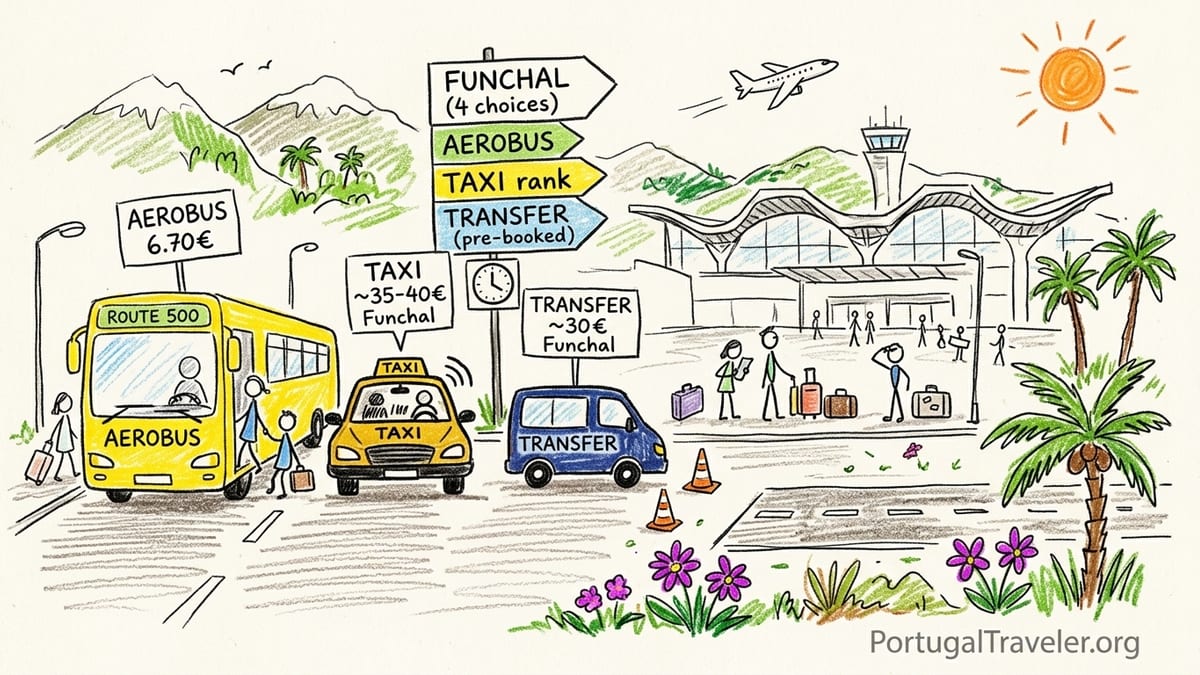
Arriving in Madeira: Airport Bus, Taxi or Transfer
My first decision came the moment I walked into the arrivals hall at Cristiano Ronaldo Madeira International Airport. I had three realistic car-free options to reach Funchal. The first was the Aerobus, now run as Horários do Funchal route 500 under the SIGA system, which connects the airport to the city and continues out to Praia Formosa. In 2026 the fare bought on board is about 6.70 euros per adult, with departures roughly from 08:30 until 22:00 and journey times of about 50 minutes to the Lido and city hotel zones. I bought my ticket from the driver in cash, stowed my suitcase in the rack, and treated it like a slow but simple airport train.
The second option was a metered taxi from the official rank at arrivals. Under the current regional taxi tariff, the meter starts at around 4 euros in the daytime and 4.80 euros at night, with a per kilometre rate that brings a typical daytime run from the airport to central Funchal to somewhere in the low 30s in euros, and higher at nights and weekends. With luggage supplements and a small party, you quickly get near 35 to 40 euros to most hotels in the centre or Lido zone. It is straightforward and always available, but it felt like a splurge for a solo arrival, especially compared with the airport bus.
The third option, which I used for my departure, was a pre-booked transfer. Several companies now run fixed-price airport runs where the total price is shown up front when you book online. In late 2026 I paid just under 30 euros for two people with bags from the Lido to the airport in a pre-booked car. Comparable services I compared were quoting around 30 to 45 euros per car for up to four people to central Funchal, and around 45 to 60 euros for larger groups up to eight. That meant that for couples or families, a transfer was often cheaper per person than the Aerobus and more comfortable than a taxi on the meter.
In practice, the Aerobus worked very well on arrival because my flight landed mid afternoon, well inside its service window, and my hotel was near a main stop. If I had landed after 22:00, or in heavy rain with children in tow, I would have gladly paid for either a transfer or a taxi. The first lesson, even before leaving the airport, was that car-free travel in Madeira already involves a sliding scale between comfort, cost and schedule rather than a single “right” choice.
Using Funchal as a Car-Free Base
For the week I made Funchal my only base, staying first near the old town and then moving to the Lido hotel strip. Without a car this decision mattered far more than it would on a road trip. Almost every form of organized transport I used, from levada tours to jeep safaris and dolphin trips, either started in Funchal or offered free pickup from Funchal and nearby Caniço. Staying centrally meant I spent more time hiking on ridges than waiting at remote bus stops.
From my hotel near the Lido, I could reach three key bus corridors on foot within 10 minutes. Horários do Funchal city buses linked me to the old town, cable car station and Mercado dos Lavradores for 2 to 3 euros per single ticket, slightly cheaper when preloaded onto a GIRO card. The Aerobus stop was on the same avenue for airport runs. For westbound trips towards Câmara de Lobos and Ribeira Brava, I could walk to stops shared by regional services that now sit inside the SIGA network but are still colloquially known by their old operator names like Rodoeste.
In the evenings being car-free in Funchal was almost entirely relaxing. Buses along the main Estrada Monumental and Avenida do Mar corridors were still running until around 22:30 to 23:00 on the nights I checked, and taxis were easy to flag downtown. I could have a glass of Madeira wine with dinner in the old town, then either stroll home along the waterfront or take a short bus ride back to the hotel for a few euros. The absence of parking stress, steep hotel garage ramps and one-way streets made city life genuinely better without a car.
The trade-off emerged when I considered basing myself in a smaller village. I spent one late afternoon in Câmara de Lobos, reachable by a regular bus in about 20 minutes from Funchal for roughly 2 to 3 euros. The little fishing town was atmospheric at sunset, but the return options after dinner were thinner. The last buses back towards Funchal are often around 21:30 to 22:30 depending on the line, and beyond that you are either booking a taxi or using the Bolt app. If I had been staying in somewhere like Ponta do Sol or São Vicente without a car, I would have accepted much more rigid dinner times and occasional expensive rides to avoid getting stranded.
Riding Local and Regional Buses: Freedom With Friction
On paper Madeira’s bus network looks impressive. In practice, using it as a visitor involves a learning curve and some patience. I relied mostly on Horários do Funchal routes radiating from the capital and on westbound services in the former Rodoeste territory, which now form part of the integrated SIGA system. Standard single fares on interurban routes in 2026 are typically between about 2.50 and 5 euros depending on the number of zones or stages travelled, with shorter hops like Funchal to Câmara de Lobos at the lower end and cross-island rides towards Porto Moniz at the higher end.
For timetable planning I tried three tools. The printed timetables at bus stops were often slightly worn and, while still usable, not always the latest version. The official SIGA website and PDF schedules gave the authoritative times but were not effortless to read on a phone. The most useful tool was a third-party Madeira Bus app, created by an independent developer, which aggregates timetables from multiple operators into a cleaner mobile layout. I still cross-checked any crucial early-morning run against the official site, but for everyday city rides it was enough to know the next route number and approximate departure window.
Waiting times were the main friction point. Inside Funchal, daytime frequencies on key routes were often between 10 and 20 minutes, which is perfectly comfortable. Once I headed out towards the west, the picture changed. A mid-morning bus from Funchal to Ribeira Brava or Ponta do Sol might run roughly once an hour, and a missed connection could stretch that to two, especially on Saturdays and Sundays when some runs do not operate. On one excursion to the south-west coast I misread the timetable and arrived just after a bus had left; I spent 65 minutes sitting on a bench in the sun before the next one. It was not unpleasant, but it did shorten my time in the destination by a full hour.
Evenings outside the city required discipline. On my day trip to the village of Ponta do Sol I had pencilled in a sunset drink on the seafront, but when I checked the return timetable I realised the last practical bus back to Funchal left shortly after 19:00 that day. Missing it would have meant either an 80 to 100 euro taxi or a complicated combination of local services and walking. I opted for an earlier bus and watched the sunset from Funchal’s harbour instead. The lesson was clear. Buses gave me inexpensive access to several coastal towns, but they turned some evenings into beat-the-clock exercises rather than leisurely nights out.
Guided Tours for Mountains and Levadas: When Paying More Makes Sense
The real stress test for a car-free Madeira trip comes with the island’s mountain hikes and levada walks. Many of the classic trails begin high on the central ridge or in deep valleys, far from regular bus routes. To reach these starting points without a rental car in 2026 you have three broad options: patch together buses and long walks, pay for a private taxi or transfer, or join an organized excursion that includes pickup and drop-off.
For the marquee sunrise hike between Pico do Arieiro and Pico Ruivo I chose an organized transfer. Several local operators now offer shared hiking transfers that pick you up at your accommodation in Funchal or Caniço around 05:00 to 06:00, drop you at Pico do Arieiro, and then collect you hours later at Achada do Teixeira after you have completed the trail in one direction. I paid around 30 euros per person for such a transfer in a small minibus. The driver checked our footwear, made sure everyone understood the pickup time at the end point, and took phone numbers in case of problems. There was no realistic way to replicate that with public buses, because the first standard services to the high plateau roads depart far later in the morning and do not align neatly with trailheads.
For levada walks in the Rabaçal valley, including the famous 25 Fontes and Risco trails, I joined a full guided tour rather than just a bare transfer. In 2026, several companies advertise hotel pickup from Funchal for group walks in Rabaçal, with day tour prices I saw starting around 45 to 55 euros per adult. That price covered transport in a minibus, a certified mountain guide, and time to walk the levada paths. On top of this, there is now an official nature trail fee of about 4.50 euros per person for each classified levada, paid through the regional SIMplifica booking system. Our guide had us pre-book and show the confirmation at the trail access point.
The value of the guided option only became obvious during the day. Pickup from my hotel was at 08:20, the driver arrived on time, and we reached the trailhead in just over an hour. At the end of the walk we emerged at a parking area already filling with private cars and a queue for return shuttle vans organised by local operators. As a tour guest I simply followed my group back into our own minibus. Had I attempted the same trip by bus I would have needed an early interurban service towards Calheta, then a taxi for the last steep kilometres to Rabaçal, and I would still have faced uncertainty about getting a return ride in the afternoon. For around 50 euros, the all-in tour removed at least three points of failure.
On the north coast I experimented with a more independent approach. For a levada near São Jorge I took a morning bus from Funchal that connected through São Vicente. The total cost in fares was under 10 euros, but the schedule meant I began walking late in the morning and needed to keep one eye on the time to make the only sensible return bus. There was no organized tour on that exact path the day I went, so public transport was the only non-car option. The day was rewarding but tense. If I lived on the island for a month, I would happily repeat that pattern. For a short holiday where every day counts, the security of a pickup time and a waiting minibus began to feel worth the extra money for the island’s headline trails.
Taxis, Bolt and the Last-Mile Problem
Even with buses and tours, you will eventually face the “last mile” problem between where formal transport stops and where your hike or accommodation actually begins. This is where taxis and the Bolt app became my safety net. In and around Funchal, yellow taxis were easy to find at signed ranks and via hotel calls. Under the 2026 tariff, daytime meter rates outside the city work out to roughly 1.50 to 2 euros per kilometre, with a minimum fare plus supplements for luggage and night hours.
For short last-mile hops from a bus stop to a trailhead, such as from a main road near Santana up to a closer point for the PR9 trail, drivers quoted in the 15 to 25 euro range depending on distance and waiting time. For longer crossings, such as from Achada do Teixeira back to Funchal after a hike, other travelers I spoke to and examples visible in the Bolt app showed indicative prices in the 40 to 60 euro range, again depending on time of day and demand. In the high season there are usually several official taxis waiting at the most popular hiking car parks, because they know hikers will pay for the convenience rather than navigate a patchy bus schedule.
I used Bolt twice. The first time was to rescue a late-running evening in Câmara de Lobos when the next bus was nearly an hour away and I wanted to get back to Funchal for a dinner reservation. The app showed a price around 12 euros, and a car accepted within five minutes. The second was as backup after the Pico do Arieiro to Pico Ruivo hike, when our pre-booked transfer suffered a minor delay. I opened Bolt at Achada do Teixeira and saw active cars in the area with quoted fares near 50 euros to central Funchal. We did not need to book in the end, but knowing that an on-demand option existed made waiting in the mountain car park far less stressful.
Where taxis and rideshares work beautifully is when you deliberately plan and budget for one or two strategic uses, rather than treating them as unlimited backups. A planned 50 euro ride spread across four hikers after a long traverse can feel like good value, especially when it saves two hours of bus changes and roadside waiting. What drains the budget is a pattern of spontaneous cab rides every time a bus is late or the weather changes. Over a week, three or four long taxi journeys can easily exceed the cost of a modest rental car, even before fuel.
Independent Public Transport vs Guided Day Tours
By the end of the trip I had used almost every category of organized transport on the island, which made it easier to compare independent public transport with guided day tours specifically for mountain and levada access. The key difference was not only price but what I was actually buying. With buses I was paying purely for transport, and I kept full control over my route and timing within the limits of the timetable. With guided tours I was buying risk management: someone else accepted the responsibility of re-planning if fog closed a peak, if a road was blocked by a rockfall, or if the group was delayed.
In raw numbers, a DIY day in the mountains using buses and one or two taxi segments might cost 15 to 30 euros per person, assuming there are at least two people sharing any cab rides. A comparable guided hiking day with hotel pickup in 2026 typically started around 45 to 55 euros per adult, not including any official levada trail fee. On paper that makes tours look almost twice as expensive. In practice, the real gap narrows once you factor in wasted hours and the days you simply would not attempt because the bus connections are too fragile.
For example, to reach the Rabaçal levadas without a tour I would have needed an early Funchal to Calheta bus. That ride alone would run to roughly 4 to 6 euros one way. From the main road, I would then have to either walk several steep kilometres up a secondary road, consuming valuable energy, or hire a local taxi for around 15 to 25 euros each way to reach and later leave the trailhead. Spread across two hikers, the round-trip transport cost would easily reach 20 to 25 euros per person and eat up time at both ends of the day. Against that, the 50 euro guided walk started to look like a fair premium for door to door logistics and a guide who knew the latest trail conditions.
On the other hand, for coastal villages and lower-altitude levadas closer to Funchal, independent travel won clearly. The bus to Câmara de Lobos cost a few euros and ran frequently enough for relaxed half-day visits. Once there I followed a short coastal path and a miradouro without needing any guide or extra transfer. Similarly, from a bus stop above Garajau I could walk to viewpoints and return on my own schedule. On such days a 45 euro group tour that largely duplicated what I could reach alone felt unnecessary. The sweet spot for tours was for high, remote or logistically complex routes; for everything near the city or main roads, the bus was more than adequate.
Who Can Skip the Rental Car, and Who Probably Should Not
After a week of living by the timetable, I came away convinced that Madeira is neither universally easy nor impossibly hard without a car. Whether you can comfortably skip the rental depends far more on your travel style than on any single bus route. Certain traveller types are particularly well suited to a car-free trip, especially if they base themselves in or near Funchal.
First are slow travellers and city-focused visitors. If your main goals are to stroll Funchal’s old streets, ride the cable car to Monte, visit the botanical gardens, take a dolphin or whale watching boat and perhaps join one or two guided levada walks, you can live very happily without a car. You will spend a handful of euros a day on bus fares within Funchal, perhaps 30 to 60 euros each on one or two key tours, and use an airport bus or transfer at each end. In return you avoid driving on narrow mountain roads, finding parking in steep villages or worrying about the island’s often changeable high-altitude weather.
Second are hikers who are comfortable paying for occasional guided days and transfers. If your dream is to walk famous routes like the Pico do Arieiro to Pico Ruivo traverse, the Rabaçal levadas and one or two lesser-known trails, you can construct a very rewarding car-free week by combining a central base, two or three organized hiking days with pickup, and a carefully chosen set of bus-accessible walks. You will accept that you cannot spontaneously chase every weather window or trail suggestion, but you will still experience Madeira’s mountain landscapes in depth.
On the other end of the spectrum are travellers who crave full spontaneity or who want to stay primarily in small coastal or mountain villages. If your plan is to base in Porto Moniz, Seixal, Ponta do Sol or São Vicente and drive out at sunrise for viewpoints, coffee in arbitrary miradouros and unscheduled detours every few kilometres, then a car remains almost essential. Reaching these spots by bus from Funchal is entirely possible, and I saw locals and visitors alike stepping off buses with shopping bags and backpacks, but last buses often leave in late afternoon and connections between villages can involve long gaps. The cost of plugging those gaps with taxis and rideshares would, over a week, almost certainly outstrip the cost of a small rental car.
Families with small children sit somewhere in the middle. For a family staying in a large Funchal resort with a pool, kids club and access to the promenade, a car-free stay can work very well, especially if you book one or two minibus tours that handle child seats and pickup times for you. For families who want playgrounds and beaches in multiple villages, quick returns to accommodation for naps, and flexibility to bail out of a walk at short notice, having a car remains a powerful convenience tool.
The Takeaway
My week in Madeira without a car never felt like a stunt, but it did require planning. The island’s transport landscape in 2026 is richer than many older guidebooks suggest. There is a proper airport bus with clear fares, an integrated regional network where most populated places have at least a basic bus service, taxis and Bolt cars waiting at popular hiking spots, and a thriving ecosystem of guided tours and hiking transfers that plug the biggest gaps for visitors who do not want to drive.
Where being without a car was genuinely relaxing was in and around Funchal. I could step out of my hotel, catch a bus or a tour minibus within minutes, and know that someone else was handling tunnels, gradients and parking. Evenings in the city were free of designated-driver worries and the stress of navigating unfamiliar streets. On several days I spent less than 10 euros on transport in total and still managed to visit fishing towns, walk coastal paths and sit on terraces watching the Atlantic.
Where the lack of a rental materially restricted the trip was at the fringes: early-morning ridge hikes without dedicated transfers, sunset dinners in smaller villages with limited evening buses, spur-of-the-moment diversions to little viewpoints seen from the road, or days when low cloud on the central massif suggested a last-minute switch to a different valley. I worked around these limits by buying two or three guided excursions and being ruthless about checking bus timetables before committing to dinners or long walks. The trade-off was less pure freedom but also less responsibility and risk.
If you value flexibility above all else, a rental car still unlocks parts of Madeira that are awkward by bus. If you are happy to trade some spontaneity for lower stress and the ability to look out of the window instead of at hairpin bends, then a well-planned car-free itinerary centred on Funchal can be not just viable but deeply enjoyable. What my week proved most clearly is that “no car” in Madeira in 2026 does not mean “no access.” It means choosing your base carefully, accepting a few fixed pickup times, and treating buses, taxis and tours not as compromises but as tools in a wider island toolkit.
FAQ
Q1. Is it realistic to spend a full week in Madeira without renting a car?
Yes, it is realistic if you base yourself in or near Funchal, are willing to use buses for towns and coast walks, and book guided tours or transfers for the main mountain and levada hikes.
Q2. Which area is best to stay in Madeira without a car?
Central Funchal and the Lido hotel zone are the most practical car-free bases because they combine frequent buses, airport connections, and hotel pickup for most tours and hiking transfers.
Q3. How do I get from Madeira airport to Funchal without driving?
You can take the Aerobus route 500 for about 6 to 7 euros per person, use a metered taxi for around 30 to 40 euros to central Funchal, or book a fixed-price transfer which often costs about 30 to 45 euros per car for up to four people.
Q4. Are buses in Madeira reliable enough for planning hikes?
Within and around Funchal, buses are generally reliable and frequent. For mountain and remote valley hikes, services are sparse, so they work best combined with taxis or organized hiking transfers rather than as the only transport.
Q5. When does it make more sense to book a guided levada tour instead of using buses?
Guided tours make sense for high or remote routes such as Rabaçal or Pico do Arieiro to Pico Ruivo, where public transport timings are poor and a tour’s hotel pickup, trail access and guaranteed return save several hours of logistics.
Q6. How expensive are taxis and Bolt compared with renting a car?
Individual taxi or Bolt rides of 40 to 60 euros to or from major hiking areas add up quickly; after several long trips in one week, you may approach or exceed the total cost of a small rental car, especially for two or more people.
Q7. Can I stay in a small village like Porto Moniz or Ponta do Sol without a car?
It is possible, but you must be comfortable with limited bus schedules, especially in the evenings, and budget for occasional expensive taxi rides if you want to connect hikes or return after dinner.
Q8. Do organized tours in Madeira usually include hotel pickup and drop-off?
Yes, many hiking, jeep and levada tours include pickup from hotels in Funchal and sometimes Caniço or the Lido area, which makes them particularly convenient for car-free travellers staying in those zones.
Q9. How far in advance should I book hiking transfers or guided walks?
In high season it is sensible to book at least a few days in advance, especially for popular routes like Pico do Arieiro to Pico Ruivo or Rabaçal, to secure both a seat and your preferred date and start time.
Q10. Who is best suited to a car-free holiday in Madeira?
Travellers who enjoy planning, do not mind fixed pickup times, and are happy to mix buses, taxis and organized tours are best suited. Those wanting spontaneous, late-night village dinners and daily off-route detours will be happier with a rental car.