


I spent twelve days driving a clockwise loop around Madeira, from Funchal’s waterfront to the north coast cliffs and back through the high plateau. I booked a mix of apartment stays and small guesthouses, changed base four times, and used the car for everything from dawn starts at Pico do Areeiro to late swims in Ponta do Sol. By the end, I had a clear sense of which places worked as overnight bases, which were better as short detours, and which famous names I would quietly skip if I were planning a shorter return visit.
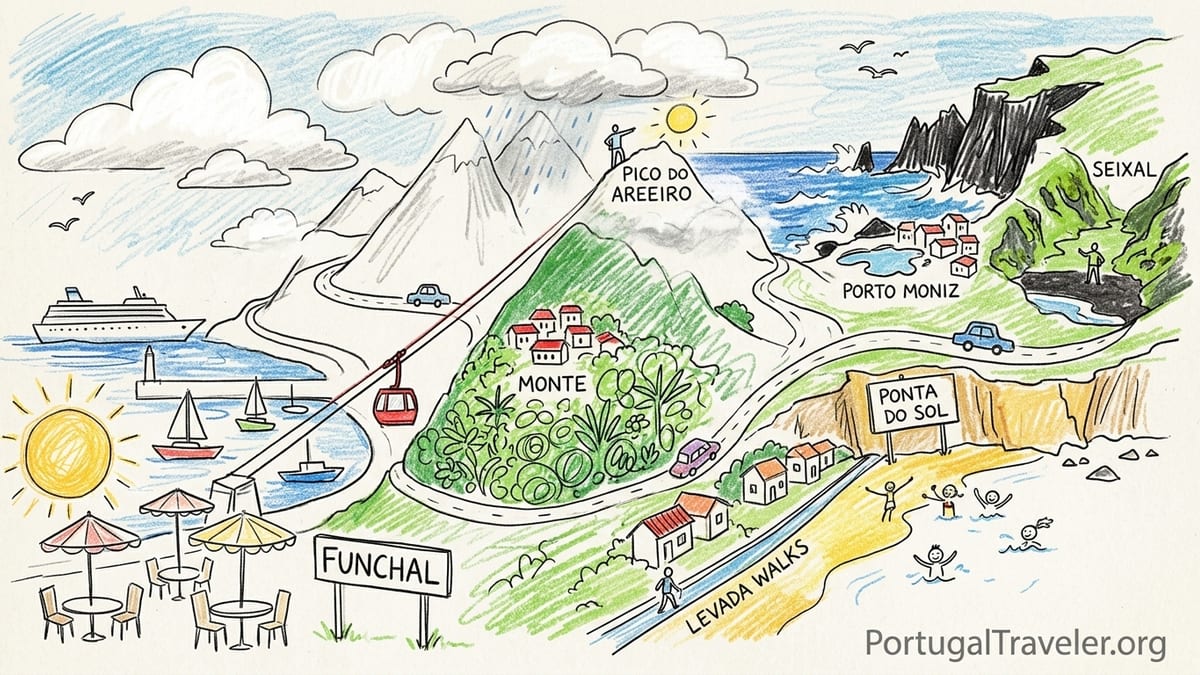
Funchal: My Essential Base, Not Just a Quick Stop
Across the twelve days, I spent five nights in Funchal, split between an apartment near the Sé cathedral and a small hotel above the Lido area. That felt about right for a first visit, but on a faster one week trip I would still allocate at least three nights here. Funchal was where I parked the car and forgot about it for a while, walked the flat waterfront, rode the cable car to Monte, and used the city buses to avoid steep uphill parking battles. A single day trip would not have given me enough time to see the old town, the covered market, the botanical gardens and still linger over an evening meal.
City life in Funchal means café terraces and busy pavements rather than skyscrapers or nightlife districts. Restaurant choice is broad: on my busiest evening I counted more than a dozen options within a five minute walk around Rua de Santa Maria, ranging from simple espetada skewers to more polished seafood. Prices felt close to what major European city centres charge for a casual dinner, with main courses in most mid range spots generally in the low to mid teens in euros when I visited. It was easy to eat well without booking weeks ahead, except when a large cruise ship had just docked.
Parking is where Funchal can either work or frustrate. My first mistake was booking an apartment in the old town with only vague "nearby street parking" hinted at in the listing. In reality, the public underground garages around the old centre and port were much easier. I learned to budget for paid parking, usually a modest daily sum for a central garage, and to treat the cable car to Monte as part of the city experience rather than something to drive to. A return ticket on the main Funchal cable car was a little over twenty euros per adult in 2026, and I found the fifteen minute ride over rooftops and gardens was worth doing once, especially with the car safely left in town.
Weather in Funchal during my stay was predictably mild and sunnier than the north coast. Even on days when clouds sat stubbornly on the central mountains, the city stayed warm enough for short sleeves. As a base, Funchal worked best at the start and end of the trip: a night on arrival to recover from the flight and get groceries, and another at the end for a final dinner, some last walks by the harbour, and a low stress drive back to the airport. I would not treat it as only a cruise day stop; it is the one place I would keep on any Madeira itinerary, even a three or four day one.
Ponta do Sol and the Sunny Southwest: Where I Should Have Stayed Longer
I devoted two nights to Ponta do Sol and quickly wished I had made it four. The village sits between cliffs on the south west coast and genuinely does feel sunnier than the north. During my stay in late spring, afternoons that were grey and damp in the interior opened into golden evenings here, with the pebble beach and small promenade catching the last light. The village delivered exactly the mix of swimming, sunset watching and low key restaurant life I wanted after days in the car.
As a base for a quieter, more local feeling stay, Ponta do Sol worked far better than I expected. There are only a handful of restaurant and bar options in the centre, plus a bakery for early morning coffee, yet I never felt stuck. I ate grilled limpets on the seafront one night, then walked all of three minutes to another spot serving simple fresh fish and house wine the next. For a self catering option, I stocked up at the supermarket in nearby Ribeira Brava before driving in, because parking right in the village is limited and I did not want to move the car any more than necessary.
Parking is the trade off for those sunsets. The first evening I arrived around 4 pm and scored a space in the small public lot near the sea. The second evening I returned later and circled long enough that I would not count on a stress free arrival in peak season. Once parked, though, I barely touched the car. This is where I walked part of the Levada do Moinho and Levada Nova loop that climbs out of the village. I underestimated the combination of heat and exposure on that path and turned back before completing the full circuit, but it gave me a clear sense that Ponta do Sol offers levada access on foot from the centre for anyone wanting a car free day.
If I were planning a shorter, seven night trip, I would probably split my time between three nights in Funchal and four in Ponta do Sol rather than moving bases more often. The weather advantage compared with the north, the easy evening swims off the pebble beach, and the simple pleasure of watching the sun slide into the Atlantic from a promenade bench made this part of Madeira feel like the place to slow down. It felt under used in my itinerary, and on a return visit I would deliberately schedule more non driving days here.
Porto Moniz and the North Coast: Great For a Day, Not For My Night
I spent one night and most of two days in Porto Moniz, drawn by the famous lava pools that appear on almost every Madeira brochure. The drive along the north west coast brought some of the most dramatic scenery of the entire trip, with tunnels cutting through sheer cliffs and sudden openings to views of surf crashing against black rock. When the sun came out, the colour of the water inside the natural pools shifted to a deep, almost tropical blue that looked exactly like the images that persuaded me to visit.
The practical experience was more mixed. I paid the modest entry fee at the main complex to swim in the organised pools with lifeguards, changing rooms and snack bar. The ticket cost a few euros per adult in 2026, and for that I got clean facilities and a sheltered swim while Atlantic waves crashed theatrically against the outer walls. For a first time visitor, it felt like money well spent. But the atmosphere around midday, when tour coaches arrived and day trippers from Funchal filled the walkways, was closer to a public resort pool than a wild natural spot. Later, I wandered over to the separate free rock pools near the aquarium and preferred the quieter, less manicured feel there.
Porto Moniz itself is small, with a handful of restaurants around the seafront. I ate one solid meal of grilled espada with banana at a restaurant that also welcomed large coach groups, and while the food was fine, the town felt more like a day trip staging area than a place to linger. By early evening, once the last buses had left, it quieted almost too much for my taste. The strong onshore wind that had kept the waves entertaining all afternoon turned cold, and I found myself walking back to the guesthouse by 9 pm. I was glad I had experienced it overnight, but for a future visit I would probably make Porto Moniz a long day trip from a base further south rather than a full stop.
Parking in Porto Moniz was easier than I feared. I arrived in the late morning, parked in a marked lot a short stroll from the pools and never had to circle more than once. Public transport connections across the north coast exist, but bus frequencies are limited enough that a car still felt like the realistic option for the sort of flexible schedule I was keeping. If you only have five or six days on Madeira, my honest advice after staying here is to treat Porto Moniz as a destination for one long, carefully chosen weather window: aim for a clear afternoon when the wind and swell line up, swim, walk the promenade, have a meal, and then drive back to your main base.
São Vicente, Seixal and the Lush Green North: Worth the Drive, Not a Primary Base
One of my main reasons for doing a full island loop was to experience the greener, wetter north. I broke the drive by spending a single night in São Vicente, with long stops in Seixal both days. The contrast with the south was immediate. Low clouds hung in the valley, waterfalls streaked the cliffs, and the vegetation looked closer to a subtropical forest than the terraced dry slopes above Funchal. As a landscape, this area fully delivered on the promise of "lush north coast" that had been in my head before I flew out.
Seixal in particular stood out. I swam off the black sand beach between rain showers, watching clouds roll over the mountain backdrop. Facilities here are simpler than in Porto Moniz, but there was free parking along the access road when I arrived mid morning and a basic bar where I paid a few euros for a coffee and pastry while waiting out a heavier shower. Even on a grey day, the setting felt spectacular, and from the road leading in I could see why so many photos of Madeira now show people looking back at the beach from the concrete pier.
São Vicente made sense as a sleepover because it sits reasonably close to some levada trailheads in the interior, but my overnight there was more functional than memorable. The village itself has a small cluster of restaurants, a riverside setting and a low key charm, yet it also sits in a deep valley that traps cloud. I had more drizzle than clear views, and by morning I was ready to climb back towards the sunnier south. The road out gave excellent viewpoints back towards the north, and in a way, that drive felt like the real reason to come here.
On a return visit, I would not use São Vicente or Seixal as my main base unless my entire trip revolved around levada hiking in the wetter, mossier parts of the island. For a typical first visit mixing city time, sea swimming and scenery, I think one or two well planned day trips from the south will show you the best of this coast. The roads are well engineered and, for all their drama, felt safe in normal weather. Just check local forecasts and webcams before committing to a full circuit if clouds are parked over the high passes.
High Mountains and Levadas: When the Weather Cooperates
I dedicated two full days to the high central mountains and levada walks, and if there is one part of Madeira where I would add more time, it is here, with one major caveat: the weather. The day I drove up to Pico do Areeiro for a dawn start, low cloud scraped the car for the final kilometres, only to part briefly at the summit for a glimpse of the famous sea of clouds. By mid morning the view was gone again. Parking near the top was already busy before sunrise, and even with an early start I used a lower lot and walked uphill to the main viewpoint.
On another day I tried to fit in a levada walk starting from a trailhead near the Encumeada pass. The path clung to the mountainside, with ferns brushing my arms and occasional views into deep ravines. What looked straightforward on a map turned into a longer outing once you factor in time for passing other hikers on narrow sections and stopping for photos. I turned around earlier than planned when afternoon cloud rolled in and muted the views. It taught me that levada days on Madeira reward a flexible schedule and the willingness to abandon a plan when conditions change.
Access to the levadas and peaks is strongly shaped by transport and, during busy months, by permit systems and capacity limits on the most popular routes. I drove myself, which made it easy to start early but required more thought about parking. At some higher trailheads, informal roadside parking that might have been tolerated a decade ago now appears to be more regulated, and I passed several areas where new signs and barriers limited where cars could pull off. Public transport to the high interior remains relatively sparse compared with coastal routes, so if you do not want to join an organised tour, a rental car still gives the most freedom.
If you only have a few days on the island, this is where hard choices come in. I would keep at least one mountain or levada day in any itinerary, but I would not try to tick off every famous walk. In hindsight, I might skip a crowded peak to spend more time on a quieter levada in the laurel forest, even if it meant following a less iconic route name. What mattered to me, once there, was the feeling of walking along a contour with water at my side and deep green slopes falling away below, not whether I had matched the most photographed trail on social media.
Calheta, Câmara de Lobos and Stops That Felt Overrated
Not every stop on my circuit of Madeira lived up to its billing. I stayed one night in Calheta, partly lured by the idea of a sand beach more suitable for an end of trip laze. The artificial yellow sand cove looked pleasant enough, especially compared with the rockier beaches elsewhere, but the area directly behind it is dominated by modern apartment blocks and a large hotel. After wandering the seafront, I struggled to find much character. There were several restaurants and a marina, but the overall feel was of a resort that could almost be anywhere. For my tastes, that single night was enough, and on a shorter visit I would probably skip Calheta in favour of more time in Ponta do Sol or back in Funchal.
Câmara de Lobos, the fishing town west of Funchal, was another place I found more appealing in photos than in person. I stopped here twice, each time for a couple of hours to wander around the small harbour and try a poncha at a traditional bar. The setting is undeniably pretty, with colourful boats pulled up on the shingle and houses rising behind them, and it has a genuine fishing heritage. Yet it was also busier and more packaged than I expected, with tour groups and tuk tuks congregating along the waterfront. Parking involved tight street spaces and a bit of patience, and once I had walked the harbour circuit, I felt I had seen what I wanted.
Both of these places reinforced an important lesson from the trip: not every name that surfaces first in guidebooks or online lists will match your personal idea of Madeira. In my case, smaller villages like Ponta do Sol, and wild corners of the north coast, delivered more of what I had flown out to find than a purpose built beach in Calheta. If you only have time for one or two short south coast detours from Funchal, I would prioritise Ponta do Sol for sunset and a swim rather than carving out a night in Calheta, and I would treat Câmara de Lobos as an afternoon wander on the way back from somewhere else rather than a destination in its own right.
Weather played its part here too. On the afternoon I went to Câmara de Lobos, cloud cover flattened the light, muting the turquoise water that makes the classic photographs. On a bluer day, I might have been kinder. But travel is about what you encounter, not what might have been, and the contrast with the golden evenings I enjoyed in Ponta do Sol made these ports feel less essential when I looked back at how I had spent my time.
The Takeaway: How I Would Redistribute My Time on Madeira
Looking back at my twelve day clockwise loop, if I were planning a tighter seven or eight day trip to Madeira, I would change how I allocated my nights. Funchal would remain my arrival and departure hub, but instead of five nights split across the beginning and end, I would book three nights there in one stretch. That would be enough for an unhurried wander through the old town and market, one cable car trip to Monte with a garden visit, and a day to explore the waterfront and Lido area, all without trying to use the car inside the city.
Ponta do Sol would be my main coastal base on a return visit. Instead of the two nights I originally gave it, I would plan four, leaving the car parked in a paid spot if needed and using those days for a mix of sea swimming, short levada walks and simple village life. From there, I could day trip west towards Calheta if I really wanted another look at the artificial beach, or east towards Câmara de Lobos and back to Funchal, but without feeling obligated to sleep in either place. The weather advantage and sunsets alone justify a longer stay here.
For the north and mountains, I would compress my time into focused day trips rather than extra one night stands. From a base in the south, I could pick the best forecast day to drive up to Pico do Areeiro for views and a partial hike, and another to cross to Porto Moniz and Seixal. This approach reduces the risk of waking up in a clouded in valley like São Vicente and wondering if you should have just stayed on the sunnier side. If hiking is your priority, you might reverse this logic and base in the interior, but my experience suggested that most first time visitors are happier sleeping where evenings are warmer and drier.
The biggest lesson from my circuit is that Madeira rewards both movement and stillness, but not necessarily in the same places. Use Funchal for culture and logistics, Ponta do Sol or a similar south west village for slow days by the sea, the north coast for big landscape drives and short dramatic stops, and the mountains for early starts and weather dependent walks. Be prepared to skip a famous spot if conditions look poor or the parking situation feels stressful. The island is compact, but not so small that you have to sleep everywhere you visit.
FAQ
Q1. How many nights should I spend in Funchal on a first trip?
Three nights in Funchal worked well for me, giving enough time to walk the centre, visit Monte by cable car and enjoy evenings by the harbour without rushing.
Q2. Is it worth renting a car for Madeira or can I rely on buses?
I drove the whole loop and found a car invaluable for reaching trailheads and the north coast on my own schedule, although Funchal itself is easier by foot, taxi and bus.
Q3. Which place on Madeira is best for sunsets and swimming?
Ponta do Sol gave me the best combination of reliable sunsets, an easy access pebble beach and a compact village where I could swim, shower and be at dinner within minutes.
Q4. Are the Porto Moniz natural pools worth paying for?
Yes for a first visit: the small entry fee buys lifeguards, facilities and an impressive setting, but I preferred the quieter free pools nearby once I had seen both.
Q5. Where would you base yourself if you only had one week on Madeira?
On a seven night trip I would split my time between Funchal for city life and logistics and Ponta do Sol on the south west coast for sea, sunsets and easy access to drives.
Q6. Is the north coast too rainy to stay overnight?
I had more cloud and showers around São Vicente and Seixal than in the south, so I preferred them as day trips, but hikers keen on lush levadas may still enjoy staying there.
Q7. Which famous places would you skip on a short trip?
On a shorter itinerary I would skip an overnight in Calheta and treat Câmara de Lobos as a brief stop, focusing overnight stays instead on Funchal and the south west.
Q8. How difficult is parking in Madeira’s small villages?
Parking varies; Funchal and Ponta do Sol can be tight at peak times, while Porto Moniz and São Vicente were manageable when I arrived earlier in the day and used marked lots.
Q9. Do I need to book levada walks or mountain hikes in advance?
For less famous levadas I simply showed up, but for the busiest routes and guided hikes, especially in high season, it is wise to check current permit rules and availability.
Q10. What surprised you most about traveling around Madeira?
The contrast between the dry, sunny south and the lush, cloudier north over short driving distances surprised me, and it changed how I chose my overnight bases mid trip.