


I went to Madeira with a simple idea: I wanted to swim in the Atlantic every day, not just look at it from viewpoints. I had seen the famous photos of lava pools and turquoise coves, but I quickly discovered that not every beautiful rock pool is actually enjoyable or even safe to swim in. Over two weeks I tested managed volcanic complexes, wild natural pools, town beaches, simple bathing terraces and straight open-ocean entries, driving the island from Funchal’s south coast to the far north. What follows is a first person account of what it really feels like to swim in these different settings, and how a visitor can decide which kind of Madeira sea experience will genuinely work for them.
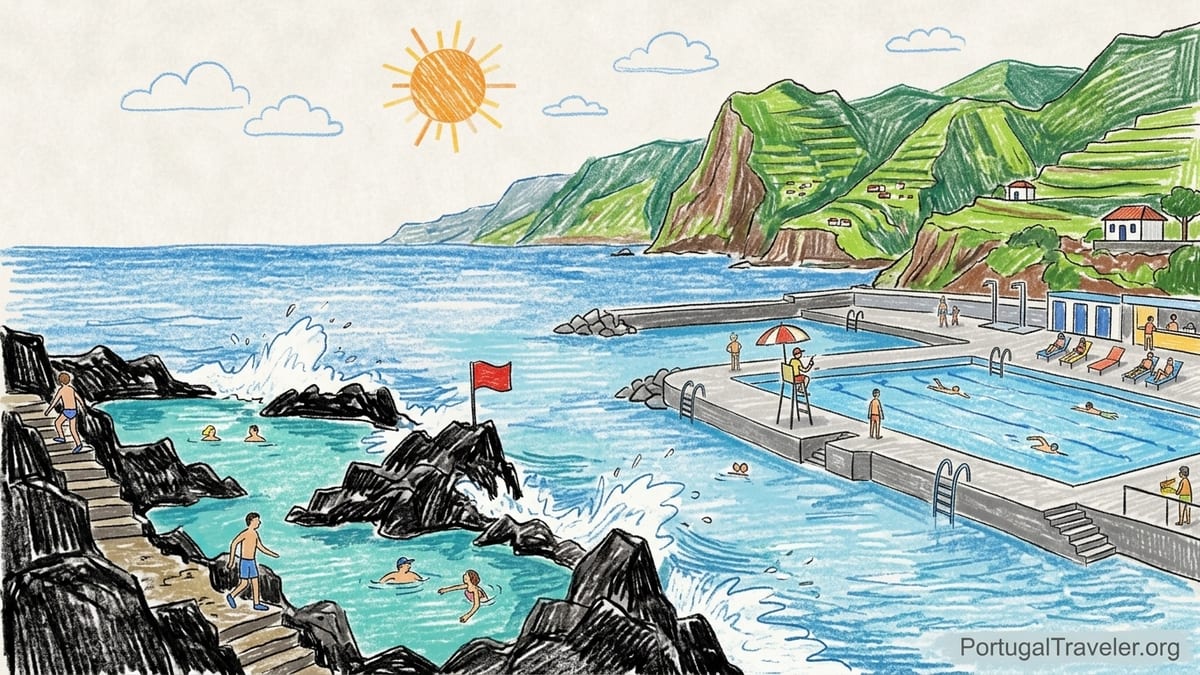
Understanding Madeira’s Sea and Water Temperatures
Before I ever stepped into a lava pool, I had to adjust my expectations about the Atlantic around Madeira. This is not a tropical lagoon. Even in high summer, the sea here usually runs in the low twenties Celsius, roughly 21 to 24 degrees, and in late autumn it can still sit around 22 to 23 degrees near Funchal. In winter it often drops to about 18 degrees, which feels brisk if you come straight from a heated hotel pool but still swimmable with a bit of determination. On my late September trip the daily sea temperature charts for Funchal showed around 23 degrees, and that matched what my skin felt when I eased down the first steel ladder into the water.
Those numbers, however, do not tell you how different the sea feels on each coast. The south-facing bays around Funchal and Câmara de Lobos tend to be more sheltered. On calm days, the water at Doca do Cavacas in Funchal felt only slightly cooler than a typical unheated Mediterranean hotel pool. On the north coast, around Seixal and Porto Moniz, the same nominal temperature felt sharper because of strong swell and wind. The Atlantic is more exposed there, so a 22 degree reading can feel almost cold when big sets pound into the rocks and spray the walkways.
I learned quickly that sun and wind changed my comfort far more than the thermometer did. On an overcast, breezy morning in Porto Moniz, I shivered climbing out of the pools, even in late summer. Two days later, with full sun and almost no wind at the same complex, the identical water temperature felt inviting and I stayed in long enough to do laps between lava outcrops. If you are sensitive to cold, choose south coast bathing complexes and mid to late afternoon sessions when the rocks have been heating for hours.
The final variable is swell. Madeira’s north coast is notorious for big winter surf that can close pools and make beaches unswimmable, sometimes even in shoulder seasons. I saw official red flags at natural pools that looked postcard perfect in photographs but were clearly unsafe in reality, with whitewater exploding across the rocks and entry ladders completely engulfed. It taught me to treat every pool as part of the open Atlantic, not as a sealed-off resort feature.
Managed Volcanic Pools: My Days in Porto Moniz
Most visitors see Porto Moniz first in photographs, a checkerboard of turquoise pools edged by black lava on the far northwestern corner of the island. I arrived on a late September afternoon and paid a modest entry fee at the main ticketed complex, the one with concrete walkways and lifeguards. Inside, I found a sprawling arrangement of interlinked pools and channels carved into the lava, laid out over roughly 3,800 square metres of swimming area and more than 3,000 square metres of solarium terraces, according to the municipality’s own figures.
In practical terms, this meant I had options. There was a shallow children’s area where toddlers splashed in knee-deep water, a mid-depth pool ringed by rocks for relaxed floating, and deeper pockets where I could push off and swim real lengths. Changing rooms and showers sat behind the pools, basic but clean, along with a snack bar and a clearly signed first-aid post. On my visit, lifeguards watched from elevated chairs, blowing whistles when teenagers tried to jump from off-limits rocks. Wheelchair ramps and railings ran along some sections, so access did not depend solely on agility or balance.
What mattered most to me, though, was how it felt to get in and out. The managed complex had metal ladders fixed securely into smooth cutouts in the rock, with handrails on both sides. I could step down slowly and gauge the swell before committing my full weight to the ocean. Even on a day with small waves, I felt the water surge through the pools, but the outer walls took the worst of it. When larger sets arrived, whitewater sometimes washed over the seaward edges, and the lifeguards temporarily closed off certain exposed corners. My comfort level remained high because I could always move to an inner section or simply climb out quickly on the ladders.
Crowding varied by time of day. Midday saw bus tours arrive and sun loungers fill, and parking in the village lot near the pools turned competitive. Early morning and late afternoon were noticeably quieter, with local families and a few swimmers doing laps. I learned to bring sturdy water shoes, since the natural lava underfoot is rough and sometimes sharp. Within the managed area it had been partially smoothed, but there were still jagged spots under the surface. With footwear, I felt confident walking from deck to pool and exploring the more natural corners near the wave-exposed side, then retreating to the main basins when the swell increased.
Free Natural Pools: Seixal and Porto Moniz’s Wild Side
After enjoying the safety net of Porto Moniz’s managed complex, I wanted to feel what the “wild” pools were like. My first test was the free natural pool by the Cachalote restaurant, just a short walk from the ticketed area in Porto Moniz. Here the lava basins remain more or less as the Atlantic carved them, with lower walls and no lifeguards or turnstiles. Entry is free and there are no changing rooms inside the pool area, only nearby toilets and restaurant facilities if you buy something.
On a calm morning, the experience was magical. Clear water filled pockets among the rocks, and I slipped from one basin to another, sometimes sitting on submerged lava ledges, sometimes floating where the depth increased. Without ladders, however, entry and exit required more attention. I had to pick my spot carefully, lower myself onto uneven rock and plan a line back out. When a slightly larger wave came through, the surge tugged harder at my legs, and I instantly understood why families with small children prefer the paid complex up the road. I felt comfortable because I am a confident swimmer, but the margin for error was smaller.
In Seixal, I found free natural pools of a very different character, sculpted in the black rocks below the main road. These pools have become popular in recent years, and in summer 2024 a lifeguard post was reportedly added near the larger basin. There were simple changing cabins and a snack kiosk, but no extensive built-up infrastructure. When I arrived on a bright day with a mid-range swell, the scene was both inviting and intimidating: glassy turquoise pools under a backdrop of green cliffs, but with wave sets that occasionally curled right over the lowest walls.
Getting into the water in Seixal’s pools meant again choosing my spot with care. Some basins had rock shelves where I could sit and slide gently into deep clear water. Others were bordered by drop-offs where the Atlantic surged in and out with force. I wore proper water shoes here and was glad I did, because the lava was extremely rough and pitted. I noticed that when a group of larger waves hit, the pools changed character in seconds. Calm mirrors turned into washing machines, and less experienced swimmers quickly scrambled back to the rocks. For me, this type of natural pool felt thrilling but required constant situational awareness. It was the clearest example of how a beautiful photo can hide a dynamic, sometimes unforgiving environment.
Beaches and Black Sand: Seixal, Calheta and Beyond
After days among lava basins, I wanted a simple walk-in entry, so I headed to Seixal’s black sand beach, sometimes called Porto do Seixal. This relatively new stretch of dark volcanic sand sits beside the small port, framed by terraced slopes and waterfalls in the distance. On arrival, I found a modest car park that filled quickly, a cluster of informal bars and snack places, and an external cold-water shower near the access path. There were no permanent lifeguard towers when I visited, though locals told me that summer weekends sometimes bring supervision.
Stepping into the water here felt entirely different from edging down a ladder. The sand shelved gradually, which made the first ten or fifteen metres very comfortable for paddling and for less confident swimmers. Small waves broke over the shallows, and even families with young children played at the shoreline. Further out, the swell started to show its power. The north coast orientation meant that sets could suddenly grow in height, and I had to keep an eye on the horizon while swimming parallel to the beach. Exit was easy in theory, because I could always walk up the sand, but I still timed my returns between bigger waves to avoid being knocked over by shore break.
On the south coast, Calheta offered a softer, more controlled beach experience. Here the main beach sits inside breakwaters built to create an artificial golden sand strip. When I swam there, the sea felt calmer and more predictable than at Seixal. There were lifeguards on duty in high season, proper changing facilities behind the sand, and cafes and restaurants along the promenade. The cost was a little less “wild Atlantic” atmosphere, but I finally relaxed into longer, uninterrupted swims without thinking about rogue sets or hidden lava shelves underfoot.
For a different flavor, I tried the pebbly stretch at Praia Formosa on the western edge of Funchal. The access involved walking over rounded stones rather than sand, so water shoes helped here too. Once in, the sea felt similar in temperature to the nearby pools, but the open exposure gave a stronger swell. There were showers along the promenade and seasonal lifeguard posts, though the exact staffing varies by month. On one day, with a moderate swell, I found it comfortable and refreshing. On another, with larger waves, the shore break made entry and exit a full-body exercise in timing and balance, and I decided to stick to waist-deep water.
Urban Bathing Complexes: Doca do Cavacas and the Funchal Coast
If natural pools are about drama, Funchal’s bathing complexes are about access. Doca do Cavacas, also known locally as Poças do Gomes, sits tucked into the rocks between the Lido area and Praia Formosa, just west of central Funchal. From the street I walked down through a small entrance where I paid a modest day fee. Inside, I found a compact complex of volcanic pools and concrete sun terraces, with a bar, toilets, outdoor showers and a tunnel that leads directly toward Praia Formosa.
The main natural pool at Doca do Cavacas was filled by the tide, its rim slightly raised above the open Atlantic. On my visit, the water inside moved gently, sloshing against the black walls without throwing me around. Several sturdy metal ladders allowed entry into both the pool and the open sea beyond. I first eased into the pool, which felt like a natural saltwater lido, then tried the direct ocean ladder. Outside the walls, the swell felt immediately stronger. Even on a calm day, the rise and fall of the Atlantic lifted me a metre at a time, so I stayed close to the ladder and kept one hand in easy reach.
The presence of lifeguards made a psychological difference here. I watched them whistle people back from wave-exposed ledges and close off the open-sea ladder for short periods when sets grew larger. The complex had a mix of visitors: local teenagers who treated it like a daily hangout, couples with beach bags, a few cruise passengers who had wandered down from the promenade. Sunbeds for hire filled early, but there was always some corner of concrete where I could lay a towel. Parking nearby was limited and often involved using a paid lot or walking five to ten minutes from street parking higher up the hill.
Elsewhere along the Funchal coast, other bathing complexes like the main Lido follow a similar pattern: ticketed access, concrete terraces, saltwater pools refreshed by the sea, showers, toilets and bars. Compared with the north coast, these sites felt almost predictable. On windy days, spray sometimes blew over the walls and rougher sea conditions could close direct ocean access, but I rarely saw the pools themselves unswimmable. For visitors who want an easy, near-urban swim with guaranteed ladders, flat surfaces and relatively warm microclimates, the south coast complexes offer a comfortable balance between nature and infrastructure.
Open-Ocean Access: Straight Into the Atlantic
Despite the allure of pools and complexes, there were moments when I wanted nothing between myself and the full Atlantic. Madeira offers several spots where you can drop straight into deep ocean water from steps or ladders cut into the rock. In Câmara de Lobos, I watched local teenagers leap from harbor walls, and in Ponta do Sol and other coves on the south coast, I found simple concrete platforms with handrails descending into blue depths.
The open-ocean swims were the most exhilarating, but they demanded the clearest self-assessment. Without enclosing walls or breakwaters, swell and currents were immediately obvious. Even on the calmer south coast, there was constant movement. I chose a ladder in a sheltered nook behind a small harbor wall and waited several minutes, watching the pattern of the waves. When I finally lowered myself in, the water felt deep and free beneath me, the seabed disappearing into blue. There was plenty of depth for confident diving and no rough lava underfoot, but I stayed close enough to the ladder to reach it in a few strokes if I needed to bail out.
These spots almost never have lifeguards or formal facilities beyond perhaps a shower somewhere on the promenade. Changing usually happens under a towel or back at your accommodation. Water shoes are useful for the approach, since many of the access points involve uneven rocks before you reach the concrete steps. On days with larger swell, I skipped open-ocean swims entirely, especially on the north coast. I saw waves slam against harbor walls with enough force to drench parked cars, and ladders that had been perfectly usable on calm days disappeared under foamy water. The sea looked magnificent, but I knew I would not enjoy a swim that felt like a constant wrestling match.
When conditions lined up, though, these ladder entries gave me my purest sense of swimming in Madeira. The water felt slightly cooler than in the enclosed pools because of the direct exposure, but the clarity of the Atlantic and the sense of depth more than compensated. Small fish flickered below, and in a couple of places, I could see the shadowy outline of submerged rocks far beneath my kicking feet. This is the kind of experience best suited to strong, confident swimmers, comfortable with unpredictable swell and without a need for nearby facilities.
How Weather, Tide and Swell Changed My Plans
Over two weeks I repeatedly discovered that what looked inviting at breakfast could be unswimmable by lunch. Madeira’s microclimates and exposure mean that the north and south coasts often live different days. On one morning, Funchal’s sea lay almost flat while Porto Moniz took direct hits from long period swell that turned the outer natural pools into whitewater. A local café owner in Porto Moniz shrugged and told me it had been calm the day before and might be calm again tomorrow. For me, that meant driving with flexible plans and never assuming that a specific pool would be swimmable on a given hour.
Tide levels also changed how each site felt. In Porto Moniz’s managed complex at low tide, some of the inner basins became more separate from the open sea, and surface chop calmed down. At higher tide, those same basins connected more strongly, and the surges around the outer walls intensified. In Seixal’s free pools, high tide brought waves right over some lava walls, temporarily flooding basins where I had floated comfortably at lower levels. On those occasions, I turned from swimmer into spectator, watching the Atlantic show off while I stayed dry.
Rain did not automatically cancel swimming, but wind often did. On one blustery day in Funchal, I walked down to Doca do Cavacas and immediately saw spray blasting over the outer railings and lifeguards keeping everyone inside the most protected basin. Technically, the complex was open and the water temperature was perfectly acceptable. In practice, the constant spray and the effort of fighting whitecaps made it look deeply unappealing. I turned around, chose a café with a glass wall facing the sea and saved my swim for the next morning, which arrived with calmer conditions and easy, glassy water.
My personal rule became simple: if the entry or exit looked like it would require a burst of athleticism or a lucky lull in the waves, I treated the spot as unswimmable for that moment, no matter how many social media posts suggested otherwise. A beautiful rock pool with dry black walls and a gentle tide can transform in minutes when the period of the swell changes. Local advice, lifeguard flags and my own eyes mattered more than any guidebook description.
Choosing the Right Kind of Madeira Swim for You
By the end of my island loop, I had a much clearer sense of which type of Madeira swimming experience suits which kind of traveler. If you value comfort and predictability above all, the managed volcanic complexes like Porto Moniz’s main pools or the Funchal Lido zone are hard to beat. You get secure ladders, flat sun terraces, showers, changing rooms, toilets, nearby cafes and usually lifeguards in season. Parking can be busy, but once inside you can relax into the water without constantly calculating how you will climb out if a bigger set arrives.
If you are a strong swimmer who enjoys a sense of wildness, then free natural pools such as Seixal’s lava basins or Porto Moniz’s unticketed Cachalote area offer something special. Here you trade facilities for atmosphere. You might change behind a rock, bring your own snacks and keep your shoes on right up to the water’s edge. In return, you swim in sculpted volcanic pockets where the Atlantic breathes through the rocks. Just accept that on rough days you may only watch, not swim.
Beach lovers will find their happiness in places like Seixal’s black sand cove, Calheta’s sheltered golden strip or the pebbly sweep of Praia Formosa. These entries feel intuitive, especially for less confident swimmers or families, because you can wade in slowly and always stand up again in the shallows. Official lifeguard presence changes by beach and season, so check current information when you arrive. Even without constant supervision, the simple fact of a sloping seabed instead of lava shelves makes these beaches feel more forgiving, as long as you respect shore break on bigger days.
Finally, if you are experienced and crave direct immersion in deep ocean, the open-ladder spots around small harbors and cliffs will probably be your highlight. Here you will find almost no facilities, often no supervision, and complete exposure to the Atlantic’s moods. Good footwear, an honest assessment of your abilities and a habit of watching locals before you jump in are essential. When it all lines up, though, you get that rare feeling of hovering in blue water with the island rising almost vertical behind you, which no built pool can quite match.
The Takeaway
I arrived in Madeira imagining that “natural pools” were a single category, a uniform experience scattered around the island. I left understanding that the phrase hides a spectrum, from highly managed volcanic complexes with first-aid posts and smooth ladders, to raw lava basins where you climb in and out on your own terms, to simple ladders bolted into harbor walls with nothing but open Atlantic beneath them. The difference between an enjoyable swim and a nervous scramble back to shore depended not only on the place, but on the day, the tide, the swell and my own energy level.
Looking back, the swims I enjoyed the most were the ones that matched my mood and ability in that moment. On windy, unsettled days I was deeply grateful for sheltered south coast complexes like Doca do Cavacas. On calm mornings, I treasured drifting through Porto Moniz’s natural shapes or duck-diving in Seixal’s glassy pools. When I wanted simple comfort, I chose a beach like Calheta where the biggest question was whether I felt like another ice cream afterward. Madeira rewarded that flexibility. The island offers nearly every kind of ocean access, from gentle family paddling to serious Atlantic immersion, often within a short drive of each other.
If you come to Madeira chasing those famous lava pool photographs, bring water shoes, a willingness to change plans and a clear sense of your own comfort zone. Trust the lifeguard flags, listen to locals when they call a spot dangerous, and accept that some of the most beautiful pools may only be swimmable for a small slice of the day or season. In return, you will get some of the most memorable saltwater hours you can have in Europe: floating among volcanic rocks as trade wind clouds slide overhead, or treading water at the base of cliffs with the whole North Atlantic breathing quietly beneath you.
FAQ
Q1. Is it safe to swim in Madeira’s natural pools if I am not a strong swimmer?
It can be, but you need to choose carefully. Managed complexes like the main Porto Moniz pools or south-coast bathing areas with lifeguards and ladders are the safest options for less confident swimmers, while more exposed free pools and open-ocean ladders are best left to strong, experienced swimmers.
Q2. Do I really need water shoes for the lava pools?
They are highly recommended. Volcanic rock in places like Porto Moniz and Seixal is rough and sharp underfoot. Water shoes make walking on the rocks, using ladders and getting in and out of natural basins much more comfortable and reduce the risk of cuts.
Q3. What is the best time of year for comfortable sea temperatures in Madeira?
Sea temperatures are usually warmest from late summer into early autumn, roughly August to October, when the water often sits around the low twenties Celsius. Winter months can still be swimmable but feel cooler, especially on windy days.
Q4. How crowded do the Porto Moniz pools get?
In high season, especially midday when tour buses arrive, the managed complex can become quite busy and parking fills up. Early mornings and late afternoons are usually calmer, with more space on the terraces and in the water.
Q5. Are there lifeguards at all of Madeira’s natural pools and beaches?
No. Some sites, such as major bathing complexes and a few popular beaches, have seasonal lifeguard supervision, but many free natural pools and open-ocean access points do not. Always check on arrival and do not assume there is a guard on duty.
Q6. Can children use the natural lava pools safely?
Children can enjoy some managed pools, especially where there are clearly designated shallow areas, gentle access and lifeguards. Many wild lava basins and exposed north-coast spots are not suitable for young children because of depth, surge and slippery rocks.
Q7. What happens if the swell is big on the day I plan to swim?
Large swell can close pools and make beaches unsafe, especially on the north coast. If you arrive to find heavy waves, treat your plan as flexible. Look for sheltered south-coast options, or enjoy the scenery from shore and wait for calmer conditions.
Q8. Are there changing rooms and showers at every swimming spot?
No. Ticketed bathing complexes and some town beaches usually provide changing cabins and showers, but many free natural pools and open-ocean ladders offer only very basic facilities or none at all. Be prepared to change under a towel or back at your accommodation.
Q9. Is parking difficult near the main pools and beaches?
In popular places like Porto Moniz, Seixal beach and Doca do Cavacas, parking can be tight in high season and midday. Arriving early or later in the afternoon, or being willing to walk a short distance from higher streets, makes the experience easier.
Q10. How can I tell if a beautiful lava pool is realistically swimmable?
Look at entry and exit points, watch how waves interact with the rocks and check for flags or warning signs. If ladders are submerged, waves are regularly washing over the walls, or locals are not swimming, it is usually better to stay on shore and enjoy the view.