


I went to Madeira imagining a relaxed island road trip: coastal viewpoints, levada trailheads and long lunches in fishing villages. What I did not fully understand, even after all the warnings, was how intense it can feel to actually drive around a steep volcanic island that has been stitched together with tunnels and hairpins. This is not a theoretical guide pulled from a map. It is what I learned from roads I genuinely drove, where my small rental car sometimes felt heroic, sometimes hopeless, and occasionally stayed parked while I let someone else do the driving.
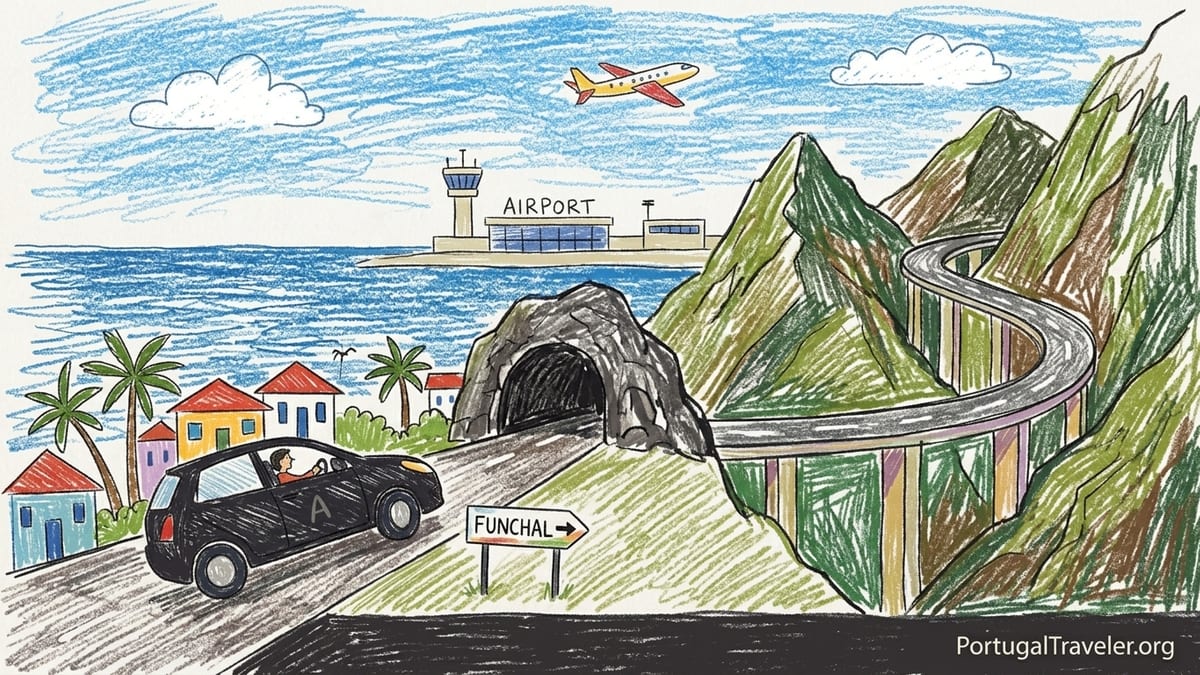
Picking Up the Car at Madeira Airport
My road trip started under fluorescent lights at Cristiano Ronaldo Madeira International Airport. The rental desks sit just beyond arrivals, with a mix of global brands and local outfits all advertising compact cars that look identical on the brochure. I had pre-booked a small hatchback, explicitly asking for an automatic with at least a 1.3 to 1.5 litre engine after reading that anything much weaker could struggle on the island’s steeper hills. When I reached the counter, the agent cheerfully told me they had “a similar car” available: a tiny petrol manual with a 1.0 litre engine.
This is the first real decision most drivers face in Madeira. A manual is cheaper and more plentiful, but it puts you in charge of every hill start and every hairpin. An automatic costs more per day, often by a noticeable margin once you add full insurance, but it removes the need to juggle clutch and throttle on gradients that would be considered extreme in many other parts of Europe. Remembering all the stories of burnt clutches and frightened drivers reversing back down lanes, I politely but firmly insisted on an automatic. After a few minutes of keyboard tapping, an automatic compact with a slightly larger engine appeared at the side entrance, and I knew I had made the right call before I even left the parking ramp.
Like most airport rentals, the car came with a large damage deposit blocked on my card and a fuel-to-full policy. I walked around it filming the bodywork and wheels, knowing that rural parking and tight garages can be unforgiving. The agent highlighted “no off-road” and “no unpaved levada accesses” in the contract, but there were no toll devices to worry about; Madeira’s roads are toll free. The final piece of paperwork was a reminder about tunnel speed cameras, both fixed and average-speed, which became very real later in the trip when I saw other drivers slam on the brakes at the start of long undersea-like stretches of VR1.
The exit from the airport car park immediately showed why car choice matters. The ramp out is short and steep, dropping you directly into traffic on a slope. In a small manual you would be balancing clutch smell and handbrake finesse from the first minute. In the automatic I only had to concentrate on the unfamiliar car and the heavy truck breathing down my rear bumper.
First Contact With Madeira’s Tunnels and Motorway Network
The drive from the airport towards Funchal along the VR1 is deceptive. On a map it looks like a tight coastal road; in reality it is a modern fast route carried on viaducts and threaded through the rock by tunnels. Within ten minutes I had passed through multiple tunnels of varying length, some short bursts of darkness, others so long that you lose sense of distance and gradient. The posted speed limit is around 100 km/h on much of this stretch, though real speeds fluctuate with weather and confidence.
On that first evening, the sky over the Atlantic was bright but the tunnels were dim and slightly damp. Entering at full daylight and emerging into blinding sun every few minutes was exhausting at first. I found myself dialing back to 80 km/h in the longer tunnels, partly to avoid catching up with local drivers who know every bend, partly because the absence of a hard shoulder made every breakdown bay and camera feel more significant. The car’s automatic gearbox helped; I could focus on the rhythm of dark and light, wet and dry, without worrying about finding the right gear each time the road tipped gently up or down inside the mountain.
What the motorway section hides is how quickly things can change when you leave it. My accommodation for the first nights lay in the hills above Funchal, so after twenty straightforward minutes on the VR1, my navigation app signaled a right turn onto a local road that immediately reared up like a ski jump. The contrast was brutal. One moment I was cruising in a tunnel; the next I was crawling in first gear up a concrete ramp between stone walls, wondering how delivery vans and buses ever reached these addresses. That single transition prepared me better than any blog post for the rest of the week.
Manual vs Automatic in Real Steep Situations
The question I am asked most often after this trip is whether an automatic is really worth paying more for in Madeira. The answer depends on where you drive, but on the roads I used, the premium felt justified every single day. Even with an automatic, I frequently had the gearbox locked in low gears on confined streets and tight viewpoints. Several times, in Funchal and in hill villages above Câmara de Lobos, I found myself on gradients that required full throttle just to maintain a slow, steady climb.
One concrete example came on a residential road north of Funchal, where my navigation suggested a “shortcut” between two main routes. The lane narrowed to a single track with parked cars on one side and a wall on the other, then suddenly pitched up to what felt like a 20 percent gradient or more. Halfway up, a local driver appeared at the top and started down. We both stopped. There was no room to pass and no obvious passing place between us. In a manual, that would have meant a nerve-wracking hill start in reverse, balancing mirrors, engine and gravity. In the automatic, reversing back to the last driveway was still stressful but mechanically straightforward. After that, I changed my app settings to strongly prefer main roads and avoided “shortcuts” that looked like goat tracks.
The difference was just as clear leaving trailheads in the central mountains. At the parking area above Pico do Arieiro, early morning cloud had left the tarmac slick. Buses, taxis and small rental cars all shared the same few meters of maneuvering space. Watching drivers in low-powered manuals try to pull out of slightly uphill spaces between coaches, on cold engines and wet tarmac, convinced me that the extra euros per day on an automatic were a form of travel insurance. My own car occasionally hunted between first and second gear on hairpins, but I never once smelled clutch or rolled back unintentionally.
If you are confident with a manual on steep terrain, a 1.2 litre or larger car will cope, and many locals drive everyday routes that tourists call terrifying. For everyone else, including me, the automatic reduced the cognitive load just enough that I could notice the scenery and stay patient when mistakes happened. The only downside was fuel economy; constant low-gear work and mountain climbs meant consumption figures that looked far worse than the brochure, but filling up at larger stations in Funchal and Ribeira Brava remained manageable across the week.
Navigating Hairpins, Gradients and Narrow Village Streets
Madeira’s most memorable roads are not technically difficult from an engineering standpoint. Surfaces are usually in decent condition, and most dangerous old alignments have been bypassed. The challenge lies in how steeply towns are built and how little spare space exists between houses, walls and terraces. In practice, this means sequences of hairpins where you are simultaneously checking mirrors for impatient locals, watching for buses that need half the width of the road, and trying to keep enough momentum that you do not stall on the tightest part of the bend.
One morning I drove from Funchal up to Eira do Serrado, the viewpoint over Curral das Freiras. The first part used a main road, wide enough for coaches, but beyond a certain junction the bends tightened and the gradient sharpened. At several hairpins, the safest tactic was to swing as wide as oncoming traffic allowed, accept that the car would almost stop mid-turn, then gently push the throttle while the automatic dropped into first and the engine roared more than I would ever tolerate at home. There were no guardrails separating me from steep slopes, only low stone walls, and on a few bends I had to reverse once to avoid crossing into the oncoming lane. Drivers behind waited calmly; they were clearly used to visiting motorists underestimating how little turning circle their rental had.
In coastal villages like Câmara de Lobos and Seixal, the issue was less about gradient and more about width. The main access roads in and out are fine, but once you follow a sign for “centro” or “zona velha,” you can quickly find yourself committed to a stone-lined lane where the wing mirrors feel wider than the asphalt. I made one such mistake in the old core of Câmara de Lobos. A sign indicated public parking ahead, but the last hundred meters ran between high walls with no passing spaces. Meeting a small truck halfway would have been impossible. I crept along in first gear, folded the mirrors and held my breath while a line of parked cars formed a metallic slalom. When I finally reached the tiny parking bay, I knew I would be walking back up the hill rather than driving deeper into the neighborhood.
These experiences taught me a hierarchy of priorities for village driving days. First, I learned to park at the edge of towns rather than following navigation arrows into the historic hearts. Second, whenever I saw a bus using a particular street, I treated that as a sign that the road, while tight, was considered a main artery and at least had somewhere to pull over. Third, I put my pride aside: if a road ahead looked so steep that I instinctively leaned back in my seat, I turned around and found an alternative route instead of proving anything.
Old Scenic Roads vs the Fast Tunnel Network
The contrast between Madeira’s old coastal and mountain roads and its modern tunnel network shapes any realistic driving itinerary. On my north coast day, I used both. Leaving Funchal, I followed the VR1 west to Ribeira Brava, then turned inland and climbed across the interior towards São Vicente. This route used a mix of long tunnels and wide modern roads, allowing me to reach the north coast surprisingly quickly. From São Vicente to Seixal and Porto Moniz, however, the character changed entirely: the road clung to cliffs, dove in and out of short tunnels, and curved so frequently that straight sections felt like a luxury.
On this stretch, the scenic value of the old alignments was obvious. Where bypasses had been built, I sought out the signed “Antiga” sections where they remained open and safe. These older fragments sat closer to the sea, sometimes with patches of moss and water seeping from the rock, but they offered unrivaled views. One pull-off near a viewpoint for the Véu da Noiva waterfall had space for only a handful of cars and a tour bus. I circled once, saw no space, and reluctantly continued rather than blocking the narrow access for the next coach. That became a theme of the day: the best views often coincided with the least forgiving parking.
Later that afternoon, tired from concentrating on blind bends and judging whether approaching headlights belonged to a jeep or a full-size bus, I abandoned my plan to continue on every remaining older coastal fragment. Instead, from near Porto Moniz, I chose a more modern inland road for the return leg, one that rejoined the tunnel network and cut back towards the south coast with fewer tight passes. The driving was faster and less romantic, but it also meant I arrived back in Funchal before dark, which felt like a reasonable trade-off after a full day behind the wheel.
Across the week, this pattern repeated. For big positioning moves between Funchal, the airport, and central-western towns like Ribeira Brava, the VR1 and its sister routes were efficient, familiar-feeling and, frankly, a relief. For specific scenic targets, like the plateau near Paúl da Serra or the north coast villages, older roads delivered the drama and views I had imagined before the trip, at the cost of shorter distances feeling like serious undertakings. On paper, some loops looked comfortably achievable in a few hours; in reality, the mental focus required made them full-day excursions.
Parking Garages, Viewpoints and When the Car Stayed Parked
Parking shaped my days as much as driving. In central Funchal, after one reconnaissance mission, I gave up on free on-street spaces. The combination of steep one-way systems, sudden dead ends and tight curbside gaps felt like an obstacle course designed by someone who disliked rental cars. Instead, I relied on paid multi-storey garages, where ramps were still steep but spaces were at least marked and monitored. The extra few euros per visit bought me time and peace of mind, and significantly reduced the risk of returning to find mystery scrapes on the doors.
At mountain and coastal viewpoints, the picture was more mixed. Popular spots such as Cabo Girão had large, orderly parking areas with attendants and clear entry points. Arriving early in the day, I could glide into a space without drama. Turning up closer to midday, queues would form behind tour coaches trying to reverse or pivot, and finding a wide enough bay to swing into with a compact hatchback was more work than the viewpoint itself. I learned quickly to pair high-demand attractions with early starts, using sunrise or early morning light to my advantage both for traffic and for photography.
On other days, the car did not move at all. In Funchal, I spent one full day exploring the city on foot and by cable car, visiting the old town, the market and the botanical garden without any need for four wheels. Another half day went to a guided levada walk that included hotel pickup. Handing navigation to a local driver for those hours transformed my mood; I could look properly at the terraces and ravines instead of scanning the next fifty meters of tarmac for potholes, drainage channels or deceptive side roads.
Those parked days were important for another reason. Driving in Madeira is not just physically tiring; it is mentally dense in a way that long straight highways are not. After two consecutive heavy driving days, one on mountain roads and one on the north coast, I noticed my reactions slowing slightly and my tolerance for surprises shrinking. Building in car-free days was not laziness; it was risk management and a way to enjoy the island’s other sides without associating every memory with engine noise and blind bends.
Navigation Mistakes, Abandoned Roads and Weather Surprises
No road trip would be honest without admitting to wrong turns and moments of doubt. Mine began within Funchal’s residential areas, where navigation apps repeatedly tried to route me along the absolute shortest connections between two points, regardless of gradient or width. On one occasion, leaving a supermarket just outside the city, I followed a left turn that appeared sensible on screen but in reality dropped me onto a one-lane descent that felt like driving down a concrete chute. The road ended at a blind T-junction on another slope, with cars parked at angles on both sides. The only way out was to reverse on a curve, slowly, while a patient local in a van waited uphill. After that, I started ignoring the first suggested turn if it looked even vaguely implausible, staying on better-marked roads until a more substantial junction appeared.
I also abandoned more ambitious plans when weather intervened. On the day I drove to Pico do Arieiro, clear skies in Funchal degenerated into fog and drizzle as I climbed. By the time I reached the upper car park, visibility had dropped to a few dozen meters. I completed a short walk between viewpoints but chose not to continue on to the longer ridge route to Pico Ruivo, partly because the path was inside heavy cloud, partly because the idea of driving back down wet mountain roads after dark did not appeal. Instead, I descended earlier than planned, stopping at intermediate viewpoints when gaps in the cloud allowed. It felt like a compromised day on paper, yet in retrospect it was one of the more responsible calls I made.
Road closures were another reality. On the western side of the island, a minor rockfall had closed a section of an older road near a coastal viewpoint I had marked in advance. Locals shrugged and pointed me back towards a higher, newer alignment. Rather than spending time hunting for unofficial detours, I accepted that Madeira’s geology occasionally wins and used the more secure inland road. That experience reinforced a simple rule: if barriers and closure signs appear on a road in Madeira, they exist for a reason, even if the tarmac beyond looks intact.
Perhaps the most humbling moment came in a small upland village when I pulled into what looked like a square that doubled as a rough car park. After a walk and a coffee, I returned to find that other cars and a delivery truck had boxed mine into a position that made the exit resemble a fifteen-point turn. Children watched from a nearby doorway as I inched back and forth, folding mirrors and listening for the slightest scrape. A local eventually stepped into the role of ground guide, signaling when I had centimeters to spare. I escaped intact, but I also understood why so many seasoned Madeira visitors recommend compact cars over anything larger.
Route Strategy I Would Use Next Time
Looking back over the roads I actually drove, my main lesson is that Madeira rewards focused driving days rather than broad loops that try to connect too many regions at once. Next time, I would still rent an automatic compact from the airport, still insist on a slightly more powerful engine and full insurance, and still base myself in or near Funchal. But I would structure the week around distinct driving themes with deliberate rest days between them.
One day would be dedicated to the central mountains, combining Pico do Arieiro with a few carefully chosen viewpoints and perhaps one short levada walk, then returning to Funchal before evening fog and fatigue set in. Another full day would focus on the north coast, using the faster roads to reach São Vicente or nearby first, then slowing down between Seixal and Porto Moniz to savor the dramatic cliff sections, while accepting that I might have to skip a viewpoint if the tiny parking area was already full.
A third driving day would explore the western plateau and valleys, including Paúl da Serra and viewpoints above Ribeira Brava or Ponta do Sol, again with a bias towards earlier starts and earlier finishes. If I wanted to see the extreme eastern tip at Ponta de São Lourenço, I would give it its own half day from Funchal, using the VR1 and adjacent fast routes, and would plan to be back at the hotel by late afternoon rather than trying to bolt it onto anything else. The remaining days I would leave the car parked, relying on walking, local buses, taxis or organized tours to cover levadas, inner-city Funchal and wine tastings.
Crucially, I would judge each day not by how many pins I cleared from a map, but by how fresh I felt when I parked the car for the last time that evening. On a steep volcanic island stitched together by tunnels and hairpins, the margin between adventurous and overwhelming is measured less in kilometers and more in concentration. Knowing that now, I would trade one or two long, stressful loops for four or five shorter, satisfying drives where both the road and the scenery could be enjoyed rather than simply endured.
The Takeaway
Driving in Madeira is neither a nightmare to avoid at all costs nor a trivial errand to approach as if you were collecting a car at a coastal resort on flat mainland terrain. The truth, at least from the roads I genuinely drove, lies between those extremes. The tunnel-heavy main routes around the south coast are modern and efficient, but they are only part of the story. The moment you turn uphill towards mountain viewpoints, old villages or remote levada trailheads, gradients steepen, lanes narrow and every decision about car choice, insurance and route planning starts to matter.
An automatic with a modestly powerful engine proved worth the additional cost for me, especially on steep starts, wet mornings and tight parking scenarios. Navigation apps were helpful on the motorways and confusing in the backstreets, requiring equal parts skepticism and restraint. Viewpoints and old scenic roads often delivered exactly the drama I had hoped for, but they also confronted me with limited parking, sudden weather changes and the humbling realization that turning around is sometimes the best form of adventure.
If there is a single lesson to share, it is that Madeira rewards patience. Give each part of the island its own day instead of sprinting through every highlight, accept that some roads will be closed or beyond your comfort zone, and allow yourself car-free days so you can appreciate the island on foot, by cable car or from the passenger seat of a local driver’s minibus. Do that, and the steep volcanic island that initially feels intimidating begins to reveal itself as one of Europe’s most memorable places to drive, precisely because it demands your full attention and, in return, gives you the feeling that every kilometre was earned.
FAQ
Q1. Do I really need a car to enjoy Madeira?
Not for everything. Funchal, cable cars, some levada walks and popular viewpoints can be reached by tours or buses, but a car helps for flexible mountain and north coast days.
Q2. Is an automatic transmission worth the extra cost in Madeira?
On the roads I drove, yes. The automatic made steep hill starts, tight village streets and stop-start traffic in Funchal far less stressful than a manual would have.
Q3. How powerful should my rental car be for Madeira’s hills?
From experience, a compact with at least a mid-range petrol engine felt comfortable. Very small, low-powered cars can struggle on steep starts, especially when fully loaded.
Q4. Are Madeira’s tunnels and motorways difficult to drive?
The main tunnel network and fast roads felt modern and straightforward, with good surfaces and clear limits. The challenge comes more from light changes and cameras than from sharp bends.
Q5. What was the scariest type of road you encountered?
The most intimidating sections were narrow village lanes on steep gradients, with stone walls close to the mirrors and limited places to pass or turn around.
Q6. How did you handle parking in Funchal and popular viewpoints?
In Funchal I used paid parking garages rather than hunting street spaces. At busy viewpoints I aimed to arrive early, and I skipped stops when tiny car parks were already full.
Q7. Did navigation apps work well in Madeira’s mountains and villages?
They handled the main roads reliably but often suggested overly steep or narrow shortcuts. I learned to favor larger, signed routes and to ignore dubious-looking turns.
Q8. Were there days when you chose not to drive at all?
Yes. I deliberately planned car-free days in Funchal and for certain levada walks, using walking, taxis or tours to give myself a break from constant concentration.
Q9. How much driving can you realistically fit into one day?
Even short distances can feel long because of hairpins and gradients. I found that one focused region per day, with time for stops, kept driving enjoyable instead of exhausting.
Q10. Would you recommend Madeira’s old scenic roads to nervous drivers?
Only selectively. Some older sections are beautiful and manageable at low speeds, but if you feel anxious on narrow, exposed roads, it is better to stick mostly to newer, wider routes.