


Madeira has a reputation for being “good value for Europe,” but that vague promise is not very helpful when you are staring at rental car quotes, new hiking fees and hotel prices that jump from one month to the next. To cut through the guesswork, this article uses my own one-week trip in spring 2026 as a concrete case study, then compares those real expenses with representative current prices on the island. The goal is not to land on a single daily average, but to show what genuinely drives costs on Madeira and where upgrades are worth paying for.
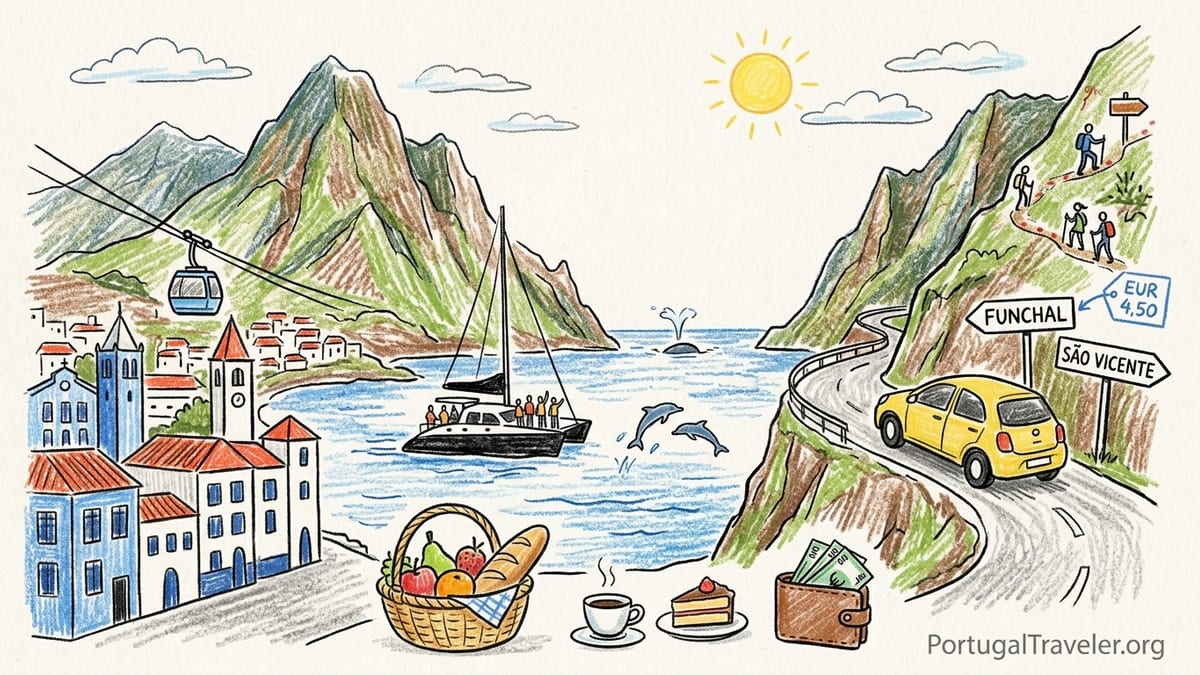
Trip Snapshot: When, Where and Travel Style
I visited Madeira from 11 to 18 April 2026, shoulder season between winter rain and peak summer holidays. I traveled as a couple, flying into Cristiano Ronaldo Madeira International Airport and basing ourselves in two places: four nights in Funchal’s old town, then three nights in the village of São Vicente on the quieter north coast. We wanted to hike several headline PR trails, see dolphins and whales, and have a rental car for flexibility while still keeping a mid-range budget.
We booked flights separately, so the cost breakdown here starts on arrival in Madeira. Our travel style sat in the middle: we chose small hotels with private bathrooms rather than hostels, cooked simple breakfasts in our rooms when possible, ate one restaurant meal most days and shared an automatic compact car. We did not splurge on five-star resorts or private drivers, but we did pay for a guided hike and a dolphin and whale watching trip to compare them with self-organised days.
Across seven nights, we spent just under 1,900 euros for two people on the island, excluding flights. That works out to roughly 135 euros per person per day. A key theme quickly emerged. Accommodation and transport decisions shaped the budget far more than individual activities or restaurant choices. When we changed base from Funchal to São Vicente we lowered driving time and fuel costs, but increased our nightly rate slightly. Paying for an automatic car removed a lot of stress on Madeira’s steep roads, and that upgrade turned out to be one of the few costs I would repeat without hesitation.
Prices in this article reflect what we paid in April 2026, along with current reference prices in late 2026 for comparison. Madeira has become more popular in recent years and the island introduced new hiking fees from January 2026, so anyone who visited before that will find some aspects – particularly trails and parking – noticeably more expensive now.
Accommodation: Location, Parking and the Cost of Convenience
For the first four nights, from 11 to 15 April 2026, we stayed at a small three-star hotel on the edge of Funchal’s old town. The nightly rate booked two months in advance was about 105 euros for a double room with breakfast and partial sea view. Similar mid-range hotels in central Funchal in spring 2026 typically range from about 90 to 130 euros per night for two people, depending on view, pool access and cancellation policy. Choosing a slightly better-located place within easy walking distance of the cable cars and restaurant streets added perhaps 15 to 20 euros per night compared with cheaper hillside guesthouses higher above the harbour.
On the north coast, we moved to a modern guesthouse in São Vicente for three nights, from 15 to 18 April 2026, at 95 euros per night without breakfast. The room had a kitchenette and free street parking outside. North coast accommodation is often a little cheaper than Funchal for comparable quality. We could have found simple rural houses or older pensions for 70 to 80 euros per night in April if we booked earlier, but we prioritised a comfortable bed, modern soundproofing and an easy walk to the seafront promenade.
What surprised me most on the accommodation side was how much the micro-location mattered once we arrived. In Funchal, being able to stroll from the hotel to the cable car station and restaurant streets in ten minutes meant we did not touch the car on some days. Guests who stay in the upper districts often need to drive or rely on uphill buses even for dinner. That may save 20 to 30 euros per night on the room but adds daily parking fees and eats into your time. For our travel style, paying slightly more for a central base felt like money well spent.
For 2026 generally, a realistic mid-range expectation per night in Funchal is around 90 to 140 euros for two people in a three or four-star hotel or serviced apartment in or near the centre, and 70 to 110 euros for similar comfort in coastal villages like São Vicente, Ponta do Sol or Machico. During summer school holidays, Christmas and New Year, those ranges rise by roughly 20 to 30 percent. Budget travelers willing to stay outside the centre in simple guesthouses, share bathrooms or forgo daily cleaning can still find rooms closer to 50 or 60 euros, but the trade-off in hills and logistics is very real in Madeira.
Rental Car, Fuel and Parking: The Hidden Big Ticket
We rented a compact automatic car for the full week, picking up and dropping off at the airport. For 11 to 18 April 2026 the base rental quote booked three months ahead was about 40 euros per day for a manual transmission compact, and 52 euros per day for an automatic version of the same category. We chose the automatic and added a moderate insurance upgrade, bringing the all-in daily cost to roughly 60 euros, or 420 euros for the week. That meant about 210 euros per person for seven days of full flexibility.
Fuel prices in Madeira in late September and early October 2026 hovered around 1.70 to 1.80 euros per litre for unleaded petrol, according to regional price bulletins. Over our week we drove just under 500 kilometres, mixing airport transfers, mountain passes to Pico do Areeiro and Encumeada, north coast runs and daily local errands. We refueled twice and spent close to 70 euros on petrol, averaging about 10 euros per day. Travelers who base themselves only in Funchal and nearby viewpoints could probably get by with 40 to 50 euros of fuel for a week, while those criss-crossing the island daily will pay more.
Parking is where the new Madeira can catch visitors off guard. In Funchal’s centre we often paid 1 to 1.20 euros per hour in municipal car parks or metered bays during the day, with nights often free after a certain hour. We spent around 35 euros on parking in Funchal over four days, including a half day parked near the cable car and a full day while we took a boat trip. At Pico do Areeiro, the main trailhead for the PR1 ridge walk, parking in 2026 now costs around 4 euros per hour in the official lots during peak daytime hours, a change reported widely in hiking fee guides. A morning hike there can easily result in 12 to 16 euros in parking if you are not careful about timing.
Looking back, renting an automatic car at a higher daily rate was an upgrade I would repeat. Madeira’s steep streets, hairpin bends and narrow village roads are demanding, and having an automatic meant I could concentrate fully on braking, mirrors and scooters rather than juggling the clutch on every incline. What I would change is the habit of using central car parks for convenience. On one Funchal day we lazily parked in a covered garage for about five and a half hours and paid close to 12 euros when we could have used cheaper street parking a ten-minute walk away. Over a week those micro-decisions add up to the cost of a nice dinner for two.
Airport Transfers, Buses and Organized Tours
On arrival and departure we used our rental car for the airport transfer, so I did not pay the shuttle bus in 2026. However, for context, the dedicated airport bus that runs between the airport and Funchal was charging just under 7 euros per adult each way in 2026, with discounts for returns. A taxi into central Funchal was typically quoted in the 30 to 40 euro range for the 20 to 25 minute ride, depending on the exact address and time of day.
Within Funchal, we rode city buses twice, mainly to avoid moving the car from our hotel’s area. A one-way urban ticket purchased on board cost around 2 euros per person in April 2026. Regional buses to villages such as Curral das Freiras or Monte fell in the 2 to 4 euro range per journey. For a traveler staying car-free and planning only a handful of long bus days, public transport can save a meaningful amount over rentals and parking, especially when combined with occasional day tours.
We tested this by booking one full-day jeep tour to the northwest during our São Vicente stay rather than driving some of the rougher forestry roads ourselves. The tour in mid-April 2026 cost 65 euros per person, including hotel pickup in São Vicente, stops at viewpoints and a short levada walk. That 130 euros for the two of us replaced what would have been a demanding and potentially stressful driving day. Given the price of fuel, vehicle wear and the value of having a guide explain what we were seeing, that felt like a fair exchange.
The cost trap here is assuming that skipping a rental car automatically saves money. For a couple who plans to do multiple boat trips, jeep tours and paid transfers between Funchal and coastal villages, the combined cost over a week can approach that of a small rental car. On the other hand, solo travelers or short city-break visitors who stick to Funchal and one or two excursions come out ahead by relying on buses and tours instead of a car sitting unused in a hotel garage.
Food and Drink: Where The Budget Really Goes Day to Day
Over seven days, food and drink accounted for a surprisingly large slice of our total spending, roughly 430 euros for two people. That worked out to about 30 euros per person per day. We mixed supermarket breakfasts, bakery lunches and sit-down dinners, and we are neither heavy drinkers nor big dessert people.
Breakfast was included at our Funchal hotel, which helped a lot. On the north coast we bought groceries from local supermercados in São Vicente. A basic shop for three breakfasts and two simple pasta dinners cost about 35 euros in April 2026, including fresh bread, fruit, pasta, tomato sauce, eggs, a bottle of regional wine and coffee. Supermarket prices in Madeira felt similar to mainland Portugal or slightly higher on some imported goods but were still lower than many northern European countries.
In Funchal’s old town, a typical lunch of a prego steak sandwich or grilled fish plate with a soft drink in a local snack bar ran around 10 to 12 euros per person. In more touristy spots near the cable car station and marina, mains alone were often 14 to 18 euros. Dinners in mid-range restaurants usually cost 45 to 60 euros total for two people, including a shared starter, two mains such as espada com banana or espetada and a glass of wine or beer each. On one splurge evening at a higher-end restaurant with harbour views and a better wine list, we paid close to 85 euros for two, which stood out against the rest of the week.
The surprise was how easily small extras stacked up. A couple of poncha drinks at a popular bar would add 12 to 16 euros. Coffee and cake after hikes ate another 8 to 10 euros each time. Over the week we probably spent around 90 euros on what felt like “small treats” on top of core meals. None were individually outrageous, but if you are working to a tight budget, tracking those coffees, cakes and cocktails is more impactful than shaving a euro off a bus ticket.
Hiking Fees, Cable Cars and Natural Pools in 2026
The biggest structural change to Madeira costs in 2026 is the introduction of access fees and mandatory reservations for most of the island’s official PR hiking trails managed by the regional forestry and conservation institute. From 1 January 2026, access to classified PR routes requires a timed booking through the SIMplifica portal and payment of a standard fee. The official walking section of the Madeira tourism board states that the general public pays 4.50 euros per person for most PR trails, with higher fees on some specific routes. Separate official guidance specifies 10.50 euros per person for the full PR1 Vereda do Areeiro ridge route between Pico do Areeiro and Pico Ruivo.
During our April 2026 stay we booked three of these PR hikes online in advance. For PR6 Levada das 25 Fontes we paid 4.50 euros each, so 9 euros total. For PR8 Vereda da Ponta de São Lourenço the same 4.50 euros each applied. We also obtained a permit for one of the shorter levada routes at 4.50 euros each. In total, trail fees came to 27 euros for the two of us for three days of official hiking. Rangers did check bookings at popular trailheads, and signs warned of fines for non-compliance, numbers that local guides later confirmed had indeed been issued in early 2026.
We combined the São Lourenço hike with the cable car at nearby Achadas da Cruz and a swim at the Porto Moniz natural pools on another day. In April 2026 the Achadas da Cruz cable car was charging around 5 euros per person for a return trip, so 10 euros for the two of us. The glassy seawater natural pools at Porto Moniz, one of the island’s most famous swimming spots, charged a modest entrance fee; during our visit this was around 3 to 4 euros per adult depending on the pool complex and season, so roughly 8 euros for both of us to spend a couple of hours there.
Looking at current 2026 information, those figures are broadly representative. Most PR trail bookings cost 4.50 euros per person, PR1 remains priced higher and popular viewpoints have introduced or increased parking fees. At Pico do Areeiro, for example, parking close to the summit in 2026 is reported at around 4 euros per hour. This means that the cost of a “free” day of hiking now includes both trail fees and, in some cases, premium parking if you choose the most convenient lots. Over a week of active travel, a couple can easily spend 50 to 70 euros on hiking and related parking, a line item that did not exist only a few years ago.
Whale Watching, Guided Hikes and Other Activities
Wildlife and ocean excursions are among Madeira’s headline experiences, and they are not cheap. We booked a three-hour dolphin and whale watching trip from Funchal for a mid-morning departure in April 2026. The ticket price on a comfortable catamaran with onboard marine guide commentary was 45 euros per person, so 90 euros for two. Operators usually advertise a high chance of sightings in spring and early summer and some offer repeat trips if you see nothing, although policies vary. Our outing delivered groups of Atlantic spotted dolphins and distant blows from at least one larger whale, along with great views of the south coast cliffs.
Whale and dolphin watching tickets in Funchal in 2026 generally cluster around 40 to 60 euros per adult for group catamaran or RIB departures, more for smaller boats or sunset combinations with food and drink. Private charters, which we did not book, can run into several hundred euros for a half day. This is one of those Madeira costs where it is extremely hard to replicate the experience more cheaply. If seeing dolphins ride your bow wave is a priority, it makes sense to budget this as a fixed big-ticket experience.
We also joined a guided hike one day, opting for an organised PR trail with pickup at our Funchal hotel. The half-day tour, including transport, guide and trail fee paid on our behalf, cost around 45 euros per person in April 2026. Without the guide, we could have driven ourselves, paid 4.50 euros each for the hiking reservation and about 10 euros in fuel and parking, for a total of perhaps 19 euros per person. The premium for the guided option was therefore a little over 20 euros per person. For that, we gained trail commentary, information on local flora, and the comfort of having logistics handled.
In retrospect, I found the guided hike useful but not essential. We had already hiked other PR routes independently using GPS maps and official information, and Madeira’s better-known paths are generally well way-marked. For nervous hikers or those without a rental car, however, guided hikes can offer good value once you factor in transfers and the time savings of not wrestling with reservations and parking. Over a one-week trip, paying for one guided hike while doing others solo felt like the right compromise. The real “wasted” spending in our case was a last-minute decision to add an optional lunch to the tour. At 15 euros per person for a simple set menu it was convenient but underwhelming. We would have preferred to bring our own sandwiches and spend that 30 euros on a nicer dinner.
Wasted Money, Smart Upgrades and What Really Drove Our Costs
Looking back at the numbers, the clear budget drivers on our Madeira trip were accommodation and the rental car, followed by food and one-off activities like the boat trip. Individual trail fees, cable cars and pools were noticeable, but they did not dominate the budget in the way you might expect from social media comments about “new charges everywhere.” Instead, the key questions were where we stayed, what we drove and how often we ate out.
The upgrades that felt genuinely worth it included the automatic transmission on the rental car, our better-located hotel in Funchal and the dolphin and whale watching excursion. Together those choices probably added about 200 to 250 euros to the week compared with a more bare-bones version of the same itinerary, yet they significantly improved our experience and reduced hassle. Driving an automatic on Madeira’s steep, multi-level roads turned daily logistics from something I dreaded into a background task. Being able to walk into Funchal’s centre in ten minutes instead of committing to nightly hill climbs or bus rides made evenings feel like a holiday rather than a commute.
On the other hand, our “wasted” spending clustered in avoidable parking fees and a couple of unremarkable meals chosen out of fatigue rather than research. That one overpriced garage in Funchal, the underwhelming set-menu lunch on a tour and two or three touristy dinners near the cable car combined to roughly 80 or 90 euros that we could have saved or redirected with a little more planning. In a seven-day budget of about 1,900 euros, this is not catastrophic, but for travelers counting every euro it highlights how much dining and convenience decisions matter.
Comparing our experience to representative 2026 price ranges from local travel resources, our daily spend per person of around 135 euros sits in the mid-range they describe. Budget travelers using guesthouses, buses and supermarket meals might manage closer to 70 to 80 euros per person per day, particularly outside peak season. Those staying in sea-view hotels, choosing larger or premium rental cars and adding multiple guided activities often land above 200 euros per person per day without much effort. Crucially, the difference between a 100 and 180 euro daily budget is rarely the cost of one cable car or trail fee; it is the sum of accommodation category, car choice and restaurant habits.
The Takeaway
If there is one lesson from our April 2026 Madeira trip, it is that the island is neither a bargain paradise nor an expensive trap. It rewards travelers who think carefully about where they base themselves, how they move around and which experiences they truly value. The structural introduction of 4.50 euro hiking fees and the requirement for advance reservations through the government portal has changed how independent hikers plan their days, but those charges still represent a small fraction of an overall holiday budget.
Accommodation, car rental and fuel, followed by restaurant meals and premium activities like whale watching, are what really move the needle. Paying for a central hotel instead of a distant hillside room may increase your nightly rate but reduce car use, parking stress and commuting time. Choosing an automatic car adds a meaningful daily cost but can make Madeiran roads accessible to drivers who would otherwise feel overwhelmed. Spending 45 to 60 euros on a boat trip or guided hike is a conscious splurge that you can plan around, rather than a creeping cost you only see on your credit card later.
For a couple in 2026 aiming for a comfortable, activity-rich week similar to ours, a realistic on-island budget excluding flights sits around 1,700 to 2,100 euros, or roughly 120 to 150 euros per person per day. You can push that down by staying in simpler rooms, cooking more and using buses, or push it up with resort hotels and private excursions. The important thing is understanding where the money goes and deciding, in advance, which upgrades will genuinely improve your Madeira experience. For us, the extra spent on ease of driving, a good location and time on the water was worth far more than the handful of euros we could have saved by skipping a cable car or nursing a single poncha all night.
FAQ
Q1. How much should I budget per day for a Madeira trip in 2026?
For a mid-range trip with a small rental car, comfortable three-star accommodation and one restaurant meal per day, a realistic on-island budget in 2026 is around 110 to 150 euros per person per day, excluding flights. Budget travelers using buses and guesthouses can get closer to 70 to 90 euros, while those choosing sea-view hotels, automatics and several paid excursions often exceed 180 euros per person daily.
Q2. Are the new hiking fees in Madeira expensive?
From 1 January 2026 most official PR trails managed by the regional forestry authority cost 4.50 euros per person, with a higher 10.50 euro fee for the full PR1 Vereda do Areeiro ridge walk. Over a week, a couple hiking three or four PRs might spend 40 to 60 euros in total on trail access. This is noticeable compared with the old free system but still a small portion of the overall holiday cost compared with accommodation, car rental and meals.
Q3. Is it worth paying extra for an automatic rental car in Madeira?
Automatic cars typically cost 10 to 20 euros more per day than equivalent manuals in 2026, but many visitors find the upgrade worthwhile because of Madeira’s steep gradients, narrow village streets and frequent hairpin bends. If you are used to driving automatics at home or feel anxious about hill starts, the extra cost can significantly reduce stress and make it easier to explore the island confidently.
Q4. Do I really need a rental car, or can I rely on buses and tours?
You can visit Madeira without a car, especially if you base yourself in Funchal, use local buses for nearby trips and book organised tours to the mountains and north coast. This usually works best for solo travelers or short city breaks. For couples or groups planning multiple hikes and rural excursions, a rental car often becomes cost-effective once you factor in the price of repeated transfers, jeep tours and taxis. The trade-off is between flexibility and the responsibility of driving and parking.
Q5. How much does whale or dolphin watching cost in Madeira?
In 2026, group dolphin and whale watching trips from Funchal usually cost between 40 and 60 euros per adult for a two and a half to three-hour excursion on a catamaran or rigid inflatable boat. This price often includes basic commentary and the possibility of a repeat trip if no animals are sighted, depending on the operator’s policy. Private charters and sunset cruises with food can cost significantly more and should be budgeted as premium experiences.
Q6. What do typical restaurant meals cost in Funchal and coastal villages?
A simple lunch in a local snack bar, such as a sandwich or prato do dia dish with a drink, usually runs around 10 to 14 euros per person in 2026. Mid-range restaurant dinners for two, including a shared starter, two mains and drinks, often total 45 to 60 euros. In highly touristed areas or at higher-end restaurants with harbour views, it is easy to spend 70 to 90 euros for two, especially if you order fresh seafood and a bottle of wine.
Q7. Have accommodation prices increased significantly in recent years?
Visitor demand has grown and hotel statistics show rising overnight stays, which has put upward pressure on room rates, particularly in Funchal and during peak periods. In 2026, central three and four-star hotels in Funchal often charge between 90 and 140 euros per night for two people in shoulder season, with higher prices in summer and around holidays. While Madeira is still generally cheaper than many northern European destinations, last-minute bargains are less common than they once were.
Q8. How much should I allow for parking over a week with a car?
If you stay centrally in Funchal and use official car parks and trailhead lots, a realistic parking budget for a one-week trip in 2026 is 40 to 70 euros for a couple. This assumes a mix of metered street parking in town and paid parking at popular sites like Pico do Areeiro. Careful planning, using free village parking where legal and walking slightly further, can lower this, while always choosing the most convenient garages and summit lots will push it up.
Q9. Are natural pools and cable cars major expenses?
Compared with hotels and rental cars, natural pools and cable cars are moderate one-off costs. In 2026, entrance to the Porto Moniz natural pools is only a few euros per adult, and smaller cable cars such as Achadas da Cruz charge in the region of 5 euros per person for a return trip. Even if you visit several over a week you are unlikely to spend more than 30 to 40 euros per person, so these attractions are easy to include without breaking the budget.
Q10. What is the single biggest factor that will change my Madeira budget?
The choice of accommodation and transport combined has the biggest impact. Staying in a central Funchal hotel and renting an automatic car at peak times can double your daily spend compared with using buses and staying in a simple guesthouse in a less central neighbourhood. Once those two pillars are set, trail fees, cable cars and occasional activities like whale watching add layers on top but rarely redefine the total in the way a hotel upgrade or car change does.