


On my most recent trip to Madeira I realized that the right hotel can genuinely change how the island feels. Not because of infinity pools or welcome drinks, but because details like steep driveways, early breakfast, laundry space for wet hiking gear and on-site parking can make a day in the mountains feel smooth instead of stressful. I booked every place myself, paid my own way, and stayed overnight in each of the properties described as personally tested below. The winners were the stays that made my time on the island easier, not just prettier.
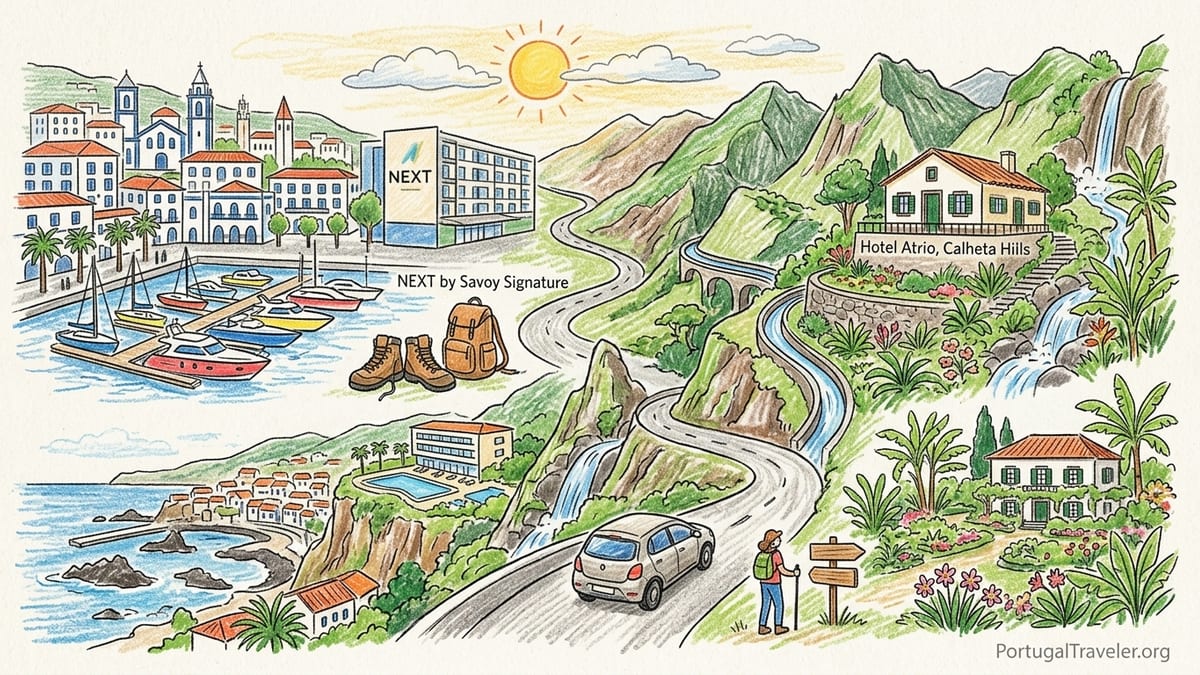
Best City Stay: NEXT by Savoy Signature, Funchal
For my city base I chose NEXT by Savoy Signature, just west of Funchal’s old town. The location made an immediate difference. Walking to the marina and the old town took me roughly 10 to 15 minutes on foot, which meant I could finish a levada hike, drop the car in the garage and still stroll to dinner without checking bus schedules. Tour operators were willing to pick up nearby, and ride-hailing cars found the entrance without confusion. The neighborhood felt urban but not rowdy, with late noise limited mostly to weekend evenings.
The standard room I booked was compact by resort standards but well laid out, with a comfortable queen bed, proper mattress support and two firm pillows plus a softer spare in the wardrobe. I am sensitive to noise and light; blackout curtains and decent soundproofing meant I slept through harbor traffic and early garbage collection. The bathroom followed the popular glass-and-tile city-hotel style, but water pressure in the walk-in shower was strong and hot water consistent even at peak morning times. There is central air conditioning with an in-room thermostat, and it cooled the room quickly without the constant hum some older units have.
Breakfast was a strong point. On hiking days I could be at the buffet right at opening and still drive out toward Pico do Arieiro before dawn. Staff were used to hikers asking for coffee the moment the doors opened, and there were enough simple options like bread, cheese, fruit and yogurt to put together an early, quick plate without waiting for cooked-to-order dishes. The rooftop pool is small but pleasant for a short swim after a day of driving Madeira’s hairpin roads, and the adjacent bar gives a full view across the harbor.
Parking and access matter in Funchal, and this is where many city hotels falter. NEXT has a fairly tight underground garage entered by a ramp that feels steeper than it looks, but the lanes inside are manageable for a typical compact rental. Spaces are not generous, so I was glad I had booked a smaller car. Getting in and out required patience rather than skill, yet after a couple of days it felt routine. Overall, NEXT worked exactly as I hoped: a comfortable city base where I could combine hikes, food and the occasional laptop session without fighting traffic every time I went out.
Best Island‑Exploration Base: Hotel Atrio, Calheta Hills
For a base focused on driving the island rather than nightlife, I moved to Hotel Atrio in the hills above Calheta on Madeira’s south coast. This small, rural-style hotel sits on a terrace high above the ocean, which meant two things in practice: wide views and winding access roads. The approach from the main road is a sequence of steep, narrow bends typical of Madeira’s south-facing villages. With a compact rental and some confidence, the drive became part of the charm, but anxious drivers might prefer to arrive before dark the first night.
The room I stayed in felt more like a countryside guesthouse than a classic hotel. It was noticeably larger than my Funchal room, with enough space to open two suitcases flat without blocking the path to the balcony. The bed was wide and firm, with a simple duvet and high-quality cotton sheets. There was no urban hum at night; instead, I heard distant dogs and the occasional car, but nothing that disturbed sleep. The bathroom had a combined bath and shower with better water pressure than I expected from a rural property. There was no central air conditioning in my room; at this elevation I did not miss it in shoulder season, since nights were cool with the balcony door cracked open, though in mid-summer heat some travelers might prefer a room with AC.
Breakfast at Hotel Atrio started early enough to support ambitious hiking plans. On days when I aimed for the Rabacal levadas or the plateau near Paul da Serra, I could sit down right at opening time, have coffee, bread, cheese and fruit, and still be at the trailhead early enough to avoid the busiest hours. The staff understood why guests were leaving with backpacks and trekking poles, and they did not fuss if someone wandered in slightly before official breakfast time to ask for a quick espresso. Dinner was offered on-site most nights, which proved invaluable on evenings when fog thickened and the idea of driving down to the coastal road in the dark lost all appeal.
Fog and rain are real considerations in this part of Madeira, especially out of high summer. On two evenings the hotel was engulfed in mist, and my original plan to drive to Calheta’s marina for dinner became unrealistic. Because the property serves its own meals and has a cozy lounge with a fireplace, the weather shift felt atmospheric instead of limiting. Parking is directly outside the main building on a sloped but manageable lot, so I never had to reverse into blind traffic or squeeze into a shared garage. As a base for island exploration by car, especially for travelers who value peace and easy access west to Porto Moniz and east toward Funchal, this stay clearly improved the rhythm of my trip.
Best Nature Stay: Quinta da Casa Branca, Funchal Gardens
Quinta da Casa Branca is technically in Funchal, but walking into its garden estate feels like stepping into a subtropical hideaway. I chose it specifically as a nature-focused stay without giving up quick access to the city. The property sits in a residential area above the Lido, with terraced gardens, mature trees and a sense of enclosure that filters out most urban noise. Within minutes of check-in I found myself slowing down, walking the garden paths and sitting among bird calls rather than traffic horns.
The modern low-rise building where I stayed contrasts with the traditional manor house on the same grounds, yet the room interior felt warmly residential. My room was significantly larger than a standard city hotel, with a sitting area, large windows and a private terrace opening onto the lawns. The bed was one of the most comfortable of my Madeira trip: wide, with a supportive mattress and a topper that softened the surface without swallowing you. The bathroom featured a double sink and a separate bathtub and shower, both with strong, reliable water pressure. Air conditioning was quiet and effective, important because the lush gardens can hold humidity after a warm day.
For a nature-focused stay, the outdoor spaces matter as much as the room itself. The pool sits among palms and flowering shrubs, and even when other guests were swimming it never felt crowded or noisy. I could hear distant sounds from the Lido area, but they were muted and irregular, more like a reminder that the city existed than an intrusion. Drying wet hiking clothes was surprisingly easy; my terrace received a good amount of indirect light and enough air movement that socks and a lightweight shirt dried overnight on the provided rack. This is the kind of detail that matters after a levada walk in drizzle.
Breakfast at Quinta da Casa Branca starts later than at some hiker-oriented guesthouses, but staff willingly prepared a simplified early tray when I had a sunrise drive planned. Parking is on-site in a small surface area reached by a short, steep entrance; once inside, spaces are level and relatively easy to maneuver compared to deeper city garages. The combination of botanical surroundings, spacious rooms and workable logistics made this my preferred choice when I wanted green calm without sacrificing Funchal’s restaurants and shops.
Best Romantic Option: Estalagem da Ponta do Sol
For a more explicitly romantic stay I chose Estalagem da Ponta do Sol, a clifftop design hotel above the little town and pebble beach of Ponta do Sol on the south coast. Arrival here is an experience in itself. After parking in a street-level garage reserved for guests, you ride a private elevator up through the rock and then follow a succession of terraces to reception. It feels like entering a secret eyrie, with the Atlantic on one side and terraced hills on the other. The location is spectacular at sunset, and the sense of seclusion is strong even though the village sits just below.
The room I booked was not among the largest of my trip, but the layout prioritized the view. A comfortable double bed faced sliding doors that opened onto a narrow balcony perched above the ocean. The mattress was medium-firm, with soft bedding and enough pillows to stack up for reading in bed. The bathroom was compact, with a walk-in shower and more than adequate water pressure. Air conditioning worked well and was quiet, which mattered at night because keeping the doors open to the balcony invited more humidity and occasional noise from the town.
Breakfast is served in a dining room with wide windows facing the sea. Timing here is more suited to relaxed mornings than pre-dawn departures. On the day I planned a longer walk on the north side of the island I found myself slightly rushed, and I would not choose Ponta do Sol as a base for a whole week of early hikes. As a place to slow down after a few intense days of driving and trekking, however, it was nearly ideal. There is a pool on one of the upper terraces where I spent an hour late in the afternoon while the cliffs caught the last light. In the evening, walking down to the village for dinner took less than ten minutes, though the climb back up involves a series of steps.
From a practical perspective, parking here is easier than it first appears. The garage at the bottom of the elevator has relatively straightforward spaces, and I never had to execute the tight multi-point maneuvers that some Funchal garages demand. The main constraint is that Ponta do Sol sits under high cliffs, and in winter months or during unstable weather the area can feel cut off by rockfall warnings or brief local road closures on the old coastal routes. During my stay the conditions were stable and dry, and the combination of ocean views, distinctive architecture and walkable local restaurants made this my favorite place to end each day as a couple.
Best Value Stay: Arts In Hotel Conde Carvalhal, Funchal
Value in Madeira has shifted in recent years, with room rates rising faster than some guidebooks acknowledge. Within that context, Arts In Hotel Conde Carvalhal in Funchal stood out as a property where what I paid felt well matched to what I received. The hotel occupies a restored building on a hill overlooking the old town, within walking distance of the market and the cable car station yet far enough above street level to escape much of the noise. The approach streets are narrow and steep, but this is typical of central Funchal and did not present unusual challenges beyond first-night nerves.
My room here was essentially a small apartment, with a sleeping area, sitting corner and a kitchenette. The bed was not as luxurious as at some of the more expensive properties, but it was genuinely comfortable, with a firm mattress and clean, simple linens. Room size was generous for the price bracket, and the extra space mattered when repacking gear or laying out wet clothes after a damp levada walk. The bathroom felt slightly dated in style but functioned perfectly, with steady hot water and acceptable water pressure. There was effective air conditioning and heating, which I appreciated on a cool, rainy evening when I returned chilled from the mountains.
Breakfast was more modest than at the resort-style hotels but still adequate, and the staff were quick to offer earlier service on the morning I needed to catch a tour pickup before the usual window. Wi-Fi speeds were strong throughout my stay, including in the room, which allowed for a solid half-day of remote work without frustration. There is no pool, which may be a drawback for some travelers, but I found that the garden terrace and views over the harbor compensated, especially given the lower room rate compared to waterfront options.
Parking is the main compromise. The property has limited on-site parking accessed via a steep driveway. When those spaces were full, I needed to park on surrounding streets, which could involve parallel parking on an incline and a short uphill walk back to the hotel. Experienced city drivers will accept this as part of central Funchal, but it could feel stressful to less confident drivers, particularly after dark or in rain. In return, the location placed me close enough to walk down into the old town for dinner, which saved time and avoided taxi costs. Taken as a whole, the combination of apartment-style space, walkability and staff flexibility made this the stay where I felt I received the most for what I paid.
Best for Hikers: Hotel Euro Moniz, Porto Moniz
When I wanted to focus on the wild north and west of Madeira, I based myself at Hotel Euro Moniz in Porto Moniz. The town is known for its volcanic natural swimming pools, but for hikers it also offers relatively quick access to trails like Levada da Ribeira da Janela and the highlands around Paul da Serra. Staying here saved me from long pre-dawn drives from Funchal on days when I wanted to be on the trail early. The hotel sits close to the seafront, a short walk from restaurants and the pools, with free street parking directly outside.
The room was simple but functional. I booked a standard double with partial sea view, which gave me enough space for two suitcases and my hiking gear without feeling cramped. The bed was adequate rather than luxurious, but I slept well after long days outside. Noise insulation was decent; I could hear waves when I opened the balcony door, yet with it closed the room was quiet even when the town was busy around sunset. The bathroom had a combined bath and shower, and water pressure was particularly strong, a blessing when rinsing off salt or mud. There was basic air conditioning, although in this wind-exposed corner of the island I rarely needed it.
Breakfast at Hotel Euro Moniz began early enough to make a proper hiking day work. Staff grew familiar with my pattern of coming down as soon as the doors opened, grabbing coffee, bread, cheese and fruit, and then heading straight out to the car. On a very early morning when I wanted to catch first light higher up, the night staff arranged a simple packed option so I could leave before buffet service officially started. Wi-Fi was perfectly adequate for checking forecasts and trail updates, though not as strong as in my Funchal hotels.
Weather is where Porto Moniz can challenge even well-laid plans. During my stay one afternoon turned from blue sky into full Atlantic squalls within an hour, and the coastal road toward Sao Vicente briefly felt exposed and demanding. On such days, being based in town rather than needing to drive in from the south coast reduced my stress. Fog on the high plateau could be dense, but it usually thinned by the time I descended back toward sea level. With easy parking, strong showers to clean up after muddy hikes and short walks to simple local restaurants, this hotel made the hiking-focused portion of my trip more efficient and less tiring.
Best for No‑Car Travel: The Views Baia, Funchal
For the segment of my trip when I did not want to drive at all, I chose The Views Baia in Funchal. The property stands on a hill above the city center, within walking distance of the old town, bus station and cable car. The climb back up from the waterfront is not negligible, but it is manageable for most reasonably fit travelers, and taxis are easy to find for the return if needed. From a no-car perspective, the hotel’s position offers a balance between broad views and practical access to public transport.
My room faced the bay with a wide balcony and floor-to-ceiling windows. The bed was large and comfortable, with a supportive mattress and quality linens. The room size felt generous, leaving plenty of space to work at the desk or stretch out on the sofa. The bathroom had a modern walk-in shower with stable hot water and good pressure. Air conditioning was central and quiet, maintaining a consistent temperature even as the sun heated the glass during the afternoon. At night, with the balcony doors shut, street noise was minimal and the view over the harbor lights more than justified the hillside location.
Breakfast at The Views Baia was one of the most extensive buffets of my Madeira stay, which helped on days when I joined group tours that collected guests from central Funchal. I could eat early, walk downhill to the pickup point in around ten minutes, and return in the late afternoon without needing to manage parking or navigation. Wi-Fi coverage was strong throughout the property, including poolside and in the lobby, and I saw multiple guests using laptops for remote work without issue. The outdoor pool is large enough for proper laps, not only lounging, which made a noticeable difference on the days I skipped hiking.
Without a car, steep access and neighborhood lighting become important realities. The streets around The Views Baia are steep but well paved, with sidewalks most of the way down into town. Returning at night felt safe and reasonably lit, though I chose to take a taxi back after a particularly long dinner. Because I was not dealing with a garage, I never had to think about ramp angles or tight corners, which simplified daily routines. For travelers planning to rely on buses and guided excursions rather than a rental car, this hotel improved the sense of freedom rather than limiting it.
The Takeaway
Across these stays, the pattern that emerged was simple: in Madeira, logistics matter as much as aesthetics. Steep drives, garage ramps, breakfast hours, fog-prone elevations and access to quick dinners after long hikes all have a direct impact on how the island feels day to day. The properties that improved my trip were the ones where those practical details had clearly been considered, whether in a city hotel with early breakfast and reliable Wi-Fi or a romantic cliffside retreat with straightforward parking and walkable evening options.
If I were planning a similar itinerary tomorrow, I would prioritize a comfortable, walkable Funchal base such as NEXT by Savoy Signature or The Views Baia for the first half of the trip, especially for no-car days or mixed work and travel. For the second half, I would choose between a west-coast hiking base like Hotel Euro Moniz or a calmer hillside retreat like Hotel Atrio, depending on how much energy I wanted to devote to driving and early starts. I would then add a short, romantic finale at Estalagem da Ponta do Sol or a garden-focused stay at Quinta da Casa Branca rather than searching for a single all-round “winner.”
Madeira rewards travelers who match their hotel not only to their budget but to their driving confidence, appetite for early hikes and tolerance for fog, rain and hills. With realistic expectations about parking, breakfast and weather, the right stay becomes a quiet ally in the background, helping you enjoy cliffside viewpoints, levada paths and ocean sunsets with a little more ease.
FAQ
Q1. Is it better to stay in Funchal or in a smaller coastal town for a first visit?
For a first visit, I found Funchal more practical because public transport, tour pickups, restaurants and supermarkets are all concentrated there, which reduced daily logistics.
Q2. How difficult is driving and parking at Madeira hotels?
Driving often involves steep hills and tight bends, and many hotel garages have narrow ramps; choosing smaller rental cars and properties with simpler access noticeably reduced stress.
Q3. Which hotel worked best when I did not want to rent a car?
The Views Baia in Funchal worked best for my no-car days, thanks to walkable access to the city center, bus station and tour pickups combined with strong Wi-Fi and comfortable rooms.
Q4. What type of stay is most convenient for early-morning hikes?
Hotels that start breakfast early or arrange simple early trays, such as NEXT, Hotel Atrio and Hotel Euro Moniz, made it much easier to reach trailheads around sunrise.
Q5. Did fog or rain make any of the more remote properties feel inconvenient?
At Hotel Atrio, foggy evenings made driving down to the coast less appealing, but on-site dinners and a cozy lounge meant I did not feel trapped or short of options.
Q6. How easy was it to dry wet hiking clothes in these hotels?
Rooms with balconies or terraces, such as at Quinta da Casa Branca and Arts In Hotel Conde Carvalhal, made drying socks and shirts overnight straightforward using portable racks.
Q7. Are pools in Madeira hotels warm enough to use outside high summer?
At the properties where I stayed, outdoor pools were unheated and felt cool in shoulder seasons, but still pleasant for short swims in the afternoon sun.
Q8. Which stay offered the best balance of comfort and price?
Arts In Hotel Conde Carvalhal provided the best balance on my trip, with apartment-style space, kitchenette and harbor views at a lower rate than seafront resorts.
Q9. Is it realistic to work remotely from these Madeira hotels?
In Funchal, Wi-Fi at NEXT, The Views Baia and Arts In Hotel Conde Carvalhal supported video calls and uploads; in Porto Moniz speeds were slower but still fine for email and browsing.
Q10. How many different bases make sense for a one-week Madeira trip?
In my experience, one Funchal base plus one coastal or countryside base works well for a week; more moves risk spending too much time packing and driving instead of exploring.