


On my first trip to Lisbon, I did what most first-timers do: I booked a cute apartment in the city center, penciled in Sintra and Cascais as “easy day trips,” and assumed everything along the Lisbon coast would feel like… Lisbon. A week later I was shivering in Sintra fog with the wrong ticket for Pena Palace, crawling through traffic on the Atlantic road, and wondering why I had tried to stack three day trips in a row. Here is what I wish I had known before exploring the wider Lisbon region for the first time.
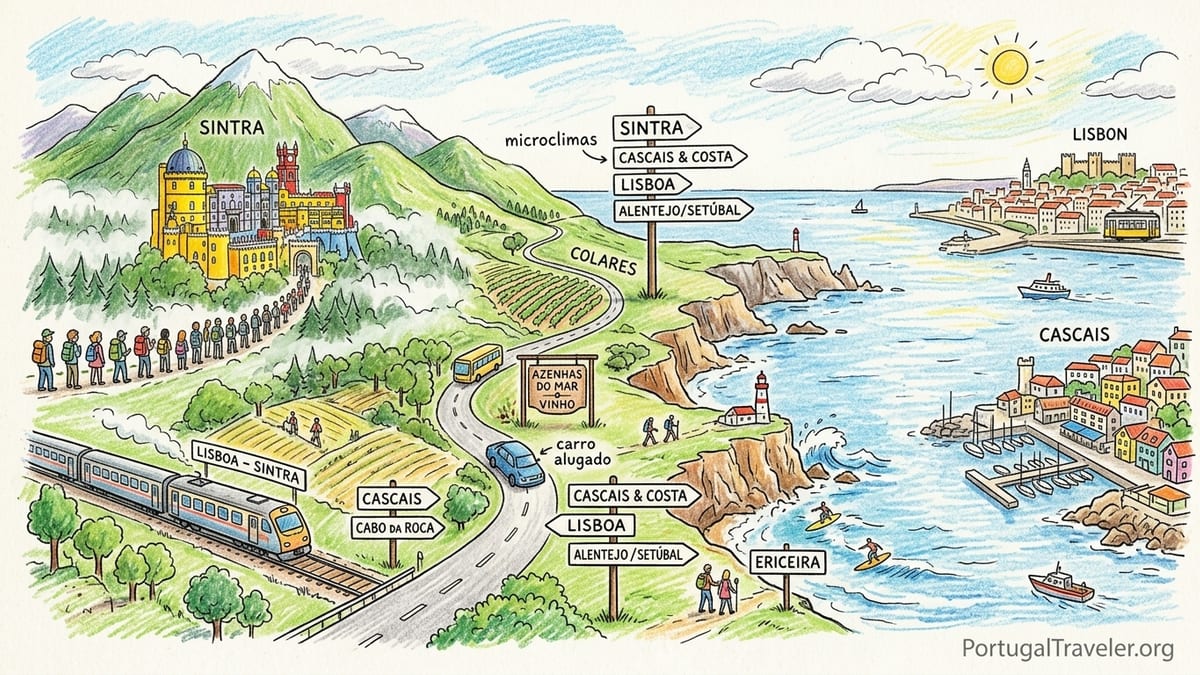
How Much of the Lisbon Region Fits in One First Trip
I landed in Lisbon with eight full days and an ambitious list: two days for the city, plus Sintra, Cascais, Cabo da Roca, a winery in Azeitão, and maybe even a surf stop in Ericeira. On paper it looked reasonable. On the ground, it felt rushed. What I did not understand until I arrived is that the “Lisbon region” is not one compact cluster of sights but a wide Atlantic arc, with Sintra and Cascais to the west, the Setúbal and Arrábida area to the south, and surf towns like Ericeira to the northwest. The distances are not huge, but the combination of winding roads, microclimates and required advance bookings turns each of these into a full, structured day.
I tried to pack Sintra and Cascais into one long day. I took the morning train from Rossio to Sintra, spent too long queuing and adjusting to the timed slot system at Pena Palace, then raced through the Moorish Castle and Quinta da Regaleira. By the time I boarded the 403 bus toward Cabo da Roca and Cascais, I was already more tired than I would have been after a full workday. I did reach the Atlantic cliffs before sunset, but Cascais became a perfunctory stroll past the marina, not the relaxed seaside afternoon I had imagined.
Looking back, I would have limited myself to one “big” excursion every other day. For an eight-day stay, that would mean three regional days at most: one for Sintra, one for the Cascais coast, and one south of the Tagus or up toward Ericeira, with the remaining days spent in Lisbon itself. The region rewards deeper time in fewer places much more than quick sampling everywhere. It is better to know Sintra’s gardens and misty trails well than to say you “covered” Sintra, Cascais, and Arrábida, but remember almost nothing specific about any of them.
Another lesson was how much recovery time each excursion demanded. A full Sintra day starting with a 30-minute train, a local bus up the hill, hours of walking on steep paths, and a return queue at the station left me arriving back in Lisbon around 20:00, too tired to enjoy the city’s nightlife. Stringing together three days like that would likely leave most travelers exhausted and cranky. Building in easier days in Lisbon between regional trips let me enjoy both sides of the experience.
The Sintra Surprise: Timed Tickets and Overplanned Days
Sintra was where my assumptions about spontaneity hit a wall. I woke up on my first potential Sintra day, saw clear skies, and decided to go without pre-booking any tickets. That was my first mistake. The Park and National Palace of Pena uses timed entries to manage the crowds, and the official information makes it clear that you must present yourself at the palace entrance at the specific time printed on your ticket, with no tolerance. Morning and late-morning slots can book out days ahead in busy seasons, and there is no refund if you miss your slot. I only discovered that standing at the Rossio ticket machine, scrolling frantically on my phone.
By the time I reached Sintra and joined the queue outside Pena, the next available interior slots were several hours away. I had to decide whether to buy a later slot and reorganize my entire day around it, or settle for the park-only ticket that gives access to the grounds and terraces but not the inside rooms. I picked the park ticket, then spent the rest of the day with mild ticket envy every time I saw people queuing for the palace interior. The interior ticket, currently around twenty euros from the official Parques de Sintra ticket office, would have cost less than the private “skip-the-line” offers that include commission for tour resellers.
That day taught me two lessons. First, for a first-time visit that includes Pena, I would book the palace-and-park ticket directly through the official channel several days ahead in high season, and at least the day before in shoulder season. Second, I would build my whole Sintra day around that slot, instead of trying to wedge the palace into a packed itinerary. The official guidance notes that it takes roughly 30 minutes just to walk from the entrance of the park up to the palace itself, which means a 10:30 interior time slot realistically requires entering the park closer to 09:45 if you want a relaxed stroll rather than a sweaty uphill march.
I also learned that not every Sintra monument demands this level of planning. The Moorish Castle and Monserrate generally do not require timed slots, and you can buy tickets at the gate or online on short notice. Quinta da Regaleira has introduced timed entries too, especially on busy summer days, but with a more forgiving grace period around your scheduled time. In practice, for a first visit, I would book Pena and Regaleira in advance, then leave everything else flexible. Trying to keep track of four separate time windows in one day turned my first Sintra trip into a logistics exercise instead of a romantic hilltown wander.
Trains, Buses, and the Point Where a Car Starts to Make Sense
Before the trip, I imagined using Lisbon’s trains and buses for everything outside the city. The reality was more nuanced. For Sintra and Cascais themselves, the train is still the easiest and cheapest option. The Rossio to Sintra line and the Cais do Sodré to Cascais line are frequent, affordable urban services, with a return to Cascais on the current 2026 tariff costing just over five euros when paid via the rechargeable transport card. Trains start before dawn and run late into the night, and there is no real benefit in pre-booking specific times for these local lines.
The problem arose on the days when I wanted to chain multiple regional places together. Getting from Sintra to Cabo da Roca and then to Cascais is easy enough with the 403 bus, which links the three in roughly 40-minute segments and feels like a rolling sightseeing tour along the cliffs. But connecting more remote spots like Azenhas do Mar or inland wineries near Colares without a car meant stitching together infrequent buses and long uphill walks. At one point, I found myself checking the time nervously in a nearly empty rural bus stop, knowing that if I missed the next bus I might be stuck for hours.
That was the moment I wished I had rented a car for at least part of my stay. Rental desks at Lisbon airport and in the city offer small cars, and by 2026 it has become standard for Portuguese rental companies to include an electronic Via Verde toll transponder with each vehicle, charging you later for motorway tolls and a daily device fee. For trips that include the A5 motorway to Cascais, the A16 toward Sintra, or longer runs south toward the Algarve, that transponder removes a lot of guesswork about how to pay tolls on mixed electronic and staffed sections.
However, I was glad I had not driven to Sintra itself. Local authorities have restricted private car access on the roads that climb directly to Pena Palace and the Moorish Castle, and the narrow historic center suffers regular traffic snarls. Driving there would still require parking outside certain zones and switching to local buses like the 434 or 435. For a first-time visitor, my hindsight advice would be to rely on trains and buses for Sintra and Cascais days, but consider a car for one or two days if you plan to explore less connected areas like the Arrábida Natural Park, inland wine estates, or scattered Atlantic viewpoints where bus frequency drops dramatically.
The Atlantic Weather Gap: Why Sintra and the Coast Feel Like Another Country
Lisbon itself has a mild Mediterranean climate shaped by the Atlantic, but staying only in the city can mask how dramatically conditions change just a short distance away. Sintra sits on a granite ridge that pushes moist ocean air upward, creating a cooler, damper microclimate. Climate data for the wider region notes that nearby Cabo da Roca, perched 150 meters above the sea, can feel 5 to 8 degrees Celsius colder than inland, with heavy Atlantic wind. The contrast with central Lisbon is sometimes as extreme as a 20-degree difference in summer daytime highs between the sheltered city and the exposed cape.
I underestimated that gap badly. One July afternoon that started at 28 degrees and sunny in Baixa turned into 18 degrees with dense fog at Pena and a chilly wind at Cabo da Roca. I had left my light jacket in the Lisbon apartment, assuming the heat would follow me. In reality, Sintra’s wooded parks held on to moisture, and the terraces of Pena Palace were swept with mist that made everyone huddle in hoodies and windbreakers bought last-minute in souvenir shops.
The coast near Cascais is different again. The Portuguese Riviera has a generally mild climate influenced by the Atlantic, but standing on the promenade between Estoril and Cascais I noticed the wind more than the temperature. By late afternoon, even on bright days, gusts coming off the ocean made it cool enough that people wrapped in towels on the sand while the sun was still high. Surfers at Carcavelos wore full wetsuits while visitors from hotter inland parts of Europe arrived in short sleeves and quickly realized the water was colder than the air.
The practical lesson for a first-timer is simple: pack and daypack for the region, not for Lisbon alone. A compact windproof layer and something warmer for evenings or exposed viewpoints take very little space but change your comfort level dramatically. If you have a Sintra day followed by a Cascais day, expect to wear more layers in Sintra’s hills and fog, and be ready for sharp ocean wind on the Cascais and Cabo da Roca stretches even when Lisbon’s streets feel balmy.
Day-Trip Fatigue: When Basing Only in Lisbon Stops Making Sense
I loved coming back to the same Lisbon neighborhood each night. It gave the trip a sense of home base and made restaurant reservations and laundry logistics straightforward. But by the fifth day, after repeat runs through the same train stations and identical commuter crowds, I realized that treating everything as a day trip from Lisbon had its own cost. The longer rides were beginning to feel like a commute, not an adventure.
My Sintra day started with the scenic novelty of leaving Rossio station and watching the suburbs slide by. My second big regional day, a hike-heavy outing near Arrábida south of the Tagus, started with the same pattern of early metro to the ferry, then another bus, and ended with another multi-leg journey back. By the time I considered a side trip to Ericeira, the idea of yet another early alarm and public transport sequence from the same apartment felt more tiring than packing an overnight bag.
The lesson I drew from that experience was that moving your base once can actually reduce fatigue. If I could replay the trip, I would still start with several nights in central Lisbon to adjust to the city, then shift for two nights to either Sintra or Cascais once I was ready to explore more of the region. That would have turned my Sintra visit into a series of shorter walks and bus rides from a nearby hotel instead of a single overstuffed day. For Cascais, sleeping in town would have meant sunrise or sunset strolls along the waterfront and the freedom to drop back to the hotel in the middle of the day instead of guarding my spot on a crowded beach knowing I still had a 40-minute train ride back.
This matters especially if you are traveling with children, older relatives, or anyone sensitive to early starts and long days. The cumulative effect of morning trains, crowded station platforms, and standing-room-only buses is easy to underestimate when looking at a clean itinerary on a screen. On the ground, sharing your time between Lisbon and at least one regional overnight base lightens the emotional load of logistics and turns the “beyond Lisbon” experience into a stay in its own right instead of an endless series of out-and-back expeditions.
When Sleeping Outside Lisbon Becomes Worthwhile
During my first trip, I stubbornly kept my entire hotel booking in Lisbon, even when I was clearly spending most of the day far from the city center. I told myself it was simpler not to repack. In practice, I paid for the convenience of a single base with sleepy train rides and missed evening atmospheres along the coast. Only when I walked past a small guesthouse in Sintra’s historic center at dusk, lights glowing through the mist, did it hit me that I was leaving just as the town was becoming most atmospheric.
If your stay in the region reaches seven nights or longer, my hindsight advice is to seriously consider splitting it. A pattern that would have worked better for me is four or five nights in Lisbon and two or three nights in either Sintra or Cascais, depending on your priorities. Choose Sintra if you are drawn to palaces, gardens, and misty hiking trails, and Cascais if you prefer waterfront promenades, bike rides, and easier access to sandy beaches. Both offer a range of accommodation options, from small guesthouses to larger hotels, at prices that are comparable to many midrange Lisbon neighborhoods outside the very center.
There are also small, quieter bases between the two, such as Colares or villages along the tram line near Praia das Maçãs, where you can wake up closer to the Atlantic rather than commuting from Lisbon each time. These spots are harder to reach by public transport alone, which is where a short car rental can pay off. With a car, a couple of nights in a rural guesthouse lets you explore at dawn or after sunset when day-trippers have left, whether that means wandering the park paths of Pena in the late afternoon light or watching the last light fall off the cliffs near Adraga or Azenhas do Mar.
The deeper benefit of sleeping outside the city is psychological. Once you set your luggage down in Sintra or Cascais, the area stops being a “trip from Lisbon” and starts being its own place in your mind. You are more likely to linger in a café, take side streets, or sit through a passing rain shower instead of rushing to cram the next scheduled stop. On my Lisbon-only base trip, I often checked the time and mentally calculated when I needed to head back. On an overnight, the only calculation would have been whether I preferred another glass of wine or an evening stroll.
Practical Lessons from Concrete Mistakes
Several specific missteps on that first regional trip have stuck with me, and they translate into clear, practical lessons. The first was arriving in Sintra in the late morning. By then, the queue for the circular 434 bus that loops up to Pena and the Moorish Castle snaked far back from the stop, and the narrow road above was already clogged with tour buses. I lost almost an hour simply getting from the station to the park gate. Starting earlier, or taking a taxi or rideshare up before the main rush, would have bought me quieter paths and fewer crowds inside the monuments.
Another was underestimating how ticket combinations and add-ons could simplify the day. The Sintra parks authority sells combined tickets and even transport bundles that tie together multiple monuments and the 24-hour bus pass on Scotturb routes 434 and 435. I only discovered that after I had already bought single-entry tickets separately, which added up to more than a combination would have cost. Taking ten minutes before the trip to read through the current official ticket options would have saved both money and queue time at on-site machines.
I also made a classic mistake with meals. In Sintra, I pushed lunch back to “whenever there is a gap,” which meant ending up in a crowded, centrally located restaurant at peak hour paying higher prices for a rushed, forgettable plate. A better approach, which I eventually adopted in Cascais, was to schedule an early or late lunch at a place a few streets back from the main square, where prices were slightly lower and service calmer. In Cascais, stepping away from the waterfront and into a residential side street led me to a small tasca with a daily lunch menu, where a hearty plate of grilled fish and sides cost noticeably less than the tourist menus facing the marina.
Transport back to Lisbon provided its own lesson. On my first Cascais evening, I left the return too late, assuming trains would be empty at night. Instead, the late service was packed with day-trippers and commuters heading back to the city. Standing shoulder to shoulder through the entire 40-minute ride was not the laid-back seaside coda I had imagined. On subsequent days I either caught a slightly earlier train or accepted that taking an extra ten minutes to reach the platform ahead of the crowd made a big difference in comfort.
The Takeaway
My first journey beyond central Lisbon taught me that the region is both more complex and more rewarding than the phrase “easy day trips” suggests. Timed tickets at high-demand attractions such as Pena Palace mean you must plan at least some elements days ahead in busy periods. Microclimates in Sintra’s hills and along the Atlantic coast can make it feel like you have traveled hundreds of kilometers rather than a short train ride. Trains and buses work brilliantly for core routes like Lisbon to Sintra and Cascais, but a car starts to make sense when you venture into the less connected corners of the coast and countryside.
Most importantly, I learned that stacking multiple long regional days from a single base in Lisbon leads to fatigue faster than you expect. Splitting time between the city and at least one out-of-town base shifts the experience from rushed excursions to genuine stays. When I return to the Lisbon region, I will pack a light windproof jacket, pre-book my key Sintra tickets, choose fewer regional targets, and give myself permission to spend entire days in just one place. The palaces, cliffs and beaches around Lisbon are not going anywhere, and they are far more enjoyable when you give them space instead of trying to conquer them all at once.
FAQ
Q1. How many day trips beyond Lisbon can I realistically fit into one week?
For a seven or eight night stay, plan on two or three full regional days at most, such as one in Sintra, one on the Cascais coast, and one either south of the Tagus or up toward a surf town like Ericeira. Filling every single day with long excursions tends to create fatigue and leaves little energy to enjoy evenings back in Lisbon.
Q2. Do I really need to book Pena Palace tickets in advance?
Yes, if you want to see the interior on a specific day, especially in high season. The Park and National Palace of Pena operates with timed entry slots, and popular morning times can sell out days ahead. Booking directly through the official system at least a day or two before your visit lets you build the rest of your Sintra plans around that fixed slot instead of improvising in long queues.
Q3. Is it worth renting a car for the Lisbon region?
It depends where you are going. For Sintra and Cascais town, trains and local buses are usually easier, particularly since private vehicles face restrictions on some roads near the main monuments. A car becomes more useful if you want to explore less connected spots such as rural guesthouses near Colares, remote beaches, or the Arrábida area, where bus frequencies drop and walking distances from stops can be long.
Q4. How different is the weather in Sintra compared with Lisbon?
The difference can be striking. Sintra’s hills trap moist Atlantic air, making it notably cooler and cloudier than central Lisbon much of the year. On my trip, a warm sunny afternoon of around 28 degrees Celsius in Lisbon corresponded to 18 degrees with fog and drizzle at Pena Palace. Packing a light jacket or windproof layer, even in summer, makes a big difference to your comfort there.
Q5. Can I combine Sintra, Cabo da Roca and Cascais in one day?
It is possible but often feels rushed. I tried to visit Pena, another Sintra site, then continue by bus to Cabo da Roca and onward to Cascais before returning to Lisbon. By the time I reached Cascais, I only had energy for a short walk. If you want to truly enjoy each place, consider focusing a full day on Sintra and another on the Cascais and Cabo da Roca stretch, or at least trimming the Sintra portion to leave ample time and energy for the coast.
Q6. When does it make sense to sleep in Sintra instead of Lisbon?
Staying overnight in Sintra becomes worthwhile if you want to visit more than one or two monuments at a relaxed pace or do any hiking in the surrounding hills. A night or two there lets you see palaces and gardens in quieter early morning or late afternoon light, without the pressure of catching a specific train back to Lisbon. It also turns Sintra from a rushed day trip into a destination in its own right.
Q7. Is Cascais better as a day trip or an overnight stay?
Cascais works well as both, but staying at least one night changes the experience. As a day trip, you will likely arrive late morning with crowds and leave on a busy evening train. Sleeping in town gives you quiet early walks along the waterfront, more flexible beach time, and the freedom to linger over dinner without worrying about catching a specific service back to Lisbon.
Q8. How early should I start my Sintra day from Lisbon?
If you are doing Sintra as a day trip, aim for one of the earlier trains from Rossio, ideally arriving in Sintra before the main tour groups. That early start shortens queues for the 434 bus to Pena and the Moorish Castle and gives you cooler, quieter conditions in the gardens. Arriving around midday, as I did on my first visit, meant beginning the day already behind the crowd curve.
Q9. Are there any parts of the region that are hard to reach without a car?
Yes. While Sintra and Cascais are very well served by trains and local buses, more scattered spots such as some Atlantic cliff viewpoints, rural guesthouses between villages, and certain Arrábida and Setúbal area sites can be time consuming to reach by public transport alone. In those cases, a short car rental, even for just a day or two, can significantly reduce connection times and waiting at sparsely served bus stops.
Q10. How should I balance time between Lisbon city and the surrounding region on a first trip?
For most first-time visitors, a good balance is to spend at least half the trip inside Lisbon getting to know its neighborhoods, viewpoints and riverfront, and use the remaining days for two or three well-chosen regional excursions. If your stay is a week or longer, consider splitting your accommodation between Lisbon and one coastal or hilltown base so that the region feels like part of your stay rather than a series of long commutes.