


In July 2024 I spent nine days island hopping in the Azores, splitting my time between São Miguel and the central “Triangle” of Pico and Faial. I tracked every euro. What surprised me most was not restaurant prices or hotel rates, but how quickly costs multiplied each time I changed islands: new car rental contracts, fresh deposits, another airport transfer, a different ferry ticket. If you are planning an Azores trip for summer 2026, understanding how logistics drive your budget is more important than calculating a simple per-day average.
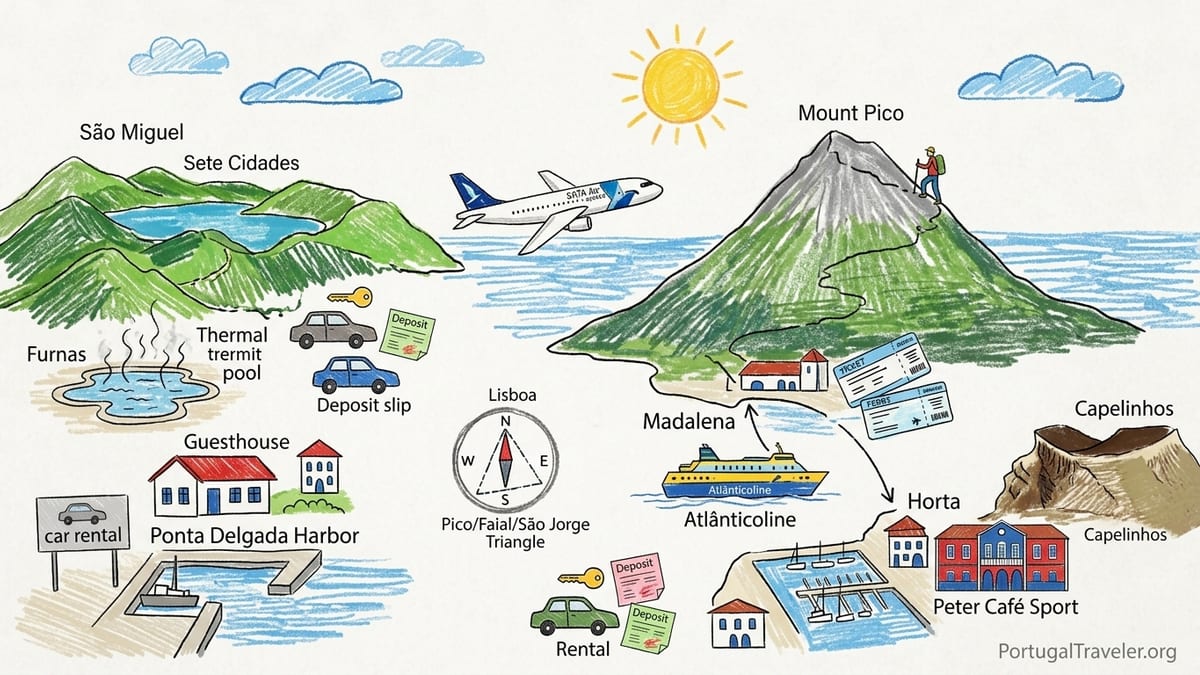
Trip Overview: Dates, Route and Why Logistics Matter
I traveled from July 13 to July 22, 2024, starting and ending in Lisbon. My route was Lisbon to Ponta Delgada on São Miguel, three full days on São Miguel, then an inter-island flight to Pico. From Pico I used ferries to hop to nearby Faial and back, before flying from Pico to Lisbon. This nine-day loop covered three islands, two Azores Airlines tickets, one SATA Air Açores inter-island flight, four ferry segments, three separate car rentals and five accommodation bookings.
I chose July on purpose, to see how true high-season pricing felt on the ground. Peak season across the Azores generally runs from early May to late October, with late June to early September seeing the strongest demand on flights and accommodation. Car rental companies confirm that July and August bring the highest prices and tightest availability, especially on São Miguel and in the Triangle around Pico and Faial.
Instead of building a theoretical budget, this article is based on what I actually paid in July 2024. Where I reference 2026 pricing, I clearly separate that as current research, using publicly available fares and tariffs as of autumn 2026. The goal is not to present a single “Azores trip cost” number, but to show how each extra island adds logistical friction and cost, particularly around transport and car hire.
Throughout the article, I will compare my three-island experience with quotes for a one-island São Miguel trip on the same July dates, so you can see precisely how island count reshapes the budget.
International Flights: Getting to the Azores in Summer
Because I was already in Portugal, my “international” flight was actually a domestic hop from Lisbon to Ponta Delgada on São Miguel, but for most North American travelers this leg is where the budget starts. Azores Airlines and TAP both operate seasonal services from several European cities to the Azores, as well as transatlantic flights from North America. For July 2024, I booked a Lisbon to Ponta Delgada return with Azores Airlines about three months in advance for 148 euros per person including taxes and a small cabin bag.
For comparison, I priced the same mid-July 2024 dates from Boston to Ponta Delgada about two months before departure. Typical economy returns on Azores Airlines and major competitors were in the 650 to 900 euro range per person, with the lowest fares requiring overnight or tight connections. Looking at summer 2026 schedules and fares published in late 2026, mid-July economy returns from Boston to Ponta Delgada are still commonly appearing in the 700 to 950 euro range when booked several months out, with Lisbon and Porto to São Miguel or Terceira from around 80 to 200 euros return in peak season depending on sale fares and baggage choices.
For my actual trip, the international leg cost for two people was 296 euros in total. If I had flown directly from Boston for the same dates instead of starting in Lisbon, my flight budget for two would have increased to roughly 1,400 to 1,700 euros, based on the real quotes I pulled at the time. The key point is that these costs do not change based on how many islands you visit, but they anchor the rest of your budget and help you decide whether adding more islands justifies extra complexity and expense.
Inter-Island Flights and Ferries: Where Island Hopping Starts to Add Up
The second layer of transport costs comes from moving between islands. In my case I used a mix of inter-island flights and ferries. On July 16, 2024, I flew from Ponta Delgada on São Miguel to Pico with SATA Air Açores, the regional carrier that links the Azorean islands. I booked the ticket three months ahead as a one-way fare and paid 79 euros per person, including checked baggage. This placed me at the lower-middle of what other travelers on similar July dates were paying, with many reporting 60 to 100 euros one way between São Miguel and islands in the central group.
From Pico I used ferries run by Atlânticoline to move between Pico and Faial. On July 18, I crossed from Madalena on Pico to Horta on Faial and returned the same evening. The Pico to Faial “Blue Line” ferry is short, around 30 minutes each way, and in 2024 a standard passenger ticket on this route was priced at about 8 to 10 euros per person per crossing. My two-person round trip cost 36 euros in total. Adding a car to the ferry would have increased the fare significantly and required early booking to secure one of the limited vehicle spaces, so I opted to rent a separate car on Faial for the day.
Looking ahead to 2026, updated Atlânticoline tariffs for the central group show that Pico to Faial passenger fares remain under 15 euros one way, with São Jorge crossings, which take longer, still generally under 25 euros for a standard adult ticket in summer. Summer 2026 schedules again show dense seasonal connections within the Triangle of Pico, Faial and São Jorge, but no direct ferry services linking São Miguel or Terceira to the other islands, so those legs continue to require flights. This means each extra island outside the Triangle tends to add another flight plus at least one additional car rental booking.
On my July 2024 route, inter-island transport for two people totaled 194 euros: 158 euros for the SATA Air Açores flight between São Miguel and Pico, and 36 euros for Pico to Faial ferries. If I had restricted my trip to São Miguel only, that entire 194 euro line would have disappeared. Conversely, had I added Terceira as a fourth island, realistic fares from Pico or Faial to Terceira in July 2024 would have added another 60 to 100 euros per person for a one-way flight, raising my inter-island total closer to 350 to 400 euros for two.
Car Rentals, Fuel and Deposits on Three Islands
Car rental is where island hopping really begins to multiply costs in ways that are not obvious at the planning stage. In July 2024 I rented three separate cars: one on São Miguel, one on Pico and one on Faial. Each rental required its own contract, fuel policy, insurance decisions and credit card hold for the security deposit.
On São Miguel I booked a compact car for four days with a local agency. With high-season pricing, I paid 228 euros including basic insurance but excluding full collision damage waiver. The agency placed a 1,200 euro hold on my credit card as a deposit. On Pico, I rented a similar compact for two days at 110 euros total, with a 1,000 euro deposit. On Faial, for a single day of sightseeing built around the ferry timetable, I rented another small car for 58 euros including insurance, with a 700 euro deposit. Across the three islands my car rental bill amounted to 396 euros in fees and temporary holds totaling 2,900 euros against my credit card limit.
Fuel costs were modest by comparison. Over nine days I drove roughly 700 kilometers across the three islands, refueling twice on São Miguel and once on Pico, for a total fuel spend of about 92 euros. Faial was small enough that the rental came with a mostly full tank and I returned it at the same level, paying only a small refueling adjustment of 8 euros at the counter. The main financial stress came not from fuel, but from repeatedly negotiating deposits, insurance upsells and inspection routines.
Based on rate sheets from major Azorean rental companies and quotes gathered for July 2026, high-season daily rates for small cars on São Miguel commonly range from 60 to 100 euros per day when booked direct, with Pico and Faial often slightly lower but still above 50 euros per day in July and August. Security deposits of 700 to 2,100 euros remain standard, unless you buy the most expensive local insurance. If you visit three islands, you can reasonably expect to sign three contracts and tie up a similar amount in cumulative card holds, especially if travel dates fall between late June and early September.
The cost difference between a one-island and three-island plan becomes clear here. If I had stayed on São Miguel for all nine days, I would likely have paid about 450 to 500 euros for a single rental in July 2024 with a single 1,200 euro hold, instead of 396 euros spread over three cars and 2,900 euros in separate deposits. The raw rental cost might not change dramatically, but the financial friction increases sharply as you add islands.
Accommodation, Food and Activity Costs in Peak Season
Accommodation in the Azores during high summer behaves very differently across islands and even within the same island. For my July 2024 trip, I chose mid-range guesthouses and small hotels in walkable locations rather than the cheapest apartments or rural stays. On São Miguel I paid 95 euros per night for a three-night stay in a guesthouse near Ponta Delgada’s center, including breakfast and free street parking. On Pico, two nights in a vineyard-view guesthouse near Madalena cost 110 euros per night without breakfast. On Faial, I booked a simple room for one night in Horta at 90 euros, again with breakfast included.
Across eight paid nights, accommodation for two came to 830 euros, or about 104 euros per night on average. Had I stayed on São Miguel only, I could likely have secured a weekly apartment for around 600 to 700 euros for the same July dates by booking early and staying slightly outside the city center. Multi-island travel often breaks that kind of volume discount. Instead of one seven-night booking in a single property, you may end up with three or four shorter stays, each priced at nightly high-season rates and often incurring separate cleaning or service fees.
Food costs felt relatively stable between islands. We ate a mix of café lunches, simple dinners in local restaurants and a few self-catered breakfasts using supermarket supplies. Over nine days for two people, my food and drink spending totaled roughly 520 euros, averaging about 58 euros per day. A typical sit-down dinner for two without alcohol on São Miguel or Pico often landed in the 30 to 45 euro range, while café lunches around Ponta Delgada or Horta tended to fall between 15 and 25 euros.
Activities added another layer. In Ponta Delgada, we joined a half-day whale and dolphin watching trip, paying 65 euros per person, which matched the 60 to 80 euro range quoted by most reputable operators for a three to four-hour excursion. On Pico, we booked a guided transfer for the Mount Pico trailhead and back, costing 40 euros for two, and paid 10 euros each for the hiking permit that regulates mountain access. Across the trip, activities, entrance fees and guided services came to about 210 euros for two people. These costs did not vary dramatically between islands, but we found that moving islands created more opportunities to book “must-do” experiences, which increased the overall activities budget.
Hidden Multipliers: Airport Transfers, Parking, Thermal Pools and Miscellany
Beyond flights, ferries, cars and lodging, smaller line items started to pile up, particularly where island changes were involved. Airport transfers are a good example. On São Miguel we relied on our rental car for arrival and departure, paying only 5 euros for short-term parking during check in. On Pico, we picked up and dropped off our rental car directly at the airport, paying no extra fees. On Faial, however, we arrived on foot by ferry and needed a short taxi ride from Horta’s port to our guesthouse, then another taxi early the next morning back to the port. Each ride cost 7 euros plus a small supplement for luggage, for a total of 16 euros.
Thermal pool visits were inexpensive but added up with repetition. At Furnas on São Miguel we visited a popular thermal complex where entry was 10 euros per person in 2024, plus 2 euros for a small locker. On Pico, entry to a coastal natural pool cost only a few euros per person, but we visited multiple times. Across the trip we spent around 40 euros on hot springs, natural pools and related locker or shower fees. If I had stayed solely on São Miguel, I might have limited myself to one or two thermal visits. With three islands in play, the temptation to repeat favorite experiences on each island nudged this category higher.
Parking fees were modest but frequent. In Ponta Delgada, paid street parking near the marina cost about 0.80 to 1.20 euros per hour in 2024, with some evening free periods. In Horta, paid parking around the harbor was similar. Over the course of nine days, we spent roughly 25 euros on parking meters and occasional day passes near popular viewpoints such as Sete Cidades. Again, these costs do not change much per island, but each new town and port introduced a slightly different parking routine, with its own potential for small but cumulative charges.
Miscellaneous costs rounded out the budget. Local SIM top-ups, extra sunscreen purchased after an unexpectedly sunny ferry day, a small backpack bought in Ponta Delgada when the airline damaged a strap and a few souvenir bottles of Pico wine together totaled around 150 euros. These items could have appeared on a single-island trip too, but moving islands created more chances to shop and respond to small inconveniences like misplaced gear or weather changes.
One-Island vs Multi-Island: Side-by-Side Cost Comparison
To understand how much island hopping changed the bottom line, I built a comparison using my actual July 13 to 22, 2024 dates. Column one is what I really spent across São Miguel, Pico and Faial for two people. Column two is what I would likely have spent if I had stayed only on São Miguel with a single car rental and one accommodation booking while keeping the same arrival and departure flights and broadly similar activity choices.
In my real three-island trip, the total spend for two people, excluding flights from Lisbon, was approximately 2,193 euros. That included 194 euros for inter-island transport, 396 euros for car rentals, 92 euros for fuel, 830 euros for accommodation, 520 euros for food and drink, 210 euros for activities such as whale watching and hiking logistics, and about 151 euros in miscellaneous, parking and small transport costs. Adding the 296 euros for Lisbon to São Miguel flights brought the door-to-door total from Lisbon to about 2,489 euros.
For a comparable nine-day, one-island São Miguel trip, my research using July 2024 quotes and current 2026 pricing suggests the following realistic totals for two people: about 450 to 500 euros for a single nine-day rental car, 120 to 150 euros for fuel, 600 to 720 euros for a week-long apartment or guesthouse stay booked early, 520 euros for food and drink (similar to what we actually spent), about 160 to 200 euros for a whale watching tour and a few thermal pool visits, and roughly 100 euros in parking and miscellaneous. That places a plausible one-island ground cost in the 1,950 to 2,190 euro range before flights from Lisbon, so not dramatically lower than my real figure, but with less financial friction and fewer duplicated fees.
The key difference is in how the money is distributed. On a single island, more of the budget flows into accommodation and a longer car rental, while on a three-island trip, a bigger share goes to inter-island flights, repeated car rentals, repeated cleaning or service fees on short stays, and logistical extras such as port taxis and multiple booking deposits. Even when the totals are similar, the multi-island experience ties up more credit card capacity, demands more advance planning and increases the number of moving parts that can go wrong when weather or schedules shift.
What Felt Worth the Money and Where I Would Save Next Time
Looking back at my July 2024 island hopping, several categories felt like good value despite the added complexity. The inter-island ferry between Pico and Faial stands out. For under 10 euros per person each way, we gained an entirely different harbor town atmosphere in Horta, walked the famous marina, visited the volcanic landscapes at Capelinhos and returned to Pico in time for dinner. That 36 euro round trip for two was one of the most memorable days of the journey and justified the small extra taxi and car rental costs attached.
Whale watching from Ponta Delgada was another worthwhile spend. At 65 euros per person in 2024, the three and a half hour trip offered multiple sightings of dolphins and whales guided by experienced naturalists. Similar tours in 2026 still generally fall between 60 and 90 euros per adult in high season. If I were designing a one-island budget on São Miguel, I would still allocate money for at least one quality marine excursion, ideally with a company that uses land-based spotters and small to medium boats to minimize disturbance.
On the other hand, there are areas where I would spend differently or try to save on a future trip. The most obvious is the number of separate car rentals. Although the total rental fees did not overrun the budget, dealing with three companies and three large deposits was stressful and occasionally time consuming. If I repeated a similar route, I would consider structuring the trip around two islands instead of three or planning longer stays on each island to reduce the number of contracts. I would also book well in advance with a single trusted rental brand present on multiple islands, even if the daily rate was slightly higher, to simplify processes and potentially negotiate better terms.
I would also rethink accommodation fragmentation. While staying in multiple small guesthouses had charm, shorter stays command a premium in summer and increase the number of check-in and check-out windows that can collide with ferry and flight times. A future version of this trip might use a four or five-night base on São Miguel and a three or four-night base on Pico, with Faial visited as a series of day trips from Pico via ferry and local transport. That pattern keeps the core experience of the Triangle but halves the number of check-ins and reduces cleaning fee repetition.
Updated 2026 Prices: What to Budget Now
Planning an Azores trip for 2026 involves building on recent experience without assuming that 2024 and 2026 prices are identical. Based on airline fare examples and current rental and ferry tariffs as of October 2026, high-season visitors in July or August can reasonably expect the following representative ranges for a nine or ten-day itinerary. All figures are indicative for two people traveling together and assume bookings made a few months in advance.
For international flights, economy returns from major North American cities to São Miguel or Terceira via Azores Airlines and other carriers in mid-July 2026 often appear between about 700 and 1,000 euros per person when purchased ahead of time, excluding checked baggage on the very lowest fare tiers. From mainland Portugal, including Lisbon and Porto, summer 2026 returns to Ponta Delgada or Terceira booked in advance typically fall between about 80 and 250 euros per person depending on the route, airline and baggage selection.
On the inter-island side, SATA Air Açores fares for high-season flights linking São Miguel to the central islands such as Pico, Faial and Terceira frequently appear in the approximate range of 60 to 120 euros one way per person, with some lower fares available on sales or off-peak days. Passenger fares on Atlânticoline ferries within the Triangle of Pico, Faial and São Jorge for 2026, according to the latest published tariffs, generally remain under 15 euros each way for the short Pico to Faial crossing and under 25 euros each way for the longer runs to São Jorge. Vehicle fares add a substantial premium, so many travelers still choose to rent separate cars on each island.
For car rentals in summer 2026, small manual cars on São Miguel booked direct with local or regional chains often price out between about 55 and 100 euros per day in July and August, depending on insurance. On Pico and Faial, recent quotes suggest daily rates around 50 to 90 euros in peak season. Security deposits of 700 to 2,000 euros per contract remain common unless you purchase the most comprehensive local coverage. Fuel prices in the Azores in 2026 continue to be higher than in some parts of mainland Europe, so budgeting 15 to 20 euros of fuel per full day of active driving is sensible for most visitors.
Accommodation and activity costs in 2026 appear broadly in line with 2024 in euro terms, with some seasonal fluctuations. Central guesthouses and small hotels on São Miguel, Pico and Faial for July and August dates still show many options between 80 and 150 euros per night for two people when booked in advance, with higher prices on waterfront properties in Ponta Delgada and Horta. Whale watching tours from Ponta Delgada, Vila Franca do Campo or Madalena are commonly advertised at 60 to 90 euros per adult for three to four hours on the water. Thermal pool entries remain in the 5 to 15 euro range per adult depending on the complex, with small extra charges for lockers or caps.
The Takeaway
My July 13 to 22, 2024 island hopping through São Miguel, Pico and Faial cost nearly 2,500 euros for two people starting and ending in Lisbon, excluding long-haul flights. That number is useful as a reference point, but the real lesson sits behind it. The Azores reward travelers who understand that each extra island does not just add one more ferry ticket. It increases the number of car rental contracts, deposits, check-ins, airport transfers and weather-sensitive connections you must manage, and it nudges up the number of activities and small purchases that feel justified “because we are here now.”
If your priority is to keep costs and stress low in summer 2026, a one-island trip based on São Miguel with a single rental car and a few well-chosen tours can deliver an excellent experience in the 2,000 to 2,500 euro range for two people excluding intercontinental flights. If your dream is to see the Triangle and climb Pico while still visiting São Miguel, then accept that logistics will take a larger share of your budget and plan for perhaps 20 to 40 percent more in ground costs. In return, you gain ferry mornings with volcano views, different island cultures and the satisfying sense of crossing an Atlantic archipelago instead of staying in one place.
Either way, the most effective budgeting decision you can make for the Azores is not how many coffees you buy, but how many islands you commit to, and how early you lock in the transport and car hire that will shape the rest of your trip.
FAQ
Q1. How much did your nine-day Azores island-hopping trip actually cost?
For two people traveling from Lisbon from July 13 to 22, 2024, my total spend was about 2,489 euros, including domestic flights, inter-island transport, car rentals, accommodation, food, activities and miscellaneous costs, but excluding long-haul flights from outside Portugal.
Q2. What would the same dates have cost if you stayed only on São Miguel?
Based on July 2024 quotes and current 2026 pricing, a comparable nine-day São Miguel-only trip for two with a single car rental and one accommodation booking would likely land around 1,950 to 2,190 euros before any intercontinental flights, with less logistical complexity and fewer duplicated fees.
Q3. How much should I budget for inter-island flights in summer 2026?
For July and August 2026, realistic one-way fares on SATA Air Açores between São Miguel and central islands like Pico, Faial or Terceira often fall in the 60 to 120 euro range per person, depending on day, demand and how early you book.
Q4. Are Azores ferries cheaper than flights for island hopping?
Within the Triangle of Pico, Faial and São Jorge, passenger ferries are significantly cheaper than flights, with typical 2026 fares under 15 euros each way for Pico to Faial and under 25 euros each way for Pico or Faial to São Jorge, making ferries the better value where routes exist.
Q5. How expensive are car rentals on São Miguel, Pico and Faial in peak season?
In July and August 2026, small manual cars on São Miguel often cost about 55 to 100 euros per day, while Pico and Faial generally run around 50 to 90 euros per day, with sizable security deposits unless you purchase top-tier local insurance.
Q6. Is whale watching in the Azores worth the cost?
Most travelers, including me, find it worthwhile. High-season tours around São Miguel and Pico usually cost 60 to 90 euros per adult for three to four hours, and the combination of frequent sightings and expert guides makes it one of the region’s standout paid experiences.
Q7. How much did you spend on accommodation across three islands?
In July 2024 I spent 830 euros for eight nights for two people, averaging about 104 euros per night across guesthouses and small hotels on São Miguel, Pico and Faial, with breakfast included at most stays.
Q8. Do food prices change much between islands?
In my experience food costs were fairly similar, with café lunches for two usually 15 to 25 euros and simple restaurant dinners 30 to 45 euros without alcohol, leading to an overall food and drink spend of about 58 euros per day for two people.
Q9. How far in advance should I book car rentals and inter-island travel?
For July or August trips, it is wise to book flights and car rentals at least three to four months in advance, and to secure ferry tickets for specific dates as soon as summer schedules are released, especially if you plan to transport a vehicle.
Q10. What is the single biggest factor that increases Azores trip costs?
The number of islands you include has the biggest impact, because every additional island usually means another flight or ferry, a fresh car rental contract and deposit, another accommodation booking and more chances to spend on activities and small extras.