


On my first trip to the Azores I arrived with a neat spreadsheet: sunrise times, whale watching slots, ferry routes between São Miguel, Pico, Faial and São Jorge, and a color code for “good” and “bad” months. Three days later I was standing at the Ponta Delgada marina, watching whitecaps march across the harbor as my whale watching tour was cancelled for the second time. The spreadsheet did not survive that week. What did survive was a different way to think about the “best time” to visit the Azores, built on what actually happened on my spring and late summer trips rather than what the climate charts promised.
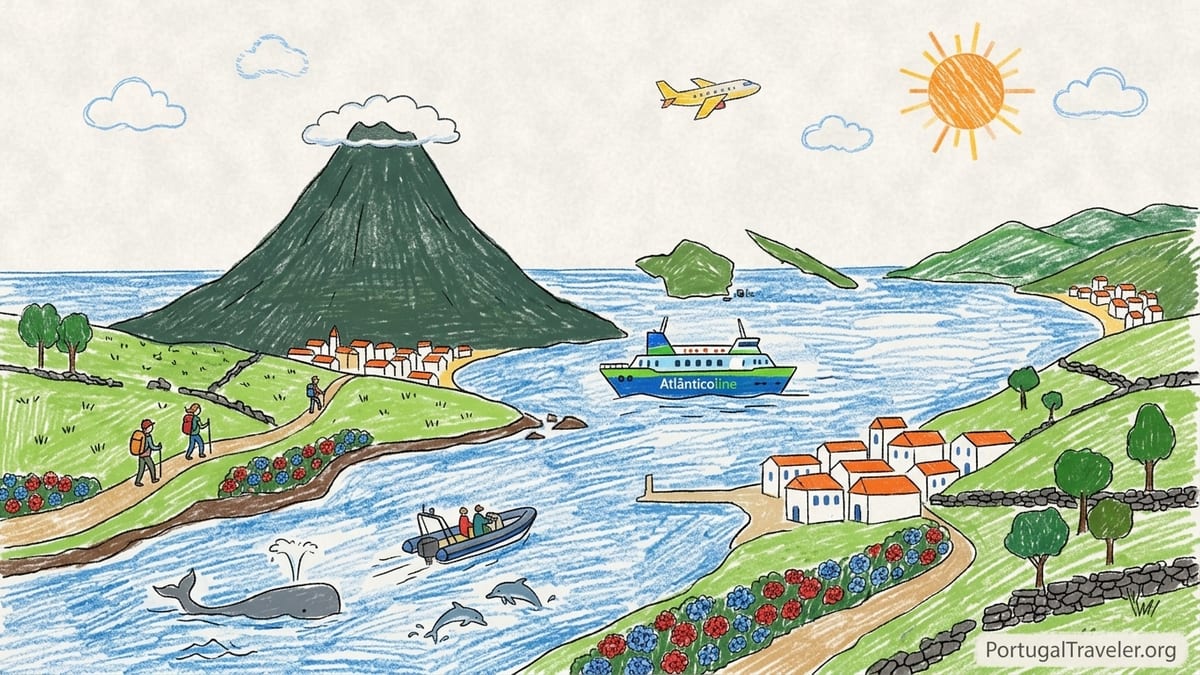
When I Actually Went: Months and Islands I Experienced
All of my on-the-ground Azores experience comes from three trips: late April into early May on São Miguel and Pico, mid June on São Miguel, and late August on the so-called Triangle islands of Pico, Faial and São Jorge. I have not personally visited in winter or deep off-season months like January or February, so anything I say about those periods comes from research rather than direct experience. The details in this article about cloud cover, wind, mud and ferry cancellations are drawn from those spring and summer weeks.
In late April and early May I based myself first in Ponta Delgada on São Miguel, then in Madalena on Pico. This is prime time for migratory baleen whales like blue and fin whales, and the islands were noticeably quieter on land. Hydrangea hedges were still mostly green, pastures vividly bright, and I often had viewpoints like Miradouro da Grota do Inferno almost to myself, when the clouds allowed any view at all.
My June trip, again centered on São Miguel, was about hiking and testing how realistic it was to swim in the ocean in early summer. By late August I returned focusing on multi-island travel. I used Atlânticoline ferries between Faial, Pico and São Jorge, added another whale watching day from Lajes do Pico, and hiked several trails including the cliff paths on São Jorge and the caldera rim on Faial. Those weeks gave me a good sense of how quickly weather can shift, how often plans changed, and which months felt better for specific activities.
Throughout the article, when I shift from “this is what I experienced” to “this is what winter is likely to be like,” I will say so clearly. The Azores reward honesty more than optimism. The goal is not to find a single magic month, but to match your priorities to the reality of an Atlantic archipelago where forecasts are suggestions rather than promises.
Spring in the Azores: April and May on the Ground
My late April and early May weeks were the most dramatic for sky and sea. On São Miguel, I would wake up to low grey cloud sitting on the mountains, drive up toward Lagoa do Fogo or Sete Cidades under fine drizzle, and watch the visibility drop from full crater views to total whiteout in minutes. At Miradouro da Vista do Rei, clouds hid the twin lakes on roughly half my attempts. On one day I drove up three separate times several hours apart. The first time the view was fully gone, the second time the clouds broke for about ten minutes, and the third time the crater filled back in like someone pulling a grey blanket across the sky.
This pattern shaped my decisions. Instead of assigning a single “hiking day” or “viewpoints day,” I kept my rental car flexible. When I saw blue sky over the central ridge from Ponta Delgada, I would immediately drive inland, sometimes abandoning a planned tea plantation visit or town walk to grab the clear conditions at altitude. Forecast apps often showed icons for “partly cloudy” all day, but in practice that meant fast-moving cloud layers, not gentle postcard skies. The lesson was to treat any stretch of sunshine as a limited-time offer, especially before noon.
On the water, April and May gave me the richest whale diversity but also the roughest rides. On São Miguel my whale watching operator warned that two or three days per week in spring can be blown out completely by swell and wind. In my case, one late April morning trip was cancelled at 8 a.m. due to high wind, and a replacement afternoon slot ran in lumpy seas that had several people seasick within 30 minutes. In return, that choppy afternoon delivered a blue whale blow on the horizon, a fin whale closer in, and a family group of sperm whales resting at the surface. Operators leaned heavily on shore-based lookouts, or vigias, to pick the windows in the waves. I learned to book three potential whale watching days spread across my stay so that one cancellation did not ruin the goal of seeing big whales.
Trail conditions in spring were wet but not impossible. On São Miguel’s Salto do Cabrito and parts of the Lagoa do Fogo trail, red volcanic soil turned to slick mud after even a short shower. The forest sections near Furnas stayed damp under canopy for hours after rain, so my shoes rarely fully dried between hikes. Temperatures at sea level usually felt like mid to high teens Celsius, comfortable in a light jacket, but at viewpoints around 800 to 900 meters I often needed an extra layer and gloves if wind kicked up. I found the ocean still too cool for long, relaxed swims without a wetsuit in late April, though locals were already using the natural pools at Ponta da Ferraria in short bursts when the geothermal spring mixed with incoming waves.
Early Summer: June for Hiking, Clouds and First Real Swims
June on São Miguel felt like a truce between winter Atlantic systems and full summer calm. Days were longer, pastures and hydrangea hedges intensified to photo-book green and blue, and the sea finally started to feel swimmable. In Ponta Delgada I measured sea surface readings in the high teens Celsius on harbor thermometers and found that I could comfortably stay in the water for 20 to 30 minutes without a wetsuit. Locals told me that the water warms rapidly from late June into July, and by September it can reach the low twenties Celsius, enough for hours in the ocean for most swimmers.
Cloud behavior in June still required tactical patience, but the extreme whiteouts of April eased slightly. Around Sete Cidades I found a pattern where low cloud often sat in the crater early in the morning, lifted by late morning, and then returned as a high thin layer later in the afternoon. On two different days I hiked the Cumeeira Grande ridge around the crater. The first time, clouds rolled over the north rim and briefly reduced visibility to about 50 meters, forcing me to pause on narrow, exposed sections. Thirty minutes later they tore open again, revealing green patchwork fields and the lakes far below. The second time, I timed my start for late morning when satellite imagery showed clearer skies, and enjoyed largely consistent views with only brief mist.
June trails were still muddy in shaded laurel and conifer sections, especially after night rain, but many open ridge and pasture paths began to dry out. On the PRC05SMI trail around Lagoa do Fogo the initial forested climb was greasy with roots, while the upper ridge in sun was firm. I carried lightweight hiking poles on this trip and considered them useful but not mandatory. At elevation temperatures were typically a few degrees cooler than at sea level, enough that a damp wind could chill you quickly if you stopped for long photos or a picnic, even if Ponta Delgada felt warm in a T-shirt.
June also brought a shift in whale watching dynamics. On a three-hour morning trip from Ponta Delgada, the swell was noticeably smoother than in April, and only one person on the rigid inflatable boat looked uncomfortable. We spent less time punching through waves and more time drifting in light chop as guides pointed out sperm whales blowing in the distance. Migratory giants like blue whales were already thinning out compared to April, but resident sperm whales and several dolphin species made up for it. Operators mentioned that June offers a good compromise: enough pelagic species still passing through, less chance of weather cancellations than in March or early April, and longer daylight for afternoon tours.
Late Summer: August for Island Hopping, Ferries and Calmer Seas
By late August, when I based myself on Pico with side trips to Faial and São Jorge, the Azores felt like a different destination again. Sea temperatures had climbed comfortably into the twenties Celsius at the surface, and locals in Horta and Madalena swam in the harbor or natural pools for long sessions without wetsuits. Air temperatures at sea level hovered somewhere around the low to mid twenties Celsius most afternoons, warm enough for shorts but rarely oppressive. Pico’s 2,351 meter summit created its own weather, with a cap of cloud most days, but on the coasts the atmosphere felt more stable than in spring.
For inter-island travel, August was clearly the peak ferry moment. Atlânticoline had multiple daily sailings on the short Faial-Pico route, and a reliable schedule connecting Pico and São Jorge. Tickets for same-day travel were easy to buy at the terminal a few hours in advance for foot passengers, although taking a car required booking earlier in the season. Importantly, even in late summer, wind could still disrupt plans. During my week on Pico one afternoon departure to São Jorge was cancelled due to strong wind and swell in the channel, and the morning sailing the next day left under a cautionary announcement about bumpy conditions. That experience confirmed that anyone building a multi-island itinerary should treat ferry crossings as flexible, not as fixed as train departures on a mainland.
Whale watching conditions out of Lajes do Pico in August felt significantly calmer than my April outings. The rigid inflatable boat still slapped occasionally into Atlantic swell, but several fellow passengers who described themselves as prone to seasickness stayed comfortable with standard precautions and medication. We saw at least two sperm whales and several dolphin pods on a half-day morning trip, though guides were clear that the variety of baleen whales was limited compared to spring. For many first-time visitors the trade-off of calmer seas, warmer air and water, and easier logistics makes August attractive even if the odds of spotting a blue whale are lower.
On land, hiking in August traded mud for heat and dust. Trails on São Jorge’s northern cliffs had dry, sometimes loose sections where red soil crumbled underfoot. Exposed coastal paths with little shade, such as the descent to Fajã da Caldeira de Santo Cristo, required an early start and plenty of water. At higher elevations on Pico and Faial, low cloud still formed frequently. A planned attempt on Pico’s summit was cancelled when guides reported strong summit winds and heavy cloud at the crater rim. Even in late summer, elevation magnified every bit of weather, turning a warm, bright morning in Madalena into drizzle and single-digit wind-chill conditions above 2,000 meters. That contrast underlined the need to pack serious layers if you plan any high-altitude hikes, regardless of the month.
Diving and Ocean Temperatures: When the Water Really Works
The official Azores dive guidance emphasizes a mild maritime climate with average air temperatures roughly in the 16 to 26 degrees Celsius range across the year and sea temperatures around 16 to 22 degrees, with the warmest and calmest diving conditions usually running from June to September. My own in-water experience lines up with the spirit of this, but the comfort level changes a lot inside that band, especially if you are used to tropical diving.
On my late April trip, snorkeling near the coast in a standard swimsuit felt bracing rather than pleasant. I could handle about ten minutes near Ponta da Ferraria before my hands and feet started to numb, even with the geothermal influence of the hot spring mixing into the surf at certain tide levels. Divers on my boat in April wore full 7 mm wetsuits with hoods and often gloves, and surfaced talking about invigorating but short bottom times compared to warmer destinations. Several described visibility as decent but not spectacular, with some greenish tinge in the water that local guides linked to spring nutrient blooms.
By June the experience softened. I was able to swim in coastal pools like those near Mosteiros and Ribeira Quente for 20 to 30 minutes without real discomfort, and local dive shops around Ponta Delgada and Vila Franca do Campo were recommending 5 to 7 mm suits depending on personal tolerance. Dive operators I spoke with cited official guidance highlighting June through September as the sweet spot when water temperature, calmer winds and clearer visibility come together. My conversations with visiting divers echoed this: many planned Azores trips for late August or early September specifically to combine pelagic encounters like mobula rays and blue sharks with water warm enough to make multiple consecutive days of diving comfortable.
Research, rather than personal dives, fills in the winter picture. In cooler months, with sea temperatures closer to the mid-teens Celsius, diving is still possible but gear becomes heavier, wind can shorten offshore windows, and visibility is often reduced by weather systems stirring up the water column. If you are planning an Azores dive trip primarily for big pelagic species and underwater photography, the most consistent reports of warm, clear, stable conditions cluster between June and September. That does not mean you cannot dive at other times, but your margin for weather-related disappointment shrinks outside the main season.
Hiking, Clouds and Elevation: How Weather Shapes Trails
Hiking is one of the main reasons many travelers choose the Azores, and it is also the activity that suffers most when you underestimate clouds and wind. Across my April, June and August trips I noticed that the difference between sea level and 800 to 1,000 meters could feel like shifting seasons. On a typical spring day in Ponta Delgada I might be comfortable in a light sweater in town at 17 degrees Celsius, only to find myself on the rim above Lagoa do Fogo with wind cutting across the ridge and visibility dropping to 20 or 30 meters in mist, making it feel almost wintry.
Clouds had two effects on hiking. The obvious one was view-blocking. On São Miguel, I lost the classic postcard view at Miradouro do Cerrado das Freiras entirely on two visits where clouds filled the entire crater. Less obvious but more important for safety was how clouds combined with wind to transform trail character. On Pico’s mid-altitude lava fields, sudden fog banks reduced depth perception, making it harder to read the rugged, uneven rock, while gusts made me adjust my balance on narrow traverses. Guides on Pico told me that they cancel or modify summit attempts frequently due to a combination of cloud and wind, not just because of rain.
Mud was a near-constant companion in spring and early summer. Trails that cut through dairy pastures, such as parts of the Mata do Canário to Sete Cidades route, were often churned up by cattle, leaving slick sections that clung to boots and turned rocks into ankle-twisters. Forest paths around Furnas and Ribeira dos Caldeirões stayed damp under the canopy long after rain stopped, so I found that my socks never truly had a dry day in April. By August, many of these paths dried out, but exposed coastal trails on São Jorge and Faial developed loose, dusty patches instead. Planning footwear around this reality matters. Lightweight trail shoes can work in August, but in April and May I was glad to have sturdier boots with decent lugs and ankle support.
Forecast reliability for hikes was mixed at best. On São Miguel, major apps often predicted “cloudy with sunny spells” or vague icons that lasted all day, which translated into fast-moving low cloud patches that could either leave your hike in full sun or full fog. I started checking local webcams at viewpoints when available and asking guesthouse owners what they saw on nearby hills in real time. In practice, I built my own simple rule: if I could see the ridge line above town in the morning, I prioritized high-level hikes that day. If the mountains were socked in, I switched to lower coastal walks, hot springs or tea plantations and tried the heights again the next day.
Whale Watching Seasons, Wind and Real Cancellation Risk
If your main goal is whale watching, timing becomes more a question of which species you hope to see and how much rough water you are willing to tolerate. Across my late April, early May and August outings, plus conversations with local operators and the latest whale watching reports, a pattern emerges. Sperm whales live in Azorean waters year-round and form the backbone of sightings in every month, but the richest mix of species, including blue and fin whales, clusters in spring, particularly March through early May.
My own April and early May trips from São Miguel delivered that mix, but at a price in comfort. Two out of five scheduled boat trips in that window were either cancelled outright or postponed due to swell and wind. Of the three that ran, one was on the edge of comfortable for many passengers, with repeated slamming into oncoming waves and a significant portion of the boat looking pale. The payoff was exceptional: on those choppy days we saw at least three different species of large whales plus multiple dolphin pods. Guides made clear that the decision to go ahead is taken trip by trip, based on reports from the vigias and real-time sea state rather than just forecasts.
By June and especially August, cancellations became less frequent in my experience, and the rides smoother, but the species list narrowed primarily to sperm whales and resident or summer dolphin species. On my August morning out of Pico, the captain described the sea as “almost as calm as it gets here,” which still meant noticeable movement but nothing dramatic. No passengers became ill, and we spent long stretches idling near groups of dolphins with the engine in neutral. The downside was that guides were transparent about the low odds of seeing blue whales that late in the season.
Across the year, reliable operators advise booking whale watching on your first full day on an island and holding at least one or two backup windows later in your stay. This mirrors my own strategy. On São Miguel I booked tours for my first, third and fifth mornings, expecting that at least one might be lost to wind. I also chose morning departures wherever possible because local crews noted that seas are often a little calmer earlier in the day before afternoon breezes pick up. Even then, flexibility is essential. Treat whale watching as something you fit around weather windows, not the immovable center of your daily schedule.
Ferries, Flights and Building Flexibility Into Your Itinerary
Island-hopping looks straightforward on a route map, but Atlantic weather and seasonal schedules complicate reality. On my late August trip, Atlânticoline ferries between Faial, Pico and São Jorge ran multiple times per day, which made spontaneous planning relatively easy. The short hop between Horta and Madalena is especially robust, with ferries shuttling back and forth many times a day in peak season. Even here, I experienced one wind-related cancellation on the Pico to São Jorge line. It forced me to delay my São Jorge hiking day and shuffle accommodations by 24 hours, a manageable inconvenience because I had left slack in the schedule.
Spring felt inherently more fragile for multi-island trips. Researching schedules for April and May, I found that some longer overnight or long-distance routes either did not operate yet or ran less frequently. In practice, this means that in shoulder months you should base your plan on flights for longer jumps, keeping ferries for shorter, more sheltered crossings where possible. It also reinforces the value of not stacking too many tight, interlocking reservations. For example, I avoided booking a nonrefundable Pico hotel night immediately after a same-day São Miguel flight and connecting ferry. Instead, I arrived on Pico a day before any fixed activities like whale watching or guided hikes.
Forecasts influenced my ferry choices as much as whale watching. On Pico I checked both standard weather apps and wave prediction tools to gauge which day in a three-day window looked calmest for the more exposed crossing to São Jorge. Local advice from guesthouse owners and ferry staff proved more useful than app icons. On one occasion, a terminal agent hinted that “tomorrow looks tricky” even though my phone showed only a modest wind symbol. I shifted my hiking day accordingly and avoided what turned into a cancelled sailing the next afternoon. That experience captured the core Azores planning principle: leave gaps in your itinerary so you can slide ferries, flights and long hikes around wind and waves.
The Takeaway
After three Azores trips spread across late April, early May, June and late August, I have stopped talking about a single best time to visit and started talking about best windows for specific priorities. If you dream of seeing blue whales and do not mind possibly rough water and fast-changing clouds, targeting March to early May gives you the richest cetacean diversity, with the caveat that wind and swell will probably cancel at least one boat trip and cloud can erase viewpoints with little warning. For hiking on drier trails and easier ferry hopping, late June through September feels more forgiving, with warmer seas, more stable schedules and fewer weather-related cancellations, even if you trade away some big whale species and accept more people at viewpoints.
Divers should read the official moderate climate guidance with a practical lens. The Azores really do offer all-year diving, but the comfortable band for multi-day, big-animal trips concentrates between June and September when air temperatures, sea temperatures and visibility align. Hikers need to plan for elevation differences, expecting that a mild afternoon in Ponta Delgada or Madalena can turn into cold, foggy, windy conditions on crater rims or Pico’s slopes in any month. Island-hoppers should think in terms of buffers rather than tight connections and accept that ferries and small planes serve an oceanic reality, not a fantasy of clockwork precision.
The most useful mindset is to treat Azores weather as a partner you negotiate with, not an obstacle you conquer. Build consecutive days in each island hub so that you can move whale watching, major hikes and ferry crossings forward or backward as wind and cloud dictate. Keep a short list of “Plan B” activities at lower elevation or under cover for each place, from tea factories and geothermal pools on São Miguel to museum visits in Horta and wine-tasting in Pico’s lava vineyards. When a whiteout steals your crater view or a gale cancels your boat, those backups turn frustration into discovery.
There is no month that guarantees glassy seas, constant sunshine and empty trails. What the Azores do offer, across much of the year, is a dynamic landscape where weather paints and repaints the same views in new moods every hour. Choose your season by what matters most to you, pack for rain, wind and sun in the same day, and leave your schedule loose enough that when the clouds finally lift over a lagoon or the sea calms for your whale encounter, you can be exactly where you hoped to be.
FAQ
Q1. What is the best month to visit the Azores if I want a bit of everything?
There is no perfect month, but June often balances factors well. On my June trip, trails were drying out compared with April, ferry routes were running more frequently, seas were calmer than in early spring, and it was just warm enough for comfortable ocean swims. You may see fewer blue whales than in April or May, but you still have good chances for sperm whales, excellent hiking and workable conditions for diving.
Q2. If I want the highest chance of seeing blue whales, when should I go?
Based on my April and early May trips and current whale watching reports, late March through early May is the prime window for blue and fin whale sightings around islands such as São Miguel and Pico. Be prepared for rougher seas, more frequent tour cancellations due to wind and swell, and clouds that may hide viewpoints. Booking multiple whale watching slots over several days is essential in this season.
Q3. How often did weather force you to cancel or change plans?
Across my spring and summer visits, I had to change or cancel plans roughly every second or third day in April and early May, mainly due to low cloud at viewpoints and wind affecting whale watching. In August the number of disruptions dropped, but I still lost one ferry crossing between Pico and São Jorge to strong wind and abandoned a planned Pico summit attempt because guides reported unsafe conditions at elevation.
Q4. Is summer always sunny in the Azores?
No. Late August on Pico, Faial and São Jorge brought more stable conditions and warmer air and sea than spring, but there were still days of solid cloud, light rain and hazy visibility. Pico’s summit in particular sat under a cap of cloud most afternoons. Summer improves the odds of settled weather and clearer seas, but it does not create Mediterranean-style blue-sky guarantees.
Q5. How trustworthy are weather forecasts for planning hikes and boat trips?
In my experience, standard weather apps in the Azores were only moderately reliable. They tended to capture general trends, such as a windy or calmer day, but could not predict when exactly clouds would clear over specific craters or ridges. I used them mainly to avoid obviously bad days for boat tours, then relied on local advice, webcams and a look at the real-time cloud cover on nearby hills to decide whether to attempt high-elevation hikes.
Q6. What should hikers pack for spring and summer in the Azores?
Across April, June and August I was glad to have a waterproof shell, a warm mid-layer, quick-drying hiking trousers, and footwear with good grip for mud in spring and loose dust in late summer. Lightweight gloves and a hat were useful at viewpoints and on exposed ridges even when towns felt mild. For summit attempts on Pico or other high-altitude routes, I would add a warmer insulated layer and consider trekking poles for stability on wet or uneven volcanic rock.
Q7. When is the sea warm enough for comfortable swimming without a wetsuit?
On my trips, late April still felt cold for more than very short dips. By June, I could swim in coastal pools and sheltered bays for 20 to 30 minutes without real discomfort, and by late August around Pico and Faial the water was pleasantly cool rather than chilly, allowing much longer sessions. Reports from locals and recent visitors suggest that late August and September are the warmest and most comfortable months for extended swims without neoprene.
Q8. Is winter a bad time to visit the Azores?
I have not personally visited in winter, but research and local guidance suggest that December through February bring more frequent storms, heavier rain and rougher seas. Ferries and small boat tours face more disruption, and diving and whale watching windows can be narrow. On the other hand, islands are quieter, accommodation can be cheaper, and dramatic weather can be appealing if you focus on slow travel, hot springs and low-level walks instead of big hikes or multi-island ferry itineraries.
Q9. How many days should I spend on each island to allow for weather flexibility?
Based on my own planning, I aim for a minimum of three full days on larger islands such as São Miguel and Pico, and at least two full days on smaller islands like Faial or São Jorge. This gives you enough time to shuffle key activities such as whale watching, major hikes or ferry crossings around poor weather days. If you have a very specific goal, such as climbing Pico or diving a particular offshore seamount, adding an extra buffer day is wise.
Q10. Should I prioritize ferries or flights for island-hopping?
In late August, ferries between close islands like Faial and Pico worked very well for me, with frequent departures and relatively low disruption. For longer distances or shoulder-season travel in April and May, I leaned toward flights because some ferry routes ran less often and were more vulnerable to cancellations. A practical strategy is to fly the longer legs between island groups and use ferries within clusters, while keeping your itinerary loose enough to absorb occasional changes.