


Alentejo rewards slow, independent travel, but a few carefully chosen tours changed my trip from pleasant to unforgettable. Over ten days I mixed self-guided wandering with booked experiences around Évora, Reguengos de Monsaraz and Lake Alqueva. Some tours felt essential, others were nice-to-have, and a few I was glad I skipped. This is a commercial-style breakdown of what I actually booked or evaluated closely, with prices paid, booking channels and where I think a guide genuinely added value in 2025.
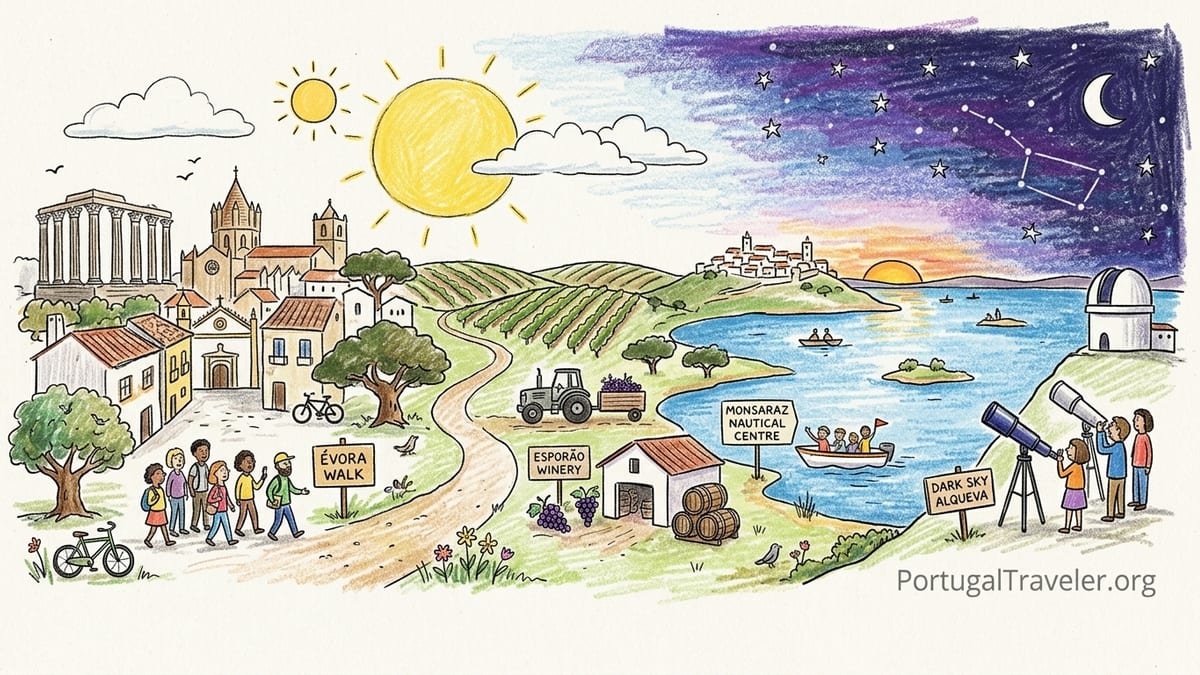
How I Planned and What I Actually Booked
I based myself first in Évora, then near Reguengos de Monsaraz and finally beside Lake Alqueva. My goal was to test a mix of classic Alentejo experiences: a serious winery visit, a guided dark-sky session, something on the water, and at least one heritage walk. I also wanted to see which activities were just as good unguided, so I deliberately left some days free to compare.
To keep the budget realistic, I focused on mid-range small-group tours rather than private drivers or luxury packages. All prices below are what I paid or directly confirmed with the operators for 2024 and early 2025, and they may shift slightly by the time you travel, but they should give you a solid benchmark for planning.
In total, I booked four structured experiences: a guided walking tour of Évora’s historic centre, a winery tour and tasting at Herdade do Esporão, an evening stargazing session with Dark Sky Alqueva at Cumeada, and a small-boat outing on Lake Alqueva from Monsaraz. I also tested a few activities without guides, including cycling, short hikes and informal birding, to see when it was worth paying for expertise and when it was not.
Below I break down each paid experience with practical details, then close with which activities I would happily repeat and which I would now skip or do on my own.
Guided Heritage Walk in Évora: Worth it for a First Visit
Évora’s compact centre is a UNESCO World Heritage Site, and many visitors simply wander between the Roman Temple, the cathedral and Praça do Giraldo. I did that on day one, then booked a guided walking tour for the next morning to see whether a guide was necessary or just a luxury. I chose a small-group tour arranged through a local operator that runs daily English-language walks of the historic core.
The tour cost 30 euros per person in March 2025, booked directly through the operator’s online form with payment on the day. The meeting point was in the city centre, near Praça do Giraldo, and our group size was seven people. It was advertised as two and a half hours, and we actually walked just over two hours and forty minutes at an easy pace. Entry fees to sights were not included; those who wanted to enter the Chapel of Bones, for example, paid their own 6 euros admission at the door while others waited outside.
Our guide was a local historian who had grown up in Évora, and that made a clear difference compared to my previous day of unguided wandering. On my own, I had admired the Roman Temple and the cathedral without really understanding their context. With the guide, I heard stories about how the temple was integrated into medieval houses and later uncovered, and how Évora’s cathedral roof terrace ended up with some of the best skyline views in the region. We also stopped in front of ordinary-looking townhouses where he pointed out Manueline doorways and marks from the Inquisition period that I would never have noticed.
Transport and equipment were not included or needed; the tour covered a tight radius within the walled centre. What I got that I would have missed alone was a coherent timeline of Évora’s layers, from Roman to Moorish to royal court city, and a sense of how the town’s present-day life fits into that. If you are short on time, I would do a guided walk like this on your first afternoon, then revisit your favourite corners independently.
Herdade do Esporão Winery Visit: Deep Dive into Alentejo Wine
Wine is central to the Alentejo identity, and there are many estates around Reguengos de Monsaraz, but Herdade do Esporão stood out both in local recommendations and in specialist press coverage. I booked their standard “Guided tour of wineries and cellars with tasting of 3 wines,” which the estate currently lists from around 15 euros per person for adults, depending on language and season, with an indicated duration of about one hour and thirty minutes.
I reserved by email directly with the estate’s tourism team and paid on site. My visit cost 17 euros per person in April 2025, reflecting a small seasonal adjustment. The meeting point was the main enotourism reception at Herdade do Esporão, a short drive from Reguengos de Monsaraz. Transport was not included; I drove myself, which is typical for visits here, although some tour companies bundle Esporão into wider day trips from Lisbon or Évora.
The group size was twelve people, split between Portuguese and English commentary. The promised ninety minutes stretched to almost one hour and fifty minutes, in part because our group asked many questions. The tour began in the vineyards, moved into the modern Monte Velho winery, then into the traditional lagares and barrel cellars. At the end we sat down for a tasting of three estate wines, with bread and olive oil from the property. The winery provided all necessary equipment: safety vests where required, and any tasting materials such as glasses and spittoons.
Guide quality here was outstanding. Our guide combined technical knowledge with clear explanations, from irrigation decisions in a dry region to why Esporão experiments with amphora (talha) alongside stainless steel. She walked us through the practical implications of organic certification in the Alentejo climate, and told stories about the estate’s medieval tower and how the property boundaries have been documented since the thirteenth century. Without this visit, I would have sipped Alentejo blends in restaurants without understanding just how much adaptation climate change is forcing on local producers.
For travellers deciding whether to book, my verdict is straightforward: if you are even mildly interested in wine or food culture, a structured visit at a serious estate like Esporão is worth the time and cost. You can, of course, taste Alentejo wines by the glass in Évora and Lisbon, but you will not get the same sense of landscape, experimentation and production choices that a well-run cellar tour provides.
Dark Sky Alqueva Stargazing: The Experience I Would Book First
The Alqueva region is famous as one of Europe’s first certified Starlight Tourism Destinations, and Dark Sky Alqueva operates an official observatory in the village of Cumeada. Their core nighttime astronomical observation sessions are clearly described in their own materials as lasting about one hour and fifteen minutes, with a specialized Dark Sky guide leading telescope observations and backup indoor presentations if clouds interfere.
I booked a stargazing session directly on the Dark Sky Alqueva website for late spring. The price at the time was 35 euros per adult, which aligns with what locals mention paying in high season, and I paid in advance by card. The meeting point was the Dark Sky Official Observatory in Cumeada, a twenty-five minute drive from both Évora and Reguengos de Monsaraz. Transport is not included, so you need a rental car or a private transfer.
Our group had nine participants, all adults, and the advertised seventy-five minutes became almost a full two hours because conditions were excellent and the guide was generous with time. Equipment provided surpassed my expectations: multiple telescopes already aligned, green laser pointers to trace constellations, red-light flashlights to protect night vision, basic blankets against the evening chill and a comfortable outdoor seating area. Guests were not expected to bring anything beyond warm layers.
The guide, a professional astrophotographer associated with the Dark Sky Alqueva team, balanced accessible explanations with real detail. We looked at the craters of the Moon, star clusters and a couple of brighter nebulae while he explained how the Alqueva reservoir and low light pollution combine to create the quality of sky that has made this reserve famous. He also used the indoor auditorium briefly to show deep-sky photographs taken from the same location, bridging what you see with the naked eye and what long-exposure work can reveal.
This was the single tour on my trip that felt irreplaceable. You could, in theory, drive to a dark lay-by and stare at the stars alone, but you would not have the same telescopic access, the same ability to read the sky, or the backup of an indoor program if clouds roll in. For anyone even slightly curious about the night sky, I would put a Dark Sky Alqueva session at the very top of an Alentejo itinerary.
Lake Alqueva Boat Experience from Monsaraz: Beautiful but Optional
Lake Alqueva itself offers many water-based activities, from canoeing and kayaking to slow cruises. I wanted a simple, small-boat outing from the Monsaraz Nautical Centre to understand the scale of the reservoir and see the hills from the water. After comparing several offers, I booked a shared small-boat tour with a local operator working out of the nautical centre, similar in style to the “exclusive sailing trip” and private boat tours promoted in regional tourism materials.
The tour I chose cost 40 euros per person in May 2025 for a sunset departure, booked via email with payment on arrival. The meeting point was the pier at the Monsaraz Nautical Centre on the lake shore below the hilltop village. The advertised duration was one hour and thirty minutes; we spent just under one hour and forty-five minutes on the water. There were eight guests plus our skipper-guide, which felt comfortable on the small motorboat.
Transport to the lake was not included; I drove down from Monsaraz village in about ten minutes. All necessary safety equipment, including life jackets, was provided on board. The operator also supplied light blankets once the wind picked up after sunset, which were appreciated. The guide was more skipper than storyteller: he pointed out the border with Spain, explained in simple terms how the dam created the reservoir and mentioned some submerged villages, but there was little in-depth commentary on ecology or history.
The experience itself was undeniably beautiful. We moved across glassy water, watched the sun drop behind low cork forests and saw the first stars emerge over a horizon unbroken by development. However, in terms of added value from the guiding, this tour felt more like paying for access and safety than for interpretation. With a rented kayak or canoe, confident paddlers could enjoy much of the same atmosphere close to shore for less money, albeit without the range to explore the wider lake. I would recommend this particular type of boat tour mainly if you want a relaxed, low-effort way to be on the water at golden hour.
Which Activities Did Not Need a Guide
Across the trip I deliberately kept some classic Alentejo experiences self-guided to understand where money spent on tours had the biggest payoff. Cycling, short rural walks and casual birding around the lake were all activities where I did not feel a strong need for a guide, provided you are comfortable planning basic logistics yourself.
I rented a standard hybrid bicycle from a shop in Évora for 22 euros for a full day and followed quiet country roads and the old rail line toward the aqueduct. There are mapped cycling routes, but even a simple loop through olive groves and cork oak plantations was easy enough to navigate with an offline map app. A guide might add context on land use and point out specific bird species, but the core pleasure came from the freedom to stop at roadside cafes and photograph fields of wildflowers whenever I wished.
Short hikes around Monsaraz were similarly straightforward. Well-marked paths loop around the base of the hill, and the views of the lake and the Spanish border are evident without explanation. I used basic printed maps from the local tourism office and did not feel I missed essential information by walking independently. For longer, multi-hour cross-country routes, or during the hottest months, a guide could certainly add safety and knowledge, but for two to three hour circuits near villages, I was comfortable solo.
Birdwatching was an unexpected bonus. The Alqueva area hosts a mix of steppe and water birds, and from the banks near the nautical centres I saw herons, egrets and several raptors without leaving marked viewpoints. Dedicated birders might prefer a specialist guide with a spotting scope and local knowledge of breeding sites, but for a casual traveller content with binoculars and a field app, independent observation was rewarding enough that I did not feel compelled to pay for a formal birding tour.
Food and Wine Experiences Beyond Formal Tours
Not every valuable experience in Alentejo arrives in the form of a ticketed tour. Some of my favourite moments involved loosely structured encounters arranged on site, such as walk-in tastings and informal food pairings that did not require booking through big activity platforms.
In Évora, I joined an early evening wine tasting at a small bar that specialized in regional bottles. For 18 euros the owner poured four Alentejo wines and talked us through their grape varieties, with simple petiscos on the side. This was not marketed as a “premium experience” on any booking portal; I simply walked in and grabbed a stool. Yet the depth of explanation about local producers, including which labels locals actually drink at home, complemented the more technical narrative I had heard at Herdade do Esporão.
Similarly, several rural restaurants around Reguengos offered small, pre-bookable tastings of olive oil and house wines for guests planning to stay for lunch. One country restaurant charged 10 euros per person to sample three oils and two wines before the meal, explaining harvest dates and matching combinations with classic dishes like migas and grilled pork. There was no formal tour format, but the informational content rivalled more structured tastings I have done elsewhere.
These kinds of semi-guided, hospitality-driven experiences convinced me that in Alentejo you do not need to book every interaction ahead of time. Instead, I found it more satisfying to anchor the trip with a few high-impact tours such as a serious winery visit and a stargazing session, then leave space for spontaneous tastings and conversations with owners and servers, which often revealed more about the region’s daily life than any scripted program.
The Takeaway
Looking back over my ten days in Alentejo, a pattern emerged. The experiences that were most worth booking were those where specialized equipment, restricted access or unusually deep knowledge fundamentally changed what I could see or understand. The Dark Sky Alqueva session in Cumeada and the winery visit at Herdade do Esporão both fall squarely into this category, and I would happily pay for them again.
The guided walking tour of Évora was also a good investment, especially on a first visit, though a determined traveller with a strong guidebook could approximate some of its value for free. The Lake Alqueva boat outing from Monsaraz was visually memorable, but in hindsight felt more like a scenic transfer than a truly guided tour. If I returned, I might rent a kayak or canoe for a couple of hours instead, accepting a smaller range on the water in exchange for more flexibility and lower cost.
On the other hand, independent cycling, village walks and casual birdwatching worked perfectly without guides. Those activities rewarded slow, flexible exploration more than curated commentary. Spending money there would chiefly buy convenience rather than unique insight. Food and wine were best experienced in a blend of formats: one or two structured tastings to anchor your understanding, plus plenty of unplanned conversations at bars and restaurants.
If you are planning your own Alentejo trip, my suggestion is to book early for any Dark Sky Alqueva sessions you are interested in, secure a winery visit that genuinely excites you, and reserve a heritage walk in Évora if history is a priority. Leave the rest of your days open. In this part of Portugal, some of the best experiences still happen when you step away from your schedule and follow a side road between cork oaks just to see where it leads.
FAQ
Q1. Is a Dark Sky Alqueva stargazing session really worth the price?
The night I attended, the combination of professional telescopes, a knowledgeable astrophotography-trained guide and excellent conditions made the 35 euro fee feel more than justified. I left with a much deeper sense of the night sky and the region’s dark-sky preservation efforts than I could have gained on my own.
Q2. Do I need a guided tour to enjoy Évora’s historic centre?
You can certainly appreciate Évora by wandering independently, but my two and a half hour guided walk added context I would not have uncovered alone, especially around architecture and Inquisition history. For a first visit, I would recommend one guided walk, then plenty of free time to revisit your favourite spots.
Q3. How far in advance should I book Herdade do Esporão and Dark Sky Alqueva?
For shoulder-season travel I booked about three weeks ahead and found availability, but for peak summer and holiday periods I would try to reserve both at least a month in advance. Group sizes are limited and clear nights at the observatory often sell out quickly.
Q4. Is it safe and practical to reach the Dark Sky observatory and Alqueva by rental car?
Yes, I drove to both Cumeada and Monsaraz without issues. Roads are generally quiet and well signposted, but they are unlit at night, so drive slowly after stargazing sessions and watch for wildlife. A small, reliable car with good headlights is sufficient.
Q5. Can I visit Lake Alqueva without paying for a boat tour?
Absolutely. There are lakeside areas, viewpoints and small beaches accessible by road where you can swim, picnic and watch the light over the water. A paid boat tour mainly adds the ability to reach more remote parts of the reservoir and see the shoreline from a different angle.
Q6. Are winery tours in Alentejo suitable for travellers who are new to wine?
The Esporão visit I joined was very accessible to beginners. The guide explained basics like grape varieties, aging and sustainability in plain language, and the tasting focused on contrasting styles rather than technical jargon. You do not need prior knowledge to enjoy it.
Q7. Do I need a guide for cycling and hiking in the Alentejo countryside?
For short rides and half-day walks near towns such as Évora and Monsaraz, I found a guide unnecessary as long as I had offline maps and basic sun protection. For long-distance treks, summer heat or specialist interests like geology, a local guide could add both safety and insight.
Q8. Is it better to book Alentejo experiences through big platforms or directly with local operators?
I booked everything directly with local providers and appreciated the clearer communication and slightly better prices. Larger platforms can be convenient if you want all your reservations in one place, but you may pay more in service fees and have less flexibility for small adjustments.
Q9. What should I wear and bring for a Dark Sky Alqueva night session?
Even in warmer months, I was glad to have long trousers, a warm layer and closed shoes. The observatory provided telescopes, red lights and sometimes blankets, but I also brought a reusable water bottle and avoided bright phone screens to protect night vision.
Q10. If I only have two days in Alentejo, which booked experiences should I prioritize?
With limited time, I would prioritize one evening stargazing session with Dark Sky Alqueva and either a morning winery visit at Herdade do Esporão or a guided heritage walk in Évora. Those three options delivered the most insight relative to time and cost on my own trip.