


I arrived in the Alentejo with seven days, a small rental car and a completely unrealistic list: two nights in Évora, wine tasting near Reguengos de Monsaraz, a detour to the Alqueva Dark Sky Reserve, at least one long beach day on the Alentejo coast and a final night somewhere quiet in the countryside. On the map it all looked close. On the road, with summer heat, late sunsets, check-in times and restaurant hours, I learned very quickly that how you divide your days in this region matters at least as much as where you go.
How Many Days I Actually Had, And What I Tried To Cram In
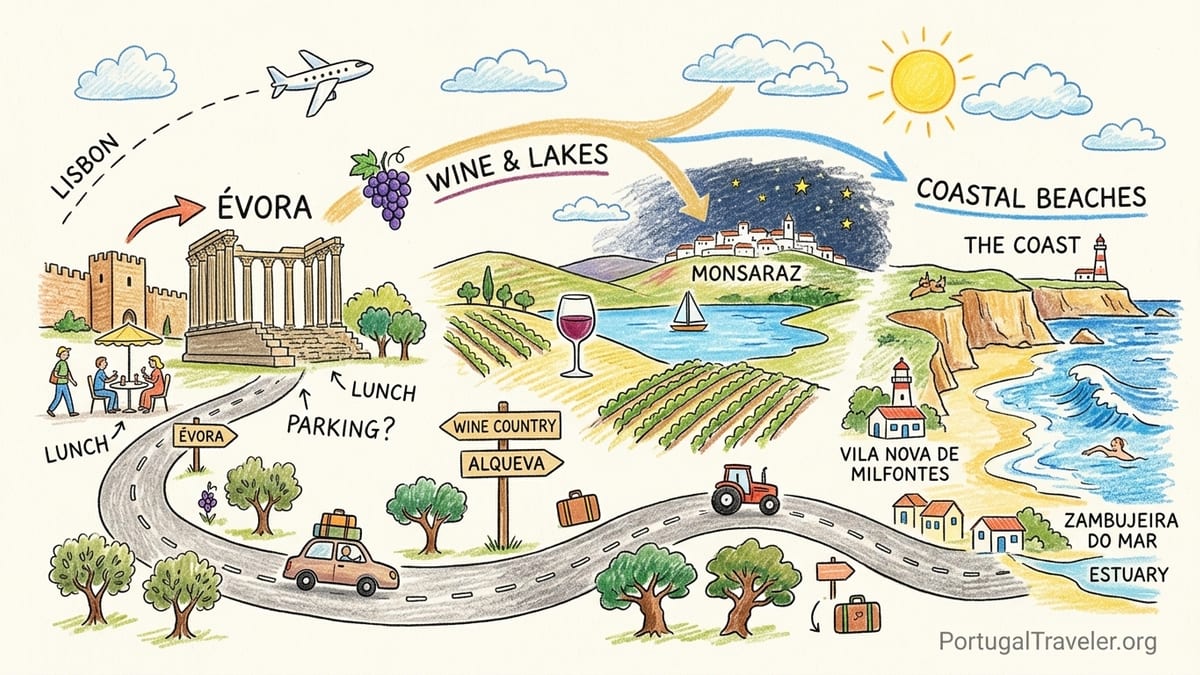
On my latest trip I had a full week based around a Lisbon flight, which translated to seven calendar days but only about five and a half truly usable days once I factored in airport time and the drive into and out of the region. I picked up a car in Lisbon, drove to Évora for two nights, spent two nights near Reguengos de Monsaraz for wine and Alqueva, then tried to tuck two nights on the Alentejo coast around Vila Nova de Milfontes and Zambujeira do Mar at the end before driving back north.
Lisbon to Évora is roughly 130 kilometers and takes around 1 hour 30 minutes on the A2 and A6 motorways in light traffic, which sounds short until you realize that you almost always arrive around lunch and cannot check in until mid-afternoon. My first lesson was that a “half-day” in Évora after the drive disappeared into finding parking just outside the historic walls, walking luggage over cobbles, and then sitting down for a late prato do dia in the shade near the Roman Temple while waiting for the room to be ready.
From Évora I planned a loop through wine country and the Alqueva area. Many of the best-known estates such as Herdade do Esporão are near Reguengos de Monsaraz, about 45 minutes’ drive southeast of Évora on straightforward regional roads according to both the local tourism board and winery information. That sounds like an easy day trip, but once you add a 10:30 winery tour, a long tasting lunch, a stroll in hilltop Monsaraz and a swim in the Alqueva reservoir, it quickly turns into a 10 to 11 hour day with nearly two hours of driving in heat that can reach the mid 30s Celsius in summer.
My final plan was to cross the region west to the Atlantic, aiming for Vila Nova de Milfontes and then down to Zambujeira do Mar. Évora to Vila Nova de Milfontes is about 150 to 170 kilometers depending on the route you choose and generally takes close to 2 hours by car. On paper it looked like an easy repositioning day plus a sunset swim at Praia do Farol. In reality, moving hotels, stopping for fuel and a quick roadside café lunch, and simply slowing down behind tractors on single carriageways meant there was barely time to drop bags and walk down to the riverfront before the light turned gold over the Mira estuary.
Why Three Days Forces Hard Choices
After that week on the road, I have a much clearer view of what a three-day Alentejo trip can and cannot be. With only three days, trying to “do” Évora, wine country, Alqueva and the coast is setting yourself up to spend more time checking in and out of hotels and searching for parking than actually being in the places you came to see.
If you are driving from Lisbon, your first and last days are automatically shortened. Even on quiet days the door-to-door journey to Évora is about two hours once you include picking up the car, crossing the Tagus and making a fuel or coffee stop. That already compresses a three-day itinerary into something closer to two full days of real sightseeing. In that context, splitting your time between three different bases is simply unrealistic. Every new base means another strict hotel checkout at 11:00, another lunch window that runs from roughly 12:30 to 15:00, and another arrival at exactly the time when the afternoon sun is too strong for comfortable walking.
In three days, Évora plus either wine country or the coast is a more satisfying choice than trying to connect all three. For example, with two nights in Évora you can explore the historic center on foot, visit a nearby winery such as Cartuxa or Fitapreta just outside town with a short taxi or self-drive, and still have the time and energy for a half-day trip to Monsaraz or Arraiolos without rushing. Alternatively, you could base those two nights on the coast around Zambujeira do Mar or Porto Covo, which a number of Portuguese weekenders do, and accept that your Alentejo will be mostly about beaches, simple seafood lunches and slow drives between small whitewashed villages.
My biggest mistake in thinking about three days was underestimating fatigue. After a 10:30 wine tour, a long multi-course lunch with generous pours, a wander around vineyard viewpoints and then a 45 minute drive back to Évora, I barely had the energy to stroll to the Praça do Giraldo for a late evening drink. Trying to string two days like that back to back in a three-day window would have made everything blur together. If I had only three days, I would skip the long coastal detour completely, keep my driving radiuses shorter than one hour each way, and concentrate on either the medieval hill towns and vineyards or the Atlantic light, but not both.
What Five Days Actually Makes Possible
With five days, the Alentejo starts to open up. You still have to make choices, but you can combine two very different faces of the region without turning your trip into an endurance test. In my case, the seven-day trip I planned behaved very much like a five-day one once I stripped out the unproductive hours taken by flights and car logistics, and that is where the most useful lessons came from.
A realistic five-day structure from Lisbon looks something like this: arrive in Évora on day one and settle in for two nights, move to the Alqueva or Reguengos de Monsaraz area for one night devoted to wine and starry skies, then finish with two nights by the sea around Vila Nova de Milfontes or Zambujeira do Mar before driving back north. The key is that you do not try to do serious sightseeing on the days you move bases. Those days become “travel plus one anchor experience” rather than full itineraries loaded with back-to-back sights.
For example, on my transfer day from Évora to the Alqueva area I kept the morning in town very light. I checked out around 11:00, made a brief stop at the Alentejo Wine Route tasting room near the cathedral to ask about which producers were open that afternoon, then drove the 45 minutes to Reguengos de Monsaraz. I booked a late lunch slot at a wine estate and left my suitcase in the car shaded under cork oaks in the car park, then aimed for a sunset walk on the castle walls of Monsaraz. That one winery visit, one long meal and one golden-hour stroll felt rich, but I would not have tried to add a museum or detour to Mourão on top.
The same principle applied when I crossed from wine country to the coast. I checked out of my rural guesthouse near Alqueva after breakfast, drove for around two hours towards Vila Nova de Milfontes, stopped for a simple grilled-fish lunch at a roadside restaurant where truck drivers also eat, and only planned one real activity: a late afternoon swim and walk between the river beach and the open Atlantic beach that share the sand bar at the Mira estuary. Trying to squeeze in a formal wine tasting that morning, then reach the coast, then push further down to Odeceixe for sunset would have turned what should be a relaxing day into hard work.
How Seven Days Changes The Rhythm Instead Of Just Adding Stops
With seven days in the Alentejo, the temptation is to start adding more pins on the map: Beja to the south, Portalegre and Marvão to the north, extra winery appointments, maybe even a day trip into Spain. My experience was almost the opposite. The real improvement that comes with a week is not seeing more towns. It is having the space to see fewer places more slowly, to repeat things you like at different times of day, and to build in genuine rest instead of just shorter drives.
In Évora, an extra day meant I did not have to choose between the city’s major sights and pure wandering. On one morning I visited the cathedral roof, the Roman Temple and the Chapel of Bones in a single gentle loop, stopping for a pastel and coffee in the late morning and retreating to my hotel courtyard during the hottest hours. On the second morning I did nothing on the official list at all, just followed narrow lanes out towards the aqueduct, watched everyday life in small squares and browsed the covered market. Those unstructured hours were when I felt I understood the city, but they only happened because I had the time cushion.
Near Alqueva, having two nights made a real difference. On my first evening I drove to a lakeside viewpoint for sunset and signed up for a Dark Sky Reserve stargazing session that started around 22:00. The slow drive back along unlit roads was not something I would have attempted if I also needed to check out the next morning, drive to another town and make a fixed-time wine tour. The second day was left almost entirely free for a gentle walk near the water, a long coffee under the plane trees in Reguengos de Monsaraz and only one afternoon tasting at a nearby estate.
The same was true on the coast. Two nights in Zambujeira do Mar allowed me to split the experience: one full lazy beach day, walking down to Praia da Zambujeira in the late morning, staying under an umbrella through the strongest sun, then watching the sky slide through pink and orange as the Atlantic swallowed the sun around 20:30 in early summer; and another day for exploring a little further, driving 20 to 30 minutes to a different stretch of sand such as Alteirinhos or a short hop up towards Porto Covo. With only one night, those subtle changes in light and mood would have been lost in the stress of arrival and departure.
Driving Hours, Check-ins And The Myth Of “Close On The Map”
The most humbling part of planning this Alentejo trip was realizing how often I used the phrase “it is all quite close” before I arrived. On the map, distances like Évora to Monsaraz at about 50 kilometers or Reguengos to some of the lakeside villages around Alqueva at 25 to 30 kilometers look like nothing at all. In practice, the combination of summer heat, two-lane roads where you slow down behind farm vehicles, and frequent temptation to pull over for yet another photograph of olive groves and cork oaks makes even a short transfer feel longer and more tiring than the bare numbers suggest.
Check-in and check-out times exaggerate this effect. Across the region, I almost always encountered a 15:00 check-in and 11:00 check-out policy, from simple guesthouses in village centers to polished rural estates. That meant my plans for a productive early arrival almost always collapsed into a two-hour gap where I had to decide whether to sit in a café with my luggage or to drive out to a sight and back before the room was ready. With hindsight, I should have embraced those gaps instead of trying to fight them: pick a shaded terrace, order a bica and a glass of cold water, and accept that this is part of how the region forces you to slow down.
Lunch timings also matter. In smaller towns, kitchens in traditional restaurants rarely stay open much past 14:30. On one transfer day I found myself between Évora and the coast around 14:15, assuming I would find somewhere to eat in the next village. Twice I ran into places where the cook was already cleaning down the grill. I eventually ate excellent grilled dourada in a simple roadside place filled with truck drivers, but only because I accepted the first open kitchen I found instead of hunting for somewhere cute. Next time, I would plan both my driving and my sightseeing around the lunch window, not the other way round.
Finally, there is the question of who drives after wine tastings. Many estates schedule their main cellar tours around 10:30 or 11:00, followed by a seated tasting of three to five wines that can easily stretch past midday if you add a lunch pairing in the estate restaurant. With air temperatures sometimes above 30 degrees in the afternoon and long straight roads shimmering in the heat, this is where it pays to book a driver for a day, alternate designated drivers if you are a couple, or restrict yourself firmly to tasting measures and water if you need to drive yourself back to Évora or your guesthouse.
Where Two Nights Beat One, And When A Day Trip Works
If I look back over the week and circle the places where two nights were clearly better than one, three bases stand out: Évora, the Alqueva area near Reguengos de Monsaraz, and the stretch of Alentejo coast between Vila Nova de Milfontes and Zambujeira do Mar. In each of those, the second night turned what could have been a busy tick-box stop into somewhere I actually inhabited for a while.
Évora rewarded lingerers. Two nights allowed one structured sightseeing day and one day tuned to the city’s rhythm. I could slip into the cathedral early, before groups arrived, then retreat during siesta hours and come back out around 18:00 when locals were reappearing on the streets. With only one night, all of that would have collided with check-in, check-out and the need to get back on the road, which is why I now recommend Évora as a two-night stop even for people who are usually one-night-in-each-town travelers.
Around Alqueva, two nights created space for very different experiences that would not fit comfortably into a single 24-hour window. One evening was devoted to looking up: a late, slow dinner and a stargazing session under the officially recognized Dark Sky Reserve. The following evening was about looking out across the water at sunset from the walls of Monsaraz. During the day between, I could recover from the late night, visit one estate for a tasting and still have a proper afternoon rest before heading out again. Cramming both the night sky and the lake light into one night is technically possible, but it turns your trip into a checklist instead of an experience.
The coast was similar. A single night in Vila Nova de Milfontes or Zambujeira do Mar is almost always sabotaged by travel logistics. By the time you arrive, check in and make your way down to the beach it may already be late afternoon. You will probably still enjoy a walk in the low light and a seafood dinner on a terrace, but the real joy of this coastline is choosing your beach according to the wind, the tide and your energy each morning, something that only really becomes possible when you have at least two nights based in one small town.
By contrast, I was surprised by how well certain places worked as day trips. Monsaraz, for example, is easily combined with a winery visit and a lakeside stop from a base either in Évora or near Reguengos, as long as you accept that the day will be full but focused. Likewise, from a base on the coast, driving 30 to 40 minutes to another beach or small inland village and back in a day felt easy compared with the multi-hour crossings between coast and interior.
What I Would Drop From A Shorter Itinerary
After this trip, if I had to compress my Alentejo experience into less time, the first thing I would sacrifice is the idea of “tasting everything.” On my original plan I marked more wineries than I could sensibly visit: big names near Reguengos, smaller family estates further south, and even one cooperative near Beja that locals mentioned for its honest everyday wines. In practice, more than one proper winery visit in a day became repetitive and tiring, especially under the afternoon sun. Given three or five days, I would pick one estate that offers a full visit and a good restaurant and treat that as both tastings and lunch, instead of hopping from cellar to cellar.
I would also be merciless about long cross-region detours on a short trip. Beja is interesting, with its castle and slightly different feel to the landscape, but the extra driving time from Évora and back chews up hours you will miss elsewhere. The same goes for pushing all the way down the coast in the direction of the Algarve just for the satisfaction of crossing a regional boundary. The beaches between Porto Covo and Zambujeira do Mar already give you that mix of high cliffs, surf and fishing villages people associate with Portugal’s west coast.
On a three-day itinerary, I would completely drop the idea of staying both inland and on the coast. The choice would be either a two-night Évora and wine focus with one inland day trip, or a coast-only stay where Évora is saved for another trip. Even on five days, I might avoid splitting my time across more than three bases: once you go beyond that, you notice your memories shift from squares and landscapes to car parks and reception desks.
Finally, I would fight the temptation to fill the extra hours created by late sunsets with more sights. In high summer the light can last well past 20:30 in this part of Portugal, which seduces you into thinking each day can hold more. The reality is that the same sun that gives you golden light on the castle walls at 20:00 has been draining your energy since late morning. The best evenings I had in the Alentejo were the simple ones: a slow walk in town, a table outside with soup, porco preto and a glass of local red, and then bed at a reasonable time, ready for another unhurried morning.
My Revised Allocation For 3, 5 And 7 Days
Looking back, I would now plan my time in the Alentejo less around “seeing everything” and more around finding a comfortable rhythm between driving, resting, eating and a small number of strong experiences each day. Here is how I would divide the same seven calendar days if I could do it again, and how I would adapt that logic down to five and three days.
With three days from Lisbon, I would either dedicate the trip to Évora and nearby wine country or to the coast, but not both. For an inland focus, that would mean two nights in Évora with one full day in the city and one day for a winery visit and a late afternoon side-trip to Monsaraz or another nearby village before returning to sleep in the same bed. For a coastal focus, it would mean driving straight to Vila Nova de Milfontes or Zambujeira do Mar, accepting that the first and last days are mostly about travel and short walks, and giving the middle day entirely to beach time and short scenic drives without any pressure to tick off named sights.
On five days, I would keep three bases. Night one and two in Évora, night three near Reguengos de Monsaraz or the Alqueva lakeside, and nights four and five on the coast. I would avoid trying to fit a proper winery visit on my transfer day to the sea and instead book that for my full day in wine country, combined with either a night-sky experience or a slow sunset in one of the hill towns. That way, both move days have just one goal beyond reaching the next bed: a short town stroll and a relaxed meal either at lunchtime on the road or in the early evening after arrival.
With a full seven days, I would lengthen stays rather than adding new dots. I would still start with Évora, but I would give it three nights, even if that means arriving late on the first evening, precisely to create that one unstructured day with no big must-sees. I would then spend two nights around Alqueva, leaving time for both lake and sky, and finish with two nights on the coast, ideally without any long drive on the final day other than returning the car in Lisbon. Detailed daily suggestions fit better in dedicated guides to Évora, the coast and Alqueva, but the underlying principle stays the same: allow two nights where you are tempted to book one, choose one or two anchor experiences per location, and use the spaces between check-out and check-in for rest rather than more rushing.
In the end, the lesson the Alentejo taught me is that itineraries here are not about how many towns you can string together. They are about how much empty time you are willing to protect between them. Whether you have three, five or seven days, you will come back happier if you trade a couple of extra pins on the map for the memory of one long lunch under cork oaks, one unhurried swim under soft Atlantic light and one quiet walk at dusk through a whitewashed town as the heat finally slips out of the stones.
The Takeaway
Planning the Alentejo looks simple until you factor in how the region actually feels on the ground. Distances appear short, but the combination of heat, two-lane roads and slow rural rhythm changes the equation. Check-in times, lunch hours and late sunsets pull at your schedule in ways that guidebooks rarely highlight. The practical result is that many travelers try to combine Évora, wine country, Alqueva and the Atlantic in too few days and come away with a blur of driving and hotel lobbies rather than a sense of place.
After a week of experiments, my advice is straightforward. On three days, choose one face of the Alentejo and stay loyal to it, inland or coast. On five, combine two faces but limit yourself to three bases and one major experience per day. On seven, resist the urge to add more stops and instead add more time in the places that speak to you, especially Évora, the Alqueva area and the stretch of coast between Vila Nova de Milfontes and Zambujeira do Mar. Let the drives be part of the pleasure, but keep them shorter than the romantic map-view might suggest.
Most importantly, leave deliberate gaps in your days. Those unscheduled hours in the shade of a square, on a quiet pier over the reservoir, or on a nearly empty beach while the sun lowers over the Atlantic are not wasted time. In the Alentejo, they are the point. The detailed daily building blocks can come from dedicated guides to Évora, the wine routes, Alqueva and the coast. What matters first is how you divide your days, how gently you move between them, and how willing you are to let this wide, slow region set the pace.
FAQ
Q1. Is it realistic to visit Évora, Alqueva and the Alentejo coast in just three days?
No. With the driving time from Lisbon and hotel check-in and check-out, three days only comfortably covers Évora and nearby wine country or the coast, not both.
Q2. How many winery visits should I plan per day in the Alentejo?
One substantial visit that includes a tour and tasting, ideally paired with lunch, is usually enough. A second stop can feel repetitive and tiring in the afternoon heat.
Q3. Do I need a car to follow the kind of itinerary you describe?
A car gives you far more flexibility for villages, wineries and beaches. Without one, you would need to rely on organized tours and buses and narrow your scope further.
Q4. How long is the drive from Lisbon to Évora, and from Évora to the coast?
Lisbon to Évora usually takes around 1.5 hours on motorways. Évora to the Alentejo coast around Vila Nova de Milfontes is closer to 2 hours on smaller regional roads.
Q5. Are late sunsets in summer a reason to schedule more sightseeing each day?
Not really. The long light is wonderful for slow evening walks, but the same strong sun can be exhausting. Use late sunsets for gentle activities, not for overloading your days.
Q6. Is Évora worth two nights if I am usually a one-night-per-town traveler?
Yes. Two nights let you see the main sights without rushing and still have a looser day to simply wander, which is when the city feels most rewarding.
Q7. How many bases would you recommend for a five-day Alentejo trip?
Three bases work well: Évora, somewhere near Alqueva or Reguengos de Monsaraz, and one town on the Alentejo coast. More bases usually means too much packing and driving.
Q8. Can I visit Monsaraz as a day trip instead of staying overnight?
Yes. Monsaraz combines well with a winery visit and a lakeside stop from either Évora or Reguengos, as long as you accept it will be a full but focused day.
Q9. How should I plan around restaurant lunch hours in smaller towns?
Aim to sit down between about 12:30 and 14:00, especially on driving days. After that, many traditional kitchens close and options become more limited.
Q10. If I have seven days, should I add more towns or stay longer in a few?
Staying longer in a few places works better. Seven days allow you to slow down in Évora, Alqueva and the coast, rather than turning the trip into a checklist of towns.