


On paper, an Azores road trip sounds like driving one car across a string of Atlantic islands. In reality, your "road trip" is broken into short chapters, each on a different island with a different rental car contract. On my last journey through the archipelago, I rented separate cars on São Miguel, Terceira and Pico, and skipped a car on Faial by using taxis and a local tour. The lessons from those contrasting days behind the wheel changed how I would plan any future Azores itinerary.
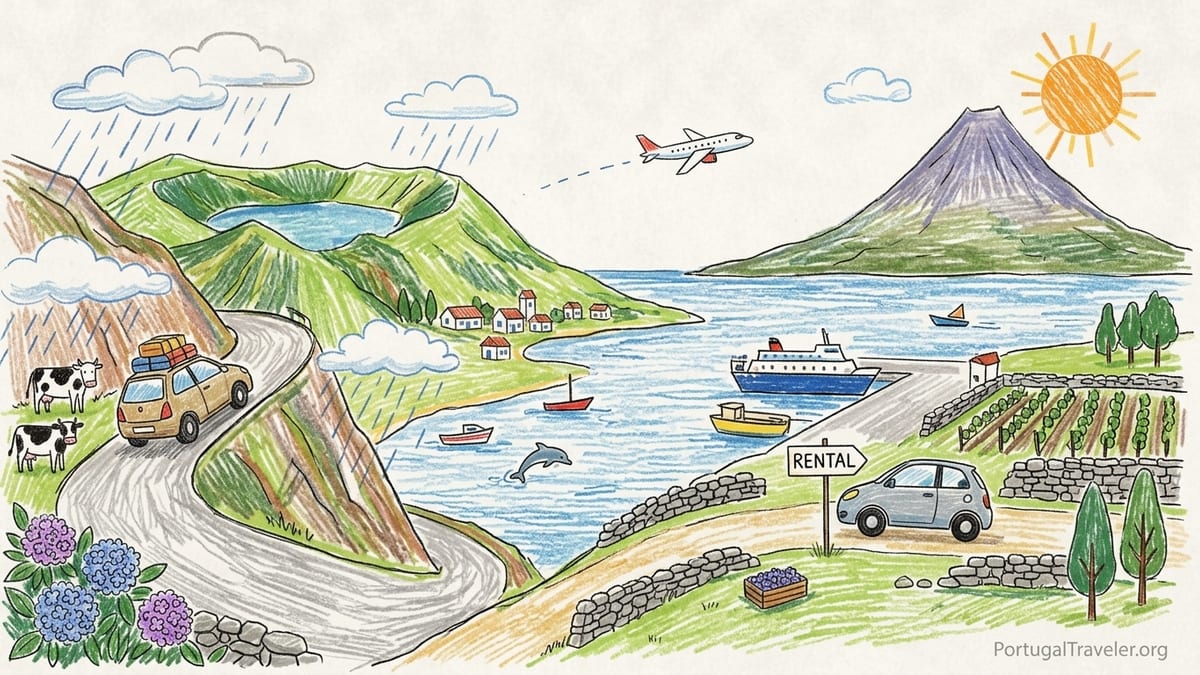
Why an Azores Road Trip Is Really Several Mini Road Trips
Unlike a continental driving holiday, you cannot drive between Azores islands. Every move between islands involves a flight or a ferry, and every new island means a fresh car rental agreement or the decision not to rent at all. This structure affects your costs, your energy and your sense of freedom. Instead of thinking "10 days with one car," it is more realistic to think "three or four separate 2 to 3 day rentals."
On São Miguel, I picked up a compact car at the airport for four days, returned it before flying to Terceira, then repeated the process for a shorter two day rental on Terceira and a three day rental on Pico. Each contract meant another deposit, another inspection and another moment of learning how a different car coped with volcanic hills, narrow village streets and changeable Atlantic weather. By the time I reached Faial, I chose to rely on taxis and a full day tour instead of renting again, and the contrast helped me see clearly where a car is essential and where it is optional.
This article stays grounded in those exact rentals and roads. It looks at how airport pick ups and drop offs actually worked, how steep the hills felt with small engines, which islands were stressful to park in, and how long I really spent driving each day. It also compares that experience to days when I deliberately did not rent, so you can decide how many separate car bookings make sense for your own Azores route.
São Miguel: First Rental, Biggest Island and Longest Days Behind the Wheel
São Miguel is the island where most visitors land first, and it is also where having a car made the largest difference. I booked a compact manual car with air conditioning through a local agency that had a small desk inside Ponta Delgada airport. Pick up took about 25 minutes from walking into the arrivals area to pulling away from the car park. The agent checked my passport and license, placed a hold of a few hundred euros as a deposit on my credit card, and offered additional coverage beyond the basic collision damage waiver that was already included in the rate. I accepted a moderate extra insurance package that reduced the excess, conscious that I was still learning the local roads.
The vehicle itself was a small hatchback, roughly the size of a Renault Clio, with a manual gearbox. On paper it was sufficient for two people with medium bags. In practice, the luggage just fit in the trunk and rear visibility felt limited when reversing on narrow village lanes. The engine handled the main highways easily, but on steep secondary roads near Sete Cidades and in the hills above Furnas I often found myself dropping into first gear for hill starts, especially when I had to stop behind other cars at tight bends.
Daily driving time on São Miguel was longer than the map suggests. One loop day that combined Sete Cidades, the coastal viewpoints near Mosteiros and a stop at the hot springs in Ferraria involved roughly 4.5 hours of actual driving from first move in the morning to parking for the night, not counting sightseeing breaks. Another day that linked Lagoa do Fogo, Caldeira Velha and Furnas came out closer to 3.5 hours behind the wheel. Delays came from slow traffic on curving sections, cautious driving in fog near higher viewpoints and frequent short stops where I pulled into small lay-bys to let faster locals pass.
Navigation mistakes added real time as well. On my second day I missed the correct exit toward Lagoa do Fogo, followed the main highway too far and then had to double back through a series of roundabouts. That single wrong turn added about 20 minutes to the day. Around Furnas, narrow one way streets meant that missing a signed turn forced a full loop around the village, something that happened to me twice. I relied on offline smartphone maps, which generally worked, but signal dropped in a few deep valleys and I occasionally overruled the suggested route if it tried to send me down a side lane that looked uncomfortably tight.
Road Conditions, Weather and Parking on São Miguel
São Miguel's main roads between Ponta Delgada, Ribeira Grande and the key interior turnoffs are in good condition, with clear markings and frequent roundabouts. The challenge comes when you leave those larger roads. Secondary roads up to viewpoints like Miradouro da Boca do Inferno or along the rim of Sete Cidades can be unexpectedly narrow, with short sections where two cars struggle to pass. I experienced this on a lane above the lake where basalt walls hemmed in both sides and I had to reverse to a wider passing point to let a minibus by. It was manageable, but it demanded focus.
Livestock appeared most often in rural areas east of Furnas and on the road toward Nordeste. On one afternoon drive near Nordeste, a small herd of cows crossed the road in fog that limited visibility to roughly the next bend. Another time, dogs wandered along a side street near a village above Ribeira Grande. These encounters were brief, but they reinforced the need to keep speeds modest, particularly in poor light or cloud.
Weather made some São Miguel days unexpectedly tiring. On one day that began bright in Ponta Delgada, cloud rolled over Lagoa do Fogo by late morning, reducing visibility and producing constant fine drizzle. The wipers ran almost continuously for over an hour as I drove up, walked at the lake in damp fog, then descended in heavier rain toward Caldeira Velha. Glare from wet tarmac and the concentration required in those conditions meant I arrived in Furnas more fatigued than I would have been in dry weather, even though the number of kilometers was not large.
Parking on São Miguel varied from easy to mildly stressful. In Ponta Delgada I chose a paid parking lot near the center to avoid circling on narrow streets. At popular viewpoints such as Vista do Rei above Sete Cidades, there was formal parking but at peak times vehicles spilled along the road, and once I abandoned a possible photo stop because there simply was not a safe place to pull over without blocking traffic. In Furnas, I found signed parking areas near the hot springs and lake, but I had to maneuver carefully around other cars and pedestrians in tight spaces. Returning the car at Ponta Delgada airport was straightforward: fuel station near the airport to fill the tank, then follow clear rental car return signs, a brief inspection and the deposit released a few days later.
Terceira: Short Rental, Different Pace and One Day Without a Car
Terceira felt slightly more relaxed to drive than São Miguel, partly because it is smaller and partly because I consciously limited my driving days. I arranged a two day rental from a mid sized local company with a counter at Lajes airport. This time I chose an automatic compact, again with air conditioning. The reasoning was simple. After several days of manual hill starts on São Miguel, I wanted less effort in Terceira's towns and on its interior roads.
Pickup at Lajes was efficient. From walking into the arrivals area to leaving the airport parking took around 20 minutes. The rental included basic coverage, and I again accepted a moderate extra package to reduce any excess. The deposit was similar in size to São Miguel. The car, roughly equivalent to a small automatic hatchback from a mainstream European brand, had more forgiving acceleration from standstill than the manual on São Miguel, which helped at uphill T junctions where I needed to join faster moving traffic.
On the first driving day, I combined the historic streets of Angra do Heroísmo with a loop of the island's interior viewpoints and the coast near Serra do Cume. The actual driving time was around 3 hours, spread between morning and late afternoon. Roads were generally in good condition, and traffic was light outside Angra. My main navigation error came after leaving a viewpoint near Serra do Cume, where I followed the wrong minor road and ended up on a smaller lane running between fields. It remained paved, but its narrowness and the presence of cows in adjacent pastures reminded me to pay extra attention. I rejoined the main road after about 4 kilometers, losing perhaps 15 minutes.
On my second full day on Terceira, I chose not to rent a car at all. Instead, I stayed in Angra and used my feet and a taxi to reach a couple of nearby sights. This gave me a clear comparison point. Within the compact core of Angra, a car would have been a liability, not an asset. Streets are narrow and parking spaces can be scarce near the waterfront and historic center. The day without a car felt calmer and showed me that in our overall Azores itinerary, car rentals could be focused on days when we wanted to reach rural viewpoints or undertake longer loops, while town days could rely on public transport or taxis.
Terceira’s Road Character, Livestock and Weather
Terceira's main ring road and key interior connectors are well surfaced and often provide expansive views over green fields and volcanic cones. Compared with São Miguel, I found fewer tight village streets on my chosen routes, though this is partly due to planning. I avoided driving deep into very small settlements unless a specific sight demanded it. Where I did pass through villages, such as on the way back toward Angra, oncoming traffic usually slowed and we negotiated passing without difficulty.
Livestock was more visible in Terceira's interior than beside its larger roads. On one stretch near fields east of Serra do Cume, I saw cows close to the roadside, though none stepped onto the asphalt. Their presence, and the occasional farm vehicle moving slowly, kept my speed moderate. Once, a dog crossed ahead of my car near a small farm gate, which reinforced why I avoided distraction even on apparently empty rural roads.
Weather during my Terceira driving days shifted between bright and overcast. One afternoon, low cloud covered a viewpoint I had planned to revisit, and I decided not to drive back up, saving both fuel and concentration. That decision illustrated a broader lesson from the Azores. Because conditions change rapidly, it is useful to build a flexible mindset where you accept that a planned scenic drive may not repay the effort in poor visibility. On Terceira, the shorter total driving times per day, roughly 3 hours or less while I had the car, meant that I arrived back in Angra less fatigued than after the long loop days on São Miguel.
Returning the car at Lajes was simple. I topped up fuel at a station a short drive from the airport and arrived about 90 minutes before my flight. The rental lot was clearly signed, the staff performed a quick exterior check for new scratches and confirmed the tank was full. The deposit hold dropped off my card some days later. This smooth experience reassured me that short, targeted rentals on individual islands can be logistically easy if you allow enough pre flight time.
Pico: Steep Grades, Smaller Towns and Planning Around Ferries
Pico presented a different rhythm. We arrived from Faial by ferry and picked up a rental car near the harbor. I had arranged the booking in advance with another regional agency and specified an automatic compact car again, having learned how much mental energy hill starts could require. The office was a short walk from the ferry terminal and handled both ferry day arrivals and airport customers. Check in took around 20 minutes, and the deposit was in a similar range to my previous rentals.
The car on Pico felt slightly more powerful than the Terceira vehicle but still solidly in the compact class. Space was adequate for luggage, and the automatic transmission made starting on steep grades smoother. This mattered because roads on Pico often rise quickly from sea level to elevated viewpoints or accommodation located partway up the slopes of Mount Pico. On one arrival evening, I drove from the harbor area up a winding road to a guesthouse in the vineyard zone. The combination of darkness, occasional fog patches and tight hairpin bends meant my speed was low and my focus very high.
Pico's daily driving times were shorter than on São Miguel but still significant. One day that linked lava fields along the coast, several vineyard viewpoints and a stop in the island's small towns involved around 3 hours of active driving. Another day, focused on reaching trailheads and scenic pullouts, probably totaled 2.5 hours. The roads themselves shifted between well kept two lane sections and narrower stretches where basalt walls and vines came close to the roadside. In several vineyard areas, I passed potential viewpoints but chose not to stop because there was no clearly marked bay to pull into and I did not want to block the road.
Because we were leaving Pico by ferry rather than by plane, the timing of the car return felt slightly different but required similar care. I filled the tank at a station on the way back to the harbor and arrived at the rental office about an hour before the scheduled ferry departure. The agent inspected the car, confirmed the fuel level and ended the contract, leaving us free to walk to the ferry queue with our luggage. This sequence highlighted a key planning factor for island by island rentals in the Azores. On days that combine a morning sightseeing drive with an afternoon flight or ferry, you need to leave enough margin for weather, roadworks or slow agricultural traffic that may delay your return.
Choosing When Not to Rent: Faial as a Case Study
Faial was the island where I most clearly saw that a car is optional, depending on your priorities and energy. Instead of booking another rental, I used a mix of walking within Horta, one organized full day tour to reach the Caldeira and Capelinhos areas, and a taxi for a short transfer. The tour vehicle handled the steep interior roads and parking at viewpoints, while I simply looked out the window and saved my driving concentration for other islands.
Horta itself, with its marina, waterfront cafes and painted harbor walls, is easy to explore on foot from central accommodation. Streets are still narrow in places, and parking can be busy near the marina, so I felt relieved not to have a car there. When I wanted to visit a viewpoint slightly further out, I requested a taxi from my guesthouse. The ride lasted under 20 minutes and cost what felt like a fair amount for the convenience, especially compared with another full rental day plus fuel and insurance.
The organized tour day provided an instructive comparison. In 7 to 8 hours, our driver covered many of the classic Faial sights, but as a passenger I realized that replicating the same itinerary alone by rental car would have meant around 3 hours behind the wheel, plus the strain of parking at busy scenic spots and navigating in changing weather. For travelers who are comfortable letting someone else set the pace and who are staying only 1 or 2 nights on Faial, a tour or taxis can be a practical substitute for renting, particularly if they have already driven a lot on other islands.
This experience on Faial influenced how I now advise friends planning their own Azores trips. I suggest identifying one or two islands where you genuinely need the flexibility of a car to reach hiking trails, hot springs or scattered viewpoints, and allowing yourself at least one island where you deliberately do not drive, especially if your overall stay is 10 days or more. The mental rest from constant navigation and parking decisions can make the whole trip feel more balanced.
How Many Separate Car Rentals Do You Really Need?
After combining these experiences across São Miguel, Terceira, Pico and Faial, a pattern emerges. São Miguel practically demands a car for at least a few days if you want to visit interior lakes, hot springs and more remote viewpoints without relying entirely on tours. Terceira and Pico strongly reward having a car for 1 to 3 days each, especially if you want to stop spontaneously in villages and viewpoints or time your visits to match breaks in the weather rather than fixed bus schedules. Faial can be approached either with a rental or through a combination of tours and taxis, depending on your confidence and desire to keep driving.
Translating that into concrete rental decisions, a traveler with 10 to 12 days in the Azores might consider three separate rentals. For example, 3 to 4 days with a car on São Miguel, 2 days with a car on Terceira, 2 to 3 days with a car on Pico, and no car on Faial while relying on a tour and walking. Someone staying only on São Miguel could limit their rental to the exact days they plan to leave Ponta Delgada and range farther afield, perhaps keeping a city day at the end without a car to simplify departure logistics.
Another key lesson is to match the car type and gearbox to your comfort level rather than simply chasing the lowest price. My manual car on São Miguel was affordable but required constant attention on hills, especially in rain. The automatics on Terceira and Pico felt easier, and at the end of long sightseeing days I appreciated needing one less decision at each junction. For drivers who rarely use a manual gearbox at home, the extra cost of an automatic in the Azores can be worthwhile, particularly given the steep gradients and frequent hill starts.
Finally, it is crucial to build realistic driving times into your plans. Map distances can look short, but between curvy roads, occasional livestock, fog and photo stops, a loop that appears to be a simple 120 kilometer circuit can still translate into 4 hours of cumulative driving. On my longest São Miguel loop I felt this clearly. By the time I returned the car to Ponta Delgada in the evening, I had enjoyed every viewpoint but also felt the mental fatigue of concentrating on narrow lanes and variable weather. Recognizing this before you go will help you decide how many islands you want to cover by car and when it might be better to stay longer in one place with fewer contracts.
The Takeaway
Driving in the Azores is less about one epic road and more about stringing together several compact rentals, each with its own rhythm and compromises. On São Miguel, a small manual hatchback from an airport counter carried me up to crater lakes and down to ocean cliffs, at the cost of a few navigation errors and some tiring wet weather days. On Terceira and Pico, short rentals in automatic compacts eased the strain of hill starts and left more energy for exploring towns and trails. On Faial, leaving the driving to local tour operators and taxi drivers offered a welcome pause from constant decisions.
When you plan your own Azores trip, think island by island. Ask where a car unlocks experiences you could not easily reach otherwise, and where public transport, tours or taxis would give you nearly the same access with less stress. Factor in not just the daily rental rates and deposits but also the real time you will spend driving, parking and filling the tank before flights or ferries. Choose gearboxes and vehicle sizes that match your comfort with steep, narrow roads instead of focusing purely on price.
If you do this, your Azores road trip becomes a deliberate mosaic of driving days and car free days, instead of an exhausting sprint from rental desk to rental desk. The goal is not to drive every possible kilometer of asphalt across the archipelago. It is to pair the right wheels with the right island, so that when you hand back the keys for the last time, you remember the lakes, pastures, villages and sea views more vividly than the queues at the fuel station.
FAQ
Q1. Do I need a car for all Azores islands?
Not necessarily. A car is very useful on São Miguel, Terceira and Pico for reaching interior viewpoints and rural stops at your own pace. On Faial, you can combine walking, taxis and an organized tour instead of renting, especially for short stays.
Q2. How much time should I allow each day for driving?
Expect 3 to 4.5 hours of actual driving on full loop days, even when distances look short on a map. Curvy roads, slow traffic, livestock, fog and photo stops all add time. Plan lighter driving days between longer ones so you do not arrive at your accommodation exhausted.
Q3. Is a manual or automatic car better in the Azores?
If you are fully comfortable with manual hill starts, a manual compact can work and may be cheaper. If you rarely drive manual at home, an automatic is kinder on steep grades and in villages, and helps reduce stress after long sightseeing days.
Q4. How early should I return the car before a flight or ferry?
Aim to have the car back at the rental office or airport lot at least 60 to 90 minutes before departure. This gives time to refuel, handle inspections and walk to the terminal or ferry queue without rushing, even if weather or slow traffic delay you slightly.
Q5. Are the roads in the Azores dangerous?
The main roads are generally well maintained and signposted, but they are often curvy and can be narrow in villages and rural areas. Cows, dogs and agricultural vehicles appear from time to time. Driving at moderate speeds, avoiding distractions and respecting changing weather conditions are the keys to staying safe.
Q6. How challenging is parking on the islands?
Parking is usually straightforward at larger viewpoints and in smaller towns, but it can be tight in central Ponta Delgada, Angra do Heroísmo and near busy marinas. Using paid lots in cities, arriving early at popular viewpoints and avoiding informal roadside stops where there is no safe bay all help.
Q7. Can I rely on public transport instead of renting a car?
On São Miguel and some other islands, there are public buses, but schedules may be limited and not designed for visitors who want early starts or sunset viewpoints. You can combine buses and taxis in compact towns, but for flexible access to remote lakes, hot springs and trailheads, a car or guided tour remains more practical.
Q8. What size of vehicle is best for Azores roads?
Compact hatchbacks balance comfort on main roads with easier parking in villages and tight viewpoints. Larger vehicles provide more space but can feel cumbersome in narrow lanes or small parking areas. Very small city cars are nimble but may struggle more with steep hills when fully loaded.
Q9. How does weather affect driving in the Azores?
Cloud, rain and fog can appear quickly, especially near higher viewpoints. Wet roads and reduced visibility demand slower speeds and more concentration. Some days that looked modest on paper felt tiring simply because I drove several hours in drizzle or under low cloud, so it is wise to keep your plans flexible.
Q10. How many separate car rentals should I book for a 10 day Azores trip?
A workable pattern for about 10 to 12 days is three rentals: several days on São Miguel, a shorter rental on Terceira and another on Pico, with at least one island such as Faial explored without a car. Adjust up or down depending on how many islands you visit and how much you enjoy driving in hilly, rural conditions.