


Madeira’s tourism slogan might as well be “mild and unpredictable.” Before my first trip, I read that temperatures hover around 17°C in winter and 25°C in summer, with a pleasant ocean and a reliably green landscape. That is technically true, but it hides what really shapes a visit: fierce microclimates, sudden fog at 5,000 feet, dry sunshine in Funchal while the north coast is drenched, and trade winds that can turn a calm hike into a battle with gusts. The “best time to visit” Madeira is not one answer. It is a set of trade-offs between south and north, sea and peaks, and what you want most from the island.
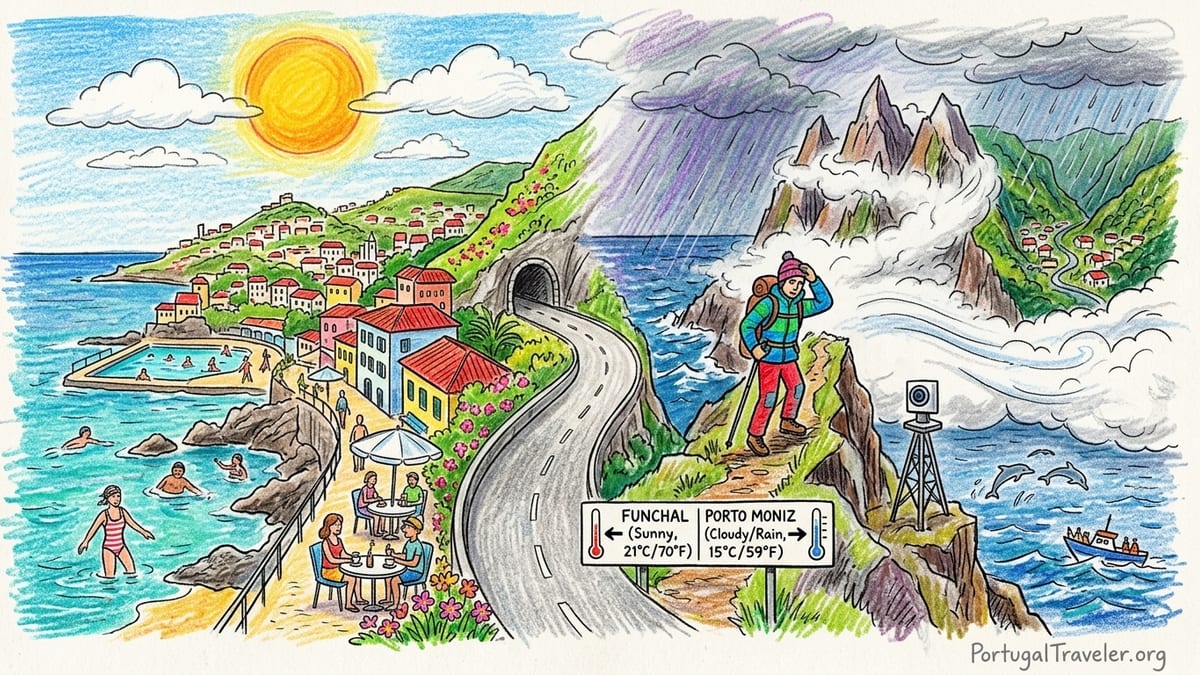
Understanding Madeira’s Microclimate Puzzle
On paper, Madeira looks simple. Official tourism figures talk about a mild year-round climate, with average air temperatures roughly 62°F in winter climbing toward the mid-70s°F in summer, and sea temperatures from the mid-60s°F to mid-70s°F. In reality, changes in a single day can feel like traveling between seasons. The south coast, especially around Funchal and Câmara de Lobos, is warmer and sunnier, while the mountains and the north coast are cooler, cloudier and often wetter. Elevation, exposure to the Atlantic and the northeast trade winds combine to create dozens of microclimates on one small island.
I first understood this on a March morning when I left Funchal in a T-shirt at about 70°F. The sky over the harbor was bright blue. Forty-five minutes later, standing near Pico do Areeiro at over 5,900 feet, the car thermometer read 48°F. A curtain of cloud rolled in so quickly that one minute I could see the jagged ridge trail toward Pico Ruivo and the next I was alone in a whiteout, wind cutting through my fleece. That 22-degree difference shaped the rest of my day: instead of starting a long ridge hike, I did a short out-and-back and drove back toward the sun.
Microclimates also mean rain is rarely island-wide. On another March day, forecasts showed light showers “across Madeira.” In Funchal, that translated to a brief drizzle and dry pavements by late morning. But when I drove through the Encumeada pass to the north side, the rain intensified into steady showers that never really stopped. The north coast was wrapped in low cloud while the south coast stayed bright enough for people to sit outside at cafés. The key lesson was that the best time to visit depends not only on the month, but on which parts of the island you want to explore most.
Spring Trips: Flowers, Unstable Mountains and Mixed Seas
My first visit to Madeira was in late March and early April, drawn by the promise of flowers and shoulder-season quiet. In Funchal, daytime highs often sat between the upper 60s°F and low 70s°F. Mornings were fresh enough for a light jacket, but by lunchtime I was in short sleeves on the promenade near Praia Formosa, watching locals swim in the ocean-side lidos. The sea itself felt cool but usable: I would estimate around the mid-60s°F. I managed short swims in the Lido pools and at Ponta Gorda, though I did not stay in long without a rash vest.
In the mountains, the same days felt like a different season. One morning, I drove from a bright 71°F in Funchal to the Pico do Areeiro parking area, where fog was already pooling in the valleys. The digital sign at the car park showed 50°F, and as I walked toward the viewpoint, wind gusts pushed against my backpack. Within twenty minutes, a wall of cloud surged over the ridge, completely blocking the famous sea-of-clouds view. The path became wet underfoot as mist turned to fine drizzle. That day taught me to bring gloves and a hat to any route above about 4,000 feet in spring, even if the coast feels like early summer.
Spring also gave me my first real taste of the south-versus-north divide. On a late March afternoon, weather apps showed generic icons: little grey cloud symbols over most of the island and a 40 percent chance of rain. Funchal had patchy cloud but plenty of sun breaks. I decided to drive to Seixal for the black sand beach. By the time I exited the São Vicente tunnel, the sky turned slate grey and the wind picked up. Seixal beach was almost empty, rain sweeping in dramatic sheets. Rather than force a gloomy beach day, I turned around, drove back south through the same tunnel and emerged again into filtered sunshine near Ribeira Brava. That immediate contrast, on the same day and within an hour, was routine in spring.
For hikers and flower lovers, spring is rewarding but requires flexibility. Many levada walks on the south and central parts of the island, like Levada do Castelejo or Levada dos 25 Fontes, felt pleasantly cool in March, with lush green walls and running water. Higher mountain routes, such as the Areeiro to Ruivo traverse, demanded winter layers and a willingness to turn back if wind and fog closed in. For swimming, the natural pools at Porto Moniz looked inviting, but the combination of cool Atlantic swell and cooler air meant I preferred the more sheltered lidos in Funchal. Spring is a time when you can do a bit of everything, as long as you plan each day around altitude and exposure rather than the simple month on the calendar.
Summer on Madeira: Warm Seas, Busy Trails and Hidden Breezes
My summer experience of Madeira came in late June and again in early September, when temperatures and sea conditions changed my trip in almost every way. In Funchal in late June, daytime highs reached the upper 70s°F and occasionally the low 80s°F. The heat felt moderated by the ocean, especially with the common north-easterly breeze, but in sheltered streets temperatures still climbed. The sea became a major part of my days. At the Lido complex and Doca do Cavacas, the water felt genuinely warm, likely into the low 70s°F. I could swim for twenty or thirty minutes without feeling chilled, and by early afternoon those facilities were busy with a mix of locals and visitors.
Up in the mountains, June warmth did not always translate to summer ease. On one hike from Pico do Areeiro toward Pico Ruivo, Funchal had started the morning around 75°F. By the time I reached the ridge, the car display showed 61°F. The sun was strong enough that exposed sections felt hot, but the wind funneled along the ridge in powerful gusts. At certain narrow points with steep drops on either side, the wind was strong enough that I waited, braced with trekking poles until it briefly eased. That wind, more than the absolute temperature, shaped how safe and enjoyable the route felt that day.
On another summer trip, this time in early September, the north coast once again told a different story. Funchal was at about 78°F with a high, hazy cloud cover and light breeze. I booked a whale watching trip from Calheta, motivated by calm-looking seas on a marine forecast app and relatively low afternoon wind predictions. When we got beyond the shelter of the south coast, the wind stiffened and short-period swell made the small catamaran pitch more than many passengers expected. The crew explained that, at that time of year, conditions often look gentler on general weather apps than they feel once you are exposed directly to the Atlantic. I still saw dolphins and an offshore view of the dramatic coastline, but I would have chosen a morning departure next time, when winds and chop are more often lower.
Sea temperatures in late summer made spontaneous swimming possible almost anywhere. I swam at Praia de Machico, Caniçal’s pebble coves and the natural pools at Porto Moniz within the same week. Water felt comfortably warm, and even evening dips were pleasant. Yet the summer sun also meant that exposed levadas at lower altitude, such as walks near Ponta do Sol, felt hot in the early afternoon. I learned to start hikes before 9 a.m., retreating to the sea or shaded cafés by lunchtime. For those prioritizing swimming and stable weather, late June through early October felt like the most forgiving window, provided you accept higher visitor numbers in the main resort areas.
Autumn and Early Winter: Quieter Trails, Lower Sun and North Coast Drama
My most recent Madeira visit stretched from late November into early December, a period many guidebooks frame as “off-season.” In Funchal, it did not feel particularly wintry. Afternoon temperatures hovered around the mid to upper 60s°F, with some days nudging 70°F under clear skies. Evenings were cool enough for a sweater while sitting outside at restaurants in the Old Town, but by no means cold. The Christmas lights were being installed, and there was a steady but not overwhelming trickle of cruise passengers. It felt like a calm, lived-in city with a gentle hint of festive season.
The mountains, however, reminded me that autumn edges into winter quickly with height. On one late November morning, Funchal was about 68°F at sea level. Driving up toward Poiso, light drizzle began to hit the windshield. At around 4,000 feet, the roadside temperature sign showed 52°F. By the time I reached Pico do Areeiro, the air felt sharp, wind-driven mist blew horizontally across the parking lot, and visibility dropped to a few dozen yards. I wore a thermal base layer, fleece, waterproof shell, hat and gloves, and still felt chilled when standing still at the Miradouro do Juncal viewpoint. Cliffs and ridges appeared and disappeared in the rolling fog. It was atmospheric but demanded full winter gear for even short walks.
On another day, I aimed for a levada on the north side near São Jorge. Weather apps showed showers symbolled over the island, but Funchal started with bright patches between clouds. As I approached the north coast through the tunnels, rain intensified until wipers were on their highest setting. Stepping out at the trailhead, I found saturated ground and a fine but relentless rain. Wind drove spray off the ocean up the cliffs, and waves boomed against the rocks below. After twenty minutes of slogging in, I turned back, worried about slippery roots and low cloud obscuring drop-offs. Driving back through the same tunnel toward the south, I emerged into brighter skies and drier roads. That kind of stark contrast felt even more pronounced in late autumn, when the atmosphere seems to hold more moisture.
Despite the wetter, more dramatic conditions, this period delivered some of my favorite levada days. Walks like Levada do Rei and Levada dos Cedros offered cool, steady temperatures and deep greens. I rarely felt overheated, and crowds were noticeably thinner than in summer. For swimming, the story shifted. Outdoor hotel pools were still open in Funchal, and I saw some people using the Lido complex, but my own dips were short. The sea felt cooler, probably somewhere in the upper 60s°F at best. I chose sheltered spots, like the pools between rocks at Doca do Cavacas, rather than fully exposed Atlantic entries. If your main goal is hiking in lush landscapes with quieter viewpoints, late autumn can work well, as long as you pack robust rain gear and keep coastal and mountain backup plans ready.
What Weather Apps Got Right, Wrong and How Webcams Saved My Days
Over multiple trips, I learned that Madeira rewards those who treat weather information as a starting point, not a verdict. On my first visit, I relied mostly on generic weather apps that show a single icon “for Madeira” or at best break things down into Funchal, Santana, Porto Moniz and Machico. These apps did fairly well at predicting broad trends, such as “today will be mostly dry” or “a rainy front is moving through,” but they consistently failed on detail in the mountains and timing on the north coast.
Several times in March, the Funchal forecast showed a friendly mix of sun and cloud with maybe a small chance of showers. When I checked a more specialized mountain forecast and looked at the freezing level and wind speed at 1,500 and 2,000 meters, the picture was very different: wind gusts above 35 or 40 miles per hour and dense cloud around the main peaks. On those days, my experience matched the mountain information, not the city icon. I drove up to Pico do Areeiro once, saw the parking area buried in fog and battered by wind, and simply turned around to walk a lower levada instead. The app had not been “wrong” about Funchal. It had simply told me nothing about life on the ridge.
The real breakthrough came when I started checking live webcams before committing to a drive. Several cameras, including on Pico do Areeiro and at key passes like Encumeada, show real-time cloud cover and visibility. On one summer morning, mountain forecasts suggested clear skies. Before leaving, I opened a webcam feed for Pico do Areeiro and saw a solid deck of cloud just below the peak, with the ridges poking into blue sky. That convinced me to go. When I arrived, conditions matched what I had seen: glorious sunshine above a “sea of cloud,” relatively light wind and temperatures in the low 60s°F. On another day with a very similar forecast, the webcam showed total whiteout. I changed plans within seconds and headed for a coastal walk near Ponta de São Lourenço instead. I saved over an hour of driving and a likely frustrating stumble in fog.
Apps also struggled with local wind. For boat trips out of Calheta and Funchal, marine forecasts that show wind strength and wave height were much more useful than simple weather icons. For example, one September afternoon showed pleasant temperatures and partly cloudy skies across Madeira in a general app. A marine-focused forecast, though, indicated 15 to 20 knot winds off the south coast with choppy seas. I spoke with a whale watching operator at the marina, who confirmed that morning trips had been relatively calm but that afternoon sailings might be rougher. I switched to a morning departure the next day, which turned out almost glassy until midday, when the wind picked up during our return.
The pattern was clear. General weather apps worked fine for packing decisions in Funchal and other low-lying towns. For anything involving altitude, cliffs or the open sea, webcams and specialized forecasts were essential. Combining them allowed me to change plans within minutes, pivoting from mountains to coast, from north to south, or from boat to levada with almost no lost time.
Matching Madeira’s Seasons to Hiking, Swimming, Whale Watching and Quiet Sightseeing
Because of these microclimates, there is no single best month to visit Madeira. Instead, each period offers a different balance for specific activities. For hiking, especially on levadas at low and medium altitude, I found late March and November ideal. Temperatures in those shoulder seasons stayed mostly in the 60s°F in Funchal, cooler in the hills, and vegetation was lush. Trails such as Levada das 25 Fontes, Levada do Alecrim and Levada do Caldeirão Verde felt comfortable for long walks without the intense sun of mid-summer. The trade-off is that mountain routes at higher altitude can be foggier or windier and may require more weather-related cancellations.
For high mountain hikes between Pico do Areeiro, Pico Ruivo and surrounding peaks, the combination of relatively stable weather and manageable heat felt best in late June and early September on my trips. In those weeks, the difference between Funchal at roughly the upper 70s°F and the peaks in the low 60s°F, combined with early starts, made the long ascents doable. However, wind remained a frequent companion, and fog could still arrive suddenly. I would be cautious about promising anyone “perfect” mountain conditions in any month.
Swimming and sea-focused holidays, in my experience, were most enjoyable from late June through early October. During my late June and early September stays, I swam almost daily, either in the Lido complexes, at Praia de Machico or at natural pools like Porto Moniz when swell allowed. The ocean felt warm enough for extended swims, and air temperatures on the south coast hovered around the upper 70s°F or more. Outside this window, particularly in March and late November, I still swam but for shorter periods, and I gravitated toward sheltered, man-made pools that reduced wind chill and wave impact.
For whale and dolphin watching, operators in places like Funchal and Calheta run year-round, and different species migrate through at different times. On my September trip, seas in the morning were calm and visibility excellent, leading to multiple dolphin sightings and clear views along the cliffs. In March, with more unsettled weather and stronger trade winds, swells were higher and some trips were cancelled or rescheduled. I found that May through early October offered a higher chance of calm, clear outings, especially if I chose early morning departures and checked marine forecasts rather than relying on generic apps. Travelers particularly prone to seasickness may want to build in extra days to allow flexibility.
For quieter sightseeing in towns and villages, November stood out. Funchal felt more like a local city than a resort. Queues for the Monte cable car were short, cafés in Câmara de Lobos had space even at lunchtime, and hotel prices were lower than in peak summer based on the rates I compared while booking. At that time, cloudier days became an opportunity to explore museums, the Mercado dos Lavradores and the narrow backstreets above the Old Town. Microclimates still mattered, but with fewer outdoor commitments, I felt less pressure to “chase the sun” and more freedom simply to enjoy whichever mood the island served up.
The Takeaway
After several trips across spring, summer and late autumn, the main lesson Madeira taught me is that “best time to visit” depends less on the numbers in a climate chart and more on how you combine microclimates with your priorities. Official averages tell you that the island rarely freezes and seldom scorches, but they do not tell you that you might go from 70°F in Funchal to 48°F and dense fog on Pico do Areeiro in under an hour, or that you can leave a rainy, windswept north coast and be back in dry sunshine on the south side before lunch.
If hiking is your main focus, shoulder seasons like March to April and late October to November can be excellent, as long as you respect the mountains, bring proper cold-weather gear and use webcams and mountain forecasts to decide whether today is a ridge-day or a levada-day. If swimming and sea time are central, late June through early October offers warmer water and more stable conditions, with early morning boat trips and hikes helping you avoid both crowds and heat. Whale watching works most of the year, but calmer months and careful time-of-day choices improve the odds of smooth water.
Across all seasons, the strategies that improved my trips were simple. I treated forecasts as regional sketches rather than promises, always checked at least one mountain-specific forecast and a couple of key webcams, and I kept a list of plan B and C options that shifted between south and north, high and low, mountains and coast. Instead of asking “what is the best month for Madeira,” I now ask myself “which mix of hiking, swimming, boat trips and city wandering do I want, and how flexible am I willing to be with the weather?” Travelers who embrace that mindset will find that Madeira rewards them in every season.
FAQ
Q1. Is there a truly bad time of year to visit Madeira?
In my experience across spring, summer and late autumn, there was no completely bad month, but some periods demanded more flexibility because of wind, rain or fog, especially in the mountains and on the north coast.
Q2. What months did you personally find best for hiking?
I found late March to April and November ideal for levada hikes at low and medium altitude, while late June and early September worked well for higher routes between Pico do Areeiro and Pico Ruivo when I started early and watched wind forecasts closely.
Q3. When did sea temperatures feel warmest for swimming?
On my trips, late June through early October offered the most comfortable sea temperatures, especially around Funchal, Machico and Porto Moniz, allowing relaxed, extended swims rather than quick dips.
Q4. How big was the temperature difference between Funchal and the mountains on the same day?
More than once I left Funchal at around 70 to 75°F and arrived at Pico do Areeiro to find readings near 48 to 61°F, often combined with much stronger wind and lower visibility.
Q5. Did you experience fog suddenly arriving at viewpoints?
Yes. At Pico do Areeiro and nearby viewpoints I saw clear panoramas vanish in minutes as fog rolled in, turning sunny ridges into whiteouts and forcing me to shorten or cancel planned hikes.
Q6. How often was the north coast rainy while the south coast stayed sunny?
This happened several times in both March and November, with steady rain and low cloud around places like Seixal and São Jorge while Funchal and Ribeira Brava remained bright or only partly cloudy.
Q7. Did wind ever cause you to change hiking or boat plans?
Yes. Strong gusts along the Areeiro to Ruivo ridge convinced me to turn around once, and higher-than-expected afternoon wind offshore led me to switch from an afternoon whale watching trip to a calmer morning departure on another day.
Q8. How reliable were weather apps for planning each day?
General apps were reasonably accurate for Funchal but often missed mountain fog, wind on the ridges and localized showers on the north coast, so I learned to use them only alongside mountain forecasts and live webcams.
Q9. Did checking webcams before driving really help?
Definitely. Seeing real-time conditions at Pico do Areeiro and passes like Encumeada helped me avoid wasted drives into whiteouts and choose days with clear views above the clouds instead.
Q10. If someone wants quieter sightseeing with some hiking and limited swimming, when would you suggest based on your trips?
Based on my own visits, late November into early December worked very well for quieter sightseeing and cool, green levadas, with only short, sheltered swims in Funchal when the weather and sea felt inviting.