

On my first serious trip through Alentejo I did what most travelers do: I circled the big names on the map, booked two nights in Évora, penciled in a stop in Elvas, and figured everything else would fall into place. What actually happened, over ten days of August heat, slow roads and surprise lake views, was a complete reshuffling of what I considered “essential” in this region. Some famous towns were perfect as quick stops rather than bases, while a few quiet places I had barely noted on my spreadsheet ended up defining the whole journey.
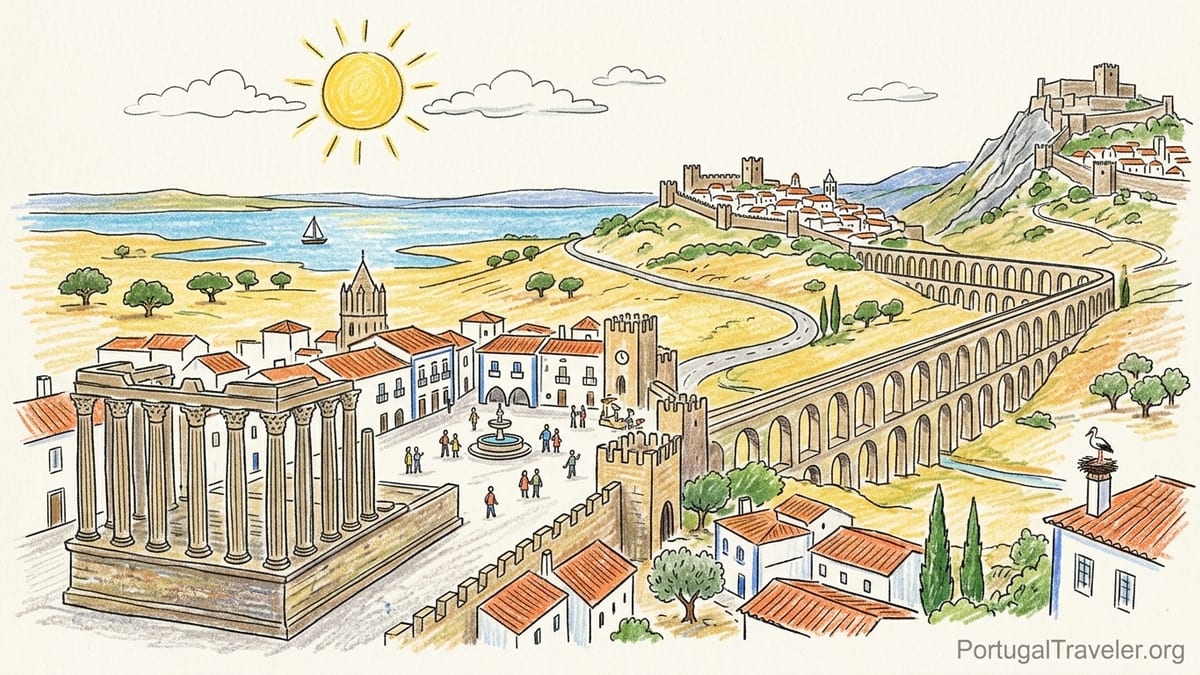
How Évora Anchored My Trip (And Why Two Nights Was Enough)
I started in Évora because it felt like the logical gateway to Alentejo. The city is ninety minutes from Lisbon by car on the A6, and it concentrates a rare amount of history in a compact center that you can cross on foot in about twenty minutes from the aqueduct area to the Roman temple. I arrived around 11:00 on a Tuesday in late August, parked just outside the medieval walls near Largo da Porta de Moura where blue-zone spaces turn over fairly quickly, and immediately understood why Évora is on the UNESCO list. Roman stone, whitewashed alleys and university energy all sit in the same small bowl of streets.
I stayed two nights at a small guesthouse just off Praça do Giraldo, which turned out to be the right amount of time. That first afternoon I walked a simple loop: Roman Temple, Cathedral roof terrace for the view over the terracotta rooftops, then down to the Aqueduto da Água de Prata where houses are built between the arches. By 16:00, the stone had soaked up enough sun that each step felt like walking past an open oven door. Évora’s inland location means summer afternoons regularly spike over 35 degrees, and more than once I ducked into whichever café had real shade and cold água fresca, without caring about the décor.
What made Évora worth two nights rather than a simple stopover was the evening atmosphere. Around 20:00 the heat finally began to slide off the cobbles, and locals reclaimed Praça do Giraldo. I remember one dinner in particular at a modest tasca near the square, where a plate of migas with black pork cost roughly 16 euros and the waiter talked us through which wines actually came from just outside the city. It was in that hour, watching kids race over the square while older couples lingered over dessert, that Évora shifted from “open-air museum” to somewhere that felt lived in.
Still, by midday on the second full day I felt ready to move on. The main sights are central and close together, and by the time I had visited the Bone Chapel just after it opened at 10:00, climbed the cathedral tower again in softer morning light, and wandered beyond the main walls toward the university buildings, my curiosity was more about what lay beyond the city than what else I might discover inside it. If I had only three days in Alentejo, Évora would keep its place but as a firm two-night base, not the four-night stay I had originally imagined.
Elvas: A Spectacular Two-Hour Detour, Not an Overnight Base
From Évora I drove east to Elvas, lured by the promise of monumental star-shaped walls that had earned the town UNESCO World Heritage status. The drive on the A6 took just over an hour, and I reached the outskirts of Elvas around 10:30. The first impression was the Amoreira Aqueduct rising along the roadside, a long rhythm of arches up to four tiers high that once brought water to the fortified city. Visually, it is extraordinary, but it also set the tone: this was a place built for function and defense, more about bastions and glacis than cafés and long promenades.
Parking in Elvas demanded a little patience. I followed signs toward the historic center and finally left the car near the aqueduct, choosing a shaded spot on a side street instead of squeezing into the upper lots close to the castle. From there it was a fifteen-minute uphill walk through the gates and into the core of the old town. In August heat that climb felt longer, and by the time I reached the main square I was already thinking about shade and cold drinks more than military history.
I spent roughly two and a half hours in Elvas, and in that time I walked the short distance from the central square to the castle, explored part of the ramparts and took in the views toward Spain and the outlying forts. The scale of the fortifications is undeniably impressive. The whole place is a three-dimensional lesson in how early modern Europe prepared for war on the border, and when you stand at a bastion and look out over the dry landscape you can almost see the geometry of defense in the angles of the walls and ditches.
Yet as a traveler, I realized Elvas did not reward slow time in the same way as other towns on my route. Once you grasp the fortification system and spend a few minutes inside the castle, the urban fabric itself feels quieter and more workaday than atmospheric. I had a quick espresso and pastel in a café just off the main square for under 3 euros, watched a handful of locals talk over the day’s news, and then walked back to the car. If I were planning this trip again, Elvas would remain on the itinerary but always as a half-day or even two-hour stop folded into a drive from Évora toward the Spanish border, not as a place to sleep.
Monsaraz and Alqueva: Where the Lake Changed My Sense of Alentejo
Leaving Elvas, I swung south toward Monsaraz and the vast Alqueva reservoir. This is where my pre-trip planning had failed me. On the map, Monsaraz looked like just another hilltop village among many. In person, arriving around 17:00 on a clear day, it felt like a balcony hung over an inland sea. The walled village sits above Lake Alqueva, one of Europe’s largest artificial lakes, and from the castle ramparts the water spreads away in sinuous inlets and tiny islands until it blurs into the horizon.
I checked into a simple guesthouse in Telheiro, a village just below Monsaraz, around 16:00, dropped my bag, and drove the short five-minute climb up the hill. Day-trippers from Évora were already drifting back to their cars, and by 18:00 the main street inside the walls had thinned out. That timing mattered. In the middle of the day, narrow cobbled lanes can feel crowded and hot, and the parking strip just outside the walls fills up quickly. By arriving late afternoon I could leave the car relatively close to the gate and stroll into a village that was slowly exhaling.
The moment that fixed Monsaraz in my memory came just after 19:30, from the terrace of a restaurant tucked into a 15th-century building near the top of the village. The table looked directly out over the lake, with low sunlight catching every wrinkle in the water. Two of us shared a bottle of local white from Reguengos de Monsaraz for about 18 euros and lingered over a plate of pork secrets grilled simply with flakes of salt. I remember the way conversation from other tables would stop for a few seconds every time the sky changed color, as if everyone had silently agreed that whatever they were saying could wait until after the next shade of orange.
The next morning I walked the streets again just after 8:00, when delivery vans and residents outnumber visitors, and Monsaraz felt almost like a private village. I spent another hour inside the castle, looking out over Alqueva in full daylight, then drove down to one of the small lakeside marinas for a short boat tour. A one-hour circuit cost just under 20 euros per person and provided a completely different sense of the landscape. From the water, the village above looked impossibly small, a thin line of white and stone against a wide sky.
If I had to cut the region down to five days, Monsaraz would still get one full night. The combination of hilltop village, lake landscape and nearby wine country around Reguengos gives it more layers than many other stops. What I would not do again is plan it as just a lunch stop between Évora and the Spanish border. Monsaraz needs the soft light of late afternoon and the cool of early morning to balance the harshness of the midday sun and to show how the lake reshapes the classic mental picture of Alentejo as nothing but wheat fields and cork trees.
Marvão: My Mountain-Edge Escape Above the Plains
Where Monsaraz gave me a lake horizon, Marvão gave me altitude. I reached Marvão around 16:30 after a longer drive north through Portalegre and into the Serra de São Mamede. The final approach winds up a narrow road, and there is a distinct moment when you realize the village is clinging to the very crest of a ridge at around 860 meters. I parked in a small lot just outside the walls, where the last regular spaces give way to a drop toward the valley, and walked up through the gate with a sweater in my bag despite the August date. By 18:00, as shade filled the alleys, I was glad I had brought it. Even in summer, evening air up there carries a chill.
Marvão became my example of why some places demand an overnight stay rather than a flying visit. During the late afternoon the village still had a trickle of day visitors, and I joined the usual circuit up to the castle, paid a couple of euros to enter, and walked the walls. The 360-degree view from the keep across the plains of Alentejo to one side and the hills of Spain to the other is dramatic in any light. Yet it was only after 20:30, when the last tour groups had gone and the stone lanes had emptied, that Marvão really felt like a place rather than a viewpoint.
I stayed in a family-run inn inside the walls, the sort of place with creaking floors, mismatched antique furniture and a breakfast room that looks straight toward the Spanish border. We checked in around 17:00, dropped our bags, and later that night walked less than five minutes to a small restaurant tucked alongside the ramparts. Dinner was basic, hearty food, a jug of local red and a shared chocolate mousse, around 25 euros per person. The real luxury was the silence when we stepped back out. Street lamps cast small pools of light on the cobbles, and for a few minutes we had the main square entirely to ourselves.
The next morning I set an alarm for 6:45 and reached the castle gate right when it opened. At that hour, standing alone on the walls, you feel the full effect of José Saramago’s famous line about Marvão being the place from which you can see the entire world. The experience had nothing in common with the heat and bustle of midday. The air was cool enough for a jacket, and the first light picked out ridges and fields far below. After an hour on the walls I followed one of the signed trails that descend toward the Roman ruins of Ammaia, walking for about two hours through a quieter side of the natural park before catching a taxi back up for under 15 euros.
In trip-planning terms, Marvão taught me that “hilltop village” is not one fixed category in Alentejo. Compared with Monsaraz, Marvão feels more remote, more vertical and more deeply connected to the surrounding mountain-edge scenery. If I had only three days, it might get squeezed out in favor of Monsaraz because of the additional driving involved. With five days or more, I would absolutely trade a second night in Évora for a night here, precisely because the atmosphere before 9:00 and after 20:00 is so different from what most day-trippers see.
Rural Stays and Wine Country Between the Towns
The spaces between Alentejo’s headline destinations ended up shaping my trip as much as the towns themselves. After Monsaraz I chose to spend two nights on a rural estate between Reguengos de Monsaraz and the lake, a working farm with converted stone barns, vines rolling down the hill and a pool that looked over nothing but cork oaks and sky. I checked in around 15:00 on a scorching afternoon and did something I had not originally planned: I abandoned sightseeing and spent the rest of the day oscillating between the shade of an old oak, a book and short swims.
That pause changed the rhythm of the entire journey. Instead of driving 200 kilometers per day in a loop of monuments and hill towns, I built my days around cooler hours and shorter hops. One morning I booked a tasting at a nearby winery for 10:30, when the cellar was still cool and the light gentle and sideways across the vineyards. The basic tasting of three wines cost 15 euros per person and included a quick walk among the vines, with explanations of how local producers were dealing with hotter, drier summers. Hearing a winemaker talk frankly about irrigation costs and grape stress was a reminder that the landscapes I was photographing for their beauty were also workplaces feeling real pressure.
Evenings on the estate were some of my favorite hours in Alentejo. Dinner was either a simple board of local cheeses and cured meats bought earlier that day in Reguengos or a short drive back into town for a more formal meal. In one modest restaurant just off the main square I paid about 12 euros for a plate of lamb stew that could have fed two people and watched as families stepped in to collect takeaway grilled chicken. It felt like the reverse of the UNESCO towns: fewer international visitors, more everyday life.
Looking back, I would allocate more time to these in-between stays if I returned. A single night on a rural property works as a novelty, but two or three nights allow you to settle into the slower tempo that defines the region. If I had to cut something from an overstuffed week-long plan, I would sacrifice an extra museum in Évora or the idea of covering both Elvas and another far eastern town, and instead give myself an extra sunset by the vines or an early-morning walk through fields still holding onto the night’s cool.
The Atlantic Edge: Why I Needed the Wild Coast At Least Once
For all its inland charm, Alentejo is not only about stone and fields. On my way back toward Lisbon I swung west to the Atlantic coast for one night, aiming for that stretch between Vila Nova de Milfontes and Zambujeira do Mar that locals often describe as the region’s wild side. I reached the coast around 16:00, checked into a small guesthouse on the cliffs, and walked to the nearest viewpoint just in time to watch the sun drop into a restless line of surf.
After days of inland heat, the shift in climate was immediate. Temperatures fell a few degrees, and a constant breeze came off the ocean. The villages along this section of coast are still small, with whitewashed houses and low-rise development, but they attract a younger, more surf-oriented crowd in summer. At 19:30, sitting at an outdoor terrace with a plate of grilled sardines for around 14 euros and a cold beer, I heard as much Spanish and French as Portuguese and English. The mood felt more casual and temporary, like a beach town at the height of the season, in contrast with the timelessness of hilltop villages such as Marvão.
The real draw for me was the landscape itself. Early the next morning, before driving back inland, I walked a portion of the coastal trail, following red and yellow markers along the cliffs for about ninety minutes. Sand paths wound through low vegetation and opened onto views of steep drops to hidden coves, with fishing boats as tiny dots below. The Atlantic here has an energy that inland Alentejo never shows, and for a moment it was hard to believe that slower, hotter world was only a couple of hours away by car.
If a friend told me they had only three days in Alentejo, I would probably steer them toward Évora and one inland village rather than the coast. Yet with five days or more, I would argue for at least one night on this Atlantic edge. It acts as both a visual and physical reset before or after the heat and stone, proving that the region cannot be understood as a single postcard of golden plains.
The Takeaway
When I look back at that first extended trip through Alentejo, what stands out is not one single “best” place but a series of contrasts. Évora and Elvas gave me concentrated UNESCO heritage, with Évora rewarding slow evenings and Elvas shining brightest as a focused, two-hour dive into military history. Monsaraz and the Alqueva lake offered a combination of hilltop charm, water and wine that felt unique, especially in the light of early morning and late sunset. Marvão lifted everything onto a ridge, turning the region into a panorama framed by stone walls and mountain air. Rural estates and the Atlantic coast filled in the spaces between, reminding me that landscape, agriculture and sea are as much a part of the story as any chapel or castle.
If I could reallocate my own time on a second Alentejo trip, I would do a few things differently. I would keep Évora as a two-night base at the start, arriving late afternoon to avoid parking stress and scheduling major sights early and late in the day. I would still stop in Elvas, but I would cap that visit at three hours, around a coffee and a circuit of the walls, and resist the temptation to book a hotel there. The time saved would be invested in two full nights near Monsaraz and Alqueva, one inside or just below the village to enjoy the views and one on a rural estate closer to the water, with at least a short boat trip or stargazing session built in.
Marvão would move from “maybe” to “must” if I had five days or more. I would plan one night there, arriving by mid-afternoon, and make it a point to see both sunset and sunrise from the castle. Between those anchors I would choose one coastal night, either at Milfontes or Zambujeira do Mar, to remind myself that Alentejo also faces the Atlantic. What I would cut, without hesitation, is any attempt to cram in a long list of secondary towns just for the sake of ticking boxes.
Alentejo rewards travelers who are willing to travel more slowly and accept that they will not see everything. On paper, it is easy to line up Évora, Elvas, Monsaraz, Marvão, the lake and the coast in a tidy row of dots. On the ground, heat, distance and the texture of each place argue for fewer moves and longer stays. My advice, shaped by long afternoons in parked cars and late-night walks on stone streets, is simple: pick the roles you want your destinations to play, whether that is historic city, hilltop village, wine country, lake landscape, wild coast, rural countryside or mountain-edge scenery, and then give each role enough time. The region deserves that, and so does your own patience.
FAQ
Q1. How many days should I spend in Alentejo for a first trip?
For a balanced first trip, I would recommend at least five days. That allows two nights in Évora, one night around Monsaraz and Alqueva, one night in Marvão or another hilltop village, and one night on the Atlantic coast. With only three days, focus on Évora and a single inland village such as Monsaraz.
Q2. Is it realistic to visit Évora, Elvas and Monsaraz in one day from Lisbon?
It is technically possible but not enjoyable. You would spend most of the day driving in heat, and each stop would feel rushed. Based on my experience, Évora alone deserves a full day and night, with Elvas or Monsaraz added as a separate excursion or on a multi-day loop.
Q3. Do I need a car to explore Alentejo in the way you describe?
To link historic cities, hilltop villages, rural estates and the wild coast in a single itinerary, a car is very helpful. Public transport connects major towns like Évora and Elvas, but buses to smaller villages and lake or rural areas are limited. Having a car allowed me to time my arrivals for early morning or late afternoon, which made a big difference in comfort and atmosphere.
Q4. How bad is the summer heat, and how did it affect your plans?
In August the heat shaped every day of my trip. By mid-afternoon in Évora and Elvas the stone streets felt extremely hot, and I avoided long walks between roughly 14:00 and 17:00. I planned major sightseeing early in the morning and after 18:00, using the hottest hours for long lunches, siestas or pool time at rural stays.
Q5. Which hilltop village would you choose if you could only visit one, Monsaraz or Marvão?
If I had to pick just one, I would choose Monsaraz. The combination of lake views over Alqueva, nearby wineries and the option of a short boat trip gives it more variety in a single stop. Marvão is unforgettable for its mountain-edge scenery and sunrise from the castle, but it involves more driving and feels better suited to a slightly longer itinerary.
Q6. Is Elvas worth visiting if I am not especially interested in military history?
Yes, but I would keep it short. Even without a deep interest in fortifications, the scale of the walls and the aqueduct are impressive and justify a two-to-three-hour visit as part of a longer drive. If you are choosing between an overnight in Elvas and extra time in Évora, Monsaraz or a rural stay, I would personally give priority to the latter.
Q7. How expensive were meals and wine in the places you stayed?
Prices were generally moderate compared with coastal tourist centers. In village restaurants I often paid between 12 and 18 euros for generous main dishes, with house wine by the glass starting around 3 euros. A basic winery tasting near Monsaraz cost about 15 euros per person, while dinners in more atmospheric spots with lake or castle views could climb toward 25 to 30 euros per person including wine.
Q8. Is it necessary to stay overnight near Lake Alqueva to enjoy it?
Staying overnight near Alqueva adds a lot to the experience. While you can see the lake briefly from Monsaraz during a day trip, an overnight stay lets you enjoy sunset from the walls, a possible boat trip, and the quieter early-morning views. I found that one night in or just below Monsaraz and another on a rural property closer to the water would be ideal if time allows.
Q9. How did driving in Alentejo compare to other parts of Portugal?
Driving in Alentejo felt calmer than in more densely populated regions. Main roads between cities are modern and straightforward, while smaller roads to villages and rural estates are slower but usually quiet. I allowed extra time for winding approaches to hilltop towns like Marvão and for occasional tractor traffic near farms. The trade-off was the freedom to reach places early or late, when they were at their best.
Q10. If you returned to Alentejo, what would you skip next time?
On a return trip I would skip trying to add more mid-sized towns just for the sake of variety. Instead, I would avoid an overnight in Elvas, reduce repeat museum visits in Évora, and invest that time in longer stays in rural properties, extra evenings in Monsaraz or Marvão, and at least one more night along the Atlantic coast.