


I learned how big Alentejo really is the hard way, with a suitcase that never quite stayed unpacked and night drives across dark cork-oak plains. On a recent ten-night trip I tested three different bases in the region interior city, countryside wine stay and the Atlantic coast and kept notes on what actually worked on the ground. This guide walks through that real itinerary in detail, then compares what it feels like to stay in a historic town such as Évora, a wine and countryside property near Reguengos de Monsaraz, the Alqueva lakeside, northern Alentejo around Castelo de Vide and Marvão, and the low-key Alentejo coast around Vila Nova de Milfontes.
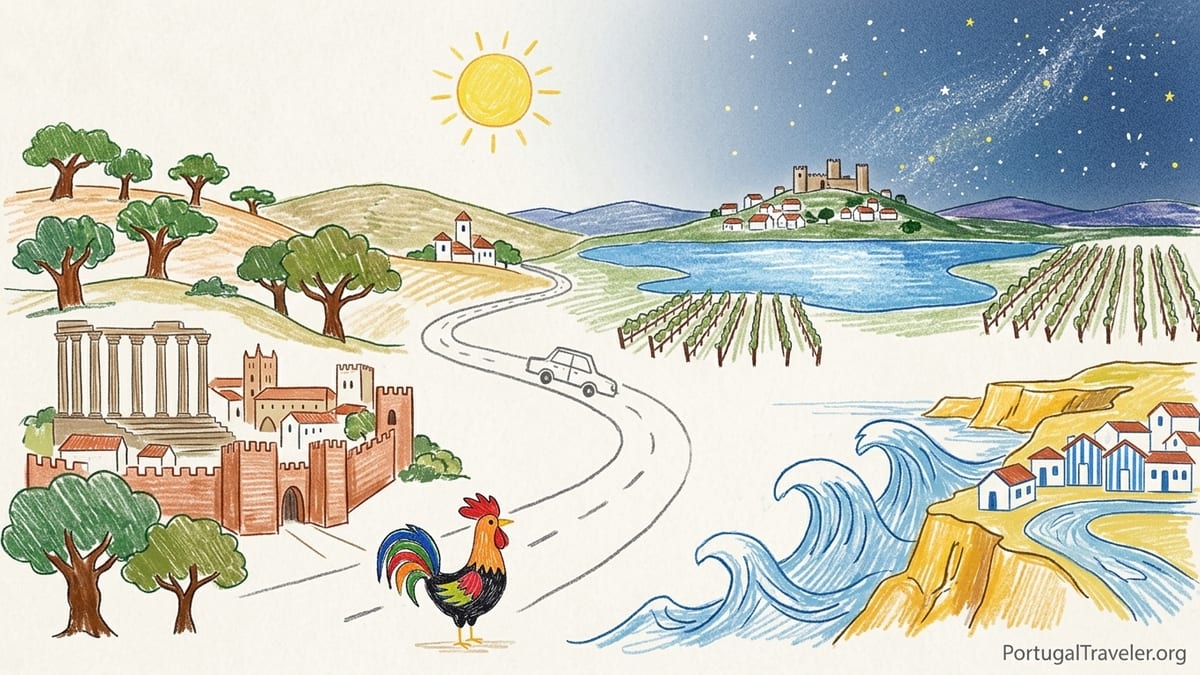
My Real Alentejo Base Strategy: What I Actually Did
I had ten full days for Alentejo and wanted to see both the interior and the Atlantic. After too many trips that turned into constant packing, I set a rule for this one: a minimum of three nights per base. I ended up using three bases in Alentejo plus Lisbon on each end four nights in Évora, three nights in the Alqueva wine and lakeside area near Reguengos de Monsaraz, and three nights on the coast in Vila Nova de Milfontes.
This created a triangular driving route. From Lisbon, it was about 1 hour 30 minutes to Évora by toll highway. From Évora to the Alqueva area near Monsaraz took roughly 45 minutes on national roads through Reguengos de Monsaraz. From there to Vila Nova de Milfontes on the coast was just under two hours, cutting through Beja and then west to the ocean. Finally, the return from Milfontes to Lisbon took a little over two hours north along the coastal A2 corridor. None of these legs felt oppressive, but they are long, dark stretches at night, so I tried to move bases in daylight.
Did I regret unpacking three times? A little. On the days I switched bases, we spent a full morning checking out, driving and doing a supermarket stop before settling into the next place. I could feel the friction in small ways, like hesitating to swim because the bag with my swimsuit was still zipped or losing track of where we had stashed the corkscrew. But in exchange, we cut down daily driving once we were in each base and avoided two-hour round-trip slogs back to a single central hotel every night.
Daily driving looked very different in each base. From Évora, day trips rarely exceeded one hour each way, and many sights were within 30 minutes. From the Alqueva base, we sometimes drove only 10 to 25 minutes in the evening for dinner in Monsaraz or Reguengos, then returned along almost empty roads under a very dark sky. From the coast, we mostly hopped 20 to 40 minutes up or down to beaches and trailheads. By the end of the trip I was convinced that three bases for ten nights was workable, but I also saw clearly where I could combine or split things differently next time.
Staying in a Historic City: Evenings, Parking and Real-Life Convenience
Évora is the obvious interior base and for good reason. It is a compact UNESCO-listed city with a genuine evening atmosphere. After dark, we could walk from the hotel to dinner in under ten minutes anywhere inside the walls. On our first night, we ate near the Roman Temple and finished dinner close to 10 p.m. Even that late, there were enough people in the streets that the walk back felt safe and lively rather than empty. This matters in Alentejo, where many smaller towns go quiet by 9 p.m. outside peak summer.
Parking in Évora required a little strategy. Inside the walls, streets are narrow and mostly for residents. We opted for accommodation on the edge of the historic center with its own small car park, and that made all the difference. Each morning we could roll the bags straight to the car and be on the ring road in five minutes. Returning after dinner, I was glad not to be reverse-parking into a tiny stone-lined space. For travelers who plan to arrive late from Lisbon, I would strongly recommend choosing a place with either private parking or a well-reviewed nearby public lot and messaging ahead about the best route in, because the one-way tangle inside the walls can be stressful in the dark.
The advantage of a historic city base showed every morning. In Évora, we could decide at breakfast whether to take a short stroll to the market and stay local or to leave town by 9:30 a.m. for a bigger day trip. Roads in and out are simple, mostly well-signposted national routes, and fuel is easy to find on the outskirts. On one day we drove about 45 minutes to Estremoz for its marble architecture and market, another morning 40 minutes to Arraiolos to see its embroidery tradition, and we were back in Évora by late afternoon with plenty of restaurant options. That flexibility just is not possible from a very remote countryside stay.
Noise in Évora was the trade-off. Our room faced a side street, and we could hear late-night conversations and the occasional scooter, especially on a Friday. It did not go on past midnight, but light sleepers should request courtyard-facing rooms or choose hotels slightly off the main restaurant lanes. Even so, the practical benefits of evening restaurant choice, walkable streets, and easy fuel and supermarket access made the city base feel like the most relaxed part of the trip.
Sleeping in Wine Country and Near Alqueva: Magic vs Inconvenience
After four nights in Évora, we moved east toward the Alqueva area, basing ourselves at a countryside wine and lakeside property between Reguengos de Monsaraz and Campinho. This is within the certified Dark Sky Alqueva reserve, recognized internationally for its exceptionally low light pollution. The property sat alone among vineyards and holm oaks, with a partial view of the lake. Night skies really were as dark as the photos suggested, and on clear evenings we could see the Milky Way without leaving the pool terrace.
Out here, the magic was strongest in the quiet hours. Morning meant nothing but the sound of bells from distant sheep and the hum of tractor work in the vines. We could start the day slowly and still reach Monsaraz in roughly 20 minutes by car. In practice, that meant we sometimes did not leave until nearly 10:30 a.m., and we still had time to park below the walled village, climb up for coffee, and walk the walls before midday heat. In the late afternoon we would return to the hotel pool while the sun dropped behind cork trees and the lake turned silver. Alqueva’s still water gives a mirror effect that doubles the gold and pink tones at sunset, and that view was the single most convincing argument for sleeping in the countryside.
The inconveniences came from the same isolation. Evening restaurant choices were limited unless we were willing to drive. On our first night we ate at the property restaurant, which was good but fairly expensive compared with meals we had later in Reguengos de Monsaraz. On the second night, we drove about 15 minutes to a simple restaurant in Reguengos, then another 15 minutes back along unlit roads. It was fine in dry weather with clear signage, but I would not want to do that after a heavy wine tasting dinner or in fog. Fuel and supermarkets were in town, not near the hotel, so we learned quickly to combine late-afternoon errands with sightseeing before returning to the property for the night.
Arrival times also mattered. Countryside hotels in this part of Alentejo often ask guests to arrive before 8 or 9 p.m., especially outside high season when staffing is leaner. We made a point of checking in before sunset, which meant planning driving legs so that we were never more than an hour away by late afternoon. On one day we broke this rule to spend sunset in Monsaraz itself and drive back in full dark. The road surface was fine, but the complete lack of traffic or roadside light can feel unsettling if you are not used to rural driving. For travelers unfamiliar with Portuguese secondary roads, I would not recommend counting on repeated late arrivals at isolated estates.
Northern Alentejo: Romantic Hill Towns and Longer Drives
On this particular trip, we visited northern Alentejo around Castelo de Vide and Marvão as a very long day out instead of a separate base. From Évora, it is roughly 115 kilometers to Castelo de Vide and local journey planners put the drive at around 1 hour 40 minutes each way by car, mostly on national roads. That meant a very early start. We left the hotel around 8:30 a.m., refueled on the ring road, and arrived close to 10:15 a.m., just as cafés were filling up. The drive itself was straightforward but long, with changing landscapes from open cereal plains to the more wooded slopes of Serra de São Mamede.
Castelo de Vide and Marvão share a romantic hill-town feel that is completely different from Évora. One has earned the nickname “Sintra of Alentejo” for its gardens, softer microclimate and greenery. Walking the steep lanes and castle walls is rewarding but tiring: cobbles, inclines and frequent staircases. In mid-afternoon, when the sun was still hot, we found ourselves grateful we did not also have luggage to drag up from a car park to a guesthouse. For couples on a romantic itinerary, a night or two up here would feel special, but the experience is much more vertical and weather-dependent than the gentle slopes of the wine country around Alqueva.
The downside of not staying in the north was the return drive. By the time we had visited both towns, lingered over a late lunch and taken photos from Marvão’s walls, it was almost 5 p.m. when we began the journey back to Évora. We arrived just after 6:30 p.m., tired from the road and very happy to hand the keys to the hotel receptionist and walk to dinner without navigating any more curves. That day convinced me that if I wanted to hike in Serra de São Mamede or explore more villages in Alto Alentejo, I would absolutely book at least one dedicated base in the north to avoid repeating that out-and-back drive.
Evenings in these small northern towns are much quieter than Évora or the coast, which can be an advantage or a drawback depending on your style. Many restaurants close by 9:30 or 10 p.m. outside August, and streets empty quickly. If you like nights under a blanket with a book and a glass of wine, it is dreamy. If you enjoy strolling from dessert to an after-dinner drink bar, you may feel confined. Road access is simpler than it appears on a map, but twisty climbs to hilltop centers can be stressful for drivers not used to manual cars on gradients, so choosing accommodation with nearby, level parking is especially important here.
Basing on the Alentejo Coast: Beach Days without Losing the Interior
Our third base was Vila Nova de Milfontes, the largest true town on the Alentejo coast. After the silence of the interior, Milfontes felt almost urban. There are proper supermarkets, several fuel stations on the inland approach road and an off-season population large enough that cafés, bakeries and restaurants stay open outside July and August. We arrived from the Alqueva area in mid-afternoon, parked at our small guesthouse on a residential street and were on foot on the riverfront within ten minutes.
The biggest advantage of Milfontes as a base was evening choice combined with easy driving days. After dinner on the main square, we could walk home in under 15 minutes, even at 11 p.m. in shoulder season, and we never worried about leaving the car far from the accommodation. Streets were quiet but not deserted, with a mix of local families and visitors out for ice cream or a drink. Parking near the historic center gets crowded in peak summer, but further back from the river we always found a free space. For drivers nervous about tight old-town lanes, staying just outside the center simplifies everything.
From Milfontes, we drove out each morning along the coastal road to beaches and sections of the Rota Vicentina coastal path. Distances were short: often 20 to 30 minutes to a trailhead or beach parking. One day we aimed for Zambujeira do Mar but turned back when we saw festival infrastructure going up for a major summer music event and instead spent the day on a quieter stretch south of town. That kind of spontaneous adjustment is only possible when you are already on the coast and do not feel pressure to “make a big drive count.”
What we did not do from Milfontes was drive back inland during this section. Even though Évora is theoretically only about two hours away, the thought of four hours in the car for a day trip was unappealing once we had already spent a week in the interior. In practice, combining a substantial inland base with a coast base meant splitting the trip into two distinct moods. Restaurant styles, light, even the pace of the day changed completely between them, which is exactly what we wanted from a coast-plus-interior itinerary.
One Base vs Multiple Bases: Matching Strategy to Trip Type
After testing three different bases across ten days, I came home convinced that the right number of Alentejo bases depends less on how many nights you have and more on what kind of trip you want. For a first visit focused on classic sights and food rather than covering ground, a single base in Évora for four to five nights works well. From there you can reach many of the region’s signatures, including cork-oak country, wine estates and even a first taste of the Alqueva area, all within day-trip distance, then return to a lively historic center each evening.
For a more ambitious road trip that includes both interior and Atlantic coast, two bases are ideal. One in or around Évora or another interior town such as Estremoz, and a second on the coast, either in Vila Nova de Milfontes or slightly north or south depending on your planned beaches. This keeps driving legs around two hours on moving days and 30 to 60 minutes on sightseeing days, which most travelers find comfortable. It also reduces the number of times you have to unpack and repack. In hindsight, I could have folded my Alqueva wine stay into the Évora section with one overnight near Monsaraz, keeping the whole trip to two bases.
For romantic trips and wine-focused itineraries, adding a third base in the countryside makes sense. A couple of nights on a wine estate or lakeside property near Alqueva changes the tempo of the trip. You trade some driving convenience for dark skies, unbroken silence and long dinners close to your room. If your priority is slow mornings, private terraces and stargazing rather than packing days with destinations, that exchange is worth it. Just be realistic about restaurant access. Unless you deliberately book accommodation with a well-reviewed on-site restaurant, you will likely be driving 10 to 20 minutes in the dark for dinner.
Travelers who dislike long drives should resist the urge to cross the entire region in one visit. Alentejo looks compact on a map, but the combination of low speed limits, agricultural traffic and two-lane roads means you rarely average highway speeds between towns. In that case, it may be wiser to choose either an Évora-centered trip that adds only short day trips or a coast-only base near Milfontes or Comporta and save northern Alentejo and deeper interior towns such as Beja or Mértola for a second visit.
Practicalities: Arrivals, Fuel, Noise and How Late You Can Show Up
Across the region, the most important practical choice you can make is to align your usual daily rhythm with that of the place you are staying. In towns like Évora and Milfontes, restaurants usually begin serving dinner after 7:30 p.m. and reach their busy period between 8:30 and 10 p.m. That means you can comfortably arrive at your hotel as late as 9 p.m. from Lisbon, check in, leave the car in a public lot or small garage, and still find hot food within a short walk. Street noise will run a little later in summer but tends to die down by midnight outside major events.
In the countryside, schedules shrink. Wine estates and rural guesthouses often maintain reception only until early evening. Some arrange late arrivals, but you will need to coordinate by email or phone and expect to find gates closed and lights off after 10 or 11 p.m. Sharp curves, unlit access tracks and occasional wildlife near the road make very late arrivals stressful. On our trip, we treated 7:30 p.m. as a soft cut-off for reaching rural accommodation, and that worked well. It also gave us time before sunset to understand where the parking was, how to reach the main road and which direction to turn for the nearest fuel.
Fuel availability is not a serious problem in Alentejo, but you cannot treat it like a city. Larger towns such as Évora, Beja, Reguengos de Monsaraz, Elvas, Portalegre and coastal centers have multiple stations, some operating 24 hours with card pumps. Between them, there may be stretches of 40 or 50 kilometers with only one small station attached to a village café. I tried never to let the tank drop below half when we were in the interior and always topped up near major junctions before heading onto less-trafficked roads. This made the drives to and from northern Alentejo and across to the coast feel much more relaxed.
Noise and isolation are two sides of the same coin. In city bases you accept some nighttime bustle in exchange for walking to dinner. In the countryside, you gain silence but also surrender the option of a spontaneous second glass of wine at a restaurant in town because you need to drive back. On our second night by Alqueva, we enjoyed an extraordinary stargazing session from the property terrace, complete with the reflection of constellations in the lake below, but wrapped up by 11 p.m. because there was nothing else to do. In Évora and Milfontes, our evenings stretched later but the night sky was a dull grey compared with the inky black above the lake.
The Takeaway
Looking back, I would plan my next Alentejo trip with two or three bases depending on the focus. For a balanced first visit with both culture and sea, I would choose four nights in or near Évora as a central interior base and three or four nights on the Alentejo coast, probably again in Vila Nova de Milfontes or a similar small town with services and evening life. From Évora, I would dedicate one of those days to the Alqueva area and Monsaraz, staying late enough to see the sky darken but returning to the city to sleep. From the coast, I would not attempt big inland day trips and would instead commit to beaches, small fishing villages and coastal walks.
If the trip were more focused on romance and wine, I would add a short third base in the Alqueva countryside, staying at a property with its own good restaurant so that we could leave the car parked at night. That base would get two or three nights, bookended by three nights in Évora and three on the coast or in northern Alentejo, depending on the season. In cooler months, when hiking is more comfortable, I would consider replacing the coast with two nights in the northern hill towns and accept more driving in exchange for misty sunrise views from castle walls.
The lesson from my own itinerary was simple. Alentejo rewards fewer moves and deeper stays. It is better to have two well-chosen bases that match your style than four rushed stops that keep you on the road. Pick one place where you can walk to dinner every night and one place where you can hear nothing but wind and bells, and you will have captured the region’s essential contrast without living out of a suitcase.
FAQ
Q1. Is Évora the best single base for a first visit to Alentejo?
Évora is usually the most practical single base because it combines major sights, a walkable historic center, evening restaurant choice, and good road and fuel access for day trips.
Q2. How many bases should I plan for a 7 to 10 day Alentejo trip?
Most travelers are comfortable with two bases for a week to ten days, for example one interior town such as Évora or Estremoz and one coastal town like Vila Nova de Milfontes.
Q3. Is it worth sleeping near Alqueva instead of just visiting on a day trip?
Sleeping near Alqueva is worth it if you care about dark skies, countryside silence and slow mornings, but it adds driving for dinners and requires earlier evening arrivals.
Q4. Should I stay in northern Alentejo around Castelo de Vide and Marvão?
Stay in northern Alentejo if you want romantic hill towns and hiking in Serra de São Mamede; otherwise it can be visited on a long day trip from the interior.
Q5. What is the best base for an Alentejo wine-focused trip?
A wine-focused trip works well with Évora or Estremoz as a town base plus a countryside stay near Reguengos de Monsaraz or Alqueva where many estates and tastings are concentrated.
Q6. Where should I base myself on the Alentejo coast?
Vila Nova de Milfontes is a good coastal base because it has open restaurants and services for most of the year and short drives to beaches and coastal hiking trails.
Q7. Is driving in Alentejo difficult for visitors not used to rural roads?
Driving is generally calm, but secondary roads are unlit and can feel very dark at night, so it helps to arrive at rural properties before sunset and keep fuel above half a tank.
Q8. Can I explore Alentejo without a car?
It is possible to reach Évora and some larger towns by train or bus, but exploring wine estates, Alqueva and small villages is much easier and more flexible with a rental car.
Q9. What is the best base if I dislike long drives?
If you dislike long drives, stay in Évora and focus on nearby towns and wine country, or pick a single coastal base and leave more distant parts of Alentejo for another trip.
Q10. How late can I realistically arrive at my accommodation in Alentejo?
In towns you can usually arrive until late evening, but rural estates often prefer check-in before 8 or 9 p.m., so always confirm reception hours and plan your driving around that.