


I thought I knew the Alentejo before I split a longer Portugal stay between the Atlantic coast and the inland plains. On the map it is one region. On the ground it felt like two completely different trips: one strung along windy beaches and fishing villages, the other unfolding between cork-oak estates, fortified hill towns and the big sky over Alqueva. What surprised me most was not just beach versus countryside, but how everything changed: what I ate, how I drove, when I slept, how much I spent and even how long I wanted to linger.
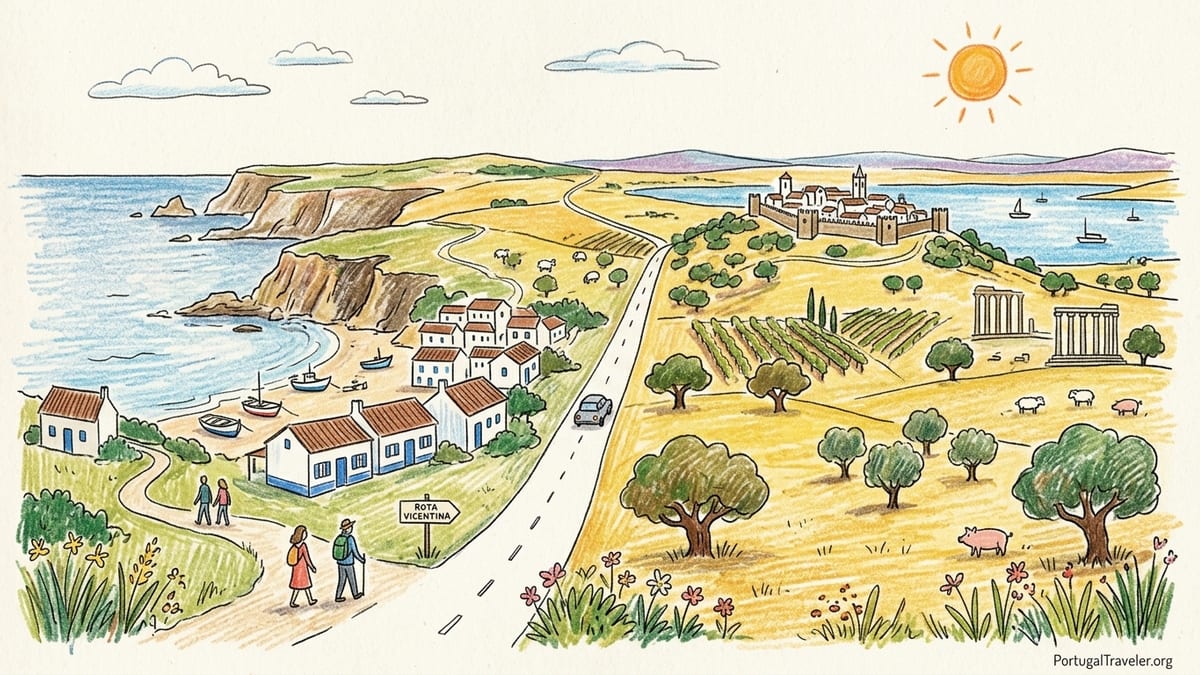
Setting the Scene: Where I Went on the Coast and Inland
On the coast I followed what locals consider the Alentejo litoral, roughly between the Sado estuary area and Zambujeira do Mar. I based myself first near Vila Nova de Milfontes, inside the Southwest Alentejo and Vicentine Coast Natural Park, and later in Porto Covo and Almograve. These are low-rise beach settlements with fishing boats pulled onto sand, a few streets of white houses and the Atlantic pounding just beyond. Much of the coastline here is protected, with long reaches of cliffs and dunes where the Rota Vicentina hiking routes link small coves and big open beaches.
Inland I divided my time between Évora, Reguengos de Monsaraz and the Alqueva lakeshore. Évora is the region’s showcase city, a UNESCO World Heritage site with a Roman temple, cathedral, and bone chapel concentrated in a compact center of alleys and azulejo-fronted houses. From there I drove east through the cork-oak and vineyard country that feeds the Alentejo Wine Route, spending nights on rural estates close to Reguengos and then up in the hilltop village of Monsaraz, which looks out over the Alqueva reservoir, the largest artificial lake in Western Europe.
What tied these places together was the feeling of the wider region: the whitewashed architecture, the long horizons and a slower rhythm than Lisbon or Porto. What separated them was almost everything else, starting with where I slept and how I moved around.
Where I Slept: Guesthouses by the Sea vs Rural Estates and Village Casas
On the coast my accommodations were compact and social. In Vila Nova de Milfontes I booked a simple guesthouse two streets back from Praia da Franquia. It was a converted townhouse with tiled floors, bright blue shutters and a breakfast room that opened onto a small patio. Rooms were modest, usually between 12 and 18 square meters, with a balcony or shared terrace and often no pool because the real water was a short walk away. In July and August these kinds of places often start around 90 to 140 euros per night for a double, higher if you want direct sea views or a boutique style hotel.
In Porto Covo I stayed in a small, design-forward B&B that tried to balance coastal ease with city comfort. The owner offered surfboard storage instead of wine tastings, and decor leaned into rattan lamps and beach towels. Mornings were about getting out the door for walks along the cliffs or down to Praia Grande before the afternoon wind picked up.
Inland, everything opened up. Near Reguengos de Monsaraz I stayed at a wine and country house surrounded by vineyards, olive groves and cork-oak forest. Properties in this part of Alentejo are measured in hundreds or even thousands of hectares, and the feeling is of being on a working estate rather than in a hotel district. My room looked directly over vine rows, and the pool sat slightly above the landscape, with loungers facing a sweep of golden plains. Nightly rates here often range from about 120 to 250 euros for a double room with breakfast, depending on the estate, season and whether a winery visit or dinner is included.
In Monsaraz itself the scale shrank again, but in a different way from the coast. Here I chose a small guesthouse inside the medieval walls, with low ceilings, thick stone walls that kept out the heat and window seats that framed the lake. Instead of hearing the surf, I heard the church bells and occasional footsteps on cobblestones. It felt deeply local and intimate, less seasonal and party-driven than the coast. If I had to pick the place where I instantly relaxed, it was on that hilltop, with the view across Alqueva and the quiet that dropped after sunset.
Driving and Logistics: Curvy Coastal Roads vs Empty Highways and Long Distances
Both trips depended heavily on having a car, but the driving felt different. Reaching and moving along the coast involved a mix of main roads and local lanes that dipped in and out of villages. Between Sines, Porto Covo, Vila Nova de Milfontes and Zambujeira do Mar, I spent a lot of time on the national roads that roughly parallel the sea and then cut off toward whatever beach I wanted that day. Some access roads to coves like Praia do Malhão or smaller stretches of sand near Almograve were gravel or narrow asphalt, with dusty parking lots that filled by late morning in August.
In summer it could take 30 to 45 minutes to move between coastal bases simply because of slower traffic through villages and stops for views. Parking in the heart of places like Vila Nova de Milfontes was competitive in peak season, and I learned quickly to leave the car slightly outside the center and walk in. Coastal logistics rewarded travelers who were happy to park once and spend the day moving on foot along the cliffs or the beach.
Inland, the challenge was not traffic but distance. Leaving Évora toward Reguengos de Monsaraz or Beja meant long stretches of open road with very little development between towns. The main regional roads are wide and generally well maintained, and I often drove 20 or 30 minutes without overtaking another car. Driving was relaxed but I had to plan fuel and breaks, especially in the heat of mid-afternoon when services could feel far apart.
Reaching wineries, cork estates or lake activities often involved short gravel tracks branching off the main road. They were easy enough in a standard rental car, but at night there was little lighting and I drove more slowly. If coastal logistics felt like threading through seasonal crowds, inland logistics were about planning around distance, heat and early closing times in smaller places.
Weather and Atmosphere: Atlantic Wind vs Interior Heat and Big Skies
The most visceral difference between the two trips was the air. On the Alentejo coast even in the peak of summer, afternoons came with a strong Atlantic breeze. On beaches like Praia do Malhão or Praia das Furnas, I spent as much time weighting down towels and pulling on a light windbreaker as I did swimming. Daytime highs along this stretch commonly sit in the mid-20s Celsius in summer, but the combination of sun and wind can be deceptive. I wore sunscreen constantly and still felt cooled by the airflow.
Inland, once I left the immediate influence of the ocean, the heat thickened. Around Évora, Reguengos and Beja, summer temperatures often climb into the mid-30s Celsius, and it is not unusual for heatwave days to touch higher. The air was still and heavy, and the landscape’s golden fields seemed to radiate warmth back up at me. Walking the streets of Évora in mid-afternoon felt noticeably more punishing than wandering along a breezy coastal cliff path.
Evenings reflected this difference. On the coast, nights cooled quickly. I watched sunsets in Porto Covo with a light jacket, waves turning pink below me and local families still arriving for an evening stroll. Inland evenings remained warm well into the night but brought a different reward: the sky. Near Alqueva I joined a small stargazing session in a dark sky area recognized for its low light pollution, and lying back to see the Milky Way arch above the plains felt entirely unlike the energetic, bar-lit nights on the coast.
If you are sensitive to heat and planning a July or August visit, the coast will likely feel physically easier during the day. If you want that slow, hot, deeply summery feeling and are comfortable organizing your schedule around early mornings and late evenings, the interior delivers it completely.
Food and Drink: Seafood Taverns vs Wine Country Kitchens
My daily menus changed almost overnight when I left the ocean behind. On the coast, lunch often meant grilled fish, percebes when they were available, and simple seafood rice in village restaurants that looked straight out to sea. In Vila Nova de Milfontes, I ate dourada and robalo that had almost certainly been caught not far from the harbor, served with boiled potatoes and salad. In summer, popular spots filled by 8 p.m., and advance reservations in August made the difference between a table with a view and a long wait outside.
Inland, meat, bread and olive oil came to the front. Around Évora and Reguengos de Monsaraz, traditional taverns serve dishes like migas with pork, lamb stews and açorda, thickened bread soups laced with coriander or garlic. One small restaurant in a town square brought out plates of black pork secretos, a cut known for its marbled fat thanks to pigs feeding on acorns under cork oaks. The environment around me matched the plate: cork forest, vineyards and grain fields visible as soon as I drove out of the village.
Wine was a supporting character on the coast and the main actor inland. In the interior Alentejo I visited estates that are part of the Alentejo Wine Route and joined structured tastings where I tried whites and reds that rarely travel far outside Portugal. A guided visit with tasting at a larger estate typically cost somewhere around 15 to 25 euros per person, with more elaborate wine and food pairings priced higher. Many estates combine tastings with lunch, turning an afternoon into a slow sequence of dishes and glasses overlooking the vines.
Price-wise, everyday meals in both areas remained reasonable by Western European standards. Traditional restaurants in small inland towns still offered prato do dia lunch menus, often including soup, a main dish and a drink, for roughly 8 to 12 euros. On the coast I found similar deals at more local, less view-focused places slightly away from the front line, while beach restaurants with sunset terraces charged more for location. The difference was not that one region was dramatically cheaper, but that inland I naturally gravitated toward slow, multi-hour meals, whereas on the coast I often ate with sandy feet and an eye on the evening light.
Landscapes and Activities: Coastal Hiking and Swimming vs Cork-Oak Plains, Castles and the Lake
On the Alentejo coast my days formed a simple rhythm: pick a section of the Rota Vicentina or a particular beach, drive there after breakfast, then spend hours walking and swimming. From Porto Covo I walked the clifftop section that passes countless small coves with turquoise water, wildflowers in spring and constant views north and south. Some beaches required a steep descent on sandy paths, so I balanced how adventurous I felt with how much I wanted to carry. Swimming was in the Atlantic, brisk even in August, with waves that surfers in nearby towns were happy to chase.
The coastline here felt raw but still human-scaled. Fishing boats dotted the horizon, and I passed farm fields growing close to the cliffs. Activities tilted toward the sea: surf lessons, kayaking around rocky outcrops and simply spending long hours on sand. Inland, on the other hand, my days rarely involved saltwater. Instead, the land itself was the attraction.
Between Évora and Monsaraz the main visual notes are cork oaks, olive groves, low vineyards and the occasional white village on a rise. I spent one morning on a jeep tour of a cork estate, where a guide explained how bark is stripped from trees every few years and pointed out the biodiversity that lives under those canopies. Another day I followed quiet walking trails that looped through farmland and small hamlets, with endless sky overhead and few other hikers in sight.
At Alqueva, water re-entered the picture in a new form. Here the Guadiana River has been dammed to create a vast reservoir with hundreds of kilometers of shoreline. I joined a short boat trip from near Monsaraz, gliding past small islands and seeing swimmers enjoying freshwater beaches that locals have arranged along the banks. It did not feel like the open ocean but instead like a tranquil inland sea framed by hills and oak groves. Evening kayaking and star-focused boat outings came up repeatedly in local recommendations, combining the lake with the region’s famously dark night skies.
Crowds, Evenings and How Each Place Felt
If mornings and afternoons on the coast were about movement, evenings were about energy. Porto Covo’s central square in August felt like a holiday stage set: families eating ice cream, kids playing around the church, outdoor tables filled with people lingering over grilled fish and jugs of wine. Vila Nova de Milfontes had a slightly larger-town scale, with more restaurants and a small bar scene that ran late into the night on summer weekends. I never felt overwhelmed, but it was a social, shared atmosphere built around long, light evenings above the sea.
Inland, nights wound down earlier, especially outside Évora. Monsaraz after dark was so quiet that my footsteps echoed off the stone. Locals sat on benches talking softly, and the light from house windows spilled onto the lane. There were restaurants, and some were busy at peak dinner time, but within a couple of hours the village seemed to fall asleep. Instead of staying out late, I found myself on the terrace of my guesthouse listening to crickets and occasionally looking up at the stars.
The types of travelers differed too. On the coast I met Portuguese families from Lisbon and the north, surfers from other parts of Europe and a fair number of camper vans parked near the more accessible beaches. Inland, the visitors I met were more often couples or small groups doing wine tourism, cultural sightseeing or longer road trips between Lisbon and the Algarve. The vibe inside a wine estate or a small-town tasca was relaxed and conversational rather than festive.
Personally, I felt more socially engaged on the coast and more contemplative inland. After a few days by the sea, I wanted to stay for the easy mix of walking, swimming and evening people-watching. After a similar stretch in the interior, I wanted to stay for the rhythm of long lunches, naps in the heat and slow walks through history-laden streets as the day cooled.
Money, Practicalities and How Long I Wanted to Stay
From a budget perspective neither side of the Alentejo felt extreme, but my spending patterns shifted. On the coast I paid a noticeable premium for sea-view rooms and restaurants on the frontline above the beach. Simple guesthouses a few streets back represented good value, especially if I self-catered some breakfasts with supplies from local supermarkets. Activity costs were relatively low: coastal hiking is essentially free, apart from occasional parking fees, and swimming costs nothing if you already have basic gear.
Inland, accommodation at rural estates or wine hotels often looked expensive at first glance, but I had to remember that the nightly rate frequently included breakfast, access to the pool, and sometimes a welcome tasting or activities on the property. Meals at traditional inland restaurants were slightly cheaper than similarly pitched coastal places, though once I added in winery visits and tastings, the difference narrowed. Cultural venues such as the cathedral roof in Évora or small local museums were modestly priced and easy to fit into a day without feeling like big-ticket attractions.
Logistics influenced how long I wanted to stay in each area. On the coast I could easily imagine a week or more, using one base to explore different beaches and sections of the Rota Vicentina while settling into village life at night. Distances between key spots were short enough that I never felt stuck, and if one beach was windy or foggy, another a short drive away might feel different.
Inland, I found that three to five days in each sub-area worked well: two or three nights based in Évora for its monuments and restaurants, then another two or three around Reguengos de Monsaraz and Alqueva for wine, lake time and stargazing. Beyond a week inland in peak summer, the heat and distances began to make me dream again of the breeze by the sea. In shoulder seasons, though, I could happily imagine spending much longer with the cork oaks and fortified towns.
Which Trip for Which Traveler
If I were planning a first visit for friends who love beaches, walking and easy-going evenings, I would steer them to the Alentejo coast. The combination of cliff-top trails, accessible coves, simple seafood restaurants and villages that come alive at night creates a satisfying rhythm with relatively low planning stress once you have your base and a rental car. It is a place to be outdoors, to feel the Atlantic in your hair and to end the day with sunset over water.
For travelers who care more about wine, food, history and quiet, the interior wins. Évora’s layers of Roman, medieval and later architecture are compelling on their own, and when you add winery visits, cork-oak landscapes and the serenity of Alqueva, it becomes a different kind of holiday. You trade surf for cellars, beach bars for starlit terraces and busy promenades for almost-silent village squares.
As for where I personally relaxed more, the answer surprised me. I arrived certain that the coast would be my happy place, but the deepest sense of exhale came inland, on a warm night in Monsaraz with the lake below and the sky alive with stars. The coast thrilled me and kept me active. The interior slowed my thoughts to match the landscape’s pace.
Neither side of the Alentejo is universally better. They simply serve different moods. The real magic, if you have the time, is to let your trip bend through both, feeling the shift as the salty wind at Zambujeira do Mar gradually gives way to the still heat, vineyards and old stones above Alqueva.
The Takeaway
Traveling the Alentejo coast and interior on one extended trip showed me that a single Portuguese region can deliver two entirely different styles of journey. Along the Atlantic I lived by the tides and the wind, structuring days around hikes, swims and lively summer evenings in compact fishing towns. Inland I followed the sun and the shade, pairing fortified towns and archaeological sites with long meals, winery visits and nights under enormous skies reflected in a calm lake.
If you are most alive with sand underfoot, salt on your skin and the sound of surf as you fall asleep, the coastal Alentejo from the Sado area down toward Zambujeira do Mar is likely your natural first choice. If you ache for open land, heritage towns, meaningful encounters with local food and wine and a pace that feels a step or two removed from the coast’s seasonal buzz, then the interior around Évora, Reguengos de Monsaraz and Alqueva will probably resonate more.
In practice, the decision often comes down to season and tolerance for heat. In high summer the coast offers physical relief and social energy, while the interior rewards early risers and those who embrace the slow, hot afternoons of a true southern summer. In spring and autumn, the plains and hill towns become more forgiving, and the combination of interior and coast on a single loop becomes especially attractive.
For my own travels, I would return to the coast when I crave movement and spontaneity, and to the interior when I want depth, reflection and the taste of wines that seem tied to the very fields outside the window. If you can, give yourself at least a few days on each side of this region. Let the contrast be part of the experience, and you may end up, as I did, feeling that you have visited not one destination, but two distinct worlds separated by only a couple of hours of road.
FAQ
Q1. Is the Alentejo coast or interior better for a first-time visitor to Portugal?
The coast is easier for a classic summer holiday with beaches and simple hikes, while the interior is ideal if you already know Portugal a bit and want wine, history and quieter evenings.
Q2. Do I need a car for both the Alentejo coast and the interior?
Yes, a car is very helpful for both. Public transport between small coastal villages and inland wineries or lake spots is limited, and many of the best beaches and rural estates sit off main routes.
Q3. How many days should I spend on the Alentejo coast?
Plan at least three to four nights if you want to sample different beaches and a section of the Rota Vicentina. A week works well if you like slow days of walking, swimming and village evenings.
Q4. How long do I need for the inland Alentejo around Évora and Alqueva?
Four to six nights split between Évora and the Reguengos de Monsaraz and Alqueva area lets you see key towns, visit wineries, enjoy the lake and still have time to slow down.
Q5. Is the interior of the Alentejo too hot to visit in summer?
It can be very hot in July and August, with daytime highs often in the mid-30s Celsius. It is manageable if you plan activities early and late in the day and rest during the afternoon.
Q6. Are prices much higher on the coast than inland?
Sea-view rooms and beachfront restaurants on the coast usually cost more, but everyday meals and non-luxury stays inland and by the sea can both be good value compared with many parts of Western Europe.
Q7. Which area is better for swimming, the coast or Alqueva lake?
The coast offers classic Atlantic beaches with waves and cooler water, while Alqueva provides calmer freshwater swimming from lake beaches and boat trips. It depends whether you prefer surf or still water.
Q8. Is the Alentejo coast very crowded in August?
Popular villages like Vila Nova de Milfontes and Porto Covo feel busy in August, especially on weekends, but the area is less dense than major Algarve resorts and quieter coves are still findable with a car and some walking.
Q9. Is it possible to combine the coast and interior in one itinerary without rushing?
Yes. With about 8 to 12 days you can comfortably spend several nights on the coast and several inland, using Évora or Monsaraz as your interior base and one coastal village as your seaside base.
Q10. If I love wine, should I skip the coast and go straight inland?
If wine is your main focus, prioritise the interior around Évora and Reguengos de Monsaraz, but you do not need to skip the coast. A few days by the sea at the start or end makes a balanced trip.