


I spent a week trying to cross Portugal’s Alentejo without renting a car, moving between Évora, Beja and the coast using nothing more than trains, regional buses and a few taxi transfers. On paper, the network exists: there are Comboios de Portugal trains, Rede Expressos coaches and small municipal buses that reach many towns. In practice, travelling this low density region on public transport alone means thinking like a local commuter instead of a road tripping visitor. This is the story of what actually worked, what failed, and how I would plan a car free Alentejo trip next time.
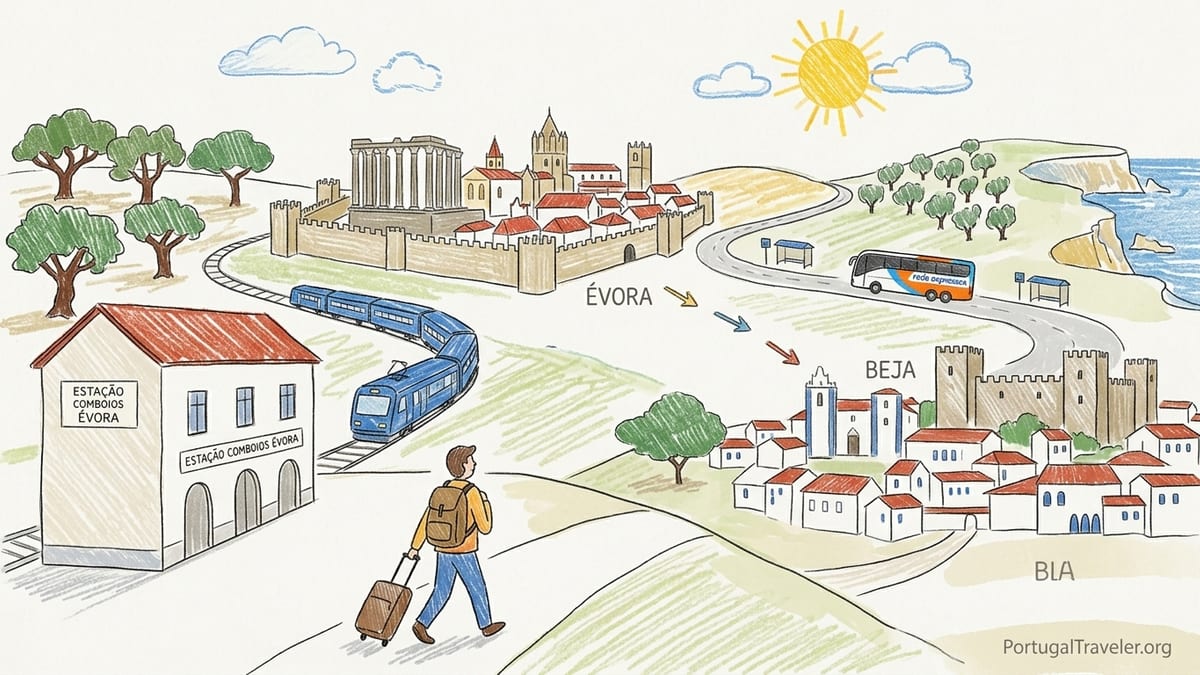
Why I Tried to Cross Alentejo Without a Car
My Alentejo experiment started in Lisbon, where I deliberately skipped the airport car rental desks and walked instead to the train booking counters at Santa Apolónia. I bought a ticket on Comboios de Portugal for the Intercidades service to Évora, paying a little under 15 euros for a second class seat booked a few days in advance. The ride takes about 1 hour 30 minutes, which is similar to driving in light traffic but without tolls or parking to worry about. As the train left Lisbon and rolled into the open fields south of the Tagus, it felt like proof that at least the first step of an Alentejo trip works very well without a car.
Choosing a rail connected base was deliberate. I knew that once you move away from the main Évora line, services thin out quickly. A quick check of the national rail timetable showed that Beja, another regional center, has only a few trains a day from Lisbon via Casa Branca, and that many smaller towns have lost their rail service entirely in favor of regional buses. My plan was to use Évora and Beja as hubs, reach at least one cork forest estate and one stretch of the Alentejo coast, and see how far I could get before the lack of wheels became more frustrating than romantic.
I also wanted to test the grey areas that do not show up in timetables. How far is the station from the historic center when you are dragging a suitcase at midday in August heat. What happens if a bus is late and you miss a connection with the last train of the day. These details matter more in Alentejo than in dense cities because frequencies are low and distances between villages are long. The goal was not to declare the region off limits without a car, but to work out who can realistically manage with trains and buses and who should budget for a rental or private transfers.
Lisbon to Évora by Train: When Public Transport Really Works
The Intercidades service from Lisbon to Évora is where Alentejo public transport shines. Trains typically run several times per day from both Santa Apolónia and Oriente. I bought my ticket at the station from a staffed counter, but there are also ticket machines that accept cards and offer English language options. Seats are reserved, the rolling stock is air conditioned and there is ample luggage space in overhead racks and at carriage ends. For anyone hesitant about driving straight out of Lisbon traffic, this rail link is an easy win.
On arrival in Évora, the first minor compromise appears. The station sits on the edge of town, roughly a 15 to 20 minute walk from the walled historic center where most visitors stay. With a small backpack, the walk along Avenida dos Combatentes is manageable, though pavements can be narrow in parts and summer sun is strong. With a rolling suitcase, you either accept the trundle over cobblestones at the end or spend roughly 6 to 8 euros on a short taxi ride. There is a local bus that links the station and center, but departures are infrequent and posted as a paper sheet, which makes them easy to miss if your train arrival does not line up.
I stayed in a small guesthouse inside the walls near Praça do Giraldo and quickly saw the advantage of treating Évora as a main base if you are not driving. The town has enough restaurants, Roman ruins and museums to fill two full days without leaving on excursions. More importantly, it has both rail and intercity bus links, which makes it one of the few Alentejo towns where you can wake up and realistically decide between a day trip by train, bus or organized tour without rearranging your entire schedule.
Day Trips Around Évora: Cork Forests, Megaliths and Missed Buses
My first attempt to leave Évora without a car was to reach the nearby cromlech sites and cork oak countryside. The most famous stone circle, Almendres Cromlech, sits roughly 15 to 17 kilometers outside town on small rural roads. There is no scheduled public bus that stops at the site. At the Évora tourism office, staff confirmed that the realistic options were an organized half day tour in a van, a taxi booked by the hour, or a rental car. Tours advertised in town ranged between roughly 35 and 55 euros per person, including hotel pickup and a couple of short stops at viewpoints. A taxi quoted a similar overall price if I hired it for two to three hours and shared the cost with another traveler.
This was my first clear lesson in the limits of Alentejo public transport. On a map, 15 kilometers feels close. On the ground, it is a rural road with no safe shoulder for pedestrians and few opportunities to flag a taxi. With no car, I booked a small group tour that left from just outside the city walls. It felt slightly against the spirit of doing everything by public transport, but it was the only option that kept the schedule tight enough to catch the evening train passengers were relying on. In practice, it worked well for the day: no timetable stress, and I still got three hours of countryside without driving.
The next day I tried something closer to a real bus based day trip. I bought a ticket at Évora’s small bus station for a morning Rede Expressos coach to Estremoz, a hill town about 45 minutes away. The station is outside the walls, about a 10 to 12 minute walk from the center. Tickets can be purchased at a counter or online in advance and, on the day I traveled, the fare was under 10 euros one way. The coach was comfortable and on time, but there were only a handful of departures in each direction, which meant that missing the midday bus back would have pushed my return to late afternoon.
This is where spontaneity took a hit. In Estremoz, I would have liked to hop between nearby marble towns or follow a walking trail through vineyards. Without a car, every side trip required either a pre booked taxi or a long walk with the clock constantly in mind. With only a couple of buses back to Évora, lingering over lunch meant doing mental math about whether I was willing to risk arriving after dark or paying for a taxi all the way back if something went wrong. The bus trip itself worked perfectly. It was the low frequency and distance from trailheads that made the day feel more constrained than it would have by car.
Évora to Beja: Chasing Trains, Missing Connections
For the next leg, I headed deeper into Alentejo to spend a night in Beja. Here, the rail map looks encouraging but demands more attention than the Lisbon to Évora leg. The typical route is an Intercidades or regional train from Évora to Casa Branca, then a connection to Beja. When I checked timetables shortly before travel, there were only a few daily services linking all three points, with some gaps of several hours. I bought my ticket at Évora station the day before travel because I wanted a human to confirm that the connection time at Casa Branca was realistic.
The ticket for this regional hop cost under 15 euros, but came with a warning from the clerk: if the first train was delayed and the second could not wait, I might face a wait of several hours at Casa Branca, which is a small junction without any town center right by the platforms. In the end, my outbound connection worked. The train from Évora arrived on time, and a handful of passengers walked straight onto the Beja train on the next platform. The rolling stock was older and slower, but there was plenty of space and the views of sunburned fields and olive groves compensated.
Arriving in Beja showed another side of the "last mile" problem. The station sits about a 15 minute walk from the historic center, and my small hotel was tucked into a narrow lane near the castle. The walk uphill with a mid sized suitcase was manageable but uncomfortable in the afternoon heat. Taxis were present at the station, but there were fewer than in Évora and no obvious ride hailing options. If I had been travelling with heavier luggage or with mobility issues, that final climb would have required a taxi budget on top of the rail ticket.
The real test came on the way back. I planned to return toward Lisbon via a morning train, connecting again through Casa Branca. On the day, the Beja service departed about 10 minutes late after waiting for a small group of commuters. That delay was enough to make my scheduled connection at Casa Branca very tight. The conductor confirmed that the Lisbon bound train would not hold indefinitely. I made the change by jogging under the underpass, but it would have been stressful with children or heavy bags. Missing it would have meant a wait of several hours or an improvised bus alternative from a roadside stop. This experience did not make me avoid trains altogether, but it convinced me to favor earlier departures and larger time buffers whenever a connection in rural Alentejo is involved.
Beja to the Coast: When Buses and Taxis Have to Team Up
I did not want to leave Alentejo without at least touching the Atlantic, so from Beja I aimed for Vila Nova de Milfontes on the Alentejo coast. Looking at a map, Beja and Milfontes are not especially far apart. On public transport, every route involves doglegs. I ended up taking a morning Rede Expressos bus from Beja to Odemira, followed by a local bus to Milfontes. Tickets for the first leg were easy to buy at the small Beja bus station, which has a staffed counter and printed schedules posted on the wall. My ticket cost a little over 10 euros.
The first coach trip was smooth and air conditioned, and took about 1 hour 30 minutes. At Odemira, the connection turned from intercity predictability to local improvisation. The onward bus to Milfontes is run by a smaller regional operator and had only a few departures listed for the entire day. When we arrived, my connection was scheduled within about 40 minutes. The stop was a simple roadside stand, and there was no digital display. A few locals waited in the shade and confirmed that the bus normally arrived within a 10 minute window of the posted time, but also shrugged when I asked what would happen if it failed to appear.
This time, the bus arrived. It was a smaller, older vehicle with no space for large suitcases except the aisle, and the driver sold tickets in cash only for a modest fare. The ride to Milfontes took another 35 to 40 minutes on narrow, winding roads. Here, public transport technically connected two points, but it would have been very difficult to coordinate with a tight train schedule or late afternoon arrival. By the time I rolled into Milfontes and wheeled my bag along the hill toward the guesthouse, I had spent most of the day in transit and felt acutely aware that any missed connection would have stranded me mid route without many taxis around.
For my onward trip along the coast, I decided to compare the public transport experience with a hired transfer. For a journey between Milfontes and another coastal village with little or no bus service, a local taxi company quoted around 60 to 80 euros for a 45 to 60 minute ride, depending on location and time of day. That is a significant cost compared with a 15 to 20 euro bus and train combination, but it came with door to door pickup, luggage help, and a guaranteed arrival time that did not depend on a chain of low frequency services. On a per person basis, two or three travelers sharing such a transfer could justify it for long hops when public transport schedules simply do not line up.
How The Same Journeys Feel by Car
To put the experience into context, it helps to compare a couple of these routes with driving times and costs. The rail trip from Lisbon to Évora took around 1 hour 30 minutes and cost under 15 euros. Driving the same route on the main motorway typically takes a similar 1 hour 30 minutes in light traffic, with additional costs for tolls and fuel. Renting a compact car from Lisbon airport for a week often starts somewhere around 250 to 350 euros in the shoulder season, plus fuel estimated at perhaps 60 to 90 euros for a moderate Alentejo itinerary. For a solo traveler focused on one or two towns, the train can be cheaper and simpler. For a couple or group planning many rural detours, the car quickly becomes more economical per person.
Between Évora and Beja, the train itinerary via Casa Branca occupied a good part of the day once buffer times were included. The ticket cost under 15 euros, but came with connection anxiety and a hot uphill walk at the Beja end. Driving between Évora and Beja, by contrast, takes roughly 1 hour 15 minutes and gives the option to stop at small villages and vineyards along the way. Here, the lack of a direct, frequent bus or train made me very aware of the tradeoff. Public transport got me from A to B safely and for a modest sum, but it turned what could have been a flexible half day meander into a fixed block in the middle of the schedule.
The biggest contrast was on the trip between Beja and the Alentejo coast. My multi stage bus route took most of a day once waiting and walking times were considered. A driver making the same trip by car could cover the distance in around 1 hour 45 minutes, even with a short coffee stop. In addition, the car opens up beaches and viewpoints that are effectively inaccessible on public transport, such as small coves between the main towns or hilltop villages slightly inland from the coastal highway. Putting numbers against it, the extra flexibility of a rental car would probably have cost me the equivalent of a couple of taxi rides per day. Whether that feels worth it comes down to how strongly you value spontaneous stops versus the appeal of leaving the driving to professionals.
Strategies That Helped: Bases, Tours and Selective Car Rental
By the end of the trip, I had abandoned the idea of doing absolutely everything by scheduled services and moved to a more pragmatic mix. Three strategies proved especially helpful. The first was choosing my bases around transport hubs. Évora, Beja and Odemira anchored the itinerary because they offered both rail or long distance bus links and at least some local buses or taxis. From each hub, I then allowed myself to use short taxi rides for the final stretch to rural accommodation or trailheads. These last mile trips usually cost between 8 and 20 euros, and made the difference between being stuck on the main square and actually waking up in countryside guesthouses.
The second strategy was to use small group tours in place of awkward public transport combinations. In Évora, the stone circle tour solved a problem that buses simply do not address. On the coast, a half day boat trip and a guided hike between villages meant I could see stretches of scenery without juggling bus stops and taxi numbers. These tours had clear departure points and times, were easy to book through local agencies or hotel desks, and removed the stress of missing the one afternoon bus back.
The third strategy, which I would lean into more on a return visit, is selective car rental. Instead of picking up a vehicle at Lisbon airport for the entire period, I would consider arriving by train to Évora, spending two or three nights walking the town, then renting a car locally for three or four days to explore the hinterland and move on to the coast. Returning the car in a larger center such as Sines or even back in Évora, then finishing the trip again by train or coach, would keep the driving days focused on rural sections where public transport is weakest. In my case, I did a smaller version of this by arranging one long taxi transfer along the coast, but I could feel how a short rental period would have opened up several side valleys and hilltop villages that remained dots on the horizon.
Across all these strategies, one constant remained. Schedules and fares in Alentejo change, and information is not always centralized. Before each leg, I checked train times on Comboios de Portugal and cross referenced bus timetables at stations or official operator sites. Staff at tourist offices and bus counters were helpful in confirming whether services were current, especially for local lines that only run on school days or do not operate on Sundays. Anyone planning a similar trip should be prepared to repeat this verification shortly before travel, rather than relying on notes from previous seasons.
The Takeaway
Travelling through Alentejo without a car is neither impossible nor effortless. It sits in a middle ground that rewards preparation and punishes improvisation. Trains and long distance coaches work very well between major towns such as Lisbon, Évora, Beja and some coastal centers. They are affordable, reasonably comfortable, and usually reliable when you build in sensible connection times. Within those hubs, you can fill several days with meaningful experiences on foot, from Roman ruins and medieval castles to riverside promenades and local markets.
Where public transport struggles is in the fine detail that road trippers often take for granted. The most atmospheric rural guesthouses are frequently several kilometers outside town on narrow roads with no pavements. Trailheads and viewpoints may sit between villages rather than in them. Low frequency bus services mean that missing the midday departure can turn a relaxed day trip into a stranded afternoon. In my own itinerary, public transport worked perfectly for the Lisbon to Évora leg and for the trunk route from Beja toward the coast. It became constraining whenever I wanted to stitch together multiple small places in a single day or respond spontaneously to what I saw out the window.
For the traveler who refuses to drive at all, the key is to accept Alentejo on its own terms. Base yourself in a handful of well connected towns such as Évora, Beja, Odemira or a larger coastal village. Plan no more than one major move every couple of days. Use trains and Rede Expressos coaches for the long hops, then budget for short taxi rides and the occasional organized tour when you want to reach countryside estates, stone circles or isolated beaches. Choose accommodation within easy walking distance of stations or bus stops to avoid draining time and energy on the last mile. With this approach, you will not see every remote village, but you will still experience the region’s landscapes, food and slower rhythm without ever touching a steering wheel.
For someone comfortable renting a car only for part of the trip, Alentejo becomes much more flexible. Arrive by rail to avoid Lisbon traffic, enjoy a couple of car free days in your first base, then pick up a car locally for three or four days dedicated to rural explorations and coast hopping. Return the car in another hub and finish with a relaxed train or coach back to Lisbon. This hybrid model keeps overall costs and driving stress down, while unlocking back roads, farm stays and trailheads that are impractical on public transport alone. In hindsight, this is how I would structure my next visit.
For travelers wondering whether to rent from day one, the decision comes down to your style. If your vision of Alentejo is a classic road trip of spontaneous stops at every hilltop town and winery, then a car from the outset matches that dream and will likely be more time efficient. If, instead, you prefer to linger in a few places, people watch in main squares and join occasional tours for hard to reach sights, then combining trains and buses with occasional taxis can serve you well, provided you accept that schedules, not whims, will shape your days. My week without a car taught me that Alentejo welcomes both types of traveler. You just need to decide whether you want the freedom of the open road or the slower, sometimes awkward, but often rewarding rhythm of traveling like a local.
FAQ
Q1. Can I visit Alentejo without renting a car at all?
Yes, if you focus on well connected bases such as Évora, Beja and a few coastal towns, use trains and intercity buses for long hops, and accept some reliance on taxis and tours for rural sights.
Q2. Which Alentejo town works best as a car free base?
Évora is the easiest overall, with direct trains from Lisbon, a compact historic center, enough sights for several days, and both bus and tour options for nearby excursions.
Q3. How reliable are trains and buses in Alentejo?
Major trains and Rede Expressos coaches are generally reliable, though occasional delays and tight connections do happen. Local buses can be infrequent, so always check the latest timetable shortly before you travel.
Q4. Do I need to book tickets in advance?
For long distance trains and intercity coaches, advance booking is wise in busy seasons or on weekends. For short regional buses, tickets are often sold on board, but having cash and arriving early helps.
Q5. How do I handle luggage on rural buses and trains?
On trains and mainline coaches there is good luggage space. On smaller rural buses, large suitcases may need to sit in the aisle or limited underfloor compartments, so traveling with one medium case or a backpack is more comfortable.
Q6. Are taxis easy to find in small Alentejo towns?
In larger centers like Évora and Beja, stations usually have taxis waiting. In smaller villages, you may need your hotel or a café to call one, and waits can be longer, so plan ahead for early or late transfers.
Q7. Is it safe to travel alone by public transport in Alentejo?
Journeys felt generally safe during the day, with a mix of locals and a few travelers on board. Normal precautions apply, especially at quieter rural stops and in the evenings.
Q8. What if I miss the last bus or train of the day?
In small towns that can mean an expensive taxi ride or an unplanned extra night. Keeping buffer time between connections and avoiding the last departure of the day where possible reduces that risk.
Q9. When does renting a car for part of the trip make sense?
Renting for three or four days is ideal if you want to reach remote farm stays, trailheads or small coves between coastal towns that scheduled buses do not serve well.
Q10. How should I choose accommodation if I rely on public transport?
Look for places within walking distance of stations or main bus stops, ask in advance about local taxi availability, and consider staying in town centers rather than isolated rural properties unless transfers are arranged.