


I went to the Azores assuming I would pick one “best” island for whale watching and be done. Instead, after booking trips from São Miguel, Pico and Faial over two separate visits, I came home convinced that whale watching here is an archipelago-wide experience shaped as much by weather, boats and operators as by geography. This is a report from the water, not a ranking table, focused on what actually happened on my tours and how those realities can help you plan your own.
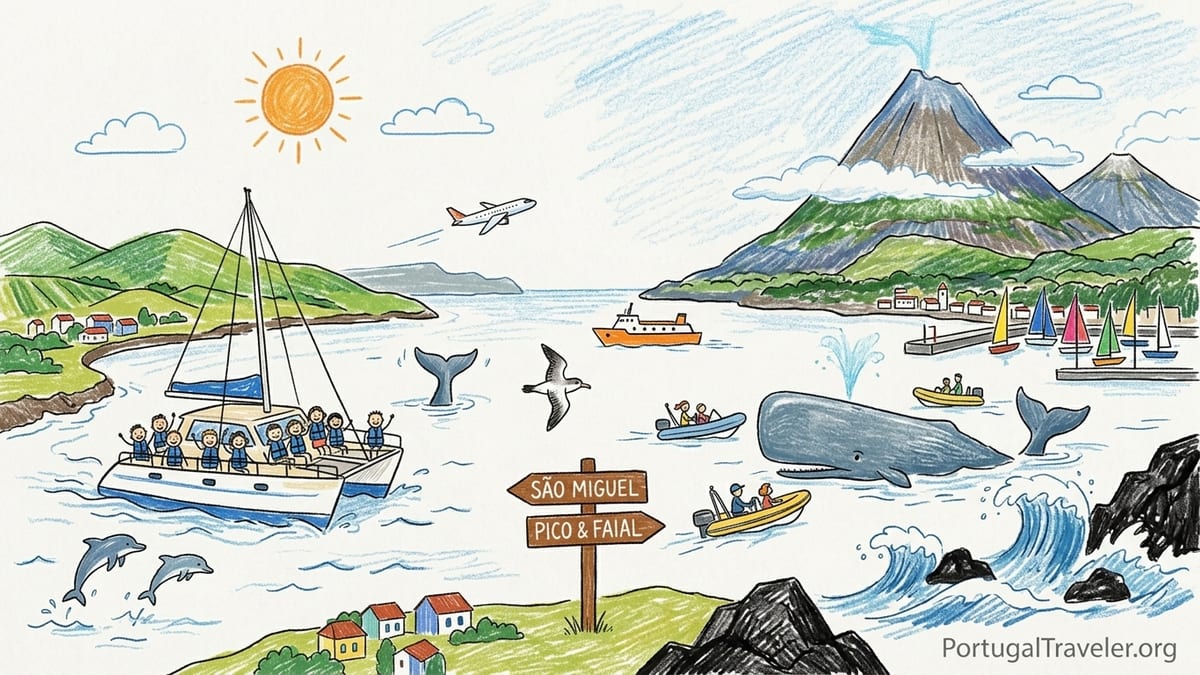
Why Whale Watching Feels Different Across the Azores
On paper, whale watching in the Azores looks fairly uniform. Most tours run three to four hours, most operators advertise similar resident species like sperm whales with seasonal visitors in spring, and the major departure ports repeat from brochure to brochure: Ponta Delgada and Vila Franca do Campo on São Miguel, Lajes do Pico and Madalena on Pico, Horta on Faial. In practice, my experiences on the water felt quite different from island to island, even when the tours were technically similar in length and price.
Across my trips, prices clustered between roughly 55 and 75 euros per adult for a standard half-day whale watching excursion, whether I was paying a São Miguel company operating out of Ponta Delgada’s marina or a Pico-based specialist in Lajes do Pico. São Miguel offered the broadest choice, from larger catamarans in Ponta Delgada aimed at cruise passengers to semi-rigid inflatable boats zipping out of Vila Franca do Campo. Pico and Faial had fewer total departures in a day but a noticeably denser concentration of dedicated whale operators and a more “all in” atmosphere around the marinas.
The fundamentals, however, were consistent. Every tour I joined included a mandatory safety briefing on shore, a clear explanation that sightings were never guaranteed, and some kind of marine biologist or naturalist presence, whether that meant a single guide juggling commentary and safety, or a small team with one staffer focused purely on interpretation. What shifted from island to island was everything around that core: group size, boat type, sea conditions, crowding at sightings and how cancellations were handled when Atlantic weather refused to cooperate.
Because the Azores sit in the middle of the North Atlantic, conditions change quickly. I ended up having at least one trip rescheduled on every island. That might sound frustrating, but it meant that the tours I did take were in workable seas, and the contrast between a choppy morning on a São Miguel catamaran and a mirror-calm Faial afternoon in a small RIB showed me just how much the “same” activity can feel different depending on where and how you do it.
São Miguel: Big-Marina Convenience and Mixed Sea Conditions
My first Azores whale watching trip departed from Ponta Delgada, the capital of São Miguel, on a sturdy catamaran with a local operator that also runs jeep tours and hiking excursions. The departure port could not have been easier. I walked from my guesthouse in central Ponta Delgada to the marina in about ten minutes, checked in at a small office facing the harbor and joined roughly fifty other passengers, including families with young children, for a three-hour morning tour.
After life jackets were demonstrated and stowed, a marine biologist gave a briefing in English and Portuguese covering species we might see, the history of whaling in the Azores and basic rules such as not leaning over the rails or crowding the bow. Seasickness pills were recommended at check-in, but left to personal choice. I had taken a tablet about half an hour earlier and was glad I did. It was late April, the forecast looked reasonable, yet once we cleared the breakwater the swell rolled in at a steady, queasy rhythm. Several passengers retreated inside to the more stable central cabin within the first half hour.
Despite the motion, that São Miguel trip delivered some of my most memorable encounters. Offshore spotters, still using hilltop lookout posts that once guided whaling boats, directed our captain toward activity. Over the course of just under three hours, we watched a group of common dolphins riding the bow wave, followed a pod of bottlenose dolphins at a respectful distance and had two short but clear views of a sperm whale fluking before deep dives. The catamaran shared the sperm whale area with three other boats, but because of strict approach rules, we took turns moving closer and then backing off. It never felt like a scrum, though the number of people on my own vessel meant a bit of shuffling for rail space.
Later that week, I joined a second São Miguel outing, this time from Vila Franca do Campo on the south coast with a smaller specialist company that focuses heavily on whale watching and research. The departure involved a 30 to 40 minute drive from Ponta Delgada, but the atmosphere on the dock could not have been more different. Our semi-rigid boat carried only about a dozen passengers, paired with a skipper and a marine biologist. The safety briefing was more intimate, with individual checks that everyone had their life jacket correctly fastened and clear guidance about bracing feet and knees for the ride. The sea that day was choppier than expected, and despite my medication I felt the slap of each wave. One passenger became seasick enough that the skipper deliberately slowed and repositioned the boat to reduce impact.
The payoff was speed and maneuverability. Where the Ponta Delgada catamaran had taken its time, the RIB skimmed between patches of activity. Over nearly four hours on the water we saw common, striped and Risso’s dolphins, plus at least one confirmed sperm whale blow in the distance before the animal vanished. The marine biologist kept up a running commentary on dorsal fins, behavior and data collection, but was also quick to underline that no one, including the spotters, could ever promise a particular species or a close encounter. By the time we returned to Vila Franca, the afternoon wind had picked up significantly, reinforcing my conclusion that on São Miguel, morning departures offered a better balance of calmer seas and adequate sleep.
Pico: Specialist Operators and Deep-Water Drama
My next whale watching base was Pico, specifically Lajes do Pico on the island’s south coast. If São Miguel felt like a city where whale watching was one of many activities, Lajes felt like a town built around it. The small harbor was lined with a handful of dedicated whale watching outfits, gear drying in the sun and staff chatting with guests in several languages. I booked two separate morning trips here on different days with two different operators, both using semi-rigid boats carrying between ten and sixteen passengers.
The pre-departure routine on Pico was noticeably more detailed. Each tour started with a short classroom-style talk in a room above the harbor, where a biologist used maps to show the deep underwater canyon south of Pico that helps explain why sperm whales are so frequently recorded in this area. That context, plus a recap of the island’s whaling past and the modern use of land-based lookouts, made the experience feel anchored in place rather than just a generic wildlife excursion. Only after questions were answered did we suit up in waterproof jackets and board the boats.
Conditions during my first Pico outing in early May were almost ideal. We left Lajes at around 9 a.m. under high, thin cloud with only a modest swell. Seasickness was mentioned as a possibility, but no one on board appeared to suffer. Within forty minutes we were in sight of our first sperm whale blow. Over the next three hours we rotated between two or three different individuals, always following the Azorean guidelines on minimum approach distances and time spent with each animal. We also encountered common and bottlenose dolphins and briefly drifted with a raft of Cory’s shearwaters. The group size felt right. With twelve passengers there was room for everyone to sit on the tubes or stand at the stern without jostling.
My second Pico trip, a couple of days later, underscored just how variable the same location can be. A weather front had brushed the islands and although the operator judged conditions safe, the swell was higher and more confused. Before we even left the harbor, the staff went out of their way to ask if anyone was anxious or prone to seasickness and reminded us that we could sit closer to the center of the boat for stability. Within an hour, two people were pale and quiet, and one ended up using the biodegradable sick bags the crew had pointed out earlier. Sightings were also thinner. We had one distant sperm whale, a few common dolphins and long, quiet stretches where the only sound was the hull thumping off wave crests. The same operator that had felt magical in perfect weather now felt like a sober lesson in Atlantic reality. I came back grateful that I had booked two mornings in Pico rather than trying to squeeze everything into a single shot.
From a logistics point of view, Pico required more advance planning than São Miguel. Getting to Lajes from my accommodation near Madalena meant a drive of about forty minutes along the south coast, plus a buffer for parking and check-in. The reward was a more focused, less crowded scene on the water. Even at peak times, I rarely saw more than three or four other boats near a sighting area, and the mood between operators seemed cooperative rather than competitive. If your priority is depth of whale watching culture more than overall tourism infrastructure, Pico delivers that feeling without needing to idolize it as universally “best.”
Faial: Channel Crossings, Horta Vibes and A Tale of Two Trips
Faial entered my whale watching story in two different ways. On one visit, I based myself in Horta and booked a standard half-day trip directly from its marina with a well known local operator that runs both catamarans and smaller inflatables. On another, I visited Faial as a day trip from Pico, crossing the Faial-Pico channel on the morning ferry and joining an afternoon whale watching tour from Horta before returning in the evening.
The Horta marina has a completely different energy from Lajes or Ponta Delgada. Sailboats on Atlantic crossings tie up here, and the quays are lined with colorful paintings left by yacht crews. My first Faial trip used a mid-sized RIB carrying about fourteen passengers. The safety briefing took place right on the quay, delivered by a bilingual guide who doubled as the on-board naturalist. Compared with Pico, there was a bit less pre-trip classroom time and a bit more emphasis on practical instructions: how to hold on, what to do if someone felt sick, where the radio and emergency gear were stored.
That morning the sea between Faial and Pico was glassy. We could see the outline of Mount Pico towering across the channel. Within an hour we were watching a mixed group of common and striped dolphins leaping beside the bow, and a little later we had distant but repeated views of sperm whale blows closer to Pico’s coastline. One moment that stuck with me was the way the operator coordinated with boats from Pico over the radio, sharing information on whale locations and agreeing on who would approach from which direction to avoid surrounding the animals. It reinforced the idea that, biologically, this area is a single whale watching zone regardless of which island you sail from.
My second Faial experience, on a different trip, was a logistical puzzle. I stayed on Pico but wanted to see Horta, so I booked a morning ferry across the channel, allowing several hours to wander the town before an afternoon whale watching departure. This is where I hit my most instructive cancellation. As the day wore on, the wind rose and whitecaps appeared in the channel. About two hours before the scheduled departure, the operator sent a text message to everyone booked, explaining that the afternoon tours were canceled for safety reasons and offering either a refund or a reschedule for the next suitable day. Because I was returning to Pico that evening, rescheduling was impossible. I took the refund and sat on the breakwater watching the waves pound the harbor entrance, feeling grateful that the company had made a conservative call.
The Faial example convinced me that if you plan to whale watch there, it is best to build at least two possible days into your Horta stay rather than relying on a single afternoon around a ferry timetable. When the sea cooperates, Faial delivers the same species mix I saw off Pico and São Miguel, with the added interest of working that narrow, deep channel between islands. When it does not, you need the flexibility to shrug and come back another day.
What I Learned About Weather, Timing and Seasickness
Across all three islands, the single biggest factor shaping my experience was not the operator or even the island but the weather. In practical terms, that meant wind strength, swell height and how much those elements changed between morning and afternoon. On São Miguel and Pico especially, I consistently found that morning departures offered calmer seas and a higher chance that the tour would run at all. Operators told me that by early afternoon, the wind often increased, particularly in spring, which lined up with my own time on the water.
On my first São Miguel catamaran tour, the 9 a.m. departure still encountered a noticeable swell, and by the time we returned around noon the whitecaps were more frequent. An afternoon RIB outing later that week from Vila Franca felt significantly rougher. On Pico, my best sea conditions were on a 9 a.m. departure, while an 11 a.m. start two days later already felt closer to the weather’s turning point. Faial gave me the clearest contrast. The morning trip from Horta had mirror-like water that made photographing dorsal fins easy. The afternoon tour that was later canceled would have departed into building chop and gusts that were already rattling rigging in the marina.
Those shifts made seasickness a real consideration. I tend to be cautious, so I took over-the-counter motion sickness tablets before every trip and avoided heavy breakfasts. Even so, I felt queasy on the rougher São Miguel and Pico days and stayed happiest when I could watch the horizon and sit closer to the stern. I saw other passengers underestimate the motion, particularly on São Miguel’s larger boat where the solid appearance seemed to lull people into a false sense of security. On the smaller RIBs, guides were more proactive, warning guests that the ride could be physically demanding and suggesting they sit closer to the center of the boat or consider staying ashore if they were very prone to motion sickness.
The key lesson I drew from this is that flexibility is not a luxury in the Azores but part of responsible planning. On every island, operators took weather safety seriously and canceled or rescheduled when necessary, even if the harbor looked deceptively calm. I never felt pressured to accept a voucher instead of a refund, but I also recognized that booking a tour for my first full day on an island gave me more options to shuffle plans if conditions looked marginal. Travelers who have only one afternoon free for whale watching anywhere in the archipelago run a real risk of missing out purely because the Atlantic has other ideas that day.
How Operators Handled Safety, Briefings and Cancellations
Although the tone varied from island to island, several safety and procedural elements were consistent across all the tours I joined. Every operator, whether in Ponta Delgada, Vila Franca do Campo, Lajes do Pico or Horta, ran some form of safety briefing before departure. Life jackets were either worn throughout the trip on the smaller boats or easily accessible on larger vessels, and in every case crew members demonstrated how to put them on correctly. Basic rules about staying seated during higher speeds, not standing on benches and keeping bags under control were clearly explained.
Marine biologists or trained naturalists were integral to each tour. On the big São Miguel catamaran, one biologist delivered commentary to the whole group over a sound system and later answered questions on deck. On the São Miguel and Pico RIBs, a biologist or guide sat or stood at the stern, combining safety checks with species explanations and individual conversations with passengers. On Faial, the naturalist divided time between the bow and stern, pointing out behavior, translating radio updates about potential sightings and explaining approach rules around the whales.
Crucially, every operator I used was explicit that sightings could not be guaranteed. The use of land-based lookout posts increased the odds of finding animals, but staff emphasized that whales and dolphins are wild and that some trips return with only distant blows or non-dolphin wildlife like seabirds and sea turtles. I experienced this range first-hand. My most wildlife-rich outings included multiple sperm whale encounters and several dolphin species, while my leanest tour offered only a handful of common dolphins and long empty stretches. None of the companies offered partial refunds on slower days, and all framed the uncertainty as part of the reality of observing wild animals.
Cancellation and rescheduling policies were broadly similar. When weather forced a change, São Miguel and Pico operators first tried to rebook passengers on another departure during their stay, often suggesting earlier morning slots on the following day when conditions looked better. On Pico, a front that canceled my planned afternoon tour turned into a clear, calm morning 24 hours later, and the operator automatically moved my reservation with my approval. On Faial, where I lacked the flexibility to reschedule, the company processed a full refund back to my card without fuss. These experiences reinforced my impression that the serious whale watching operators across the Azores are aligned in putting safety and animal welfare ahead of squeezing every departure out of the calendar.
Choosing Boat Type, Group Size and Island Based on My Trips
After several tours on different islands, I began to see patterns in how boat type, group size and departure point shaped my own enjoyment far more than any theoretical ranking of “best” island. On São Miguel, the larger catamaran from Ponta Delgada felt comfortable and reassuring. It offered indoor seating, toilets and space to move, which suited older passengers and families. The downside was crowding at rails during good sightings and a certain distance from the water that made dolphin encounters feel less immediate.
In contrast, the semi-rigid boats I used from Vila Franca do Campo, Lajes do Pico and Horta put me right at the level of the sea. Group sizes never exceeded about sixteen passengers, and sometimes dropped closer to ten. This brought both benefits and trade-offs. The experience was more physically intense, especially on choppy days when riders absorbed each impact with their knees and backs. Seasickness appeared quicker on these smaller boats, but so did the sense of connection with the animals and the environment. When a pod of common dolphins rode our bow wave off Pico, we could feel them slicing through the water within arm’s reach, always at the distance enforced by the skipper but close enough to hear their breaths.
Logistically, São Miguel was the simplest island for whale watching. Flying in and out through Ponta Delgada, I could fit a morning tour on my first or last full day without additional flights or ferries. Pico required more deliberate planning of internal flights or ferry connections, plus rental cars to get to Lajes. Faial, as part of the central “triangle” with Pico and São Jorge, rewarded travelers willing to manage ferry timetables and fuel their plans with flexibility. Once there, however, the actual at-sea experience felt similar between Pico and Faial, especially when we were watching the same individuals across the channel.
From my personal perspective, if I were traveling with a multi-generational family or anyone anxious about the sea, I would lean toward a São Miguel catamaran or one of the slightly larger boats that some operators run from Horta. If I were visiting with friends who were reasonably fit and very keen on whales, I would prioritize at least a couple of mornings in Lajes do Pico or Horta on semi-rigid boats, accepting that one or more departures might be canceled or deliver only modest sightings.
The Takeaway
After watching whales and dolphins from São Miguel, Pico and Faial, I no longer ask which Azores island is “best” for whale watching. The more useful question for me is which island and operator combination fits the rest of a specific trip, and how much flexibility I have to work around Atlantic weather. My own tours ranged from calm, wildlife-packed mornings to lumpy, quiet outings where the most memorable sound was the thud of the hull on waves, and they all helped me understand what this archipelago-wide activity really involves.
If I were planning a return trip focused on whale watching, I would start by deciding how much of my holiday I wanted to dedicate to the sea. For a first-time visitor who also wants hot springs, crater lakes and restaurant variety, I would probably begin with São Miguel, staying in Ponta Delgada or Vila Franca do Campo and booking at least two morning departures with reputable operators that include marine biologists and clear safety briefings. I would check recent reviews for how they handle weather cancellations and group sizes, and I would avoid squeezing whale watching into a single afternoon window.
For a repeat visit centered more heavily on cetaceans, I would structure several nights around Pico and Faial, perhaps splitting time between Lajes do Pico and Horta to experience both sides of the channel. I would book small-boat tours on multiple mornings with different operators, allowing weather to shuffle the exact sequence. Instead of chasing any promise of “guaranteed sightings,” I would look for companies that talk honestly about variability, use land-based spotters and show visible respect for approach limits.
Ultimately, the Azores taught me that the richest whale watching is not about fixing a single perfect island on the map, but about matching your expectations, your tolerance for motion and your schedule flexibility to what this part of the North Atlantic can offer on the days you are actually there. With that mindset, São Miguel’s convenience, Pico’s deep-water drama and Faial’s channel crossings all become different ways into the same remarkable experience.
FAQ
Q1. Which Azores island did you personally enjoy most for whale watching?
From my own trips, Pico felt the most immersive because Lajes do Pico is so centered on whale watching, but I also appreciated São Miguel’s convenience and Faial’s channel scenery. My preference was about atmosphere and logistics, not a guarantee of better sightings.
Q2. Did you see more whales from São Miguel, Pico or Faial?
The most individual sperm whales I saw in one outing were off Pico on a calm May morning, but I also had strong mixed-species dolphin encounters from São Miguel and Faial. Sightings varied trip by trip, so I cannot say one island always produced more animals.
Q3. How many whale watching trips would you book per island?
After experiencing both wildlife-rich and quiet outings, I would aim for at least two departures per island if time allows, preferably on different mornings. That gave me a better chance of matching good sea conditions and seeing a reasonable variety of species.
Q4. Are the smaller RIB boats worth it compared with larger catamarans?
For me, the RIBs offered a more intimate, sea-level experience and easier maneuvering at sightings, but they were also bumpier and less forgiving if you are prone to motion sickness. Larger catamarans from places like Ponta Delgada felt more stable and comfortable, especially for families, at the cost of some immediacy.
Q5. How far in advance did you need to book your tours?
In shoulder season, I could usually reserve a spot a few days ahead, especially from São Miguel. On Pico and Faial in late spring, popular morning departures sometimes filled earlier. For a focused whale watching trip, I would now book key dates a few weeks in advance and keep at least one backup morning free.
Q6. What time of day worked best for you in terms of sea conditions?
On my trips, morning departures almost always had calmer seas and a higher chance of going ahead as planned. Afternoon wind and swell built up enough times, including one full cancellation from Horta, that I now prioritize early starts wherever possible.
Q7. How did operators handle cancellations and bad weather?
Every company I used treated safety as non-negotiable. When conditions looked marginal, they either canceled outright with refunds or offered to rebook me on another day. None tried to push ahead in seas that would have been unsafe or miserable.
Q8. Was seasickness a serious issue on your tours?
Yes, particularly on rougher days from São Miguel and Pico. I saw several passengers become quite ill on smaller boats. Taking motion sickness medication in advance, choosing morning departures and sitting closer to the stern helped me manage it, but anyone very sensitive should be realistic about the risk.
Q9. What did you look for when choosing operators?
I prioritized companies that clearly stated they followed local wildlife approach rules, included marine biologists or naturalists on board and were honest online about the possibility of quiet trips. Recent traveler reviews mentioning good briefings and respectful behavior around animals were also an important filter.
Q10. If you returned to the Azores, how would you choose where to whale watch?
If I had limited time and wanted a mix of activities, I would choose São Miguel and book with a reputable operator in Ponta Delgada or Vila Franca do Campo. If I could dedicate more days to the sea, I would add Pico and Faial for several small-boat mornings, building my plan around flexibility rather than expecting one island to deliver consistently better sightings.