


On my first serious island-hopping trip through the Azores, I confused “good flight connectivity” with “easy travel days.” SATA’s Dash 8 turboprops linked almost every island to another, and the summer schedule looked generous and frequent. I took that as a green light to squeeze in as many islands as possible. In reality, my 11 days dissolved into a blur of 6 am alarms, half-unpacked suitcases and long airport coffees. I still loved the Azores, but I came home knowing I would divide my time very differently next time.
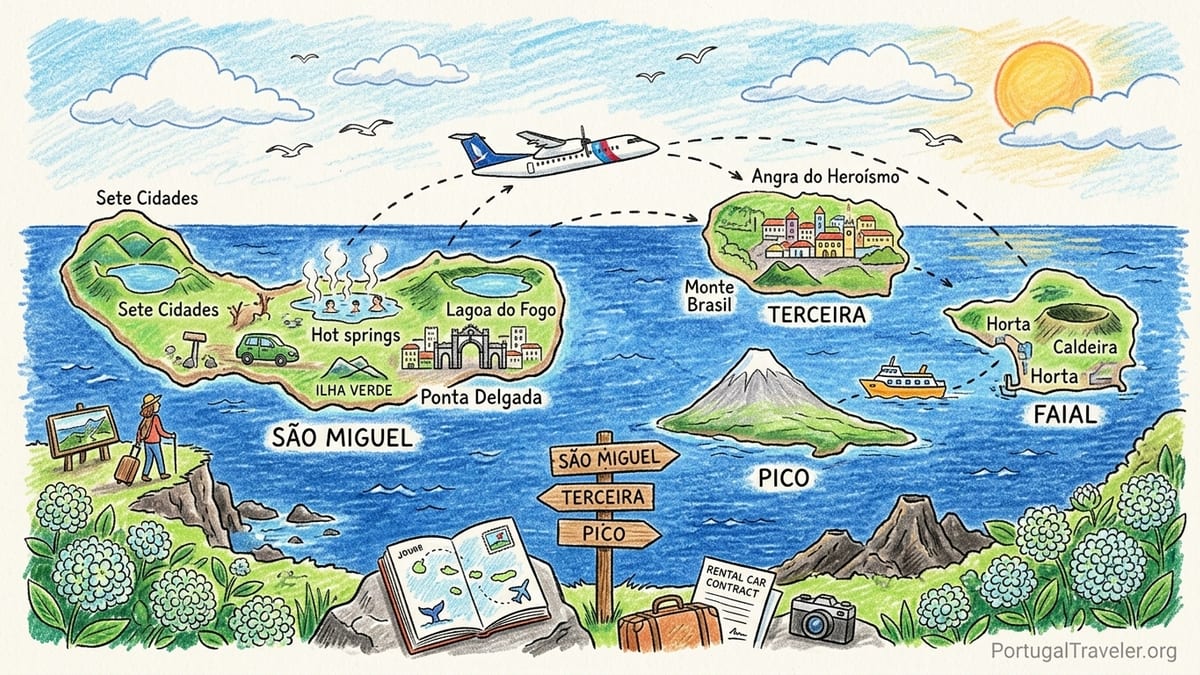
What I Tried On My First Azores Island-Hopping Trip
I built my original 11-day Azores trip around the idea that “two nights is enough” on most islands. I landed in Ponta Delgada on São Miguel, spent three nights there, then hopped to Terceira for two nights, Pico for two, Faial for two and squeezed in a one-night stop on Flores. On paper it looked balanced, with SATA Air Açores flights zigzagging me neatly across the archipelago. In practice, too many of those days were burned in transit.
Most inter-island flights in the Azores are short in the air, often 35 to 60 minutes between the main hubs like São Miguel, Terceira, Pico and Faial, operated by SATA Air Açores with Dash 8 aircraft. But by the time I returned a rental car, lined up at the small airport, waited through a weather delay and picked up another car on the next island, entire mornings vanished. On the day I flew from São Miguel to Terceira, my alarm went off at 6.00, I dropped the car at the airport by 7.15, and I did not check into my Terceira guesthouse until nearly 11.30. That pattern repeated on almost every transfer day.
Car rentals became another hidden time sink. I had booked separate cars on each island, because companies like Ilha Verde and Wayzor price rentals by island and most travelers treat each rental as a standalone booking. Web searches before my trip showed baseline daily prices around 30 to 40 euros outside the August peak, but the real cost was the hour spent in each pickup queue, inventory check and contract review. On Pico, a delayed flight meant four customers reached the counter at once. By the time my keys were in hand, I had lost the soft evening light I had hoped to use to explore the north coast.
My Flores detour exposed the brittleness of planning weather-dependent activities on the last possible day. I arrived on Flores in the afternoon with a canyoning tour booked for the following morning. Overnight, Atlantic clouds rolled in, and by 8.00 the operator messaged that water levels were marginal. We waited for an update, only to see the tour cancelled two hours later. My outbound flight was that same afternoon. Flores is one of the most dramatic islands in the archipelago, with long-distance trails and cliff-top viewpoints, but I left having seen mostly the road from the airport to Santa Cruz and back. One night there was not just rushed; it was almost pointless.
Why A Dense Flight Network Still Feels Exhausting
Looking at SATA’s published summer 2026 plan, the group advertises more than 800 weekly flights across domestic and inter-island routes, with Ponta Delgada functioning as a central hub. That is an impressively dense operation for a small archipelago, and it does mean you can theoretically hop between multiple islands in a single week. The problem is that flight frequency does not erase airport friction or the realities of weather in the mid-Atlantic.
All inter-island flights rely on relatively small aircraft and short runways, which makes schedules sensitive to wind, low cloud and rain. On my trip, one morning departure from Terceira to Pico slipped from 9.15 to almost 11.00 because low cloud sat on Pico’s runway. The official delay was under two hours, but it had a cascading effect. I arrived on Pico well past the daily car rental rush, meaning another 30 minutes in line, then missed the midday departure of a popular whale watching tour out of Lajes. The tour company kindly rebooked me for the next morning, but that in turn forced me to shuffle a planned hike and tasting visit to the vineyards.
The structure of inter-island routes also adds hidden transfers. Not all islands are connected directly, especially outside high summer. When I tried to reach Flores from Pico, the most workable option routed me back through São Miguel. My door-to-door travel time ended up around six hours, even though none of the individual flights was longer than an hour. Add rental car drop-off on Pico, pickup on Flores and brief waits at security and check-in, and I had effectively lost one full day of an 11-day trip to transit.
Finally, every transfer chips away at your sense of place. I underestimated how mentally tiring it would feel to learn a new road network, new trailhead locations and a different town layout every other day. On Terceira, I drove out to the lava tubes at Algar do Carvão and Gruta do Natal, enjoyed them and then realized I had only half a day left for Angra do Heroísmo’s UNESCO-listed center. Instead of wandering the streets at a relaxed pace, I skimmed the highlights, already thinking about the next morning’s flight and car procedures.
Minimum Nights I Would Now Give Each Type of Island
After that trip, I started to think of Azores islands less as a checklist of nine names and more as three broad categories in terms of how many nights I would personally commit. The exact island may change from traveler to traveler, but the logic holds: some islands concentrate activities in a small area, others reward long stays, and a few work best as day-trip satellites.
São Miguel, as the largest island with hot springs, crater lakes like Sete Cidades and Furnas, and the main international hub at Ponta Delgada, now gets a personal minimum of four nights for me, five if I plan several hikes. Three nights felt like a sampling platter: I managed a driving loop around Sete Cidades, an afternoon soaking in the thermal pools at Parque Terra Nostra and a quick visit to Lagoa do Fogo, but each day was rushed. Considering that average car rental prices on São Miguel in shoulder season often sit around 35 to 50 euros per day before fuel and that you will likely drive 100 to 150 kilometers on a full sightseeing day, those extra nights are not an extravagance so much as a way to make that fixed overhead worthwhile.
Medium-sized islands with a clear main town and a mix of cultural and outdoor activities, such as Terceira or Pico, have shifted to a baseline of three nights in my planning. On Terceira, three nights give space for at least one full day focused on Angra do Heroísmo’s streets, museums and viewpoints, another anchored by volcanic sights like Algar do Carvão, and a flexible third day for a coastal drive or whale watching. On Pico, three nights offer room for a vineyard day in the UNESCO-listed lava fields near Madalena, a dedicated day for whale watching or a summit attempt of Mount Pico if the weather cooperates, and a cushion day to absorb any ferry or tour rescheduling.
Smaller or more remote islands, especially those reached with limited direct flights, deserve a baseline of two nights if you go at all. In my current framework, islands like Flores or Santa Maria fall into this category. Two nights create one full day on the ground, which is the absolute minimum that feels responsible given the carbon cost of flying and the time cost of transfers. A one-night stop like I attempted on Flores is essentially a gamble against Atlantic weather. If your single day is fogged in or your inbound flight is late, your “visit” consists of airport and hotel transfers and little more.
Seven Days: Why Fewer Islands Usually Means a Better Trip
With only seven days in the Azores, my experience has convinced me that travelers should treat the week as a choice between depth on one island or a focused two-island combination, not an opportunity to touch three or four. A dense SATA schedule can make a three-island week look tempting, but each extra island adds the equivalent of at least half a lost day once you account for rental cars and airport time.
In practical terms, a seven-day plan that tries to include São Miguel, Terceira and Pico will end up with two or three mornings largely consumed by check-out, car return, short flights and new car pick-ups. If you budget 90 minutes for a small-airport check-in, around 45 minutes of flying on a route like Ponta Delgada to Terceira, and another 60 to 90 minutes dealing with baggage and rental cars on arrival, you have already used three to four hours of prime daylight. Repeating that cycle twice in a single week compresses your time on each island into one or one-and-a-half functional days.
By contrast, a seven-day trip split between São Miguel and one other island plays to the strengths of the network without letting logistics dominate. Arriving into Ponta Delgada and spending four nights on São Miguel gives you three full days plus two flexible half-days at the beginning and end. You can then add three nights on a second island that matches your interests, whether that is Terceira for culture or Pico for whales and wine. Even with a flight in between, you still preserve at least two full days on that second island, which is enough to form real memories instead of a blur of viewpoints and parking lots.
There is also a psychological benefit to a simpler week. In hindsight, the most relaxed day on my trip was not a dramatic hike or a canyoning descent; it was an unhurried morning coffee in Ponta Delgada, knowing I had no ferry to catch and no boarding time to watch. With seven days, you do yourself a favor by building in at least one of those lingering mornings on each island instead of packing transfers into every second day.
Ten Days: Added Flexibility, But Still Demanding Choices
With 10 days, it becomes realistic to visit three islands, but only if you keep a tight rein on the minimum nights per island. The temptation is to assume that three or four nights on São Miguel, plus two nights each on Terceira, Pico and Faial, will fit neatly into a longer trip. On my 11-day itinerary, which was only marginally longer, I learned how quickly that plan turns into an exhausting rotation of one- and two-night stays that leave little margin for fog, wind or tour cancellations.
A more sustainable way to use 10 days is to keep your core time anchored on one major island and then add two shorter stays elsewhere. For example, you might still give São Miguel five nights because of its larger network of roads, towns and hiking areas, then allocate three nights to Pico and two nights to Terceira. That structure retains my personal minimums of four nights for a main hub island and three for a medium-sized island, but compresses the third island to a two-night taster rather than pretending it will be a full exploration.
Within those 10 days, discipline around transfer timing becomes crucial. If you fly from São Miguel to Terceira on day six, count that as a partial day and avoid loading it with ambitious activities. Booking a lava cave tour on Terceira for the same afternoon as your flight, for instance, nearly backfired on me when a minor delay and slow car pickup left me rushing straight from the airport to the tour office in Praia da Vitória. Moving that tour to the following morning would have cost nothing and created breathing room.
The other trade-off at 10 days is whether to include a very remote island like Flores, which often requires a change of planes and functions almost as a separate chapter of your journey. If you slot Flores into a 10-day plan, logic suggests two nights at minimum, which in turn forces you to reduce time elsewhere. Looking back, I would only add Flores to a 10-day trip if I were willing to trim São Miguel to four nights and limit myself to just one other island in the central group, rather than attempting Flores on top of São Miguel, Terceira, Pico and Faial as I initially tried.
Fourteen Days: A True Multi-Island Journey Without Constant Transfers
Two full weeks in the Azores is where the inter-island network finally has space to breathe. With 14 days, it becomes possible to design an itinerary that includes four or even five islands without turning every second day into a travel day. The difference lies in respecting generous minimum stays and grouping islands to minimize backtracking.
If I were to rebuild my trip within a 14-day window, I would still start by giving São Miguel five nights. That may feel like a disproportionate share of the trip, but the combination of crater lakes, tea plantations, hot springs and coastal towns easily fills that time. It also buffers you against days when low cloud hides viewpoints like Lagoa do Fogo; with several days at your disposal, you can shuffle hikes and thermal baths according to the weather, instead of staring at a fogged-in crater on your single day there.
Next, I would target four nights in the central group around Pico and Faial, using the short ferry connection between Horta and Madalena to avoid extra flights and car rental contracts. Current ferry schedules usually list sailings of around 30 minutes between the two islands in summer, and taking your rental car on the ferry, where allowed by your contract, lets you explore landscapes on both islands with one vehicle. Four nights in this cluster, split perhaps as two nights on Pico and two on Faial, feel entirely different from the rushed one-day shuttle I attempted between them in the past.
That structure still leaves five nights within a 14-day plan for other islands. Here the choice is between depth and variety. One option is to invest three nights in Terceira for its UNESCO-listed Angra do Heroísmo and volcanic interiors, plus two nights in a remoter island such as Flores or Santa Maria. Another is to focus those five nights entirely on a single smaller island like São Jorge, known for its fajã coastal flats and long-distance trails, which rewards hikers with multiple weather windows and rest days. In either case, the guiding principle is to avoid any one-night stands and to group islands in ways that align with direct flights or short ferries.
The key is that with 14 days, you can plan no more than three genuine transfer days, leaving at least 11 full days on the ground. That ratio transforms the feel of the trip. Instead of worrying about printing boarding passes or confirming car rental pickups every other day, you settle into each island’s rhythm, notice small details like bakery rituals and neighborhood festas, and give yourself permission to have the occasional slow morning even when the forecast is perfect.
How I Now Decide Whether An Island Belongs On The Trip
When I sketch an Azores itinerary today, I start by listing the specific experiences I care about rather than the islands by name. Do I want to soak in multiple hot springs, attempt a major summit like Mount Pico, or walk long coastal trails through fajãs? Only once that list is clear do I map those experiences onto islands. São Miguel, for instance, becomes non-negotiable in any plan that prioritizes volcanic lakes and accessible hot springs. Pico rises on the list when I want whale watching and a serious hike. Flores enters the conversation only if wild, remote landscapes outrank everything else.
Then I cross-check that desire list against the reality of flights, ferries and my personal minimum nights. If a particular island requires a plane change in Ponta Delgada or Terceira, plus a separate car rental and at least two nights to feel worthwhile, I treat it as a significant investment of my time budget. That investment only makes sense if I am willing to reduce the number of other islands accordingly. It no longer feels sensible to layer Flores on top of an already ambitious circuit through São Miguel, Terceira, Pico and Faial. Instead, Flores becomes the centerpiece of a separate trip, perhaps paired with Corvo as a day excursion from Flores, and I save the central group trilogy for a different journey.
Another filter I use is seasonal crowding and cost. Rental car data from booking platforms suggests that August is by far the most expensive month for cars in the Azores, with average daily prices on some islands in that period climbing well above 70 euros when demand peaks. In that context, adding a fifth or sixth rental contract for brief stays is not just tiring but also expensive. Concentrating your time on fewer islands reduces the number of separate contracts and the number of days you pay high-season rates simply to drive from an airport to a hotel and back.
Finally, I ask whether I can handle the cumulative mental load of more than three different bases in a single trip. Each new island means new driving habits, parking rules and unspoken local rhythms. On my first itinerary, by the time I reached Faial I had passed through so many variations on roundabouts, town one-way systems and parking schemes that I felt more like a delivery driver than a traveler. Now, if I am already planning stays in three distinct locations, I only add a fourth if it offers something I truly cannot find elsewhere in the archipelago.
The Takeaway
The main lesson from my first Azores island-hopping trip is that more islands do not equal a better journey. SATA’s extensive 2026 inter-island schedule, with hundreds of weekly flights across the region, makes it tempting to hop constantly, but flights, car rentals and weather delays quietly erode your days. One-night stays in particular rarely deliver enough time to see or feel an island, especially when you factor in the risk of fog, rain or wind disrupting a tightly packed plan.
If you have seven days, think in terms of one major island plus a second, complementary one, and give yourself permission to stay four or five nights in a single place. At 10 days, three islands become realistic, but only if you respect meaningful minimums like four nights on São Miguel and three on any medium-sized island you care about, leaving only one island as a two-night taster. A 14-day trip opens the door to four or even five islands, but that freedom works best when you cluster them sensibly, use ferries where appropriate and still refuse to book single-night stops.
In practical planning terms, I now follow a simple island-count rule. For a week, I cap myself at two islands. For 10 days, I allow three. For 14 days, I rarely go beyond four, reserving a fifth only when I can connect two of them with a straightforward ferry or when one is a true day-trip satellite accessed from a longer base. Within that framework, I prioritize four to five nights on my main island, three nights on any secondary island with substantial activities, and at least two nights on smaller or remote islands that require a change of planes.
That revised strategy has a clear goal: to convert the Azores from a rushed checklist into a sequence of distinct, memorable stays. SATA’s 2026 inter-island operation remains a powerful tool for connecting the archipelago, but it is no substitute for unhurried mornings, flexible weather windows and evenings where your suitcase finally stays closed. The islands reward time far more than movement, and the smartest itineraries are the ones that protect that time as fiercely as any seat reservation.
FAQ
Q1. Is it realistic to visit three Azores islands in just seven days?
It is physically possible if you rely on SATA’s dense inter-island network, but it usually feels rushed. By the time you account for airport procedures, short flights and car rental logistics, each transfer can eat three to four hours of usable daylight. In a seven-day trip that might mean losing almost two full days to transit, leaving you with only one meaningful day per island. I recommend focusing on one main island and, at most, one additional island for a week-long trip.
Q2. How many nights should I plan on São Miguel if it is my main base?
Based on my own experience, four nights is an absolute minimum and five is more comfortable if you want to visit major sights like Sete Cidades, Furnas and Lagoa do Fogo without rushing. São Miguel has enough roads, viewpoints, hot springs and small towns to fill a full week, and the extra nights also give you flexibility to shuffle plans when crater lakes are fogged in or rain moves across the island.
Q3. Are one-night stays on remote islands ever a good idea?
In the Azores, one-night stays rarely pay off, especially on remote islands that rely on weather-sensitive flights. If your inbound flight is delayed or low cloud cancels a planned activity, your short visit can collapse into an airport transfer and a single rushed walk. I now treat two nights as the bare minimum on any island that requires a separate flight and rental car contract.
Q4. How much time do inter-island flights really take door to door?
Even though many flights are only 30 to 60 minutes in the air, you should expect the full transfer to take most of a morning or afternoon. Allow roughly 90 minutes for a small-airport check-in and security, add the short flight, then another 60 to 90 minutes to collect luggage, sign car rental paperwork and drive to your accommodation. It is safest to assume that any island change will consume at least three hours of useful travel time.
Q5. When does renting a car on each island become too complicated?
Car rentals are essential on most islands, but juggling four or five separate contracts in a short trip becomes tiring and can be expensive, especially in August when daily prices often exceed 70 euros on popular islands. A good rule is to limit yourself to two or three different rentals per trip, which usually aligns with visiting two or three islands. In the central group, you can sometimes take a car on the ferry between Pico and Faial, reducing the number of separate rentals you need.
Q6. Should I plan weather-dependent activities like whale watching for my last day on an island?
It is safer to schedule weather-dependent activities early in your stay so that you have time to rebook if wind, rain or swell forces a cancellation. On my trip, I booked canyoning and a whale watching tour for final mornings on different islands, and both plans nearly collapsed due to weather and flight delays. Now I try to place such activities within the first half of my time on each island and leave later days more flexible.
Q7. How do ferries fit into Azores itinerary planning?
Ferries, especially between Pico and Faial, can simplify itineraries when combined thoughtfully with flights. Crossing between Horta and Madalena generally takes around 30 minutes in summer and allows you to explore both islands as a single cluster, sometimes using one rental car if your contract permits. This approach reduces the number of separate check-ins, flights and car pickups compared with flying between each island individually.
Q8. Is it better to start or end on São Miguel?
Either approach can work, but starting on São Miguel often helps you adjust to the Azores at a manageable pace. As the main international gateway, Ponta Delgada offers the most accommodation and rental car options, making it easier to handle delays or baggage issues at the start of a trip. Ending there can also be useful if you want a final buffer night before an early transatlantic departure.
Q9. How many islands can I reasonably include in a 14-day trip?
With 14 days, most travelers can comfortably include four islands and sometimes a fifth if two of them are clustered and connected by short ferries. The essential condition is to respect meaningful minimum stays: about five nights on a main hub island like São Miguel, three nights on secondary islands, and at least two nights on more remote islands. If you try to squeeze in all nine islands in two weeks, the majority of your days will be consumed by transfers rather than experiences.
Q10. What simple rule can I use to avoid overpacking my Azores itinerary?
A practical guideline is to cap yourself at two islands for a seven-day trip, three islands for 10 days and four islands for 14 days, only exceeding those limits when you have very short ferry hops between clustered islands. Within that cap, enforce a personal minimum of four or five nights on your main island and avoid single-night stays altogether. This approach preserves travel flexibility and ensures you spend most of your time exploring rather than in transit.