


I spent just under two weeks driving the Algarve from east to west with a rental car, staying in a mix of towns and tiny beach villages. I booked most of it on cancelable rates, fully expecting to reshuffle my plans once I figured out which places actually felt worth my time. By the end of the trip, some hyped spots felt crowded and forgettable, while a few low-key villages, boardwalks, and surf beaches became the places I now recommend without hesitation. This is how I would allocate my own days on a second Algarve trip, based only on places I actually visited and stayed in, and on how they worked in real life as bases, stops, and overnights.
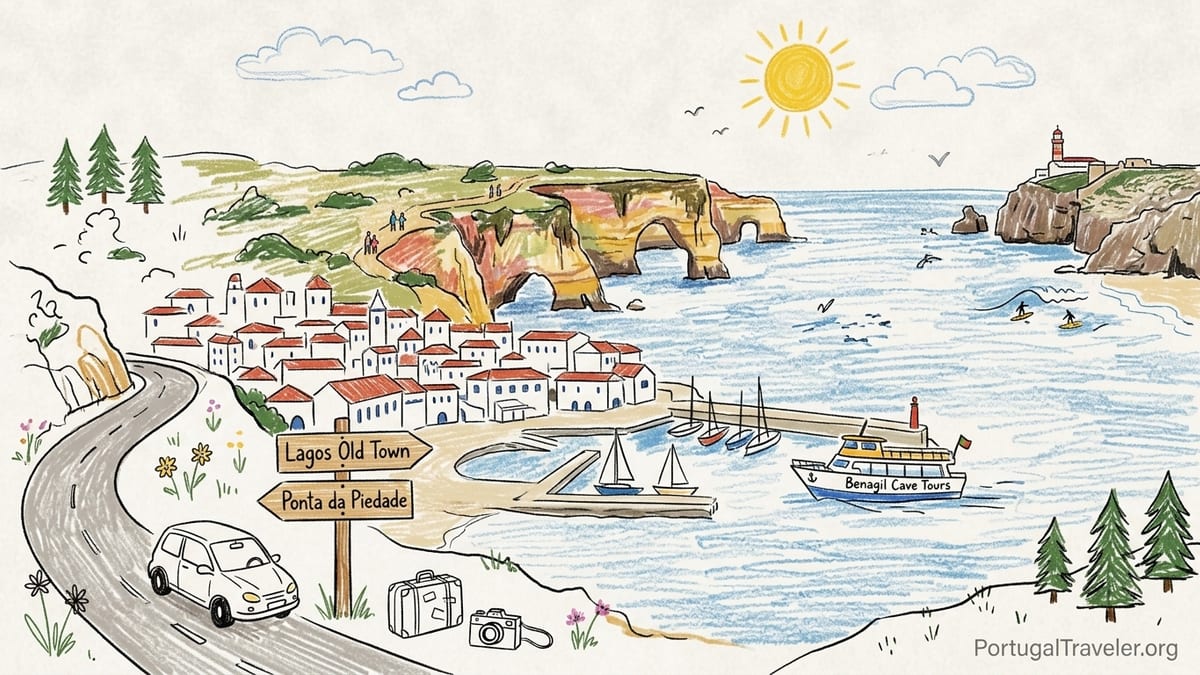
Lagos: My All‑Round Base, With Caveats
I spent four nights in Lagos, arriving in the late afternoon from Lisbon by car and using it as my main base for the western and central Algarve. For a first visit, this worked very well. Lagos gave me easy access to dramatic headlands like Ponta da Piedade, boat trips into sea caves, and a proper town where I could walk to dinner instead of driving every night. It felt busy but not out of control in late spring, and I never struggled to find an open restaurant or a bakery for an early coffee before day trips.
As a base, Lagos shines because you can reach Sagres in about an hour’s drive and still be back for dinner, or head east to Portimão, Ferragudo, and the Carvoeiro coastline without changing hotels. Several operators in town run half‑day boat trips to the Benagil caves and the cliffs around Praia da Marinha, typically priced around 40 to 60 euros per adult depending on the season and vessel type, which meant I did not have to move my luggage just to see that stretch of coast. Boat stalls cluster around the marina and along Avenida dos Descobrimentos, so it was easy to compare departure times in person.
Lagos was not perfect. Parking close to the walled old town turned into the most frustrating part of my days. Street spaces near the historic center are a mix of free and blue‑zone paid areas, with pay‑and‑display meters that usually run from roughly 9:00 to 19:00 on weekdays. In peak afternoon hours I often had to circle toward the marina side or park a 10 to 15 minute walk from the center. After 20:00 it became easier, and by 22:00 many locals had driven home, leaving more space. If you are staying in high season and can afford it, I would look for accommodation with on‑site parking or at least a reserved space in a nearby garage.
Once day‑trippers left, Lagos changed character. The narrow streets around Praça Luís de Camões and Rua 25 de Abril were still lively but less chaotic, and it was finally possible to get a table on a terrace without a wait. I liked evenings best in the back streets just outside the densest bar cluster, where I could find Portuguese seafood spots and wine bars without blaring music. On a second Algarve trip, I would still keep Lagos as my western base, but three nights instead of four would be enough. I would use the “extra” night in a quieter village nearby to balance things out.
Carvoeiro and the Seven Hanging Valleys: Cliff Drama, Crowds Included
I gave Carvoeiro only a single afternoon on my first itinerary, which turned out to be a mistake. I parked above the little town, in a signed public lot near the boardwalk, paid a couple of euros at the meter for the remaining daylight hours, and walked down toward the whitewashed houses and the small central beach. For a place sometimes dismissed as too resort‑oriented, it felt more intimate than I expected, especially compared with larger resort strips elsewhere on the Algarve coast.
The main reason I came, though, was not the town itself but the cliffs between Carvoeiro and Praia da Marinha. The wooden Carvoeiro boardwalk begins above town and winds along the cliffs toward the famous Algar Seco rock formations. Farther east, the Seven Hanging Valleys Trail connects Praia da Marinha with Praia de Vale Centeanes, hugging a coastline of limestone arches, sea stacks, and hidden coves such as Praia da Corredoura. Official descriptions and local signage describe it as a moderately challenging route of roughly six kilometers one way, and that matched my experience: plenty of exposed sections, some steep staircases, and constant distractions from the scenery.
In mid‑morning the parking at Praia da Marinha was already close to full, with rental cars jostling for any remaining spot along the access road. This is one of the beaches that regularly appears in international “best beaches” roundups, and it shows. After 10:30 it felt almost like a procession along the clifftop path, with guided groups and independent walkers sharing a relatively narrow trail. Boat trips from Portimão and Carvoeiro also converge on the area, taking visitors beneath the natural arches and past the entrance to the Benagil cave. Typical two‑hour coastal cruises covering Benagil and Marinha currently run in the region of 30 to 45 euros per person from nearby ports, depending on group size and whether it is a simple RIB tour or a larger catamaran.
The experience shifted completely after 17:00, when most buses and day‑trip boats had already come and gone. The car park slowly emptied, the noise dropped, and there were sections of the trail where I saw only a handful of other people. Golden‑hour light brings out the warm tones in the cliffs and makes this stretch of the Algarve feel closer to a national park than to a sun‑lounger resort. In hindsight, I would spend at least one full day and a night in or near Carvoeiro. It works well as a two‑night base for hikers and photographers, and I regret not giving myself an early‑morning start directly on the trail without having to drive in first.
Sagres and the Wild West: Where I Finally Slowed Down
I set aside two nights in Sagres, almost as an afterthought at the end of my route. The town is often described as a sleepy surf outpost at the end of the road, and that is accurate. It sits close to the south‑western tip of mainland Europe, surrounded by the protected landscapes of the Costa Vicentina. I arrived from Lagos along the N125, turned off toward the fortress, and found free parking in dusty pull‑offs near Praia da Mareta with no problem at all. After Lagos, the absence of parking meters felt like a small luxury.
Surf culture shapes the rhythm of Sagres. Several established surf schools operate in town and on nearby beaches, including Freeride and other local operators that shuttle students to beaches such as Praia do Tonel and Praia do Beliche when conditions are suitable. Independent reviews and booking platforms list typical group lesson prices in the range of 50 to 80 euros for a multi‑hour session with equipment included, which is consistent with what I saw advertised on sandwich boards in town. On days when the swell on the west coast was too heavy, schools rerouted to more sheltered spots near Sagres or toward Praia do Amado farther north, which underlined how flexible the local surf scene is.
I drove out to Cabo de São Vicente for sunset on both evenings. The small parking area near the lighthouse filled up about 30 minutes before sunset, but drivers simply lined the roadside leading in, and there was still space if you arrived a bit later and did not mind a short walk. Vendors selling snacks and wool sweaters added a slightly touristy layer to what is otherwise a very stark piece of coastline. What I remember most, however, is the feeling when the tour buses left. Sagres town itself quieted down around 22:00, with just a few bars and casual restaurants staying open. Walking back to my guesthouse under a clear, dark sky, I could hear the ocean in the distance, which did not happen in any of the larger towns.
Two nights felt about right in Sagres, but I could easily stretch to three if I were surfing or hiking more. It is a better base than I expected for exploring the western beaches of the Costa Vicentina, from Praia do Amado to Praia da Bordeira, because the roads are uncongested and the scenery on even routine drives is beautiful. On a repeat trip, I would keep Sagres in the plan and maybe shift one night from Lagos to stay longer here, especially if I were visiting in peak summer and wanted to escape the densest crowds.
Praia do Amado and the Costa Vicentina: Surf Beach That Earned an Overnight
On my first pass through the western Algarve I treated Praia do Amado as a simple day stop. I drove up from Sagres in about half an hour, following signs toward Carrapateira and then out to the coast. The final section is a paved road that ends at a clifftop parking area positioned just above the sand. Even on a sunny weekend the main car park had space by mid‑morning, with a few camper vans and surf school vans already in place. A short path leads down to the beach, where wooden huts house surf schools and simple snack bars.
Praia do Amado is widely known in regional guides as one of the Algarve’s flagship surf beaches, with consistent beach breaks, a sandy bottom, and schools geared toward beginners and intermediates. Local surf school listings show half‑day group lessons starting from about 45 to 50 euros per person, which typically include board, wetsuit, and transport from nearby villages such as Carrapateira or Sagres. Standing on the sand and watching line after line of whitewater roll in, it was easy to see why. The beach is long enough that even when there are multiple groups in the water, there is room to spread out.
What surprised me was how wild the surrounding coastline felt. Wooden walkways connect viewpoints along the headlands above Praia do Amado and neighboring Praia da Bordeira, giving you wide views over dunes, cliffs, and a piece of the Atlantic that feels much rougher than the sheltered bays around Lagos. After about 16:00, surf school activity tapered off, day‑trippers started to drift away, and by early evening the car park was nearly empty apart from a handful of vans and people lingering for sunset. The beach turned quiet enough that the loudest sound was simply the surf itself.
Looking back, I wish I had booked at least one night in nearby Carrapateira instead of treating Amado as a side trip. The village has a handful of guesthouses and restaurants, and staying there would have allowed a sunrise walk on Praia da Bordeira and an unhurried evening over seafood rather than a sunset drive back to Sagres. On a future itinerary I would carve out one or two nights here for a very different Algarve experience centered on surf, nature, and early nights.
Tavira and the Eastern Algarve: Understated and Better Overnight
I originally slotted Tavira in as a day trip from Faro, which turned out to undersell it. I arrived by regional train, stepping off directly into a compact town of tiled facades, churches, and a slow river spanned by the pedestrian bridge. Tavira has been gaining more attention in recent years as the eastern Algarve’s quieter answer to the resort towns, yet it still felt grounded in local life when I visited in shoulder season. The pace was noticeably slower than in Lagos or Carvoeiro, and the restaurant mix leaned more toward simple seafood and Portuguese dishes than international menus.
From the town center, small ferries and water taxis connect Tavira with the long barrier island beaches of the Ria Formosa Natural Park. In high season, public ferries run frequent services to Ilha de Tavira, with return tickets that are generally under 10 euros per person. The crossing is short but transports you to a very different landscape of sandbanks and low dunes, with sunbed concessions near the main arrival point and emptier stretches if you are willing to walk. During my visit outside of peak months, the beach never felt crowded, and a short walk eastward was enough to find quiet patches of sand.
I spent part of the afternoon wandering Tavira’s back streets and climbing up toward the ruined castle for views over the terracotta roofs. By early evening, day‑trippers were heading back toward Faro, and the town settled into an almost village‑like calm. Restaurant staff had time to chat about the daily fish deliveries, and the main square along the river filled with residents on their evening stroll. It was at that point that I regretted not having luggage with me. Tavira would have made an excellent two‑night base for exploring the eastern Algarve and the Ria Formosa by boat.
Next time, I would swap one of my nights in Faro for an overnight stay in Tavira. The town’s walkability, island access, and quieter evenings make it one of the better choices for travelers who want atmosphere and good food without nightclub noise. It also works without a car, thanks to the regional rail line that connects Tavira with both Faro and Vila Real de Santo António along the Spanish border.
Faro and Albufeira: Useful Gateways, Mixed Impressions
Faro was my arrival point for the Algarve, thanks to its busy international airport and the convenience of picking up a rental car there. I stayed one night in the city on the way in and passed through again before flying out. The historic old town enclosed by medieval walls and facing the Ria Formosa lagoon is genuinely atmospheric, with cobbled streets, a cathedral, and squares that feel more lived‑in than curated. I enjoyed an evening walk and a seafood dinner overlooking the marina, and it was pleasant to be able to return the rental car and continue on foot.
As a base, though, Faro made less sense for the kind of trip I was taking. The city has easier public transport connections than many Algarve towns, with regional trains and buses fanning out along the coast, but the beaches sit on barrier islands reached by short boat crossings or, in some cases, by causeways. That means a bit more logistical effort if you want a spontaneous swim. For travelers flying in late or leaving early, a single night in Faro is practical. On a dedicated beach holiday, however, I would head onward quickly to a coastal town.
Albufeira provoked the most mixed feelings of my entire itinerary. I visited for an afternoon and evening out of curiosity, parking in a multistory garage uphill from the old town to avoid the denser tangle of streets closer to the beach. Payment there was straightforward, with ticket machines that accepted both coins and cards. From the moment I emerged into the main strip, it was clear that Albufeira is one of the Algarve’s loudest and most nightlife‑oriented resorts, which matches its reputation as a party hub within the region.
The central beach, flanked by cliffs and densely built apartments and hotels, is objectively attractive. The problem is that the density of bars, clubs, and aggressive drink promotions in the adjacent streets changes the mood. Even outside the absolute peak of summer, the bar district was already rowdy by early evening, and restaurant touts were actively trying to pull people into their venues. If your idea of a successful Algarve trip includes late‑night clubs and karaoke, this may be the right fit. For me, it felt like a place to see once rather than somewhere to sleep. I was glad I had kept my accommodation in Lagos and only given Albufeira a few hours.
How I Would Reallocate My Time Next Trip
Looking back at the pattern of my days, my original allocation was four nights in Lagos, one night in Faro, two in Sagres, and the rest scattered in central Algarve towns with short stops at Carvoeiro, Tavira, and Praia do Amado. It worked, but it was optimized more for avoiding hotel changes than for maximizing the best experiences. The moments that stayed with me were almost all either on cliffs, in small villages, or in towns that felt like themselves even after the tour buses had left.
If I were planning the same length of trip again, I would cut my time in larger hubs slightly and redirect nights to places that came alive in the mornings and evenings. Lagos would drop from four nights to three, keeping it as an all‑round base for boat trips, restaurants, and access to the western coast. Faro would become a pure gateway, either with a late arrival and immediate transfer to another town, or just a single night on arrival or departure.
Those “saved” nights would go to Tavira, Carvoeiro, and the Costa Vicentina. Tavira would get at least two nights to allow a full beach day on Ilha de Tavira plus time to explore the town at a relaxed pace. Carvoeiro and the Seven Hanging Valleys area would earn a proper overnight so I could walk the trail at sunrise and linger at Algar Seco without watching the clock on paid parking. Finally, I would add one or two nights in or near Carrapateira for Praia do Amado and Praia da Bordeira, making surf, walks, and quiet evenings the center of that part of the itinerary.
The only place I would not add time is Albufeira, despite its convenient position roughly in the middle of the coast. I would keep it as a possible afternoon stop, if at all, rather than an overnight base. The Algarve is compact enough that, with a car, you can reach most of these destinations within one to two hours from whichever base you choose. Using that flexibility to bias your overnights toward the places that feel most “Algarve” to you, whether that means surf and cliffs or seafood and tiled streets, makes all the difference.
FAQ
Q1. Is it better to have a rental car in the Algarve or rely on trains and buses?
For the itinerary I describe, a rental car made a big difference, especially for reaching Sagres, Praia do Amado, and the cliff walks near Carvoeiro where public transport is limited. Trains and buses work well between larger towns like Faro, Lagos, and Tavira, but getting to trailheads and some beaches without a car can add long walks or taxi rides.
Q2. How difficult is parking in popular Algarve towns like Lagos and Carvoeiro?
Parking in central Lagos can be stressful in the middle of the day, with a mix of paid blue‑zone streets and free areas that fill up quickly. Carvoeiro and Praia da Marinha have dedicated lots, but these also get busy by late morning. I found that arriving before 9:30 or after 17:00 usually meant a much easier parking experience in all of these places.
Q3. When do the cliff walks such as the Seven Hanging Valleys Trail feel most crowded?
On my visit, the busiest period was roughly from 10:30 to 15:30, when tour buses, guided groups, and self‑drive visitors all converged. Early mornings and the last two hours before sunset were far quieter. If you want to photograph arches and sea stacks without many people in the frame, those shoulder times help a lot.
Q4. Is Sagres worth staying overnight or just as a day trip from Lagos?
After two nights in Sagres, I was glad I did not limit it to a day trip. The town is quiet but atmospheric in the evenings, and staying there allowed unhurried visits to Cabo de São Vicente and nearby surf beaches. You can technically see the main sights in a long day from Lagos, but you lose the slower, end‑of‑the‑road feeling that makes Sagres special.
Q5. How expensive are surf lessons on the Algarve’s west coast beaches?
Prices vary slightly by school and season, but recent listings for group lessons around Sagres and Praia do Amado typically fall between about 45 and 80 euros per person for a multi‑hour session including board and wetsuit. Packages for several days often reduce the daily cost a little, while private lessons cost more.
Q6. Which town is best for a quieter stay with good food and some local character?
If you prefer quieter evenings and a more local feel, Tavira and smaller villages near the Costa Vicentina suited me better than the big resort strips. Tavira combines tiled streets, island beaches, and relaxed restaurants, while places around Carrapateira and Sagres offer simple seafood spots and early nights after days outside.
Q7. Is Albufeira a good base if I am not interested in nightlife?
Based on my visit, Albufeira is heavily oriented toward bars, clubs, and a louder party scene, especially around the main strip behind the beach. If nightlife is not a priority, I would suggest basing in Lagos, Tavira, or Carvoeiro instead and treating Albufeira, if at all, as a short side visit.
Q8. Can I enjoy the Algarve without visiting the famous Benagil cave?
The Benagil cave is spectacular from a boat, but it is far from the only coastal highlight. Walking the Seven Hanging Valleys Trail, exploring Ponta da Piedade near Lagos, and watching sunset at Cabo de São Vicente were just as memorable for me. If boat tours are not your thing, you will still have plenty of scenic experiences.
Q9. How many nights should I spend in Lagos on a first Algarve trip?
I spent four nights and felt that three would have been enough, especially with a car. That allows you to explore Ponta da Piedade, take a cave or coastline boat trip, and do at least one day trip to Sagres or the central Algarve while still enjoying evenings in town.
Q10. What is the best way to balance east and west Algarve in one trip?
On a trip of around ten days, I would divide time between one western base such as Lagos or Sagres and one eastern base such as Tavira, adding short stays in Carvoeiro or the Costa Vicentina. That split lets you experience surf beaches, dramatic cliffs, and the quieter Ria Formosa side without changing hotels every night.