


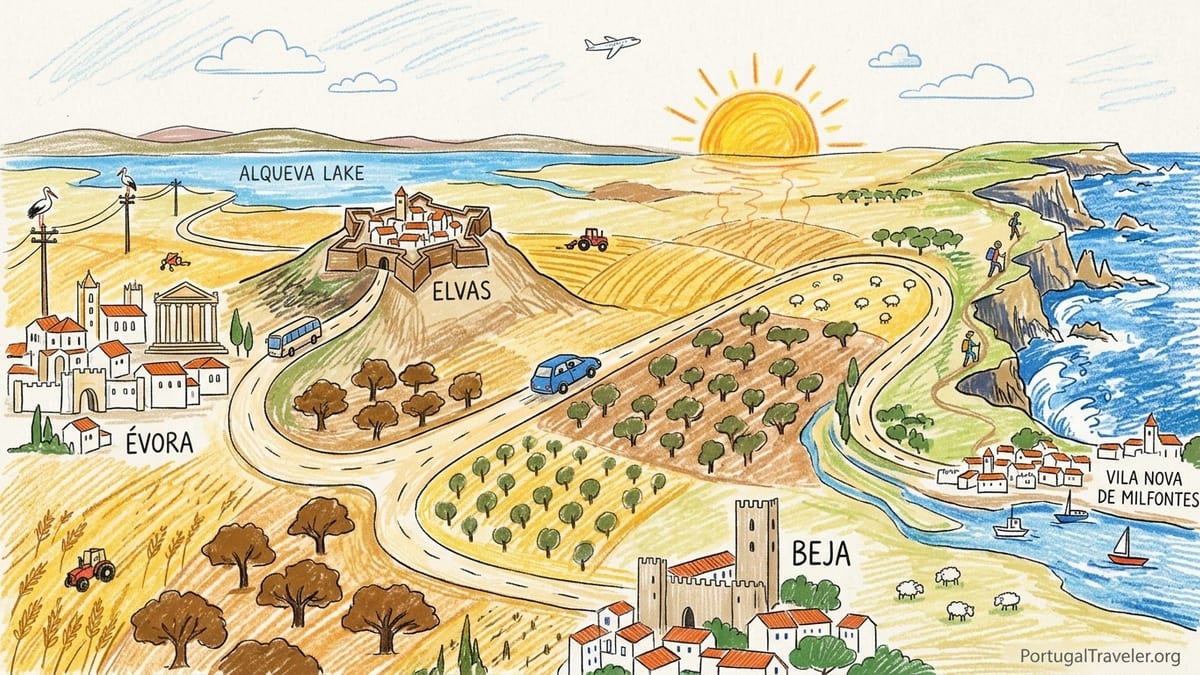
I crossed Alentejo from the Spanish border to the Atlantic coast in a slow, looping road trip that took nine nights, three bases and around 900 kilometers of driving. I entered from Spain at the Caia border near Badajoz, picked up a rental car on the Portuguese side, and then moved in stages: two nights in Elvas, three in Évora with a side trip to Monsaraz and the Alqueva reservoir, two in Beja on the southern plains, and finally two nights near Vila Nova de Milfontes on the Atlantic. I had expected easy hops between villages, lazy lunches and a vague sense of “rural Portugal.” What I found instead was vastness, emptiness on the roads, distances that felt longer than the map suggested, and a region that changed character every time I thought I had understood it.
How I Planned the Route and Why Alentejo Feels Bigger Than the Map
My rough plan looked simple on paper. From Lisbon, I took a bus east to Elvas, then picked up a car to drive back across Alentejo toward the ocean. The idea was to sweep inland first, following the A6 motorway and IP2 spine roads, then drift south to Beja and finally out to the Atlantic. The scale did not worry me: in pure distance, Elvas to Évora is about 80 kilometers, Évora to Beja roughly 80 to 90, and Beja to Vila Nova de Milfontes around 90 to 100 depending on the route. Measured in time and heat, though, those short numbers stretch.
I chose Elvas, Évora and Vila Nova de Milfontes as bases partly because they sit close to major roads. Elvas and Évora both hug the A6 motorway that links Lisbon to Spain, with a junction near Évora connecting to the IP2, while Beja lies on the IP2 further south. Official tourism maps and road authorities describe this as the main north–south axis of inner Alentejo, and you really feel that: once you leave the motorway, long ruler-straight sections of IP2 cut across wheat fields and cork forests with very few villages and almost no shade. On a temperate day that feels liberating. In August heat, with the air at around the mid 30s Celsius in the afternoon according to recent regional weather summaries, it starts to feel serious.
Before the trip I had considered doing Alentejo fully by public transport. In practice, although Rede Expressos and Rodoviária do Alentejo run buses between key towns like Elvas, Évora and Beja, frequencies drop sharply as soon as you want to veer off toward reservoirs, small hill villages or the wilder parts of the coast. There are trains to Évora and Beja from other parts of Portugal, but regional reports and even local conversations in Beja confirmed that services can be limited or disrupted. In the end I kept public transport for the approach and relied on the rental car for the interior, which proved the right call for this kind of looping itinerary.
The biggest surprise in planning was how quickly “let’s just add that village” turned each day into a 200 kilometer triangle. Alentejo’s plains lull you into underestimating distance, but once you factor in heat, two or three sightseeing stops, a long lunch and slower speeds on national roads without shade, you understand why many local itineraries suggest no more than two major stops per day.
From Walled Border to Marble Towns: Entering Via Elvas
Crossing into Portugal at Caia, the first stretch of the A6 toward Elvas felt almost overbuilt for the trickle of traffic. Tolls apply on this motorway, but the handful of cars and trucks at mid-morning made it feel like a private road. The climb to Elvas is short yet dramatic. The town sits behind thick star-shaped walls on a hill above almost empty fields, a defensive posture that makes sense as soon as you see how exposed the surrounding land is.
I spent two nights inside those walls in a small guesthouse near the main square. Parking was the first lesson. Free spaces exist along the inner streets but many are reserved for residents, and the cobbled ramps up to the gates are steep. I ended up leaving the car in an unsigned gravel lot just outside the walls, where two other rentals with Spanish plates were already parked. It was a five-minute walk uphill into the old town, just enough to make me plan my outings in clumps rather than popping back to the car in the afternoon heat.
Elvas was my first taste of how evenings in Alentejo change once day-trippers go home. Buses from Badajoz and Lisboa arrive and leave in pulses at the small station outside the walls, so the middle of the day can feel unexpectedly busy. After sunset, though, the town emptied to a quiet that felt disproportionate to its size. Dinner at a simple tasca near the aqueduct started at 8:30 p.m., which was practically early by local standards, and I did not see many other visitors until dessert. It was my first hint that traveling here is as much about syncing with the daily rhythm as it is about ticking off monuments.
What surprised me most in Elvas was the contrast between the monumental scale of the fortifications and how quickly you run out of things to do inside them if you expect big-city variety. I could have visited a couple of extra small museums, but by mid-afternoon the steep alleys and reflective white walls turned the old town into an oven. On a second trip, I would still enter via Elvas for its history and views, but I would limit myself to one night and arrive in the late afternoon, exploring mostly in the cooler evening and early morning.
Évora as a Base: Distances, Day Trips and the Reality of Summer Heat
The drive from Elvas to Évora along the A6 takes about an hour, but it feels longer because the scenery flattens out and the road seems to float above endless fields. I stopped at one of the service areas near Vendas Novas to refuel, partly out of caution. Petrol stations become noticeably rarer once you venture off the motorway onto the IP2 and smaller national roads, and I did not want to watch the gauge sink while crossing a 30 kilometer stretch of sunburned nothing. Fuel prices along the motorway were a bit higher than in town, but when you are 40 minutes from the next sizable place it feels worth paying the difference.
Évora is the natural base for central Alentejo for good reason. The town sits at the junction of A6, IP2 and the N18, is served by regional buses and trains, and has a compact historic core that you can cross on foot in fifteen minutes. I stayed just outside the old walls, off a roundabout on the IP2, in a small hotel with on-site parking. That choice saved me a lot of stress. Inside the walls streets quickly become a maze of one-way alleys and limited-resident zones, and I watched more than one rental car circle the outer ring in visible confusion.
I gave Évora three nights, which felt about right as a hub, but I underestimated how much the summer heat would shape my days. Afternoon temperatures hovered in the low to mid 30s Celsius and the polished cobbles of the central streets reflected heat upward. My routine quickly adapted: early morning wanderings through the Roman temple area and aqueduct, a long coffee in the shade, then retreat to the hotel or a cool café between 1 p.m. and 4 p.m. Only after 5 p.m. did I consider getting back into the car for outings, by which time day-trippers from Lisbon had started to leave.
The most illustrative day trip was the loop to Monsaraz and the Alqueva reservoir. From Évora I took the IP2 south for a short stretch, then turned onto the EN256 toward Reguengos de Monsaraz. The full distance to the village of Monsaraz is around 55 to 60 kilometers and takes about an hour. On the map it looked trivial. In reality, late afternoon haze softened the horizon so much that the road felt endless. There are long sections without any villages or fuel, and the first glimpse of Monsaraz, perched on its hill with the blue sheet of the Alqueva lake behind, came as an almost shocking interruption of flatness.
Parking below the walled village was easy in late September. A small free gravel lot sat just outside the gate, a five-minute climb from the main street. Locals told me that in peak August, especially on weekends, space becomes tighter and some cars end up nudging onto verges further down the slope. Monsaraz emptied dramatically after sunset. Tour groups and day visitors disappeared with the last light over the lake, leaving perhaps a dozen of us wandering the silent cobbled streets. It was magical, but after a simple dinner in one of the small restaurants, I faced the 60 kilometer dark drive back to Évora. On a return visit I would stay one night out here instead of forcing it as a day trip. Combining Monsaraz, lake swimming and winery stops from Évora in a single day is possible, but you spend as much time on the road as you do enjoying the places.
North and South of Évora: Hill Towns, Empty Roads and Underestimated Detours
From Évora I did one exploratory run north toward the hillier edge of Alentejo. Instead of sticking to the motorway, I followed smaller national roads in the direction of Estremoz and the marble towns. Distances remained modest, around 45 kilometers to Estremoz, but the character changed. The flat fields of central Alentejo began to tilt, and isolated farmhouses gave way to low ridges patched with olive groves and stone walls. Traffic almost vanished. Over one 20 kilometer stretch I passed only a tractor and a single truck.
The emptiness sounds romantic until you realize how alone you are if something goes wrong. Mobile signal flickered in some dips, and there were long periods without any obvious place to pull over for shade. I started to plan water and rest stops around the handful of named villages that appeared on both the road signs and my map, rather than trusting that “something will show up.” One minor disappointment here was that I could not easily link three or four hill villages in a meaningful loop without retracing my steps. The road network is practical rather than scenic, built to connect fields and market towns instead of feeding a tourist circuit.
Heading south from Évora toward Beja, I followed the IP2 for most of the way. This road has a reputation locally as both essential and frustrating. Much of it is single carriageway, straight and fast, but it also funnels heavy vehicles, and some older sections pass directly through small towns. A recently improved stretch skirts Évora more efficiently, yet you still need to watch for sudden speed limit drops as you approach villages. The roughly 80 to 90 kilometer drive to Beja took around an hour and a half, slowed not by traffic but by my own caution.
One thing I consistently underestimated in this central belt was the time cost of “quick detours.” A winery sign ten kilometers off the main road seemed irresistible until I realized that ten kilometers each way on a narrow unshaded lane added forty minutes and significant fatigue to the day. By the time I reached Beja in late afternoon, I felt as if I had driven much farther than the odometer suggested. On a second trip I would cluster detours by day instead of sprinkling them on the main transit legs.
The Southern Plains Around Beja: Slower Days and Subtle Shifts
Beja at first felt like a smaller, quieter cousin of Évora, sitting on a modest rise surrounded by golden fields. The approach on the IP2 again involved long straight segments with only occasional service stations. Local travel information boards and the municipal website list a network of regional buses run by Rodoviária do Alentejo and partners, connecting Beja with Évora, Ferreira do Alentejo and other towns, but the schedules I checked showed only a handful of services per day. Arriving with my own car meant I did not have to shape my time around these limited departures and arrivals.
I stayed two nights in Beja near the historic center. Street parking here proved easier than in Évora or Elvas. I often left the car in a free spot near the castle and walked ten minutes back to my guesthouse along quiet streets. Evenings had an almost small-town stillness. After 10 p.m. most of the cafés around the main square were either closed or winding down, especially on weeknights, and the white buildings held onto the day’s heat well into the night. Afternoons were again dictated by temperature. Between roughly 2 p.m. and 5 p.m. shade was at a premium in the open squares, so I learned to retreat indoors or to the small municipal garden.
From Beja, I considered a southward push toward the Castro Verde mining area and on to the Algarve, but ultimately decided against it. The landscape here flattens back out into cereal fields and low scrub, and the distances between points of interest start to increase again. Instead, I used one full day just for Beja itself and the nearby countryside. This slower pace let me notice subtler aspects of Alentejo life that had blurred earlier between windshield and horizon: farmers hauling equipment home on backroads at dusk, storks building improbable nests on power poles, the way local restaurants shifted their menus slightly later in the season toward stews and heavier dishes.
My main regret about Beja was that I had not scheduled it earlier in the trip, when I still had more energy for slow observation. Coming after long days out of Évora, it became more of a rest stop, which undersold its quiet charm. If I were to reorganize the route, I would probably travel Lisbon to Beja first by bus, pick up a rental there, and then work my way north, saving the busier Évora and the dramatic coast for later.
Reaching the Atlantic: The Rugged Coast Near Vila Nova de Milfontes
The final leg from Beja to the Atlantic felt like a reward I had been driving toward for days. I set out mid-morning, again refueling in Beja before leaving because the southern plains offer few large service stations. The route I chose angled southwest through rolling countryside before meeting the main coastal corridor that runs roughly parallel to the sea. Distances here are similar to the inland jumps, with around 90 to 100 kilometers to Vila Nova de Milfontes, but the psychology flips. As the land folds slightly and the air turns saltier, the sense of vast empty plain is replaced by a patchwork of small farms, pine groves and glimpses of dunes.
Vila Nova de Milfontes sits inside the Southwest Alentejo and Vicentine Coast Natural Park, a long protected strip that encompasses cliffs, surf beaches and river mouths. After days in interior towns that more or less emptied after dark, arriving here in the shoulder season felt almost crowded. Parking near the center and riverfront was competitive by late afternoon. I usually circled once or twice before slipping into a space on a residential side street, where informal etiquette seemed to allow fairly tight bumper-to-bumper lines. During the core of summer, local guides warn that parking closer to the main beaches becomes difficult unless you arrive early in the day or stay within walking distance.
I gave the coast only two nights, which was my biggest miscalculation of the whole trip. The walking paths along the cliffs, sections of the celebrated coastal trail, deserve at least a full uninterrupted day. I tried to combine short hikes with beach time and small-town exploring between Vila Nova de Milfontes and nearby Zambujeira do Mar and found myself forever checking the clock. Public transport exists along this stretch, including seasonal free summer buses in the municipality of Odemira that link towns like Odemira, Vila Nova de Milfontes, Almograve and Zambujeira do Mar in July and August, but outside peak months, services thin out to a few daily or weekly runs. Having a car gave me freedom to hop between viewpoints and villages, yet it also meant constantly hunting for parking and resisting the temptation to over-schedule stops.
Evenings on the coast contrasted sharply with inland nights. After the day’s heat bled off over the ocean and the light faded around 8 p.m., the promenades filled with families, surfers and hikers comparing trail days over grilled fish. Restaurants worked on a later rhythm, many not even opening their kitchens until 7:30 or 8:00 p.m. The coolness and sound of waves made it easy to linger, and for the first time on the trip I found myself staying out until midnight without noticing the time. It felt like a different region, even though the drive back to Beja would have been little more than ninety minutes.
Driving, Public Transport and Practical Lessons I Learned the Hard Way
After nine nights and hundreds of kilometers behind the wheel, a few practical patterns stood out. The first is that Alentejo rewards conservative planning. Distances between main towns seem short by European standards, yet the combination of summer heat, mostly single carriageway roads and limited shade multiplies the effort of each kilometer. I learned to plan at most two major moves between towns on any driving day and to avoid stacking multiple “quick” side trips on top of a transfer leg.
Fuel and rest stops deserve deliberate thought. On the A6 and other main toll roads, full-service areas appear regularly, often with fuel, food and shaded parking. Once you turn off toward places like Reguengos de Monsaraz, Beja or the smaller coastal villages, services thin out. On the run from Évora to Monsaraz, for example, there was no large petrol station until Reguengos itself, where I gratefully topped up even though the gauge still showed a quarter tank. I started treating any medium-sized town with a visible fuel sign as an opportunity, not something to postpone until later.
Parking varied from “free and abundant” in inland towns to “mildly stressful” on the coast and in the most compact historic centers. Évora and Elvas both made me glad I had chosen accommodations just outside the walls, within easy walking distance but beyond the worst of the one-way alleys and resident-only zones. In Beja I could leave the car on quiet streets without time limits. On the coast, I had to budget an extra fifteen minutes at each new beach or village simply to find a legal space that did not involve awkward maneuvers on steep lanes.
Public transport across Alentejo works well if you accept its logic. Buses run reliably on main corridors such as Elvas–Évora–Beja and link coastal hubs like Vila Nova de Milfontes and Zambujeira do Mar, but timetables often assume that people travel at very specific times. Early morning departures, lunchtime gaps and late afternoon returns are common. I met hikers on the coastal trail who pieced together village-to-village movement using a mix of local buses, pre-booked taxis and occasional rideshares, but all of them emphasized that you cannot improvise on the day. For my kind of looping journey through both inland plains and coast, a rental car remained the most effective tool, despite the added responsibility.
Meal timing took some adjustment. In the interior especially, lunch service centered firmly around 12:30 to 2:30 p.m. Arrive at 3 p.m. in a small town and you might find only a pastry and coffee available. Dinners in inland towns often did not get busy until after 8 p.m., and in August many locals were happy to eat much later, once the streets cooled. I learned to keep basic supplies in the car, especially water and simple snacks, in case a long empty stretch of road coincided with my hunger.
What Surprised, Disappointed and What I Would Do Differently Next Time
Two aspects of Alentejo surprised me most. The first was how genuinely empty large swathes of the interior still feel, despite modern roads and the convenience of GPS. Once I left the orbit of Évora, there were long intervals on roads like the IP2 and EN256 where I could see no other vehicles in either direction. That emptiness, combined with the monotony of the landscape in high summer, created a kind of meditative calm that I did not expect from southern Europe. The second surprise was how dramatic the shift felt when I finally reached the Atlantic. The cliffs, the cooler evenings, the sound of surf and the modest bustle of coastal towns all made it feel as if I had crossed a border within the same region.
Disappointments were quieter but real. I occasionally felt I was spending more time inside the car than with the landscapes I had come to see. On the day I combined a morning in Évora with the Monsaraz and Alqueva loop, I ended up driving close to 150 kilometers, much of it in a slow daze along straight roads that all looked similar by mid-afternoon. I also underestimated how quickly the midday heat would drain the desire to explore churches, museums or long archaeological sites. More than once I walked up to a hilltop viewpoint, admired the horizon, and retreated in less than ten minutes simply because the stone underfoot felt like a hot plate.
If I could reorganize the same nine nights, I would change three things. First, I would reduce Elvas to a single night and push that extra night to the coast, giving myself at least three nights based in Vila Nova de Milfontes or a similar town. Second, I would plan a night in or near Monsaraz instead of forcing it as a return trip from Évora. The atmosphere after dark and the proximity to the Alqueva lake deserve a slower pace. Third, I would start in Beja rather than ending there, allowing me to appreciate its subtler rhythms before fatigue set in.
Despite the minor disappointments, traveling through Alentejo taught me to read the region on its own terms. This is not a place of rapid-fire sightseeing or dense clusters of attractions. It is a region of long views, gradual transitions and patterns that only emerge when you give yourself time to sit in a square in late afternoon and watch who actually uses it. The roads, too, started to feel less like obstacles and more like part of the experience, each straight gray ribbon under a big sky reminding me how rare this kind of spaciousness has become in much of Europe.
The Takeaway
So what is it actually like to travel across Portugal’s largest rural region today? It feels, above all, spacious. Alentejo is a place where you can drive for twenty minutes without changing gear, where hill towns still command open approaches rather than suburban sprawl, and where the shift from wheat plains to reservoir shore to Atlantic cliff happens over days rather than hours. It can be tiring in summer, it can frustrate with its distances and limited public transport, and it can underwhelm if approached as a checklist of “must-see” spots. Yet approached as a slow, looping journey with generous margins, it delivers a rare sense of breathing room.
For planners, the most useful truth I brought home was simple. When you look at the map of Alentejo, whatever driving or bus times you imagine, stretch them. Add more water stops, add more evenings with nothing planned, and add at least one extra night on the coast. Accept that you will not link every hill town in one go, and that some villages will slide past your window unnamed. The reward is a kind of travel that feels increasingly uncommon in Europe: moving through a region large enough to get lost in its own horizon, where the days arrange themselves around the heat and the light rather than the other way round.
If your ideal trip involves dense museum hopping, fast train connections and nightlife that runs to dawn, Alentejo will probably frustrate you. If you are comfortable with silence on the road, dinners that start late, and the small satisfaction of finding your car alone under a cork oak at the end of a long straight lane, it may become the part of Portugal you remember long after the more obvious highlights have blurred together.
FAQ
Q1. Do I really need a car to travel across Alentejo?
For a loop that includes inland plains, hill towns and the Atlantic coast, a car makes the trip far easier. Buses connect main towns like Elvas, Évora, Beja and coastal hubs, but services can be infrequent and rarely line up for spontaneous village detours or reservoir visits.
Q2. How long should I spend in Alentejo on a first trip?
With a car, a week allows you to experience inland towns and at least one coastal base without rushing. I spent nine nights and still wished for an extra night on the Atlantic to walk more of the cliff paths and enjoy slower evenings.
Q3. Is it safe and comfortable to drive on Alentejo’s roads?
Yes, driving felt safe, with good surfaces on main routes like the A6 and IP2, but you must respect long empty stretches, strong sun and occasional heavy vehicles. I treated any sizable town with a fuel station as a strategic stop and avoided driving long distances in the peak afternoon heat in summer.
Q4. When is the best time of year to visit Alentejo?
Spring and early autumn are the most comfortable for a road trip, with milder temperatures and longer daylight. I traveled in late summer and found afternoons in the interior very hot, which forced long siestas and limited active sightseeing to mornings and evenings.
Q5. Can I rely on public transport between coastal villages?
There are bus links between places like Odemira, Vila Nova de Milfontes, Almograve and Zambujeira do Mar, including extra services in peak summer, but outside July and August frequencies drop. For flexibility in choosing beaches, hiking sections and dinner options, I found having a car more practical.
Q6. Are distances between towns really as short as they look on the map?
In kilometers they are short, but they feel longer once you factor in heat, single carriageway roads and stops for water or photos. An 80 kilometer leg between towns could easily stretch to an hour and a half with a fuel stop and slower speeds through villages.
Q7. How tricky is parking in historic centers like Évora and Elvas?
Inside old walls, parking can be tight and some areas are reserved for residents. I chose hotels just outside the walls and walked in, which avoided one-way mazes and gave me easy access to main roads. On the coast, I often needed extra time to find legal spaces near beaches.
Q8. What daily rhythm should I expect in summer?
Mornings are active, afternoons are quiet and hot, and evenings start late. I planned sightseeing and driving in the early hours, took long breaks in the middle of the day, and ate dinner after 8 p.m., especially on the coast where people linger outdoors late.
Q9. Is it realistic to combine Monsaraz and Évora in a single day trip?
It is possible but tiring in summer. The roughly 55 to 60 kilometer drive each way, plus time for the village and the Alqueva lake, can turn into a long, hot day. After doing it once as a loop from Évora, I would stay a night near Monsaraz on a future trip.
Q10. How does the feeling of the inland plains compare to the Atlantic coast?
The inland plains feel spacious, quiet and often almost empty, with long straight roads and big skies. The Atlantic coast adds cliffs, surf, cooler evenings and more visible tourism, especially in towns like Vila Nova de Milfontes, creating a strong contrast that makes it feel like a different world within the same region.