


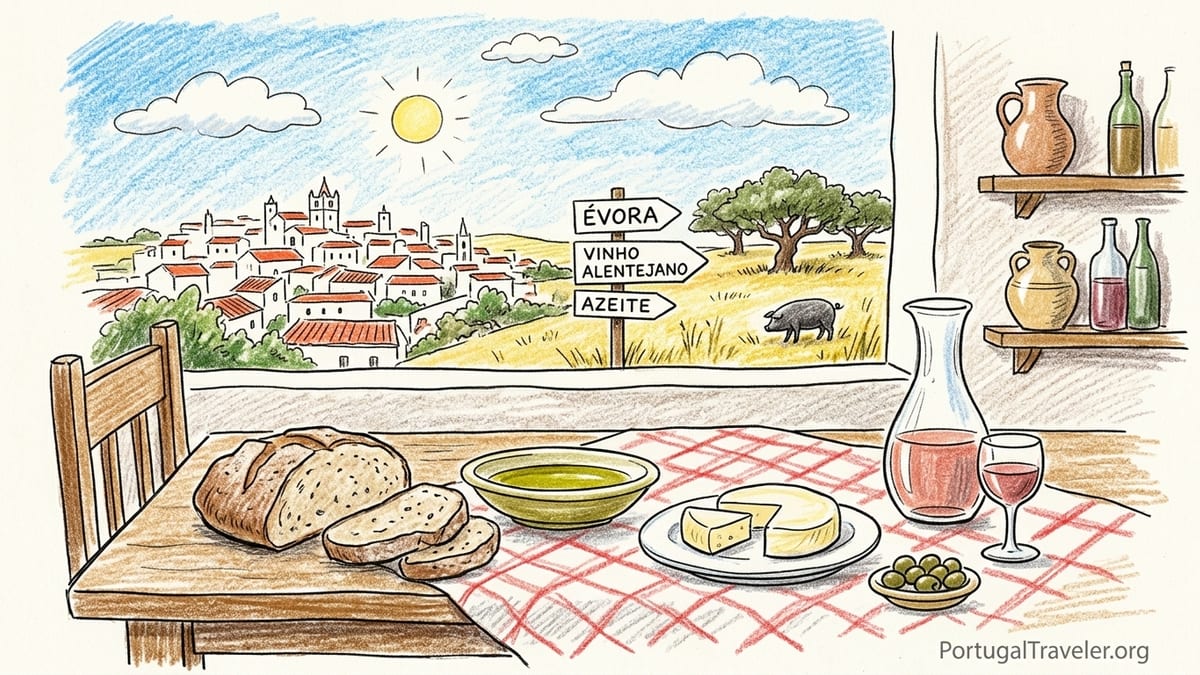
I did not really understand Alentejo until I tore off a piece of still-warm bread, soaked it in peppery local olive oil and chased it with a glass of inky red poured from a jug in a roadside tavern outside Évora. The region’s food and wine are not refined in the way some travelers expect. They are slow, generous, sometimes confusing, and absolutely central to why Alentejo gets under your skin. This article is not a classroom lecture on regional cuisine. It is the meals, wineries and small surprises that actually taught me what Alentejo tastes like, plus enough practical detail to help you decide how much eating and drinking time to build into your own trip.
Finding Alentejo Through Bread, Olive Oil and a House Red
My real introduction to Alentejo happened in a workers’ lunch restaurant on the edge of Évora’s ring road. The menu of the day was scribbled in Portuguese on a whiteboard, and every table started with the same trio: thick slices of pão alentejano, a shallow dish of green-gold olive oil and a small plate of a semi-soft local cheese. The bread was dense and slightly sour, made from a slow-risen dough that locals explained keeps for several days in the summer heat. Dipping it into the oil, which tasted of green tomato leaves and bitter almonds, was the first moment I realized how central these basics are to the region’s food identity.
Wine arrived with almost no ceremony. The waiter pointed to “vinho tinto da casa” on the board and asked “meio litro ou um litro?” The half-liter carafe cost around 5 euros and came from a cooperative winery in the wider Alentejo DOC, part of the official wine region that stretches across eight subzones including Évora, Borba, Reguengos and Vidigueira. It was not a collectible bottle, just a juicy red with soft tannins and ripe, sun-baked fruit that matched the clayey soils and open horizons outside the window.
That lunch set the tone for many others. Bread, olive oil and a simple house wine form the backbone of daily eating here, whether you are in the marble-fronted streets of Estremoz or a village near Moura. You will see branded bottles from well-known producers, but much of what you drink by the jug is regional Alentejo wine served without fanfare. Treat these house offerings as part of the experience rather than a compromise, and you will start to understand why so many Portuguese travelers come here specifically to eat and drink.
Prices in these casual places are still refreshingly gentle compared with Lisbon or Porto. In 2026, a full worker’s lunch in central Évora – soup, main dish, dessert, coffee and that half-liter of house red split between two people – typically runs between 10 and 14 euros per person depending on the dishes ordered, with rural spots often a couple of euros less. Portions, however, are large enough that it is worth asking whether a single main can be shared.
Pork, Migas and the First Time I Misordered in Alentejo
If bread and olive oil are the canvas, black Iberian pig is the paint. Much of Alentejo’s interior is cork oak forest where porcos pretos roam and fatten on acorns, and that richness shows up on the plate. My first serious encounter was a plate of “secretos de porco preto” in a no-frills tasca in Reguengos de Monsaraz. The cut, marbled and grilled over charcoal, arrived glistening with fat alongside a mound of migas – a fried mash of day-old bread, garlic and pork drippings. The combination was salty, heavy and intensely comforting, especially with another glass of carafe red from a local Reguengos producer.
My biggest ordering mistake also involved migas. In a village near Borba, I saw “migas de espargos com carne de porco” on the menu and assumed I was getting something like a side of sautéed asparagus with a small helping of pork. What landed was essentially a giant pan-fried cake of bread and wild asparagus, crisp on the outside and creamy within, topped with enough pan-fried pork to feed two or three hungry people. It was delicious, but halfway through I realized I had also ordered a starter of queijo fresco and olives and had no chance of finishing everything. The total bill, including a half liter of house red from a Borba cooperative, was just under 18 euros, but the food waste left me wishing I had asked about portion sizes.
Across the region, migas and açorda appear in many guises. Classic migas à alentejana usually involve fried bread mashed with garlic and meat juices, served with grilled or pan-fried pork. Açorda à alentejana is a very different, almost austere soup built from bread in a garlicky broth with poached egg and herbs. In Évora I sat at a tiled counter and watched the cook tear chunks of bread into a bowl, ladle over boiling water perfumed with garlic and coriander, then slide in an egg and a piece of salted cod. The bowl cost about 7.50 euros and felt like a complete meal, particularly on a cold winter evening.
The main lesson for travelers is simple: ask questions before you order. Staff are usually happy to explain whether a dish is broth-based like açorda or fried and heavy like migas, and whether one portion can reasonably be shared. It is easy to over-order in Alentejo, especially if you are pairing each course with another glass of wine.
Destination Dining vs. Everyday Tascas
Alentejo is not only about rustic taverns. Over the last decade, a handful of destination restaurants have built menus that reinterpret local products without abandoning their roots. In Évora, one contemporary dining room I tried offered a tasting menu that began with a refined version of pão, azeite e azeitonas. The bread was naturally leavened and baked in-house, the olive oil came from a small producer outside Portel and the olives were marinated with orange peel. Courses that followed included a slow-cooked lamb shoulder from Serra d’Ossa and a dessert built around Serpa cheese, honey and walnuts.
This kind of meal feels very different from a daily special in a village restaurant. The room is quieter, reservations are essential at least a few days in advance, and staff often guide you through wine pairings that jump between subregions like Portalegre for fresher reds or Vidigueira for structured whites. Expect to spend from 55 to 80 euros per person for a multi-course menu with pairings in 2026, comparable to mid-range fine dining in Lisbon but with a more intimate atmosphere and a stronger sense of connection to nearby producers.
Did every high-aiming restaurant deliver? Not quite. One well-known spot outside Estremoz, which I visited on a weekend, suffered from long gaps between courses and staff who seemed stretched by a full dining room and a wedding party on the terrace. The food – including a deconstructed version of migas with confit pork – was clever but felt fussy compared with the straightforward grilled meats and stews I had loved elsewhere. The bill approached 90 euros per person with wine, and I left thinking I would rather have had two or three simple lunches in local tascas for the same money.
On balance, I would recommend most travelers book one destination meal in Alentejo, ideally in Évora, Estremoz or near Reguengos where access by taxi or transfer is straightforward. Use it to see how chefs are evolving traditional dishes rather than as the centerpiece of your trip. The rest of your meals can and should be in everyday restaurants where you share space with local families, truck drivers and office workers eating the same food that has anchored this region for generations.
My Winery Visits: From Polished Estates to Quiet Cellars
The official Alentejo Wine Route stretches across eight designation-of-origin areas: Portalegre in the cooler north, Borba, Redondo, Reguengos and Évora in the heartland, and Vidigueira, Granja/Amareleja and Moura further south. Rather than racing through all of them, I chose a handful of wineries that could be reached comfortably from Évora and Reguengos, focusing on visits that combined tastings with some sense of place.
My most polished experience was at a large estate near Reguengos de Monsaraz that runs a full wine tourism program with guided cellar tours, tastings and an on-site restaurant. I booked online through the estate’s reservation system three weeks in advance and paid around 25 euros for a 90-minute tour and tasting in summer 2025 prices, which had not shifted dramatically by 2026. Arrival was straightforward: there is clear signage from the main road and a dedicated parking area. The visit began with a walk through vineyards, then into a modern cellar where stainless steel tanks sit alongside traditional clay amphorae used for talha wines, echoing Roman-era techniques still preserved in parts of Alentejo.
The tasting itself included four wines: a fresh white from Vidigueira grapes, a fruit-forward red from the broader Alentejo DOC, a more structured single vineyard red from Reguengos and a limited-production amphora wine. Portions were generous enough to get a feel for each style without overwhelming anyone who chose to spit rather than swallow. Bread, local olive oil and a small plate of queijo curado were included, which helped soak up the alcohol and showcased how the wines work at the table. The experience felt professional and slightly commercial, with a clear path through the shop at the end, but staff were well trained and happy to answer geeky questions about soil types and grape varieties.
By contrast, a smaller family-run winery closer to Évora offered a far more personal, if slightly chaotic, encounter. I arranged the visit by email a week in advance and was asked to confirm the day before by phone. There was no formal reception building, just a courtyard with tractors and a bell to ring. The owner’s daughter led my tour, switching between Portuguese and English, and showed me a mixed cellar of older concrete tanks and a handful of modern barrels. The tasting covered three wines, all labeled simply as Vinho Regional Alentejano rather than DOC, poured at a wooden table in the shed. The fee was about 15 euros, waived with the purchase of six bottles, and bread plus a bowl of green olives appeared without discussion. This visit felt much less scripted, and there was an unhurried opportunity to talk about harvest timing, water stress and how climate change is affecting alcohol levels and freshness.
Not every winery stop worked perfectly. One cooperative cellar in a village between Borba and Estremoz listed visiting hours on a regional wine route brochure, but when I arrived the tasting room was staffed by a single clerk who seemed surprised to see a visitor. Tasting flights were not available, only full glasses of one red and one white at the counter, each costing 2 to 3 euros. The wines were fine, but the experience felt rushed and transactional, and there was little context about the broader Borba subregion. I would not deter a curious traveler from dropping in if passing, but it is not something I would plan my day around.
Booking Tastings, Handling Transport and Staying Safe
One thing that surprised me is how essential advance planning remains in Alentejo wine tourism. Many estates still require or strongly recommend reservations, especially on weekends and during harvest. The wine tourism office in Évora, often branded around the Alentejo Wine Route, is a useful first stop if you are building an itinerary on the ground. Staff can point you toward estates in each DOC subregion and clarify which welcome visitors and at what times, something that online maps and search results do not always show accurately.
From Évora, organized half-day and full-day wine tours that include transport have become more common by 2026. Typical shared tours with a driver-guide, visiting one or two wineries and perhaps a village like Arraiolos, start around 80 to 120 euros per person depending on inclusions. These usually cover tastings, a light snack or lunch and hotel pickup in Évora. Private tours are more expensive, often starting near 250 to 300 euros for two or three people, but offer flexibility in choosing wineries and pacing. For travelers who want to drink freely or explore more remote subregions like Granja/Amareleja and Moura, these tours can be a smart investment.
If you choose to self-drive, build in time between tastings and commit to a designated driver who spits or drinks minimally. Alentejo roads are generally quiet and well surfaced, but distances can be longer than they appear on the map, and mobile coverage is patchy in some rural pockets. After my tasting in Reguengos, for instance, I allowed more than an hour to return to Évora along national roads, giving me time for a coffee stop and plenty of hydration. Some larger estates now provide contacts for local taxi drivers or transfer companies, which is worth asking about when you book.
On the budgeting side, guided tastings at mid-sized and larger estates typically run from 18 to 35 euros per person in 2026 for three to five wines, with more elaborate food pairings or full lunches priced higher. Simple counter tastings or walk-in glasses at cooperatives are cheaper but may not offer the same depth of explanation. Factor in the realistic temptation to buy bottles; even moderate purchases of 3 to 6 bottles at 8 to 18 euros each can add up quickly, so consider your luggage allowance and whether your airline charges for checked bags.
Seafood on the Coast and Amphora Wines in the South
Most visitors focus on inland hubs like Évora and Reguengos, but two experiences convinced me it is worth nudging at least one day toward the coast and the southern amphora heartlands. Near Sines, Alentejo’s main fishing port, I found a small restaurant on a back street where the menu centered on grilled fish pulled almost directly from the harbor. The waiter recommended dourada grelhada and a simple salad of tomato and onion, plus a bottle of chilled white from the Vidigueira subregion. The wine, made from native varieties like Antão Vaz and Arinto, cut cleanly through the richness of the fish and hinted at how Alentejo whites have evolved from heavy to refreshingly structured in the last decade.
Lunch for two, including the whole grilled fish, sides, dessert and that bottle of DOC white, came to just under 50 euros, more than inland tavern prices but fair given the quality of the seafood. Reservations were not essential on a weekday in shoulder season, but on summer weekends the line snaked down the sidewalk. If you have a car, combining Sines or nearby Vila Nova de Milfontes with an inland winery stop makes for a satisfying contrast between Atlantic breezes and sun-baked plains.
Further south and east, between Moura and the Spanish border, I arranged a visit to a talha-focused winery in the Granja/Amareleja subregion. Here, clay amphorae dominate the cellar, some of them over a century old. The booking process was old-fashioned: an exchange of emails followed by a WhatsApp confirmation the day before, and payment in cash on arrival for the 20-euro tasting. We tasted three amphora wines, two reds and a surprisingly textured white, in a small tasting room lined with handwritten harvest notes. Bread, olives and a dish of local sheep’s cheese accompanied the pours.
This was one of the most personal experiences of my trip, but it came with logistical challenges. Public transport to tiny villages is sparse, and mobile coverage dropped out several times on the drive from Moura. Without a car and a confident driver, this corner of Alentejo would be difficult to access. For most travelers, I would suggest seeking out amphora wines at shops and wine bars in Évora or Reguengos and prioritizing only one ambitious detour south unless you are a serious wine devotee.
How Much Food and Wine Time to Plan in Alentejo
Before visiting, I worried that building too many tastings and meals into my itinerary would turn the trip into a checklist rather than a relaxed wander. In practice, the rhythm of Alentejo encourages lingering, and food naturally organizes your days. After several visits, the balance that works best for me is simple: for a three-night stay centered on Évora or Estremoz, plan one full winery day, one destination meal and leave the rest to everyday discovery.
On the full winery day, join an organized tour or hire a driver so that everyone in your group can participate in the tastings. Start at a larger estate where you can understand the basics of Alentejo’s eight DOC subregions, cellar practices and flagship grape varieties, then move to a smaller producer for contrast. Build in a long lunch, either at a winery restaurant or in a nearby village, and end the day with a light dinner in town. You will have tasted enough wines from different zones like Reguengos, Borba and Vidigueira to gain a sense of variety without memorizing classifications.
For the destination meal, book dinner on your second night so you are not arriving tired from travel. Use it as a framework for exploring the historic centers of Évora, Elvas or Estremoz before and after, and let the sommelier choose pairings that highlight fresher northern reds from Portalegre or structured southern whites. The rest of your meals, especially lunches, can be in local tascas where daily specials might include lamb stews, grilled black pork or açorda with cod. Keep in mind that many kitchens close after mid-afternoon, and Sunday evenings can be particularly quiet, so plan accordingly.
If you are staying longer than three nights or combining Alentejo with Lisbon and the Algarve, resist the urge to fill every day with vineyard appointments. One of my favorite afternoons in the region involved no booking at all: just a terrace in a small town near Redondo, a plate of presunto and queijo, a glass of chilled white from the local cooperative and the slow movement of shadows across whitewashed walls. That, as much as any structured tasting, is what you come to Alentejo for.
FAQ
Q1. How many days should I dedicate to food and wine in Alentejo?
For most travelers, two to three full days is enough to include one winery-focused day, one destination meal and several casual tasca experiences without feeling rushed.
Q2. Do I need to rent a car to visit Alentejo wineries?
A car gives you the most flexibility, but from Évora you can also join organized wine tours with transport included or arrange private drivers through hotels and tour operators.
Q3. How much should I budget for a winery tasting in 2026?
Guided tastings at established estates usually cost between 18 and 35 euros per person for three to five wines, with simpler cooperative tastings or single glasses costing less.
Q4. Are reservations essential for winery visits?
Yes, it is safest to book in advance, especially on weekends, during harvest and at smaller family-run properties that may not staff tasting rooms without a confirmed visit.
Q5. What are the must-try traditional dishes in Alentejo?
Look for açorda à alentejana, various migas with black pork, grilled secretos de porco preto, lamb stews and simple plates of local cheese, bread and olive oil.
Q6. Is it easy to find vegetarian options?
Rural tascas are meat-focused, but you can often assemble satisfying meals from soups, vegetable-based açordas, cheese, salads and egg dishes, with better choice in larger towns.
Q7. What is the difference between Alentejo DOC and Vinho Regional Alentejano?
DOC wines come from defined subregions with tighter rules, while Vinho Regional Alentejano allows more flexibility in grape sourcing and style, often at friendlier prices.
Q8. Can I safely drink and drive after tastings?
Portugal has strict blood alcohol limits and enforcement. It is safest to use a designated driver who spits, book tours with transport or arrange taxis or transfers after tastings.
Q9. Is tipping expected in Alentejo restaurants and wineries?
Service is usually included, but rounding up or leaving around 5 to 10 percent for good service in restaurants and small change at wineries is appreciated rather than mandatory.
Q10. When is the best time of year to visit for food and wine?
Spring and autumn offer comfortable temperatures, active vineyards and rich seasonal dishes, while high summer can be very hot in the interior, especially around afternoon meals.