

On my first proper trip to Madeira, I knew I wanted to criss-cross the island for levada walks, mountain viewpoints and coastal villages, but I was far less sure where to stay. In the end I used a two-base strategy: four nights in Funchal without a car, followed by six nights in a countryside hotel near Calheta on the southwest coast with a rental car. It turned out to be a revealing experiment in what does and does not work on this compact but surprisingly slow-to-drive Atlantic island, and it is the experience I now use when advising others on where to stay in Madeira.
How I Planned My Bases in Madeira
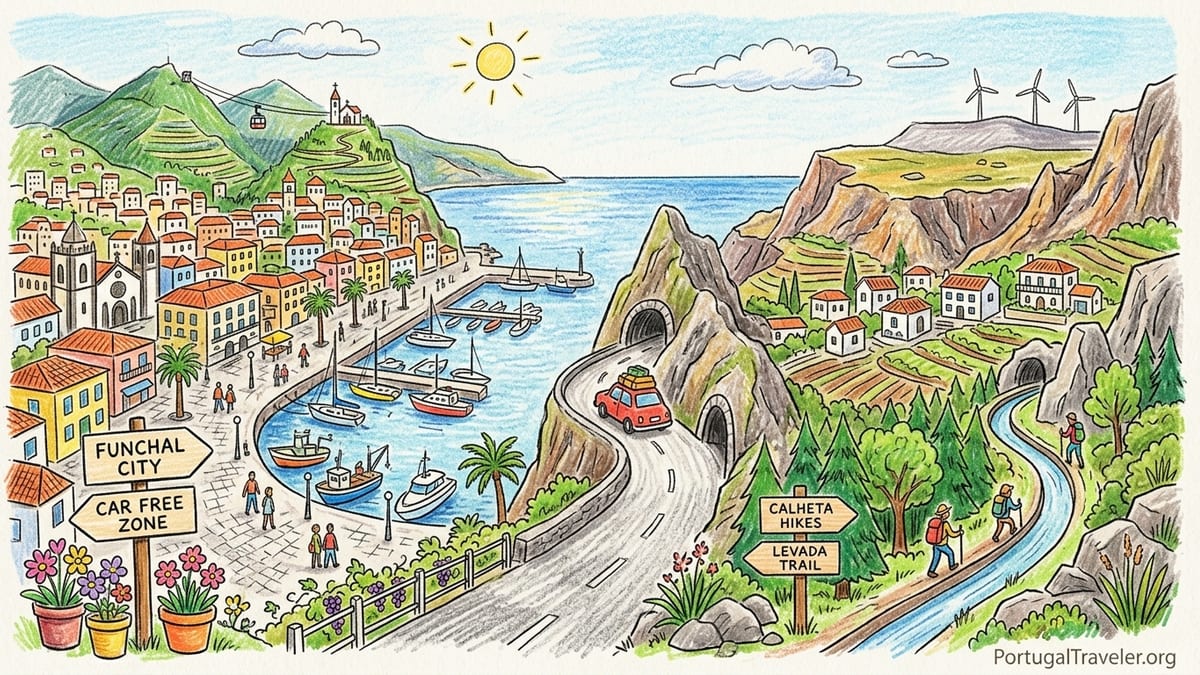
I arrived in Madeira with two different styles of trip in mind. For the first part I wanted easy restaurant choices, no need for a car, and straightforward transfers to and from the airport. For the second part I wanted to focus on hiking and viewpoints, with a quieter base and parking on site. That is how I ended up booking four nights in central Funchal, walking distance to the old town, followed by six nights in a small hotel in the hills above Calheta, around a 40 minute drive from Funchal when traffic is light.
In Funchal I did not rent a car. The airport bus and pre-booked taxi both cost noticeably less than hiring a car from day one, and from Funchal it was simple to book day tours to highlights such as Pico do Arieiro sunrise and the west coast viewpoints. Car parks in central Funchal fill up in the evening, and daily hotel parking often comes with an extra fee, so starting the trip here without a vehicle removed one of the major urban headaches.
For the second base near Calheta, I switched approach completely. I picked up a rental car from a local operator in Funchal after four days, once I was ready to move on. The logic was that most of the island’s signature levada walks and mountain trails sit away from Funchal, and driving times from the southwest are often only 10 to 20 minutes longer than from the capital. The countryside hotel I chose included free on-site parking and had a small supermarket and a couple of simple restaurants within a 10 minute drive.
Looking back, the two-base strategy worked, but I would tune it further next time. Funchal gave me an easy soft landing and car-free evenings, while Calheta proved a very practical base for drives to the Paul da Serra plateau, the north coast and several levada trailheads. However, the return drives after late hikes, especially in winter when it is dark by early evening, were more tiring than I had expected.
Driving Times and Daily Logistics From Different Bases
Distances in Madeira are short on the map, but driving feels longer because of tunnels, steep gradients and winding mountain roads. From central Funchal to Madeira Airport typically takes about 20 minutes by car or taxi. A bus transfer usually runs around 30 to 40 minutes depending on stops. By contrast, from Calheta to the airport the drive is usually around one hour, mostly on the fast coastal road but with slower stretches near villages.
For hikes, driving times matter more than raw distance. From my hotel above Calheta, I could reach the Paul da Serra plateau and trailheads for routes like Levada das 25 Fontes and Levada do Alecrim in roughly 25 to 35 minutes. Getting to the same area from Funchal usually takes closer to 45 to 60 minutes, depending on traffic out of the city. On the other hand, some eastern highlights such as Pico do Arieiro or the start of the Vereda da Ponta de São Lourenço were faster from Funchal, at around 40 to 50 minutes’ drive, while from Calheta they were often closer to 70 to 90 minutes.
Parking was a constant factor in my choice of base. In Funchal, public multistorey car parks exist near the marina and in the new town, and hotel garages are common, but spaces fill up by early evening and there is a daily cost. On the southwest coast I never once struggled for a parking spot at the hotel or in villages like Jardim do Mar and Paúl do Mar, although popular trailheads could still get crowded by mid-morning. If you plan to start hikes after sunrise, staying closer to the mountains or on the quieter coast can make the start of your day noticeably less stressful.
Evening logistics were very different between the two bases. In Funchal I could walk to dozens of restaurants in the old town and around the marina in 5 to 15 minutes, so there was no need to think about driving after dinner. In Calheta, restaurant choice was much more limited within walking distance. I usually drove 10 to 20 minutes to reach seafront restaurants in Calheta, Paúl do Mar or Jardim do Mar, then returned up narrow hillside roads in the dark. This was manageable, but it is something to consider if you are not comfortable with night driving on steep, twisting routes.
Funchal as a Base: Ideal for Car Free or Short Stays
Staying in Funchal worked extremely well at the start of my trip. For a first visit to Madeira, or for travelers who prefer not to drive, Funchal is the most straightforward base. Airport transfers are simple, many hotels offer luggage storage for early arrivals, and you can reach the old town, the cable car to Monte and the harbourfront entirely on foot. For day trips, a cluster of tour operators in central Funchal sell small group outings to the west, east or interior, with hotel pickups that remove the need to navigate.
Without a car, I still managed to reach several of the island’s signature experiences. A guided sunrise trip to Pico do Arieiro included transport, warm drinks and a short guided walk along the ridge, while an organised west coast day covered Câmara de Lobos, Cabo Girão, Ribeira Brava and the volcanic pools at Porto Moniz. For someone staying four to five nights, this pattern works well: spend one or two days in Funchal itself, one day in the central mountains, and one or two days on the west or north coast via tours.
There are trade-offs to a Funchal-only stay. You will rely on tour schedules for popular hikes, which might mean starting later in the morning than the independent hikers who arrive by car. Popular levadas close to Funchal can feel busy during the middle of the day. Also, while Funchal has supermarkets and small grocery shops, they are not always directly next to hotels in the older parts of town, so self catering apartments work best for those who enjoy walking to pick up breakfast items or picnic supplies.
In the evening, however, Funchal shines. Restaurant choice ranges from simple grill houses and traditional Madeiran food to more ambitious contemporary kitchens. Most streets in the centre are walkable, and the waterfront promenade is pleasant for an after dinner stroll. For couples and solo travelers who value being able to walk out, choose a dinner spot on the fly and have a drink without worrying about driving back, Funchal makes strong sense as at least one of your bases.
The Southwest Coast: Quieter Stays Around Calheta, Paúl do Mar and Jardim do Mar
For the second part of my trip I based myself near Calheta, which proved to be an effective compromise between access to the mountains and a quieter coastal atmosphere. Calheta itself has an artificial sandy beach, a small marina and a compact cluster of hotels and holiday apartments. Supermarkets sit a short drive up the hill from the main resort area, and there are a handful of restaurants and cafes on the seafront. Compared with Funchal, evenings were much calmer, and I could usually find free street parking near the marina or park at the hotel without charge.
From this base, the Paul da Serra plateau and the central west levadas felt very close. The drive up involved hairpin bends and occasional fog but took less than half an hour in clear conditions. This made sunrise or early morning starts realistic without forcing me out of bed in the middle of the night. Drives to the north west, including Porto Moniz and Seixal, usually ran to around one hour. These journeys passed through a mix of tunnels and older roads with superb sea views, and having a base on the southwest coast kept the overall driving time reasonable.
Nearby fishing villages like Paúl do Mar and Jardim do Mar added another dimension. Both have a low key, end of the road feel, with narrow lanes, small bars and sea walls where locals fish at sunset. They are excellent for slow coastal days or for travelers who want to sit in a café and watch Atlantic swells crash against the rocks. Accommodation here is more limited and leans towards small guesthouses and apartments rather than large hotels, so it suits independent travelers who are comfortable self catering and do not mind driving 15 to 25 minutes for a supermarket run.
The main drawback of the southwest as a single base is distance to the eastern half of the island. Driving from Calheta or Paúl do Mar to Pico do Arieiro, the São Lourenço peninsula or even some central levadas can easily take more than an hour each way, especially if you prefer to avoid driving aggressively on mountain roads. If your itinerary is heavily focused on the eastern peaks and levadas, or if you are visiting in winter when daylight hours are short, it can feel like you spend a large share of your day in the car.
The North Coast and Other Countryside Bases
On this particular trip I did not overnight on the north coast, but I spent full days in villages such as São Vicente, Seixal and Porto Moniz, and it was clear how different the rhythm is compared with the south. The north feels wilder and greener, with cliffs, waterfalls and a cooler, often more humid climate. For hikers and repeat visitors, basing here for several nights can be very rewarding, especially if you already feel familiar with Funchal and the classic viewpoints.
Driving from my southwest base to the north coast across the island generally took between 45 minutes and 1 hour 15 minutes, depending on the village and route chosen. That meant that returning to Calheta after dark, especially in rain or cloud, required full concentration. I met several travelers who were staying in small guesthouses near São Vicente or up in the hills toward the interior, and they described their bases as quiet, with very dark nights, few street lights and a lot of star visibility when the sky was clear.
Practical services on the north coast are more limited but still present. You will usually find at least a small supermarket or mini market, a bakery and a couple of cafés in or near each main village, but opening hours can be shorter than in Funchal. For coastal road trippers who enjoy slow drives and are not in a hurry to tick off every famous viewpoint, staying in these villages can cut down on daily back and forth driving. It also makes sunset or early morning visits to natural pools and black sand beaches more accessible.
There are also rural accommodations scattered through Madeira’s interior, from renovated farmhouses near the Paul da Serra plateau to boutique retreats in valleys closer to the centre of the island. These countryside properties trade longer initial drives from the airport for immediate proximity to trailheads and very quiet nights. If you plan a hiking heavy itinerary, waking up within a 15 to 20 minute drive of multiple levadas can transform your experience, but it is important to accept that restaurant choice will be limited and you may find yourself self catering more often than not.
Evenings, Food and Returning After Dark
One of the main questions I wanted to answer on this trip was how it actually feels to return to your base after dark in Madeira. In winter, sunset can fall before many hikers finish longer routes, and mountain weather can delay you unexpectedly. From Funchal, evening returns are straightforward if you have joined an organised tour, since drivers are familiar with the roads and will drop you directly at your hotel. For independent drivers, the challenge is less about the city and more about the mountain roads you must descend first.
From my Calheta base, the drive back from levadas near Paul da Serra in the dark required slow, cautious progress. Fog and low cloud are common on the plateau, and while tunnels provide some shelter, the combination of sharp bends and limited lighting means you need to feel confident as a driver. Once back on the lower coastal roads, the journey became much easier, although some smaller side roads to rural accommodations can still be narrow and steep.
When it comes to dining, Funchal is clearly superior in variety and convenience. In the capital, I could simply walk out and choose between traditional espetada skewers, fresh fish restaurants, wine bars and modern bistros within a short radius. Reservations are sensible at popular places, especially at weekends, but there is enough depth that last minute choices are still realistic. On the southwest coast, I found it wise to decide on a restaurant earlier in the day, check opening times, and sometimes call to book, particularly in smaller villages where a single family run restaurant might be the only option open.
Supermarket access followed a similar pattern. Larger chain supermarkets are easy to find on the outskirts of Funchal and along the main coastal road between Câmara de Lobos, Ribeira Brava and Calheta. Parking is usually straightforward in these retail parks. In smaller villages, I relied on mini markets and bakeries for fresh bread, fruit and basic supplies, which were perfectly adequate for breakfast and picnic lunches but less suitable for elaborate cooking. If you plan to stay in a rural apartment and cook often, it is sensible to stock up in a bigger supermarket on your way out of Funchal or from the airport.
Who Each Base Suits: Matching Areas to Travel Styles
After actually living with a split between Funchal and the southwest coast, patterns emerged about who each area suits best. For first time visitors without a car, Funchal is clearly the most practical single base. You can explore a surprising amount of the island using tours and public transport, and you gain the easiest airport access and evening options. A three to five night stay based solely in Funchal can work very well for a shorter holiday focused on city strolling, a few scenic drives and one or two headline viewpoints.
For a hiking heavy trip, especially in spring and autumn, I would now favour at least part of the stay in the countryside, either on the southwest coast or closer to the interior. Waking up under the Paul da Serra plateau or near popular levadas cuts down on pre hike driving and allows early starts, which help you avoid crowds and summer heat. Couples who value peace and views over nightlife often gravitate to hillside guesthouses above Calheta, Paúl do Mar or Jardim do Mar, where evenings are about watching the sunset from a balcony rather than heading out to bars.
Families face a slightly different set of needs. Calheta’s small sandy beach and marina, along with easy parking and apartment style accommodation, make it attractive for those travelling with children who want at least some time on a beach. At the same time, Funchal offers child friendly attractions such as the cable car to Monte and the famous toboggan rides, as well as parks and oceanfront promenades that work with a pushchair. A split stay of a few nights in Funchal followed by a longer period in Calheta or another south coast resort gives families a mix of easy logistics and downtime by the sea.
For a car free holiday, I would not recommend staying exclusively in remote countryside properties. Buses exist but are infrequent away from main routes, and taxi costs can mount quickly. Instead, base yourself in Funchal and use a combination of guided tours, the cable car, local buses and walking. For a road trip style visit, where driving scenic roads is part of the enjoyment, one option is to book a loose circuit: a few nights in Funchal, followed by two or three nights on the north coast, then two or three nights on the southwest coast before returning to the capital or the airport.
How Many Bases Does Madeira Really Need?
Before this trip I considered staying in three or four different places over ten nights, but I was concerned about spending too much time packing, unpacking and checking in and out. In the end, the two base structure of Funchal plus southwest coast felt about right for a first substantial visit. It allowed me to experience both the hub of the island and a quieter coastal region without fragmenting the trip into too many short stays. Each move between bases still took a good part of a day once driving, checking in and orienting myself were factored in.
Would one base have worked? If I had stayed only in Funchal with a rental car, I could have reached almost everywhere on the island with drives of between 30 and 90 minutes. However, that would have meant paying for city hotel parking, driving in and out of Funchal’s traffic most days and facing longer returns after western or north coast hikes. If I had stayed only in Calheta or a similar southwest village, I would have traded long eastern drives for shorter mountain access and quieter evenings, but I would have missed the ease of walking out into Funchal’s old town at night and its non driving day options.
For most travelers I now recommend one or two bases, depending on trip length and style. For stays of up to five nights, a single base is usually sufficient, and Funchal makes the most sense unless you are a repeat visitor focused almost entirely on hiking. For trips of six nights or longer, splitting between Funchal and either the southwest or the north coast gives you a change of scene and better balances driving times. While a three base road trip can work for visitors who enjoy frequent moves, it does not feel strictly necessary on an island where no drive between main settlements is much more than two hours.
On my next trip I would keep the two base strategy but shorten the Funchal stay slightly and push more nights into the countryside, particularly in spring when levadas are lush and days are longer. I would also consider moving the countryside base a little closer to the interior, perhaps on the edge of Paul da Serra, to reduce driving times still further for the longest hikes. Crucially, however, I would still end the trip with at least one night in or near Funchal to simplify the final journey to the airport and to enjoy one last evening meal within easy walking distance of my hotel.
FAQ
Q1: Is Funchal a good base in Madeira if I will not rent a car?
Yes, Funchal works very well without a car. You can reach it quickly from the airport by taxi or bus, walk to most sights, and use organised day tours and local buses for mountain and coastal excursions.
Q2: How many different bases do I really need for a one week trip to Madeira?
For about seven nights, most visitors do well with one or two bases. A single base in Funchal suits shorter, car free trips, while a split between Funchal and either the southwest or north coast works better for hiking and varied scenery.
Q3: Is it worth staying in Calheta or the southwest coast instead of Funchal?
Staying around Calheta or nearby villages is worthwhile if you plan to hike often or want quieter evenings, free parking and easier access to the Paul da Serra plateau and west coast drives.
Q4: Are north coast villages like São Vicente or Porto Moniz practical bases?
They are practical for confident drivers who want a wilder, greener atmosphere and do not mind longer journeys to the airport or Funchal. You will have fewer restaurants and services than on the south coast but closer access to dramatic scenery.
Q5: How long does it take to drive from Funchal to the main hiking areas?
From Funchal, most central levada and mountain trailheads are around 40 to 60 minutes away by car, while west coast drives can be close to an hour each way depending on the route and traffic.
Q6: Is driving back to rural accommodations in the dark difficult?
It can be challenging, especially on steep, winding mountain roads or in fog and rain. If you are not comfortable with night driving, consider staying closer to main roads or booking more nights in Funchal.
Q7: Which base is best for families with children?
Families often do well in Calheta or similar south coast areas, where there are beaches, easy parking and apartment style accommodation, combined with a shorter stay in Funchal for cable cars, parks and city walks.
Q8: Is it realistic to stay only in Funchal and drive everywhere?
It is realistic in terms of distances, but you will face daily city traffic and parking costs. For longer trips or hiking heavy itineraries, adding a countryside or coastal base can reduce driving time and stress.
Q9: Do countryside properties make supermarket shopping difficult?
Not usually, as most areas have at least a small supermarket or mini market within a short drive. However, for larger selections and better value, it is sensible to stock up in bigger stores near Funchal or along the main coastal road.
Q10: What would be an ideal base strategy for a first visit focused on hiking and scenery?
An effective approach is to spend three or four nights in Funchal without a car for easy arrival and city exploring, then move to a southwest or interior base with a rental car for four to six nights focused on levadas, viewpoints and quieter coastal villages.