

I landed in Madeira with nine full days, a rental car and an overconfident list: sunrise on Pico do Arieiro, two levada classics, natural pools on the north coast, old Funchal lanes, a boat trip, and “just a few” miradouros along every road that looked pretty on the map. It felt realistic when I was planning at my desk. On the ground, Madeira taught me that its microclimates, mountain roads and serious hikes demand a more thoughtful division of days, not a packed checklist.
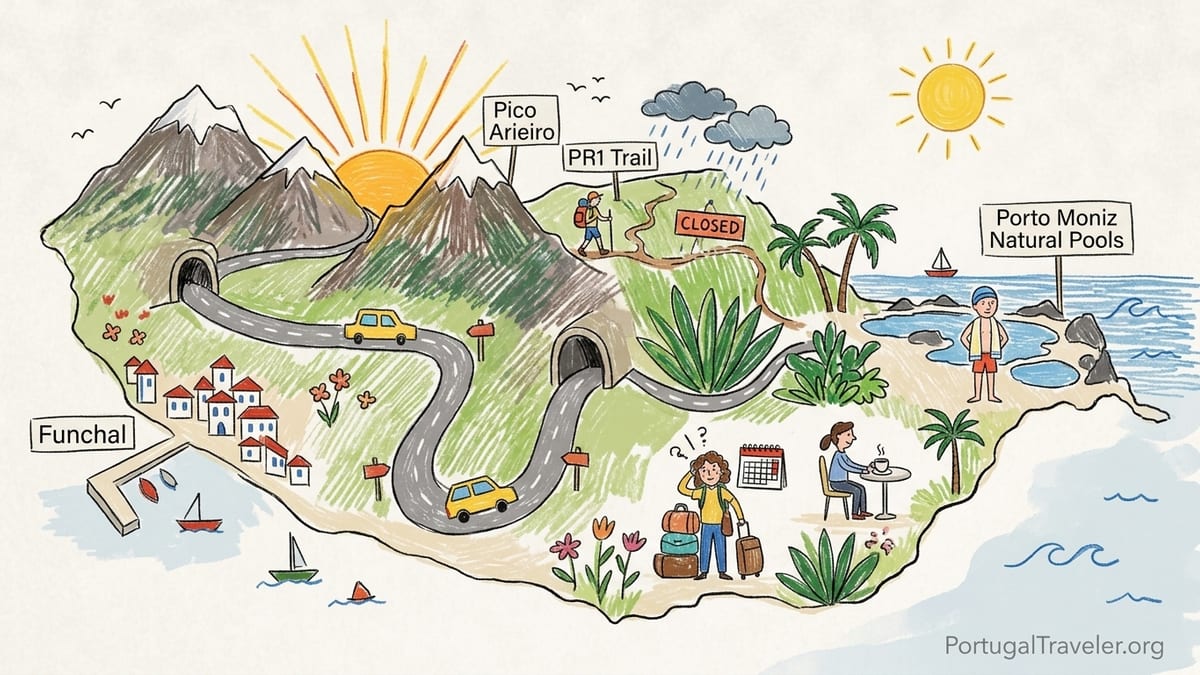
What I Tried To Do With 9 Days (And What Went Wrong)
On paper my plan looked efficient. I booked three bases: four nights in Funchal’s old town, three in São Vicente on the north coast, and two in Porto Moniz. I scheduled three big hiking days, three driving days, and “the rest” would somehow fit around coffees in Funchal and swims in the hotel pool. I stacked Pico do Arieiro to Pico Ruivo (the PR1 ridge route), the 25 Fontes levada near Rabaçal and a Caldeirão Verde levada day in the first four days, reasoning that I would be strongest at the start.
Reality intervened almost immediately. Mountain weather did not match the forecast I checked from home. The famous PR1 between Pico do Arieiro and Pico Ruivo has been partly restricted and ticketed on certain days in the past year, and sections remain subject to partial closure and capacity limits, so my original idea of “pick the sunniest day when I arrive” turned into “take the only day with available slots,” which happened to be the morning after a late flight. On top of that, the mountain forecast showed stronger wind at altitude than the coastal forecast suggested. Madeira’s tourism board and local hiking guides stress that the high peaks follow their own weather rules, and my legs learned that lesson on day two.
I then tried to cross the island repeatedly. One day I drove east from Funchal to Santana for a short levada, another day I went west past Câmara de Lobos and Cabo Girão toward Rabaçal, and then I pushed on to Porto Moniz the following morning. Each individual drive is only about 45 to 75 minutes on main roads, but the cumulative fatigue of tunnels, switchbacks and stopping at viewpoints turned my “scenic drives” into four- and five-hour driving days.
The worst mistake was leaving a weather-dependent hike for the last day in each region. I saved the Caldeirão Verde levada for my final São Vicente morning, only to wake up to steady rain and a cloud base below the trail. Local advice from my guesthouse was to skip it; the combination of wet levada edges and low visibility can close or partially restrict some routes after heavy rain. I ended up with an unplanned rest day and a nagging sense of having “missed” something, even though it was the safer call.
Patterns I Would Not Repeat: Over-Hiking, Over-Driving, Under-Resting
Looking back, the pattern is clear. First, I stacked too many big mountain experiences back to back. Pico do Arieiro at sunrise, followed the next day by a long levada above the clouds, sounds magical. After two consecutive days starting before 6 a.m., with thousands of stairs and several hours of focused walking on uneven paths, it just feels like work. Most of Madeira’s signature hikes, such as the PR1 ridge sections or Rabaçal’s 25 Fontes and Risco, are not technically extreme, but they are time consuming. Allow at least five hours from leaving your hotel to returning, even for routes that are only 10 to 12 kilometers on paper, once you factor in parking, shuttles and café breaks.
Second, I underestimated how draining the driving can be, especially if you are not used to steep mountain roads. The modern Via Rápida highway west of Funchal and the tunnel network make island crossings faster than they once were, but distances on the map still translate into high concentration driving. My “photo stops” multiplied: Eira do Serrado, Cabo Girão skywalk, countless miradouros along the north coast between Seixal and Porto Moniz. By the end of one loop day, I had driven Funchal to São Vicente, across to Santana and back, roughly 140 kilometers, with more than six separate stops. It was rewarding, but I arrived at my next base jittery and too wired to enjoy dinner.
Third, I did not explicitly schedule rest or simple swimming time. Madeira’s coastal pools at Porto Moniz, the black sand in Seixal or even a hotel pool in the Lido area are more than “nice to have.” They are where your legs recover and your trip starts to feel like a holiday instead of a training camp. I told myself I would “take a slow afternoon” after each big hike. Instead, I was tempted into another viewpoint, another small town, another espresso. Proper rest only happened on days when rain forced me to slow down.
Finally, I split my nights between too many bases for the island’s actual size. Three accommodations in nine nights sounds modest, but on Madeira every change of base involves another partial sightseeing day given over to packing, check-out, driving, check-in and orienting. In hindsight, with the current road network and wide choice of day tours from Funchal, I would have structured those same nine nights very differently.
How I Would Now Divide A Short 4-Day Madeira Trip
Four days in Madeira forces you to make clear choices. You cannot fit both the classic high-mountain experience and a deep dive into multiple levadas and both sides of the island without rushing. That is not because the distances are vast, but because the combination of microclimates, winding roads and long day hikes means each headline experience occupies most of a day.
With four days, I would now use one base only: Funchal. The capital concentrates most accommodation choices, and you can drive to key sights like Pico do Arieiro in around 45 minutes, to Câmara de Lobos in 15 minutes, and to the north coast via the central tunnels in about 45 to 60 minutes depending on the route. A compact car booked in advance from a major operator at Funchal Airport might run around 35 to 50 euros per day in shoulder season, plus fuel, which is usually enough for these short radiating trips without wasting time changing hotels.
In that timespan, I would limit myself to one serious hiking day, one mixed driving and light walking day, one Funchal-focused day and one flexible weather buffer. For example, if your main dream is standing at Pico do Arieiro at sunrise, you can devote your buffer day to shifting that attempt between day two or three based on the dedicated mountain forecast rather than the coastal forecast. Local hiking resources and mountain weather planners show that clear skies at the peaks do not always match clear skies in Funchal, especially in spring and autumn. Giving yourself at least one movable morning greatly increases your odds of seeing the famous cloud inversions that so many hikers talk about.
The trade-off is clear: on four days you will probably not drive the full loop to Porto Moniz, and you will not attempt multiple long levadas. Rather than trying to squeeze in both the 25 Fontes levada and Caldeirão Verde, pick a single levada that matches your fitness and comfort with heights and tunnels. Many new visitors choose a well-known route such as 25 Fontes and Risco or a shorter levada with easier access, and complement it with gentler coastal walks near Funchal or Câmara de Lobos instead of another long inland drive.
What 7 Days Adds: Two Bases, Three Hikes and True Downtime
Once you have a week, your options open, but it is still important not to treat each new day as another “big ticket” excursion. If I were re-planning my own nine-day trip, I would now structure the first seven days as if they were a complete holiday and treat any extra nights as optional extensions. With seven days on Madeira, I would use two bases, not three: four nights in or near Funchal, and three nights either on the north coast near São Vicente or on the far west around Porto Moniz or Ponta do Pargo, depending on whether you prefer forested valleys or rugged sea cliffs and tidal pools.
From Funchal, I would aim for two major hike days and one lighter walking or tour day in the first four. One mountain-focused day could revolve around Pico do Arieiro and its open PR1 sections or the shorter ascent to Pico Ruivo from Achada do Teixeira, depending on current trail status and whether full ridge tickets are available. The second major hike from this base might be a levada such as 25 Fontes and Risco, which combines laurel forest, waterfalls and irrigation-channel paths that Madeira is famous for. Both are long enough that you will feel them in your legs; placing a gentler Funchal day with cable car rides, market browsing or a dolphin-watching boat trip between them makes the week flow more naturally.
Shifting to a second base on the north or west coast introduces a different rhythm. São Vicente puts you within a short drive of green valleys and additional levadas, while Porto Moniz offers sea pools carved into lava rock and quick access to dramatic coastal roads. Instead of trying to conquer another pair of big hikes there, I would now plan one levada or forest walk day from this base and leave one full day for low-effort exploration: café stops in Seixal, a long swim in the natural pools, or a slow drive to a single miradouro high above the sea. This was exactly the kind of day I neglected on my own trip, and it is precisely where Madeira’s slower side reveals itself.
Crucially, seven days gives you space for at least one explicit weather buffer. I would treat one of the midweek days as a floating slot that can become a hike, a driving day or a rest day depending on conditions. If wind closes the high peaks, you can pivot to a coastal levada, which local guides often recommend in winter months, or even stay close to Funchal’s sheltered bay. On my original itinerary, every postponement caused a domino effect of cancelled dinner plans or rushed packing. With structured buffers, you bend the schedule around the island instead of the other way round.
Why 10 Days Is About Flexibility, Not Just More Stops
At ten days, the temptation is to add ever more dots to the map: perhaps a side trip to Porto Santo by ferry for its long sand beach, more passes through the Encumeada pass, or another circuit of the north coast road. My nine days came close to that length, and I tried exactly that approach. What I learned is that beyond seven days, the main benefit is not seeing more places, but seeing the same handful of places under different skies and at a slower pace.
In a ten-day framework I would still keep only two, or at most three, hotel bases. For example, you might spend five nights in Funchal, three on the north or west coast, and then return to Funchal for a final two nights to be sure you are close to the airport. The extra time lets you repeat a favourite short hike when the light is different or finally sit in the waterfront café in Câmara de Lobos instead of just walking through it between photo stops. It also makes room for a boat-based day such as a whale-watching trip, which usually lasts several hours and can leave you pleasantly tired.
Ten days also allow you to build in one or two full weather-buffer days. That is important because Madeira’s microclimates can bring low cloud to the peaks while leaving the south coast in sunshine, and vice versa. Hiking-focused resources that track conditions month by month highlight that shoulder seasons like April to May and September to October are generally excellent for walking, but individual days can still be windy or wet at altitude. With flexible days, you can wake up, check the mountain webcams or local forecast boards, and decide whether to head for Pico do Arieiro, a mid-level levada in Laurisilva forest, or the coast with its tidal pools.
Another lesson I would apply with ten days is to cap the number of driving-intensive days. In my original plan, I treated driving as something to sprinkle into leftover time after hikes. In practice, certain classic drives such as Funchal to Porto Moniz via the old coastal road, or a loop that takes in the plateau near Paul da Serra, deserve to be the main activity for the day. I would limit myself to three such driving-heavy days across the ten: one focused on the west and northwest, one on the east and Santana, and one shorter loop around viewpoints nearer to Funchal. The remaining days would be either hiking-led or deliberately slow.
Finally, ten days give you the chance to insert genuine rest after your hardest efforts. For instance, after completing a demanding ridge or long levada, I would now automatically schedule the next day as low-key: a swim at the hotel, a walk around Funchal’s old town and perhaps a cable car ride to Monte rather than another steep staircase under strong sun. The psychological effect of knowing a restful day is coming makes the hard hike feel more enjoyable in the moment, instead of something you must recover from while also worrying about squeezing in the next highlight.
Choosing Bases, Balancing Hiking Days and Rest
If I compress all those lessons into a single planning principle, it is this: decide first how many hotel bases and hiking days you really want, then let the individual sights slot in as examples rather than fixed obligations. Madeira rewards this kind of flexible structure because many of its highlights share similar elements. Several levadas pass through laurel forest, multiple viewpoints offer sweeping cloud inversions, and more than one town on the north coast has natural sea pools. You do not need to chase every named spot to experience the essence of the island.
For four days, one base in Funchal is enough. For seven, two bases feel right. For ten, I would choose either two spaciously used bases with a short return to Funchal at the end, or three bases only if you are comfortable with frequent packing and shorter stays. In all cases, keep at least half your nights in or near Funchal so that airport transfers are simple and so that you can access tours and boat trips without using the car.
In terms of hiking days, my corrected allocation would now be: one major hike day in a four-day trip, two or three in a seven-day trip depending on your fitness, and no more than four major hiking days over ten days. By “major” I mean any outing of four hours or more on mountain or levada paths, including the drive to the trailhead. Sprinkle in shorter coastal walks near villages on other days instead of treating every walk as an event. For instance, a gentle stroll from Câmara de Lobos up to a nearby miradouro in the late afternoon does not need to be labeled a “hike day” at all.
Rest and swimming time deserve equal intentionality. On a four-day stay, I would still try to protect one half-day simply for being horizontal by a pool or at the sea, whether in Funchal’s Lido area or in the natural pools at Porto Moniz if you make it that far. On a seven-day stay, I would keep at least one full rest or mostly-rest day plus a couple of half-days. With ten days, I would plan for two full low-effort days spread apart. These are the days that prevent overuse aches and help you appreciate the slower conversations with locals at a café or the feeling of swimming in the Atlantic at sunset.
Revised Sample Allocations Based On Real Lessons
To make this concrete, here is how I would now divide my time if I were to repeat the trip, using the same total length but applying what I learned about over-scheduling. Think of these not as rigid itineraries, but as ratios between hiking, driving and rest that you can adapt to your own interests.
For a four-day trip, I would stay in Funchal for all nights, assign one full day to a major experience like Pico do Arieiro and the nearby PR1 viewpoints or a single levada, one day to exploring Funchal itself with only light walking, one mixed day that combines a shorter drive with a village visit, and hold one day as a weather buffer that can become either a second hike or a relaxed coastal drive. Within that framework, a visit to Câmara de Lobos or Cabo Girão might appear, but if rain or fatigue intervene, nothing essential is lost.
For seven days, I would start with four nights in Funchal focused on two substantial hikes and one Funchal day, then move to a three-night north or west coast base. From that second base, I would aim for one more levada or forest walk, one dedicated driving-scenic day, and one mostly rest day by the sea pools or in a quiet village. The precise routes might include a popular levada through laurel forest or a drive across the Paul da Serra plateau, but those remain examples that can be swapped based on weather, closures or how your knees feel after the last staircase.
In a ten-day structure, I would spend the first five nights in or near Funchal, with two or three major hikes spread out and clear rest days in between, then three nights on the north or west coast for slower coast-focused exploration, and finally two nights back in Funchal for flexibility around departure, last-minute shopping and any delayed experiences. Instead of adding more and more distinct hikes, I would allow myself to repeat a favourite short one in better light or revisit a lookout like Eira do Serrado without the pressure of a tight schedule.
This approach also gives room for the unexpected: a recommendation from a local café owner about a quieter levada, a last-minute ticket for a whale-watching boat when the sea looks calm, or an early closure notice for a mountain path after heavy rain. With a structure based on time blocks rather than fixed attractions, you adjust without stress.
The Takeaway
My first Madeira itinerary looked efficient in a spreadsheet and felt exhausting in real life. I tried to stack big mountain days in a row, underestimated how many hours I would spend behind the wheel, and left weather-dependent highlights too late in each region. I scattered nights across three bases on an island where two would have been enough, and I treated rest as an optional luxury instead of a core component of the trip.
If I were planning again, I would decide up front how many hiking days I truly want, cap the number of driving-heavy days, and protect one or two weather buffers even on a short visit. Four days means choosing between a headline mountain experience and a deep dive into levadas, with one base in Funchal and only one serious hike. Seven days allows two bases, three meaningful hiking days at most, and real downtime. Ten days is not about ticking off more viewpoints; it is about giving yourself the flexibility to see your chosen few when the light, clouds and your own energy all line up.
Madeira rewards those who slow their planning down to the island’s own pace. Instead of asking how many sights you can squeeze into 4, 7 or 10 days, start by asking how many early alarms, steep staircases and long drives you actually want. Build your itinerary around that honest answer, and let the island’s peaks, levadas and villages fill in the gaps.
FAQ
Q1. Is one base in Funchal enough for a short Madeira trip?
For a stay of four days or less, one base in or near Funchal works well because you avoid time lost changing hotels and can still reach key sights such as Pico do Arieiro, Câmara de Lobos and parts of the north coast on day trips.
Q2. How many major hiking days should I plan in a week on Madeira?
In a seven-day trip, two or three major hiking days are usually enough for most visitors. That leaves space for recovery, coastal drives and days in Funchal without turning the holiday into a daily endurance test.
Q3. Do I need a rental car to follow this kind of flexible itinerary?
A rental car makes it easier to adjust plans to changing mountain weather and to reach trailheads early, especially for sunrise at Pico do Arieiro or for popular levadas. It is possible to rely on tours and local transport, but then your flexibility depends more on their schedules.
Q4. How should I handle Madeira’s unpredictable mountain weather?
Plan at least one or two weather-buffer days, even on a short trip, and avoid scheduling your must-do hike for your final day in a region. Check dedicated mountain forecasts and webcams on the day itself and be willing to swap a peak hike for a lower levada or coastal walk if cloud or wind looks unsafe.
Q5. Is it realistic to drive around the whole island in one day?
You can physically loop the island’s perimeter roads in a day, but it often leads to rushed stops and driver fatigue. It is more enjoyable to break the island into two or three focused driving days, each centred on one side of the coast or a specific interior route.
Q6. How much rest time should I build into a 10-day itinerary?
On a ten-day trip, aim for at least two full low-effort days, plus some afternoons devoted to swimming or simply sitting in cafés. These pauses help your legs recover between hikes and make the overall experience feel like a holiday rather than a constant expedition.
Q7. Are Madeira’s levada walks suitable for beginners?
Some levadas are accessible to people with modest hiking experience, especially shorter routes with good maintenance and minimal exposure. Others include narrow paths, tunnels and steep drops. Choosing only one or two levadas on a short trip lets you match the route to your comfort level instead of feeling pressured to attempt several challenging walks.
Q8. How many hotel bases are ideal for a 7 to 10 day trip?
For seven days, two bases are usually sufficient: Funchal plus either a north or west coast village. For ten days, you can still keep to two main bases or add a brief third stop only if you enjoy frequent changes and pack light.
Q9. Can I see both the high peaks and Porto Moniz natural pools in a 4-day visit?
It is technically possible but often feels rushed. With only four days, most travelers are happier picking either a headline mountain experience plus Funchal and nearby villages, or devoting a long day to the west coast and sea pools while accepting they may skip some interior hikes.
Q10. What is the biggest planning mistake first-time visitors make?
The most common mistake is treating every day as a big-ticket excursion, stacking demanding hikes and long drives without scheduling rest or allowing for weather. A better approach is to cap the number of major hike and driving days, protect a buffer day, and let individual sights fill those broader time blocks.