


On my first trip to Portugal, I thought I had done everything right. I booked a cute flat in Lisbon, penciled in Porto, Sintra and the Algarve, skimmed a few blogs and assumed the details would sort themselves out. Portugal looked compact on the map, trains seemed frequent and I had driven all over Europe before. Within 48 hours I was sprinting through Santa Apolónia station with a suitcase, arguing with a toll machine in broken Portuguese and eating dinner at 10 p.m. because I did not understand local restaurant hours. Portugal is easy to love but not always as simple to navigate as it looks. Here is what I wish I had known before that first trip, based entirely on the mistakes I made and what I would do differently now.
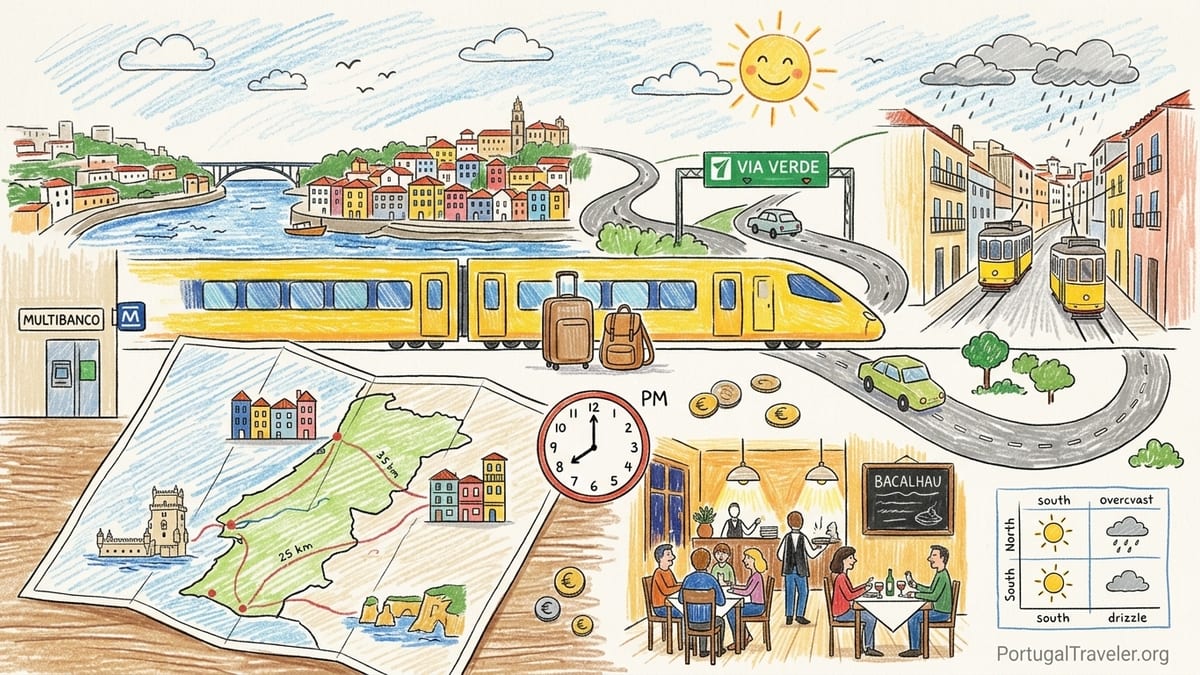
Portugal Is Small on the Map but Big on the Ground
Before that first visit, I looked at Portugal pressed against Spain and saw a petite country I could cover in a week: Lisbon, Sintra, Cascais, Óbidos, Nazaré, Coimbra, Porto, the Douro Valley and then down to Lagos in the Algarve. On the map, Lisbon to Porto is just a sliver, and Porto to the Douro barely registers. In reality, even the fast Alfa Pendular trains between Lisbon and Porto take around two and a half to just under three hours, and that is before you factor in getting to and from the stations and the inevitable coffee stop. Once I was on the ground, it hit me that every “little side trip” was half a day disappearing into transport.
I made my worst miscalculation with the Algarve. I thought I could day trip from Lisbon to Lagos for a quick beach fix. The distance is roughly 300 kilometers, but the fastest trains plus the local connection still add up to about four hours each way, not counting getting from my apartment in Lisbon to the departure station. I abandoned the idea halfway through plotting the schedule, realizing I would see more of train interiors than of Praia Dona Ana. The map invites you to stack destinations, but real-world travel time demands that you subtract instead.
If I could redo that first itinerary, I would limit a ten-day trip to two bases: Lisbon plus Porto, or Lisbon plus the Algarve, or Porto plus the Douro. On my second visit I spent five nights in Lisbon and four in Porto, using only one day for a side trip to Sintra and one short train ride out to Aveiro. That slower pacing changed the entire feel of the trip. I actually had time to linger over grilled dourada in a tasca, get lost in Alfama’s alleys and sit with a glass of vinho verde in Vila Nova de Gaia while the light changed over the Douro.
The lesson that only sunk in once I was there is that Portugal’s distances are deceptive not because they are huge, but because roads and rail lines often funnel you through chokepoints. A drive from Lisbon to the Douro looks simple until you realize that winding secondary roads, toll decisions and occasional traffic near Porto eat into your day. Portugal rewards depth over breadth; the sooner you accept that, the more enjoyable your first trip will be.
How Early to Book: Trains, Hotels and the Toll Tag I Ignored
I am not a chronic pre-booker, and on my first Portugal trip I pushed that habit too far. I assumed I could roll up to Lisbon’s Santa Apolónia station on a Friday morning and hop onto a mid-morning train to Porto. Technically I did get a ticket, but only for a slower Intercidades train, and not at the cheap advance fare I had seen weeks earlier. The fast Alfa Pendular options for reasonable times were thin by the time I tried to buy. Portuguese rail tickets on key routes open for sale ahead of time and the discounted fares can be significantly cheaper than the walk-up prices, especially between Lisbon and Porto. I learned that for popular days like Friday or the start of a holiday weekend, it is worth booking those long-distance trains at least a week or two in advance instead of trusting to luck at the station.
The same pattern played out with accommodation. In Lisbon’s historic neighborhoods such as Baixa and Alfama, and in Porto’s Ribeira district, the charming mid-range guesthouses and small hotels were largely booked out for my dates when I looked barely two weeks in advance. I ended up in perfectly fine but less atmospheric areas and paid more than if I had committed a month earlier. What surprised me was how quickly coastal places also filled. A friend joined later in the trip and struggled to find anything moderately priced in Lagos for early summer because I had encouraged her to “wait and see.” Portugal’s popularity has surged in recent years, and that shows up very clearly in hotel availability.
My most expensive lesson in advance planning involved tolls. I picked up a rental car in Porto for a Douro and Minho loop and waved off the agent’s offer of an electronic Via Verde toll tag. I had driven toll roads elsewhere in Europe and thought I could just pay cash at booths. Once I was on the A28 and A24, I discovered sections where tolls are fully electronic with no cash booths at all. I spent a nervous evening reading about how foreign-plated cars are photographed, bills pass through different agencies and late payments can snowball into unpleasant surprise fees. On my next rental, I paid for the Via Verde device at the counter, which linked all tolls automatically to the contract. It was not cheap, but the peace of mind more than justified it, and it meant I could glide through the green Via Verde lanes without fumbling for coins or cards.
If I were advising my past self, I would say this: for peak months from May through September, book your first and last city, plus any coastal base, at least four to six weeks ahead if your budget is mid-range and you care about location. For train travel between major cities, plan your main long-distance trips as soon as your dates are set, especially Fridays and Sundays. And if you will drive, either arrange a toll tag with the rental company or research in detail how you will pay electronic-only tolls before you get behind the wheel, not after you see the first gantry.
Restaurant Hours, Late Dinners and the Reality of Tipping
On my first evening in Lisbon, I walked into a small restaurant in Bairro Alto at 6:45 p.m. The staff were still setting tables, a delivery man was hauling crates of Super Bock and the waiter, smiling politely, asked if I had a reservation for later. Technically they were open, but the kitchen was not really moving yet. In much of Portugal, especially in non-touristy neighborhoods, lunch runs roughly from 12:30 p.m. to 3 p.m., while dinner is closer to 8 p.m. to 10:30 p.m. My North American instinct to eat dinner at 6 p.m. meant I kept arriving when the room was half-empty, the daily specials were not yet chalked on the board and the atmosphere felt flat. By the time I adjusted and aimed for 8 p.m., the experience changed completely: families, groups of friends and the gentle background of conversations in Portuguese instead of a quiet, half-lit room.
I also had to recalibrate my expectations about restaurant closures. More than once I set out on a Monday evening with a particular tasca in mind, only to find the chairs stacked and the lights off. Many restaurants close one day per week, often Monday or Tuesday, and smaller places might shut between lunch and dinner. In Porto’s residential neighborhoods, I found cafes that were lively all morning, closed for a mid-afternoon lull and then came back to life in the early evening. On my next trip I checked individual opening days and hours, rather than assuming a seven-day, all-day service culture.
Tipping was another area where my assumptions collided with reality. I came with the North American habit of mentally adding 15 to 20 percent to every bill. In Portugal, that kind of tipping is unnecessary and can even feel out of sync with local customs. At a neighborhood churrasqueira in Porto, where my bill for grilled chicken, rice, salad, wine and coffee barely reached 15 euros, I tried to add a 3 euro tip by card. The server looked genuinely surprised and gently pushed a one euro coin back across the table to me, laughing. In casual spots, most locals paid the rounded amount, leaving at most small coins on the table if service was warm.
In tourist-heavy areas, especially in central Lisbon, I did encounter card terminals that prompted for 5, 10 or even higher percentage tips, and a couple of higher-end restaurants added a suggested service amount of around 5 to 10 percent at the bottom of the bill. This created mental whiplash: one night in a family place in Graça no one mentioned tipping at all, and the next night near Cais do Sodré the server held the machine while the screen asked if I wanted to add a gratuity. Over time I gravitated to a simple rule that matched what I saw locals doing. For coffee and a pastel de nata at a counter, I would leave small change. For a regular sit-down meal where service was friendly and relaxed, rounding up a bill of 27.40 euros to 30 euros in cash felt generous and appropriate. Only in more polished, reservation-only restaurants did I approach something like a 10 percent tip, and even then always as cash rather than adding it on the machine.
The practical takeaway from my missteps is to adjust your eating schedule a little later than you might at home, double-check weekly closing days for any must-visit spot, and think of tipping as a modest thank-you rather than an automatic percentage. If you tap to pay in tourist zones, do not feel obligated by high suggested tip buttons on the screen. You are not being stingy by declining. In most of Portugal, the norm is to tip small, or not at all, unless something about the service really stands out.
Cards, Cash and Why My Wallet Was Wrongly Weighted
I landed in Lisbon with several hundred euros in cash, convinced that Portugal would be largely cash-first and that small restaurants would balk at cards. Within two days I realized I had overshot. In Lisbon and Porto I paid for nearly everything by card or contactless wallet: metro rides, train tickets at the station, meals in mid-range restaurants, groceries at Pingo Doce and Continente, even small purchases at pastelarias. The phrase “multibanco” quickly became my favorite word. Many places now accept standard Visa and Mastercard, and I regularly saw people tapping phones and watches to pay.
Where I did need cash was more specific than I expected. In small towns off the main tourist routes, I still met a handful of cash-only snack bars or very small tascas that took pride in avoiding card fees. On the Douro backroads, a roadside café that served me an excellent bifana and beer for just a few euros shrugged when I pulled out a card and pointed to a handwritten “Só dinheiro” sign. Street markets, some taxis that were not on apps and occasional rural guesthouses also preferred cash or had card machines that struggled with my foreign bank. In those pockets I was very glad to have physical euros on hand.
My first mistake was withdrawing too much cash at the airport currency exchange, where the rate and fees were painful. My second was carrying a thick wad of notes into crowded trams and miradouros. On my next visit, I took out a modest amount from a regular bank ATM in the city after arrival and topped up as needed. I kept most of it in my accommodation and only carried what I realistically expected to spend that day, since so many purchases would go on card.
The other subtle difference I noticed is that splitting bills is still often done in a low-tech way. In a Lisbon wine bar, my group of four asked to pay separately, and the owner simply walked around the table asking what each person had ordered, then keyed in four separate payments on the same terminal. It was friendly and unhurried, but not the app-driven itemization I had grown used to in other cities. If you travel with friends, it can be easier to pay one total by card and settle up between yourselves via transfer later rather than forcing complex splits at every meal.
If I could advise first-timer me, I would say bring one or two no-foreign-fee cards that support contactless payments, plus a backup debit card, and plan to withdraw modest amounts of cash inside Portugal as needed. Expect cards to work almost everywhere in Lisbon, Porto and the Algarve, but still carry a cushion of euros for small-town cafés, rural stays and tipping when you want to leave a little extra.
Trains, Luggage and the Myth of Effortless Connections
Portuguese trains became one of my favorite parts of the trip, but not before they humbled me. I imagined gliding between cities with minimal effort, only to realize that my overpacked suitcase was my biggest enemy. Long-distance services like Alfa Pendular and Intercidades allow you to bring luggage on board, but there are practical limits. Overstuffed, oversized cases quickly become a problem on busy services, especially if you are boarding at an intermediate station where racks are already full. On my first Lisbon to Porto journey, I lugged a large hard-shell suitcase and a bulging backpack into a nearly full carriage and spent the first fifteen minutes awkwardly shifting bags to avoid blocking the aisle.
Seats on those trains are usually reserved, so you know your carriage and seat number, but luggage space is first come, first served. Over time I learned to pack into a medium-sized suitcase that I could lift overhead without drama, plus a soft tote that could slide under the seat in front. I also started choosing seats near the ends of carriages, where larger racks often sit. Boarding earlier, especially at the line’s starting station, made an enormous difference. When I travelled from Porto to Lisbon on a later visit, I arrived at Campanhã station a bit ahead of departure, found my coach in advance and rolled straight to a half-empty luggage rack instead of fighting for space in the middle of the carriage.
My other early misjudgment was underestimating transfer time between modes. In Lisbon, Oriente station connects trains, metro and buses, but that does not mean you can leap from a delayed intercity train onto the metro and still make a tightly timed dinner reservation across town. Stations like Santa Apolónia and Campanhã are busy, and elevators and escalators can be crowded, particularly if you arrive with peak-hour commuters. Trekking across Oriente with a big case to find the metro line while scanning for signs in Portuguese took longer than I had assumed. A 10-minute theoretical connection easily stretched to 25 minutes of real movement plus a few minutes of confusion.
On regional and urban trains around Lisbon and Porto, I discovered that platforms can change at the last minute, and announcements are sometimes only in Portuguese. The first time a train to Cascais shifted tracks at Cais do Sodré, I followed the crowd somewhat blindly, aware that my language skills were just good enough to catch “alteração” but not the full explanation. I learned to keep an eye not only on printed timetables but also on the electronic boards, and to check the end destination name on the train itself rather than relying solely on the time.
The overarching lesson was simple but important: Portugal’s trains are comfortable and efficient if you travel reasonably light, arrive a little early and allow a buffer for connections. Bring luggage you can comfortably manage on stairs and through narrow aisles, assume you will need to adjust to last-minute platform changes, and do not schedule anything critical within minutes of your planned arrival. A slightly looser schedule turned stressful scrambles into unrushed walks through stations I actually had time to appreciate.
Driving, Tolls and Why the Scenic Route Is Not Always Slower
Renting a car in Portugal gave me some of my favorite memories: cresting a hill above terraced vineyards in the Douro, pulling over at a viewpoint above the Minho River, stopping on a whim at a stone village that had no public transport. It also produced my most frustrating hour of the trip, standing in front of an unfamiliar toll payment machine at a service area, trying to understand a choice of options while a line formed behind me. My initial plan had been to avoid tolls entirely to save money, but once I saw how much longer a toll-free route from Porto to the Douro could take on twisting national roads, I accepted that toll roads are often the difference between two hours of driving and four.
Portugal’s motorways include both classic toll booths, where you can pay with card or cash, and fully electronic stretches where cameras log your license plate instead. On my first drive on an electronic-only section near the north, there was no way to stop and pay at the time. The charge was applied later, and because I had declined the rental company’s electronic tag, the process of paying as a foreigner felt opaque. I spent time at a post office desk with printed forms and waited anxiously to see if any extra admin fees would show up from the rental company weeks later. They eventually did, turning what had been a modest toll into a more expensive mistake.
On my next trip, I accepted the rental desk’s suggestion of adding an electronic toll tag, even though the daily fee made me hesitate. Having that small Via Verde device on the windshield transformed the experience. I could use designated green lanes at toll plazas without stopping and did not have to worry whether a given stretch of motorway was electronic-only or traditional. At the end of the rental, the total toll amount was charged through the rental company, transparent and itemized. I still used some national roads, especially when I wanted to enjoy scenery at a gentler pace, but I made that choice intentionally rather than out of fear of the toll system.
The other misconception I had was about how tiring driving would feel. On a map, a loop from Porto through the Douro and back via the coast looks like a short, romantic road trip. In practice, driving narrow, shoulderless roads with steep drops and tight switchbacks required real concentration, especially when locals who knew every bend appeared in my rearview mirror. I learned to build in shorter driving days and to accept that the scenic road might take a similar overall time to the motorway once you factored in breaks, photo stops and slower speeds.
If you are comfortable driving and want flexibility, Portugal is rewarding behind the wheel, but only if you respect its mix of toll systems and topography. Decide in advance whether you will use motorways extensively and, if so, strongly consider taking an electronic tag through your rental company. When planning routes, pay attention not just to distance but also to estimated time and elevation changes. A 100-kilometer drive in the Alentejo plains feels very different from the same distance in the Douro. Your future self will be grateful if you prioritize shorter daily legs and allow ample daylight to navigate rural roads.
Weather Surprises and Regional Differences I Underestimated
Coming from a place where “Southern Europe” is vaguely associated with constant sunshine, I packed for my first Portugal trip as if the entire country shared the climate of a summer beach resort. Lisbon, Porto, the Douro and the Algarve all blurred together in my head as universally warm and dry. The reality on the ground was more nuanced. In April, Lisbon gave me cool mornings, warm afternoons and breezy evenings that called for a light jacket. Two days later in Porto, the temperature dropped notably, and a persistent Atlantic drizzle set in. The same lightweight wardrobe worked in both places only because I had layers, but if I had packed solely for heat I would have been buying sweaters in a shopping center instead of sipping coffee by the river.
Even in the summer months, differences stood out. A July afternoon in inland Alentejo felt oven-like, with the sun pressing down on whitewashed villages and heat radiating from stone streets well into the evening. On that same trip, the Atlantic coast around Cascais and the beaches west of Porto greeted me with brisk winds and cooler water. Locals brought hoodies to the beach and spent as much time wrapped in towels as in the waves. I watched visitors from colder climates wade in with bravado, only to retreat quickly from the chilly Atlantic.
The Douro Valley brought its own microclimate lesson. Up in the terraced vineyards during early autumn, daytime temperatures were still high, but as soon as the sun sank, the air cooled sharply. The sweater I had debated leaving behind became my best friend on winery terraces where I wanted to linger past sunset. Those temperature swings made me grateful for versatile layers instead of single-purpose outfits. I also learned that interior accommodations without strong air conditioning can feel uncomfortably warm during heatwaves, even if the nights cool down outside, so checking whether a room has effective cooling is not a trivial detail in summer.
The main adjustment I would suggest to any first-timer, based on those surprises, is to pack not only for where you start, but for where you will go next. If you are splitting time between Lisbon and Porto, assume that Porto may be cooler and wetter and bring a compact rain jacket and closed shoes. If you add the Algarve or Alentejo, prepare for intense sun and pack sunscreen, a hat and breathable clothing even if the coast in Lisbon feels mild. Portugal’s size can trick you into thinking the weather will be uniform. It is not, and having layers ready saves you from either shivering on a windy miradouro or hiding in your accommodation during the best light of the day.
Language, Etiquette and the Value of a Few Portuguese Words
Before my first trip, I heard repeatedly that “everyone speaks English” in Portugal. That turned out to be partly true and partly misleading. In central Lisbon, Porto’s Ribeira and most hotel receptions, staff did switch to English with ease. Ordering coffee near Baixa or booking a table by phone in the Chiado went smoothly in English. This gave me a false sense of security that crumbled the first time I walked into a family-run tasca in a small town outside Coimbra. The menu was written only in Portuguese, the daily specials were recited at speed and the owner smiled kindly while I scrambled to match words like “bacalhau,” “porco” and “sopa do dia” to the food that appeared at other tables.
What helped most was not suddenly becoming fluent but learning a basic set of words and phrases and using them consistently. A simple “bom dia” in the morning or “boa tarde” in the afternoon, “por favor” and “obrigado” opened doors and softened interactions in ways I did not appreciate until I tried them. When I greeted people in Portuguese and then gently asked “fala inglês?”, the conversation almost always flowed more easily than when I walked in with English from the start. Even when the answer was “só um bocadinho,” that small effort seemed to matter.
Etiquette around space and noise took a little adjustment too. Portugal’s cities are lively, but in residential lanes of Alfama or Porto’s backstreets, sound carries quickly. Dragging a rolling suitcase across cobblestones at 7 a.m. or talking loudly under people’s balconies at midnight felt out of place once I saw how closely windows and doors opened onto the street. After one awkward glance from an older woman in Alfama as my suitcase rattled by, I started carrying it for certain stretches and making a point of lowering my voice on narrow streets late at night.
Another subtle lesson was the difference between tourist-facing frustration and local tolerance. In line at a pastelaria, when an overseas visitor tried to pay a 1.20 euro coffee with a large note and held up the queue while digging through a backpack, the staff remained patient but the body language of regulars suggested mild annoyance. By my second week I had adopted local habits: ordering quickly, having small change or a card ready, clearing my table when possible in self-service spots and saying a clear “bom dia” and “obrigado” at each interaction. None of these are hard rules, but they smoothed my path and made me feel less like a walking disturbance.
If I were resetting my own preparation, I would spend an hour or two before arrival learning core Portuguese phrases, numbers, and food words, and I would mentally commit to being a little quieter and more aware of my surroundings in historic neighborhoods. The payoff is disproportionate. You do not need perfect pronunciation to make a positive impression. Even a modest effort in the local language, combined with small courtesies, turns many routine exchanges into brief, pleasant moments that stay with you long after you leave.
The Takeaway
Looking back on that first Portugal trip, what strikes me is not how much I saw, but how much better I could have experienced it with a few different choices. I tried to cover too much ground because the country looked small on the map. I booked trains and hotels later than was wise for a destination in high demand. I misunderstood restaurant hours, overestimated the role of tipping, misjudged the balance of cash and cards, and treated driving and tolls as afterthoughts. None of these mistakes ruined the journey. Portugal is forgiving and full of kindness for visitors, and I still came home with memories of azulejo-lined streets, river sunsets and lingering meals.
What changed on subsequent visits, once I had learned these lessons the hard way, was the texture of each day. With fewer bases, journeys between them became pleasant interludes instead of frantic relocations. Booking key trains and accommodations earlier gave me better seats, nicer rooms and more predictable days. Adjusting my meal times, tipping habits and payment methods helped me feel more in tune with local rhythms rather than constantly out of step. Embracing the toll tag, packing lighter for trains and layering for varied weather reduced the background stress that can quietly drain a trip.
If you are planning your first time in Portugal, consider my missteps a kind of field-tested shortcut. Accept that you will not see everything, and do not try. Choose two or three hubs and give them room to breathe. Book your main trains and stays with some lead time, learn a handful of Portuguese words, carry a mix of cards and modest cash, and treat tolls and distances with the respect they quietly demand. In return, Portugal will meet you with warm light on the tiles, the clink of small glasses in crowded tascas, the sound of waves on an Atlantic beach and, if you are lucky, the feeling that you already want to return before you have even left.
FAQ
Q1. Is it realistic to visit Lisbon, Porto and the Algarve on a 7-day first trip?
For most first-time visitors, trying to combine Lisbon, Porto and the Algarve in a single 7-day trip feels rushed. You spend a large share of your time on trains, buses or in a rental car, especially between Lisbon and the Algarve. From experience, focusing on two areas works better in a week, such as Lisbon plus Porto or Lisbon plus the Algarve, so you have time to actually enjoy each place instead of just passing through.
Q2. How far in advance should I book trains between Lisbon and Porto?
After nearly missing out on preferred times, I now try to book long-distance trains between Lisbon and Porto at least one to two weeks in advance, especially for Fridays, Sundays and holidays. Buying early usually gives you more choice of departure times and can unlock cheaper fares compared with buying at the station on the day of travel.
Q3. Do I need to reserve seats on Portuguese trains?
On intercity services like Alfa Pendular and Intercidades, seats are reserved, and your ticket will show a specific coach and seat number. You can travel without reservations on regional and urban trains around Lisbon and Porto, which operate more like commuter services. On my first trip I underestimated how full long-distance trains could get, and having a reserved seat on those journeys made travel far more comfortable.
Q4. Should I get an electronic toll tag for driving in Portugal?
If you plan to use motorways more than occasionally, especially in regions with electronic-only toll sections, adding an electronic toll tag through your rental company is worth serious consideration. After one stressful drive trying to figure out how to pay tolls retroactively, I switched to using a rental car with a tag, which let me pass through dedicated lanes without stopping and avoided later administrative fees.
Q5. How much cash should I bring if cards are widely accepted?
From my experience, you do not need to carry large amounts of cash in Portugal, especially in Lisbon, Porto and major tourist towns where cards are widely accepted. I usually withdraw a modest amount after arrival for small purchases in local cafés, rural guesthouses, markets and occasional cash-only spots, then rely on contactless card payments for most larger expenses such as hotels, train tickets and restaurant meals.
Q6. What is a normal tip at Portuguese restaurants?
On my first visit I arrived with a 15 to 20 percent tipping habit, which quickly felt out of place. In everyday restaurants, many locals simply round up the bill or leave a few coins for good service. For a sit-down dinner with friendly service, I often round up a bill of around 27 or 28 euros to 30 euros in cash. Only in more upscale, reservation-only places do I approach something like 10 percent, and even then it is a personal choice rather than an expectation.
Q7. Is it safe to rely mainly on English, or should I learn Portuguese?
You can navigate the main tourist areas of Portugal with English, particularly in central Lisbon, tourist districts of Porto and the Algarve. However, once I ventured into smaller towns and family-run spots, basic Portuguese made a big difference. Simple phrases like greetings, please and thank you, plus a few food words, improved interactions and showed respect. I would not rely entirely on English if you plan to spend time outside the main tourist routes.
Q8. What kind of luggage works best for trains and cobblestone streets?
After wrestling a large hard-shell suitcase through crowded carriages and over uneven streets, I strongly recommend a medium-sized suitcase you can comfortably lift plus a smaller day bag. Trains have limited luggage racks, platforms can involve stairs and many historic areas are paved with cobblestones. Lighter, more maneuverable bags make a noticeable difference to your energy and stress levels day to day.
Q9. How different is the weather between Lisbon, Porto and the Algarve?
On my trips I found Lisbon generally mild, Porto cooler and sometimes wetter, and the Algarve sunnier and warmer, especially in summer. Coastal breezes can make evenings feel cooler than daytime highs suggest, while inland areas like the Alentejo can be very hot. Packing layers, including a light jacket and closed shoes, worked far better than assuming uniform beach weather across the whole country.
Q10. Is it better to travel Portugal by train or by rental car on a first visit?
For my own first trip, trains were ideal between major cities such as Lisbon and Porto, while renting a car later opened up rural regions like the Douro and the Alentejo. If it is your first time, I would suggest starting with trains for city-to-city travel, then considering a short car rental for a few days to explore countryside or vineyards, rather than driving the entire time. This combination balances ease, cost and access to harder-to-reach areas.