


On my first long trip around Portugal, I made the classic mistake: I changed hotels almost every other night, assuming that more bases meant deeper travel. What I actually got was a blur of check-ins, luggage hauls up cobbled hills and far too much time thinking about parking and train schedules. On later trips, I slowed things down, chose fewer hubs and paid close attention to how far my bed was from a station, a parking garage and a relaxed place for dinner. This article draws directly from those real stays and journeys to help you answer one key question for your own itinerary: how many bases does a Portugal trip really need, and where should they be?
How Many Bases Does a Portugal Trip Really Need?
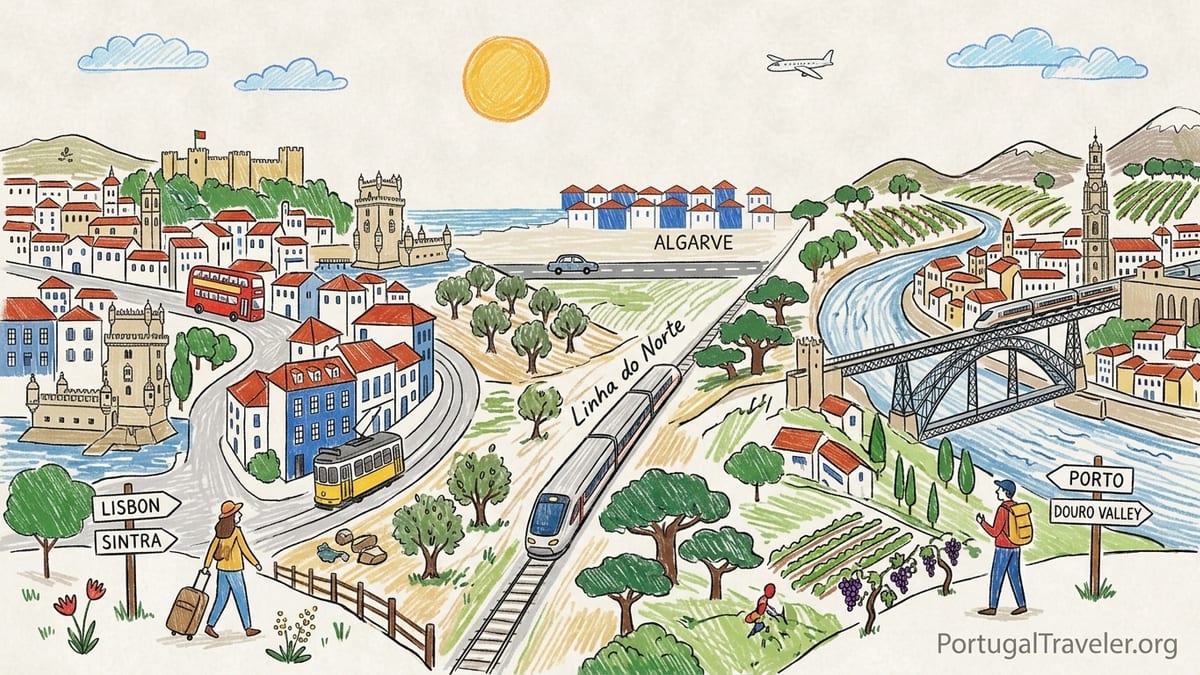
Portugal looks small on the map, but the way you structure your bases has a huge impact on how your days feel. The rail backbone between Lisbon and Porto on the Linha do Norte line is fast and frequent, with long distance trains usually taking around 2.5 to 3 hours between the two cities. Regional lines reach Coimbra, Braga, Évora and parts of the Algarve, and a modern highway network connects Lisbon to Lagos in the western Algarve in roughly 3 hours of driving in normal conditions. In other words, you can cover ground quickly if you plan around a few good hubs instead of hopping nightly.
On trips of 7 to 10 nights that include Lisbon, Porto and the Algarve, I have found that three bases are usually enough: one in or near Lisbon, one in or near Porto or the Douro, and one in the Algarve. Stretch to four only if you really enjoy unpacking and packing or want a dedicated countryside base such as the Alentejo. With two weeks or more, a fourth or fifth base can make sense, but only if each earns its place by cutting down long day trips. Each added base costs at least half a day in check-out, transfer, check-in and getting your bearings.
The decision is rarely about sheer distance. It is about the friction between hotel and station, hotel and parking, and hotel and evening life. A base that looks central but sits 25 minutes uphill from the train station on old stone sidewalks will feel very different from a hotel that is a level 5 minute walk from the platforms. Likewise, a countryside guesthouse with easy on-site parking can be much more restful than a historic center hotel that forces you into tight one-way streets and expensive garages.
The rest of this article walks through how I chose bases in Lisbon, Porto, the Douro, the Algarve and the Alentejo, using real hotel-to-station distances, approximate transfer times, parking setups and evening atmosphere. The examples are meant to help you design your own skeleton itinerary, not to prescribe exact properties to book.
Lisbon as a Base: Central Bed, Trains at Your Feet
Lisbon works very well as a rail hub. On one trip I stayed just off Rossio square, a few level minutes on foot from Rossio station, which handles frequent suburban trains to Sintra, and about a 10 to 12 minute downhill walk to Cais do Sodré, the departure point for the Cascais coastal line. That location meant I could take a morning train to Sintra or Cascais and still be back in Baixa in time for an unhurried dinner, all without touching a car or metro. Dragging a medium suitcase from the station to the hotel on arrival took around 5 minutes along flat pavements with occasional small cobbles.
Staying in Baixa or Rossio also keeps you fairly close to Santa Apolónia and Lisboa Oriente, the main long distance rail terminals. A taxi or ride hail from a central Rossio hotel to Oriente has usually taken me around 15 to 20 minutes outside rush hour. With an Alfa Pendular train from Lisboa Oriente to Porto taking roughly 2.5 to 3 hours, I could leave a Rossio area hotel around 8:30 in the morning and be stepping out of Porto Campanhã station around lunchtime without feeling rushed.
Where Lisbon becomes tricky is parking. Historic districts such as Alfama and parts of Baixa have resident-only street spaces and narrow lanes, and parking garages are the realistic solution for most visitors. On one stay, I chose an apartment hotel near the lower edge of Alfama specifically because it offered access to an underground garage under the riverfront, about a 3 to 4 minute walk from reception along level pavements. That small detail turned out to be decisive: I could drop the car for two days, use trams and metro in the city center, and only retrieve it early on the morning we drove south to the Alentejo. Having the garage ticketed and well lit also made late night walks back to the room feel safe.
In practical terms, Lisbon can easily sustain a 4 or 5 night base without feeling repetitive, because day trips to Sintra, Cascais and occasionally to Évora by train or bus are all feasible. The key is picking a bed that balances station access with an evening atmosphere you enjoy. A Rossio or Baixa address puts cafés and tiled squares right outside but can be noisy. A little north, near Avenida da Liberdade or Marquês de Pombal, you trade some picturesque alleys for wider sidewalks, larger hotels with garages and a short metro hop to the riverfront.
Porto as a Base: When the Hill Matters More Than the Map
Porto rewards careful thought about base location more than any other place I stayed. The city center is walkable in pure distance, but the elevation changes are sharp, and cobbled lanes can turn a 600 meter walk with luggage into a workout. On my first Porto visit, I opted for a small design hotel in the Ribeira quarter, overlooking the Douro. It was a romantic choice but a practical compromise. On paper it sat around 700 meters from São Bento station. In reality, that was 10 to 15 minutes of hauling bags up and down uneven flagstones, then weaving through crowds along the river.
The Ribeira hotel had no on-site parking. The staff directed us to a public garage in the historic center, roughly 8 to 10 minutes on foot, with a short but steep uphill section. We parked the car there and did not touch it for four days, which was sensible in terms of cost and nerves. Street parking around the old town is scarce and usually paid for limited hours, and the medieval street grid makes wrong turns tiresome. The trade-off was that every day began and ended with that climb, which felt less charming under drizzle with groceries in hand.
On a later trip I swapped romance for convenience and based myself in Baixa, near Avenida dos Aliados. That put me within a short walk of both São Bento and Trindade stations, with metro lines in multiple directions. A mid-range hotel on a broad avenue meant level sidewalks, a reliable lift and more straightforward taxi access. Dragging a wheeled suitcase from São Bento to the hotel took about 5 minutes on mostly flat pavement. For arrival by rail and onward day trips to Braga, Guimarães or Aveiro, this central plateau location worked far better as a base than the riverfront, despite being less visually dramatic.
For travelers with a rental car, Porto often works best as a hub if you park the vehicle in a attended garage on the edge of the historic zone or stay in a modern area such as Boavista where hotels frequently offer on-site parking and wider streets. From a Boavista hotel with its own garage, I left the car downstairs and rode the metro 10 to 15 minutes into Trindade and Aliados for city exploring, then used the car only for Douro or Minho day trips. That separation between city wandering and regional driving reduced stress and made the base feel calmer, even though it meant a metro ride home after dinner.
Douro and the Countryside: When It Is Worth Losing the Train
The most obvious way to see the Douro Valley is as a day trip from Porto by train. Regional services run from Porto Campanhã along the Douro line to towns such as Peso da Régua and Pinhão, passing terraced vineyards and olive groves. On one stay, I took an early morning train from Campanhã to Pinhão, a journey of roughly 2.5 hours. From the small station in Pinhão, the guesthouse I had chosen was about a 10 minute walk along the river on a level pavement, so I managed with a rolling bag and a small backpack without needing a taxi.
That decision to sleep in Pinhão instead of day tripping meant I could watch the valley change with the light, eat unhurried dinners and catch a quieter mid-morning train back to Porto the next day. The trade-off was that I lost the direct convenience of a big city station outside my door. Pinhão’s last trains back to Porto did not run late into the night, so when I eventually rented a car for a later trip, I made sure to select a countryside quinta with its own parking, trading rail access entirely for driveway access.
Staying at a rural wine estate in the Douro or the Alentejo often means gravel driveways, no street lighting and complete silence after midnight, but it also means never hunting for street parking or calculating tram transfers with bags. On a three night stay outside Évora, for example, I parked the rental car under a cork oak tree a few meters from my room and drove into the walled city only once a day, parking in a signed public lot about a 7 to 8 minute walk from the Roman Temple. In the evenings the base itself provided dinner and a view of the stars, so I did not miss the urban atmosphere.
If your itinerary already includes Lisbon and Porto as urban hubs, adding one countryside base like this can be worth the loss of train convenience, especially if you are comfortable driving and want a slower rhythm. The key is to look carefully at how far the property sits from the nearest town, what the access road is like and whether there is clear, level space to unload luggage. A scenic hilltop can be beautiful but requires more effort every time you come and go.
The Algarve Question: One Base or Two?
The Algarve tempts many visitors to add extra bases, moving from Lagos to Tavira to Faro in search of variety. Having tried both a single base and multiple moves in the region, I now favor one well chosen hub for most trips of 3 to 5 nights. Driving distance from Lisbon to Lagos on the main A2 and A22 toll highways is roughly 300 kilometers and usually around 3 hours in light traffic. That is long enough that you do not want to arrive only to change hotels again the next morning.
In Lagos, I once stayed in a small hotel inside the historic walls, about 800 meters from the train station and marina. With luggage, the walk took around 15 minutes, partly along flat pavements by the water, then up a mild slope into the old town. For arrival by train from Lisbon via a connection in Tunes, this was manageable. The reward was an easy stroll to restaurants on the main squares and to beaches like Praia da Batata in 10 to 20 minutes. The downside was that parking near the hotel was limited and streets were narrow. I parked the rental car in a public lot about 5 to 7 minutes away on foot and treated it as storage for most of the stay.
On a later visit I booked a modern apartment just outside the old town, roughly 10 minutes’ walk from the center but with on-site underground parking. This changed the way the base functioned. Leaving for a day trip to Sagres or the west coast beaches meant rolling the elevator down to the garage, driving out onto a wide road and being on the highway within 10 minutes. Coming home at sunset, I never had to worry about finding a street space or squeezing into an old lane. For a road tripper who still wants evening atmosphere on foot, that compromise between parking and proximity worked far better than staying directly in the maze of the historic core.
If you have at least four nights in the Algarve, one base in Lagos or nearby will cover the western and central coast comfortably by car. Eastward towns such as Tavira add character and different scenery, but shifting east for a single night will cost you several hours of packing, check-out, driving and check-in for relatively modest gains. With a full week to spare, using two bases such as Lagos and Tavira can begin to make sense, but only if each stay lasts at least three nights.
Luggage, Transfers and the Hidden Cost of One-Night Stays
When travelers talk about how many bases to use, they often focus on map distances and forget the small, repetitive frictions. In practice, what made some of my early multi-base Portugal itineraries feel tiring was not the train rides themselves but the repeated sequence of packing, carrying and orienting. A single night in Coimbra, inserted between Lisbon and Porto, looked efficient on paper. The reality was different. I checked out of a Lisbon hotel at 10:00, took a taxi about 20 minutes to Oriente, rode the train 2 hours to Coimbra-B, transferred to a local connection, then dragged my suitcase 10 to 12 minutes uphill to a guesthouse near the university. By the time I checked in, I had spent the better part of the day in motion.
Had I simply stayed on the direct train to Porto and based there, I could have checked into a central hotel by early afternoon and taken a lighter day trip to nearby historic towns later in the week. Instead I added an extra base for a single evening’s stroll along Coimbra’s riverfront. The guesthouse was charming, but in retrospect the effort-to-reward ratio did not justify the extra move.
A similar lesson came from trying to squeeze both Óbidos and Nazaré into separate overnight stops on a coastal drive. Both towns are interesting, but their compact size means that a long afternoon and evening is often enough. In both cases I spent more time dealing with parking on the perimeter and rolling luggage through crowds or up slopes than I did relaxing. On a later trip, I restructured the same route as a single base in Lisbon and a single base in the Algarve, visiting Óbidos as a half-day detour with only a light daypack, and the experience was far more enjoyable.
When planning your own bases, it can be useful to imagine each transfer in 15 minute blocks. A check-out, taxi ride, train journey, connection, walk to the new hotel and check-in easily add up to 4 to 6 hours door to door. If you are only staying one night, you will repeat much of that again the next morning. A rule of thumb that has served me well in Portugal is to avoid one-night stands unless there is a very specific reason to sleep in that place, such as a sunrise experience or an early departure that cannot be reached from a nearby hub.
Evenings on Foot: Why Atmosphere Should Shape Your Hubs
Transport logic is not the only reason to choose a base. The way a place feels after dark matters just as much. In Lisbon, staying near Rossio meant that after a day of sightseeing I could simply step outside, walk three minutes to a tiled square and decide between casual petisco bars or more formal restaurants. There was no need to think about metro times or tram crowds. The flip side was a background hum of nightlife until late, which suited me but could bother light sleepers.
In Porto, the contrast between the Ribeira and Baixa bases was particularly striking in the evenings. In Ribeira, I would sit at a riverside table as the bridge lit up, then climb a little back to the hotel within 5 minutes. The density of bars and restaurants meant that everything happened within a tight radius. When I later stayed near Aliados, evenings were slightly less postcard-like but far more practical. I could wander through different streets each night, from wine bars near Clérigos to cafés closer to Bolhão, and always be back at the hotel in 10 minutes or less, walking on broad pavements with good lighting.
By contrast, on one Alentejo stay outside Évora, evenings were almost entirely spent on the property. The guesthouse offered simple dinners and the nearest village restaurant was roughly 10 minutes away by car along an unlit rural road. That meant no wine with dinner if I was driving and required a conscious decision to go out at all. It was peaceful and restorative, but only because I arrived knowing that my evenings would be quiet and that my social time would be earlier in the day on excursions.
When evaluating potential bases in Portugal, it helps to picture your ideal evening. If you imagine strolling out the door to find a square lively until midnight, then neighborhoods around Baixa and Chiado in Lisbon or Baixa in Porto will serve you better than remote hillside hotels, even if the latter look beautiful online. If your goal is to read by the pool and hear only cicadas, then a rural Alentejo or Douro base is a better match, despite the extra driving involved.
FAQ
Q1. How many bases should I plan for a 10 day trip to Portugal?
For a 10 day itinerary that includes Lisbon, Porto and the Algarve, three bases are usually enough: one in or near Lisbon, one in or near Porto or the Douro, and one in the Algarve. This setup balances variety with minimal time lost to packing, transfers and repeated check-ins.
Q2. Is it better to visit Sintra and Cascais from Lisbon or as separate overnight bases?
In most cases it is better to visit Sintra and Cascais as day trips from a Lisbon base. Trains from central stations such as Rossio and Cais do Sodré reach both towns in under an hour, and you avoid the effort of moving luggage into small historic centers that can be hilly and busy.
Q3. Should I stay in Ribeira or Baixa when using Porto as a hub?
Ribeira is very atmospheric and close to the river, but involves more hills and often longer walks with luggage to São Bento station and public parking. Baixa and the Aliados area sit on a flatter plateau closer to both São Bento and Trindade stations and work better as a rail and metro hub, especially if you are carrying heavy bags.
Q4. Do I need a car if I base in Lisbon and Porto?
You do not need a car for the cities themselves or for classic day trips to Sintra, Cascais, Braga, Guimarães or Aveiro, which are all reachable by train or bus. Renting a car becomes useful if you want a countryside base in the Alentejo, rural Douro estates or more flexible exploration of the Algarve coast.
Q5. Is it worth staying overnight in the Douro Valley instead of doing a day trip?
Staying one or two nights in a place like Pinhão or at a rural wine estate gives you quieter evenings and sunrise or sunset views that a day trip cannot provide. It does, however, mean giving up the easy station access and dining choices of Porto, so the decision depends on how much you value that slower countryside atmosphere.
Q6. How far is Lagos from Lisbon, and is it a good single base for the Algarve?
Lagos is roughly 300 kilometers from Lisbon by the main toll highways and the drive usually takes around 3 hours in normal conditions. For trips of 3 to 5 nights in the Algarve, Lagos or its surroundings work well as a single base for western and central coast excursions, especially if your accommodation includes on-site parking.
Q7. Are one night stops in towns like Coimbra or Óbidos a good idea?
While towns such as Coimbra and Óbidos are attractive, inserting many single night stops tends to consume full travel days with check-outs, station transfers and check-ins. Unless there is a specific reason to wake up in those places, many travelers find it more relaxing to visit them as day trips from larger hubs like Lisbon or Porto.
Q8. How important is hotel distance from the train station when choosing a base?
Hotel distance to the station matters more than it appears on a map, especially in hilly cities. A flat 5 minute walk with luggage in Lisbon or Porto is significantly easier than a 15 minute climb over cobbles, and can shape how you feel about every arrival and departure.
Q9. Where should I stay if I have a car in Lisbon and Porto?
If you must have a car in Lisbon or Porto, it is usually easier to stay slightly outside the tightest historic cores, in areas where modern hotels include garages and streets are wider. You can then use metro or trams for city sightseeing and reserve the car for day trips or onward legs of your journey.
Q10. How should evening atmosphere influence my choice of base?
Evening atmosphere should be a primary factor. If you want lively squares and restaurants within a short walk, choose central neighborhoods such as Baixa and Chiado in Lisbon or Baixa in Porto. If you prefer quiet nights and self-contained stays, consider countryside bases in the Douro or Alentejo or apartment-style stays on the edges of resort towns where you are happy to drive or walk a little farther after dark.