

On my last extended stay in Lisbon, I decided to do what many visitors only talk about. I skipped the rental counter and relied entirely on public transport to explore the region. For several weeks I rode CP’s Lisbon urban trains on the Sintra, Cascais, Azambuja and Sado lines, connected to metro and buses, and crossed the Tagus by ferry. I learned where the network made a car feel completely unnecessary and where, standing on a windy platform or an infrequent bus stop, I quietly wished I had keys in my pocket.
How I Set Myself Up: Cards, Passes and First Lessons
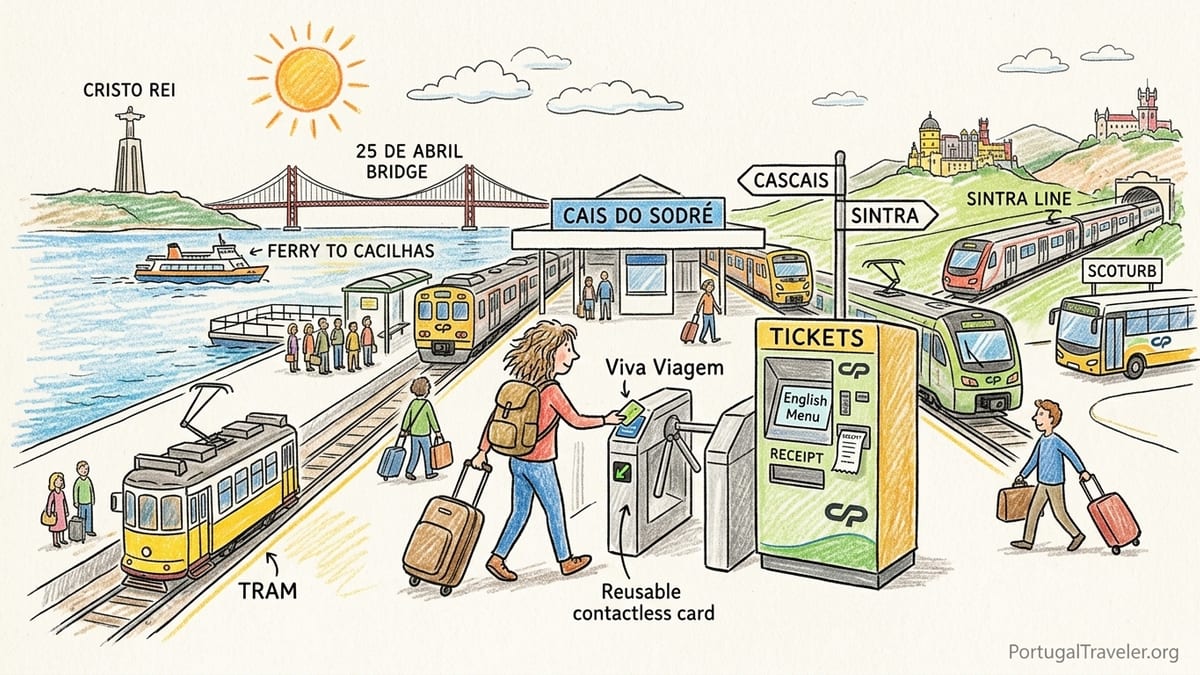
I based myself near Cais do Sodré, one of Lisbon’s key interchanges, because it connects directly to the Cascais suburban line, the metro’s Green Line and the ferry terminal for Cacilhas. On my first morning I joined the small queue at a CP ticket machine and bought a reusable contactless card. The anonymous Viva Viagem style card, which costs a few euros and can be reused, let me load single tickets, zapping credit and 24‑hour multimodal tickets accepted by CP urban trains, metro, buses and ferries. For longer stays, locals use a personalized Navegante card with a €40 Navegante Metropolitano pass that covers almost all regular public transport across the Lisbon Metropolitan Area, from Mafra down to Setúbal and out to Cascais and Vila Franca de Xira, but that requires a photo and ID and is designed more for residents than short‑term visitors.
Because I knew I would be bouncing between operators, I started with pay‑as‑you‑go zapping credit and occasional 24‑hour passes. CP’s own fares list shows that a standard Lisbon urban train journey debits about €2 from zapping for most common suburban trips, and there is also a CP / Carris / Metro 24‑hour ticket around €11 loaded on the same card, valid on CP urban trains and Lisbon’s main city operators. That first experiment already taught me something: if you plan to do more than two or three suburban legs plus some metro and buses in a day, the 24‑hour ticket is usually better value than piecing everything together ride by ride.
Buying tickets was straightforward in the stations that matter most to visitors. Oriente, Cais do Sodré, Rossio, Santa Apolónia and Barreiro all had machines that accepted cards, offered an English menu and printed receipts, plus staffed ticket counters during the day. Where it became less comfortable was on smaller stops along the Sintra or Azambuja lines, where one out of several machines might be out of order, and there was no staffed counter. More than once I watched newcomers arrive with rolling luggage, circle the concourse to find a working machine, and then sprint to a departing train. The lesson was simple: load some extra credit or a day ticket before venturing out, so that each change of line does not begin with a ticket scramble.
With my card sorted and my first balance loaded, I effectively had a key to CP’s Lisbon urban network. Over the next weeks I tested each line for the things most travelers care about: how easy it is to reach popular places, how forgiving the system is with luggage and transfers, and where the gaps still make a rental car tempting.
Riding the Sintra Line: Tourist Crowds, Easy Access and Some Frustration
The Sintra line is the route almost every visitor will ride at least once. Trains run from central Lisbon out to Sintra, with most services originating either at Rossio, a beautiful but often crowded terminal, or at Oriente and Santa Apolónia, threading across the city. On my first trip I took the classic tourist path: Rossio to Sintra. I bought a Sintra‑bound ticket at Rossio’s lower concourse, validated it at the gates and walked up to the wide, arched platforms where suburban trains depart roughly every 15 to 20 minutes in the daytime. The ride took about 40 minutes and cost close to €2 each way on zapping, noticeably less than the tourist‑targeted day tickets sold by some agencies.
With a small suitcase and a backpack I found the Sintra line manageable but not luxurious. The carriages are older suburban units with limited luggage space and plenty of grab poles. On a weekday mid‑morning, I could keep my suitcase near the doors and still find a seat. On a sunny Saturday, the same train felt completely different. Groups with wheeled luggage, strollers and large daypacks filled the vestibules. At Queluz‑Belas and Amadora, more commuters squeezed on. Technically the line works perfectly without a car, but in the high season or on weekends you need to accept that you might stand the whole way and guard your bags in close quarters.
The real test of whether a car is unnecessary comes once you arrive in Sintra. The train deposits you right in town, but the palace and castle are on the hills above. My first visit I walked outside the station and bought a ticket from Scotturb for the tourist bus that loops up to Palácio da Pena and Castelo dos Mouros. The queue for the bus was long, and traffic on the narrow mountain road reduced the benefit of public transport. Could a car have been better here? Possibly, for a family traveling outside peak times, but parking around the palaces is strictly controlled and often full. In practice, the train‑plus‑local‑bus combination still felt like the rational choice, even if it was not especially comfortable. On a later trip on a cloudy weekday, the Sintra train was calm, the bus line shorter, and I did not miss a car at all.
Further along the Sintra line, past the tourist crush, CP’s urban network shines. I used the same line to reach the National Palace of Queluz. I got off at Queluz‑Belas, crossed the road and walked about ten minutes on flat sidewalks to the palace entrance, all on the same €2 urban fare. Here the comparison was simple. Driving would have shaved only a few minutes off the journey from central Lisbon, and I would have had to think about parking. With trains two or three times an hour and a stress‑free walk, the Sintra line made a car feel redundant.
Cascais Line: Beaches, Boardwalks and Seamless City Escapes
If the Sintra line is workmanlike and often crowded, the Cascais line is where the Lisbon urban trains turn into a leisurely coastal ride. Trains run from Cais do Sodré to Cascais, hugging the Tagus and then the Atlantic, with stops in Belém, Algés, Oeiras, Carcavelos, Estoril and others. I used this line repeatedly for day trips to the beach, visits to Belém and evenings in Cascais, always starting from Cais do Sodré, which doubles as both the train terminal and a metro and ferry hub.
On my first beach day I loaded a CP urban day ticket that covers the Lisbon suburban services for 24 hours and walked up to the smartcard gates at Cais do Sodré. Trains to Cascais were posted every 20 minutes or so in the daytime. I boarded with a backpack and a small cooler bag and still had no trouble finding a seat near the window. The coastal scenery begins almost immediately after Santos, and by the time we passed Belém the carriage had a handful of surfboards and sun umbrellas in the aisles. What impressed me most was how friendly the service is to casual beachgoers with gear. The modern units on this line have relatively wide doors and a low, level floor, so even with bulky bags or a folded stroller you are unlikely to feel in the way.
My stops along this route showed how little a car adds on this side of Lisbon. For Belém, I simply got off at Belém station, walked five minutes along the riverside to the Jerónimos Monastery and the famous custard tart bakery, then on another day walked the opposite direction to the MAAT museum. For Carcavelos beach, I stepped off at Carcavelos station and walked straight down an avenue lined with cafés. The sand begins less than 10 minutes from the platform. At Estoril and Cascais, the stations open almost directly onto waterfront promenades. It is one of those rare places where the train journey feels like part of the beach experience, not just a way to get there.
There were still moments when a car would have been convenient. One afternoon I tried to reach a restaurant on a hill above Parede that was nowhere near the main bus lines. The walk up from the station, in heat and coastal wind, took almost 25 minutes and included stretches without sidewalks. For this kind of scattered, hillside suburbia, the public transport network is understandably weaker. I remember thinking that if I had been traveling with small children or someone with limited mobility, a short rental or a taxi would have been more sensible. But for most typical visitor plans along the Cascais line, the urban trains, combined with occasional local buses, outperform driving in both time and hassle.
Azambuja and Sado Lines: Everyday Commuter Lisbon, Not Instagram Lisbon
The Azambuja line runs from Lisbon out through the Tagus valley to Azambuja, with stations at Santa Apolónia, Oriente and others on the way. I used it primarily as a way to understand how the urban network serves ordinary residents and to visit Vila Franca de Xira for a riverside walk and lunch. From my base, I took the metro to Oriente, then transferred to an Azambuja‑bound suburban train. The timetable showed frequent services threading the urban sections, with a more commuter‑like spacing further out.
The transfer at Oriente was easy in physical terms. The station has clear signage pointing from the metro to the CP suburban platforms, and my Viva‑style card worked at all gates. Where it became trickier was in understanding which train accepted the urban fares. On the departure boards, intercity trains to Porto and regional services shared the platform area with the Azambuja suburban trains, but only the latter accept the simple €2‑class urban tickets and Navegante passes. On my first attempt I nearly boarded a long‑distance service because it happened to be stopping at the intermediate station I wanted. Only a last‑second announcement and the obvious difference in rolling stock made me step back. The lesson was that, outside the tourist‑heavy Sintra and Cascais corridors, the network assumes you already know what you are doing.
The Sado line, on the south side of the Tagus, felt even more like a line designed for residents rather than visitors. To reach it without a car I had to first take a Transtejo Soflusa ferry from Terreiro do Paço across to Barreiro, then connect to a CP suburban train running down to Setúbal and Praias do Sado. The ferry leg was a pleasure. I tapped my card at the gates in Terreiro do Paço terminal, boarded one of the catamaran ferries and crossed the wide estuary in bright morning light with commuters reading newspapers and students scrolling phones. The ride took around 20 minutes, and my bag sat comfortably on the bench beside me.
At Barreiro, however, the charm faded and the practical realities set in. The interchange between ferry and train is short and covered, but the station atmosphere is utilitarian. Ticket machines and validators are present, yet the schedules on the Sado line are thinner than on Sintra or Cascais, especially outside peak hours. On my outbound journey I waited just under 15 minutes for a train toward Setúbal. On my way back in the early afternoon, a missed connection from a late bus in Setúbal left me looking at a board with more than half an hour until the next departure. For commuters this might be normal, but for a traveler with luggage and limited time it is exactly the kind of moment when a small car or even a car‑sharing service begins to look tempting.
That said, both the Azambuja and Sado lines delivered what they promise. They linked me reliably to secondary towns, retail parks and residential suburbs where few tourists go. To visit a friend in Pinhal Novo, on the southern commuter belt, I combined the Sado line with a transfer to the private Fertagus line that crosses the 25 de Abril Bridge. All of it worked with the same smartcard and fare system. In this everyday Lisbon, the public transport network makes a car optional in theory, but for spontaneous side trips and rural detours you quickly hit its boundaries.
Tagus Ferries: The Joy and Complexity of Crossing the River
Lisbon’s ferries are often treated as scenic extras, but when you travel car‑free they become vital cross‑river links. Over several days I used three main routes: Cais do Sodré to Cacilhas, Terreiro do Paço to Barreiro, and Cais do Sodré to Seixal. All are operated by Transtejo Soflusa and integrated into the same fare universe as the urban trains, so my contactless card and occasional 24‑hour tickets worked smoothly at the gates.
The classic crossing is Cais do Sodré to Cacilhas. Inside the busy Cais do Sodré terminal, I tapped into the ferry concourse, joined a short boarding line and walked onto a low, wide boat with simple seating and open deck corners. The view of the 25 de Abril Bridge and Cristo Rei statue is worth the ticket on its own. At Cacilhas, I walked straight off the pontoon and onto a stretch of bars and seafood restaurants, then connected to buses and the modern tram that link up to Almada’s hilltop old town. If you stay near Cais do Sodré, this route makes exploring the south bank very straightforward without a car, especially for an evening meal across the river.
The Terreiro do Paço to Barreiro ferry is busier with commuters and students. Here I often saw people with rolling shopping trolleys and backpacks full of textbooks. On board, there is enough space for a couple of suitcases, but at rush hour it can be standing room only. The sailing is short, and the flat decks keep luggage from rolling around, but you should still keep your belongings close. Once in Barreiro, the connection to the Sado line trains is simple but time‑sensitive. On my first afternoon, I walked slowly, stopped for a coffee in the ferry terminal café, and watched the Setúbal‑bound train pull out just as I reached the suburban platforms. On my second attempt I timed my walk and saw how efficient the interchange can be if you treat the ferry and train as a single, linked trip.
For all their charm, the ferries also illustrated one of the limits of a car‑free approach. Evening frequencies can drop, and maintenance or strike disruptions occasionally suspend particular routes. One night return from Cacilhas, an earlier technical issue had bunched the departures. The waiting hall grew crowded, and boarding became a mild crush. A taxi or ride‑hailing car across one of the bridges would have been slower in traffic but more predictable. In the end the system caught up, and my ticket covered the whole ride, yet the experience reminded me that depending entirely on fixed schedules means accepting occasional delays you cannot easily route around.
Tickets, Luggage and Transfers: What Actually Happens on the Ground
Over time, patterns emerged in how tickets, luggage and transfer points shaped the quality of my car‑free days. On price, the system is kind to anyone staying long enough to justify passes. The €40 Navegante Metropolitano monthly pass, when loaded on a personalized card, covers nearly all regular suburban trains, metro, buses and ferries across the region at a flat rate that has been deliberately frozen in recent years. For a visitor staying only a week or two, the 24‑ and 72‑hour passes that combine CP urban trains with Carris buses and metro give a similar feeling of freedom. After the first two days I largely stopped thinking about individual fares and simply tapped my card whenever I walked into a station.
With luggage, my experience depended more on time of day than on operator. On early morning trains from Rossio to Sintra, a medium suitcase fit easily in the vestibule area of the older suburban carriages. By late morning in peak season, those same vestibules became walls of plastic wheels and metal handles. On the Cascais line, the slightly more modern trains handled bulky beach gear better, and boarding from Cais do Sodré’s wide platforms with step‑free access was no problem even with two bags. Ferries tolerated luggage gracefully, with many passengers wheeling small trolleys and backpacks, particularly to Barreiro and Seixal, where people connect onward to trains and buses.
The weakest link in the luggage chain was often not the vehicles but the urban environment around smaller stations. At some stops on the Sintra and Azambuja lines, lifts were out of service or absent, leaving only long staircases or steep ramps to reach the platform. Dragging a suitcase up to the overpass in the heat, then down to the opposite side, felt much more difficult than the quiet 25‑minute train ride itself. Major stations such as Oriente, Cais do Sodré, Rossio and Santa Apolónia were well equipped with escalators and lifts, but car‑free travelers who plan to stay near secondary stops should be prepared for more physical exertion.
Transfers between modes were generally intuitive in the inner city and more confusing as I moved outward. Cais do Sodré was a model of integration. In one covered complex I could step off a Cascais line train, tap into the metro, or walk downstairs to the ferry terminal in a few minutes, all without crossing major roads. Oriente, by contrast, is a large, multi‑level structure attached to a shopping center and long‑distance coach terminal. Signage is adequate, but the distances are longer. Changing from the metro to an Azambuja suburban train with luggage involved crossing busy concourses and watching departure boards carefully to distinguish regional and urban services. None of this was unmanageable, yet it reinforced the sense that Lisbon’s network is built first for daily commuters who already know the patterns, and only secondarily for visitors.
Where Public Transport Beat a Car, and Where I Still Wanted One
By the end of several weeks of moving only by train, bus and ferry, certain verdicts were clear. For core sightseeing corridors, a car would have been more burden than benefit. To visit Belém, I simply rode the Cascais line from Cais do Sodré and walked. To reach Sintra, even allowing for crowds, the Rossio suburban train delivered me right into town for a fraction of what parking and fuel would cost. To cross the river for dinner in Cacilhas or a stroll along the Almada waterfront, the ferry gave me views that no highway trip could match, and buses and metro stitched together the last mile on both sides of the Tagus.
On the other hand, the days when I explored the Lisbon region beyond the standard postcards revealed the network’s limits. Planning a loop that touched vineyards near Azeitão, a beach near Sesimbra and a remote viewpoint in Arrábida Natural Park would have required threading together multiple bus lines run by different operators, a ferry and a suburban train, all with sparse off‑season timetables. Local friends who live in Almada and Barreiro told me they rely heavily on buses and the ferry for commuting but keep a car specifically for those weekend countryside itineraries. After one afternoon of waiting at a nearly deserted bus stop near Setúbal, watching traffic sweep past toward the mountains, I understood why.
Another moment that made me long for a car was when returning late from a friend’s house in a residential development between Cascais and Sintra. The local bus that links the neighborhood to the nearest station stopped running early in the evening, and rideshare availability was patchy. My choices were a 30‑minute walk along poorly lit streets or waiting nearly an hour for a later bus from a different stop. I chose the walk and reached the Cascais line with time to spare for the last train back to Lisbon, but I did so while thinking that a modest hatchback in a driveway would transform this scenario.
Despite these frustrations, what surprised me most was how rarely I felt truly stranded. As long as my plans aligned reasonably with the suburban rail spines and the denser bus corridors, the combination of CP’s urban network, Carris and Carris Metropolitana buses, metro and Transtejo Soflusa ferries made the Lisbon region feel navigable without a car. The places that resisted my car‑free approach were, almost by definition, the kinds of rural or low‑density destinations that are hard to serve efficiently by any form of mass transit.
The Takeaway
Traveling the Lisbon region without a car uncovered a network that is at once impressively broad and unavoidably imperfect. CP’s Lisbon urban trains on the Sintra, Cascais, Azambuja and Sado lines, knitted together with metro, buses and ferries, allowed me to reach historic palaces, coastal promenades, commuter suburbs and riverfront towns on a single smartcard. In these corridors the system does more than make a car unnecessary. It offers freedom from parking stress, bridge tolls and traffic jams, and in the case of the ferries and coastal trains, it adds scenic value that driving cannot match.
At the same time, the weeks I spent relying exclusively on public transport highlighted where a car still earns its keep. Trips that hop between scattered viewpoints, wineries, rural villages or late‑night residential gatherings, especially off the main lines, can become slow puzzles of timetables and long walks. For many residents, the pragmatic answer is a mix: a monthly Navegante pass for daily life, and a car for the corners of the map that the trains, buses and ferries reach only indirectly.
If you are planning a visit focused on Lisbon, Sintra, Cascais, the riverfront and a handful of nearby towns, you can comfortably skip the rental counter and explore with CP’s urban lines, the metro, buses and ferries as your backbone. Bring a bit of patience for ticket machines and rush‑hour crowds, pack light enough to handle the occasional staircase, and treat the Tagus crossings and coastal rides as experiences in themselves rather than mere transfers. You may find, as I did, that the Lisbon region feels richer and more legible when you trace it along its rails and waterways instead of its highways.
FAQ
Q1. Can I explore Sintra and Cascais from Lisbon using only public transport?
Yes. Suburban trains from Rossio or Oriente to Sintra and from Cais do Sodré to Cascais run frequently, and local buses in Sintra plus short walks in Cascais make a car unnecessary for most visitors.
Q2. Is it worth getting a Navegante monthly pass as a visitor?
If you are staying at least a full month and moving daily across the region, the €40 Navegante Metropolitano pass can be excellent value, but it requires a personalized card and is mainly designed for residents, so shorter stays are usually better served by 24‑ or 72‑hour tickets and zapping credit.
Q3. How easy is it to manage luggage on Lisbon’s urban trains and ferries?
On the Cascais and Sintra lines and on the main Tagus ferries you can travel comfortably with a medium suitcase and backpack, though trains to Sintra can be crowded in peak season, and some smaller stations have only stairs between street and platform.
Q4. Do I need a car to visit beaches near Lisbon?
No. Beaches such as Carcavelos, Estoril and Cascais are directly served by the Cascais suburban line, with short, mostly flat walks from the stations, so public transport works very well for straightforward beach days.
Q5. How reliable are the Tagus ferries for cross‑river trips?
Core routes like Cais do Sodré to Cacilhas and Terreiro do Paço to Barreiro are generally reliable and frequent in the daytime, though evening services can thin out and occasional disruptions or crowding may occur.
Q6. Can I reach Setúbal and the Sado region without a car?
Yes. You can take a ferry from Terreiro do Paço to Barreiro and then connect to CP’s Sado line trains toward Setúbal and Praias do Sado, but frequencies are lower than on the Sintra and Cascais lines, so planning ahead is important.
Q7. Are ticket machines tourist‑friendly and available in English?
In major hubs like Cais do Sodré, Rossio, Oriente, Santa Apolónia and Barreiro, ticket machines offer English menus and accept cards, though at smaller stations machines can be fewer and occasionally out of service, so loading extra credit in advance helps.
Q8. What are the main downsides of relying only on public transport around Lisbon?
The main limitations are thinner evening and off‑peak timetables on some suburban and bus routes, occasional crowded trains to tourist hotspots, and more effort when reaching rural or hillside destinations far from the main corridors.
Q9. Is public transport in the Lisbon region affordable compared to renting a car?
Yes. Individual urban train journeys typically cost only a few euros, and integrated passes like the Navegante or 24‑hour tickets keep daily costs low, especially when compared with fuel, tolls, parking and rental fees.
Q10. For which types of trips would you still recommend having a car?
A car is most useful for itineraries that string together remote beaches, viewpoints, country restaurants or wineries in one day, especially in areas like Arrábida or the hills beyond the main suburban rail and frequent bus routes.