


I thought I knew Lisbon after a couple of city breaks, but it was only when I spent a full week using the capital as a springboard that the wider Lisbon Region finally made sense. Over seven nights I based myself in two very different areas, stitched them together with suburban trains, buses and a rental car, and saw how the Atlantic coast, Sintra’s hills, Tagus-side towns and Arrábida’s limestone cliffs all orbit the same city yet feel like separate worlds. This is what I actually did, what went wrong, and what I would plan differently next time.
How I Structured My Week Around Lisbon
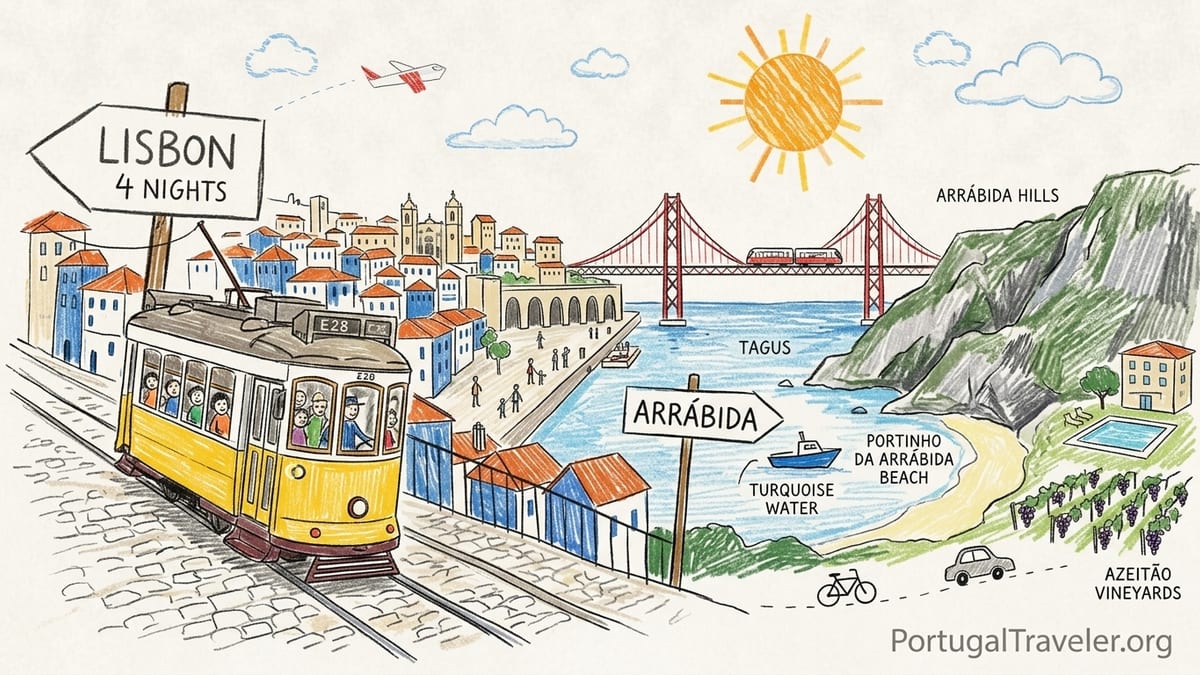
I spent a total of seven nights in the Lisbon Region, split between four nights in the city itself and three nights on the south side of the Tagus near the Arrábida Natural Park. That split shaped everything I noticed about how varied the region feels. Lisbon was my base for the classic urban experiences and for quick day trips by suburban train to Sintra, Cascais and the surf town of Ericeira. The second base, near Vila Nogueira de Azeitão, was my launching pad for quiet beaches around Arrábida and for seeing how different life is once you cross the 25 de Abril Bridge.
In Lisbon I stayed near Cais do Sodré, two blocks inland from the station. That decision turned out to be crucial because Cais do Sodré is the starting point for the Cascais suburban train and a major hub for buses and trams. I could walk to the riverfront in three minutes, reach the Baixa and Chiado on foot, and still be on a beach in Cascais or Carcavelos in under an hour door to sand. I did not rent a car during the city half of the trip, which forced me to rely on trains and buses and gave me a clear feel for how well public transport knits the region together.
For the second part of the week I picked a small rural hotel outside Azeitão, reached by a short taxi ride from Coina station on the Fertagus line after crossing the bridge. I chose it because of parking, a pool and the promise of quiet evenings after busy days on the coast. From there I rented a compact car for two days to explore the coves of the Arrábida coastline and to dip into Setúbal. That combination of car plus prior knowledge of the suburban rail system turned out to be the sweet spot for seeing very different sides of the Lisbon Region without doing a full road trip.
Across the week I used four main routes: the Sintra line from Rossio for one day, the Cascais line from Cais do Sodré for a coastal loop, an interurban bus to Ericeira via Mafra, and the Fertagus train from Roma-Areeiro to Coina, followed by driving around Arrábida. Each leg added a new texture: crowded commuter trains toward Sintra, breezy coastal stops toward Cascais, long rolling hills toward Mafra, and finally the sudden drop of limestone cliffs towards the turquoise water of Portinho da Arrábida.
Lisbon as a Base: Crowds, Weather and Getting Oriented
I visited in late May, which gave me a revealing mix of weather. Mornings in Lisbon started around 16 to 18 degrees Celsius with a grey “capacete de nevoeiro” cloud lid, then burned off to 23 to 26 degrees by mid-afternoon. That meant I could walk steep streets without overheating before lunch, but still felt the full force of the sun on the riverfront promenade in the afternoon. The sea breeze funneled up the Tagus most days, making terrace cafés at Cais do Sodré comfortable but leaving Baixa’s tighter streets feeling warmer and stiller.
My hotel in Lisbon was a three-star property with small but functional rooms and double glazing that mattered more than I expected. Trams and nightlife traffic around Cais do Sodré went on late, especially Thursday to Saturday, and I was glad I had chosen a room facing an internal courtyard. Breakfast was a basic buffet with fresh bread, cheese, ham and pasteis de nata that were never quite as good as the ones from the nearby pastelarias on Rua do Alecrim. Prices gave me a reality check: around 140 euros per night for a simple double including breakfast, booked about two months in advance. Friends visiting in August the year before had paid closer to 190 euros for something similar in the same area.
Using Lisbon as a base worked because of the density of transport options. From Cais do Sodré I could be on the green metro line in two minutes, on a Cascais train in five, or boarding a Carris bus along the river. For Sintra, I walked 20 minutes uphill to Rossio station and joined a queue of mostly tourists feeding cards into the ticket machines. At 9 am on a weekday in May, the suburban train to Sintra was standing-room only after Benfica, with a mix of commuters and day-trippers. That contrast with evenings, when the same platforms were calm and filled mostly with locals heading home, stayed with me whenever I rode the network.
One planning mistake I made was underestimating how long it takes to get oriented in Lisbon’s hills before even leaving the city. On my first morning, I tried to fit in a stroll through Alfama and a coffee in Chiado before catching a mid-morning train to Cascais. By the time I had walked up and down a few miradouros, lingered over an espresso and pastel de nata for 4 euros, and navigated the metro back to Cais do Sodré, I had already spent two hours on my feet. That meant I arrived in Cascais more tired and later than planned, right as the beaches were filling up. On later days I reversed the pattern, going straight to the train early and saving city wandering for the cooler evenings.
Riding the Rails: Sintra Hills, Coastal Cascais and Everyday Trains
I devoted one full day to the Sintra line, leaving from Rossio just after 8 am. The CP suburban network uses a zone-based fare system, and a single ticket from Lisbon to Sintra worked out at only a few euros each way in 2024. I loaded credit onto a reusable card at the station instead of buying separate paper tickets, which sped things up. Trains on this line are frequent, generally at least every 20 minutes, but by the time we passed the Benfica area the carriages had that compressed commuter feel, with locals scrolling on their phones while visitors in hiking shoes crowded around doors with backpacks and guidebooks.
Sintra itself felt almost like a different climate. When I stepped off the train the temperature dropped several degrees, mist clung to the wooded hills, and the air smelled of damp stone and eucalyptus. I bought a combined Train & Bus ticket that covered the Sintra rail leg plus local Scotturb buses up to Pena Palace and the other main sights. The price was higher than using the regular bus fare but saved me trying to pay contactless on crowded uphill buses. Even with an early start, the 434 bus to Pena was standing-room only and there were audible sighs each time it braked hard on the hairpin bends.
Later in the week I used the Cascais line from Cais do Sodré to combine a taste of suburban beach life with an easy coastal walk. These trains are electric units with large windows and a more relaxed crowd outside rush hours. A simple ticket to Cascais cost only a few euros and I validated my reusable card at the gates before boarding. We glided out along the river, passing Belém’s monuments on the left and then running right alongside the Atlantic as the water shifted from muddy Tagus brown to deep blue. I got off at Carcavelos first, where the scene was all surf schools, beach bars and wide sand, then carried on to Cascais for late afternoon gelato and a stroll around the marina.
The rhythms of these trains told me as much about everyday life around Lisbon as the destinations themselves. On the Cascais line, teenagers with bodyboards hopped on for just two stops in flip flops, while older commuters in suits listened to football commentary on their phones. On the Sintra line, office workers thinned out at intermediate stations and were replaced by hikers and tour groups. I learned to avoid the heaviest rush-hour waves when possible, boarding between 9.30 and 10.30 am or after 7 pm if I wanted a seat. When I did get caught on a peak-time Fertagus service over the 25 de Abril Bridge toward Coina, I ended up standing near the door with a backpack, watching the Tagus pass beneath and understanding why locals complain whenever timetables are cut.
Atlantic Versus Tagus: How the Coast Really Feels
The biggest surprise of the week was how different the Atlantic coast felt compared with Lisbon’s own riverfront. Standing at Cais do Sodré, the Tagus is wide enough to look almost like the sea, and on calm days its surface becomes a reflective sheet under the bridge. Yet 30 to 40 minutes away by train the open ocean changes everything. Carcavelos hit me first with its smell of sunscreen and grilled fish, a broad beach backed by surf schools offering two-hour group lessons, wetsuit and board included, for around 35 to 45 euros. Even in late May, the water temperature was cool enough that I was grateful for a full wetsuit, and the north wind picked up in the afternoon, whipping sand along the surface.
Cascais, a few stops further, felt more composed. The small town beaches around the center were calm and hemmed in by sea walls that dulled the Atlantic chop. Families spread towels right up to the promenade, and I saw more sun hats than surfboards. Prices reflected the resort pedigree: a grilled dourada with salad at a waterfront restaurant set me back just under 20 euros, compared with the 12 to 15 euros I had been paying in more local places in Lisbon. It was one of the few times I paid the “view tax” knowingly, consoling myself with a glass of vinho verde that cost less than the same wine by the river in Lisbon.
Ericeira, which I visited on a separate day trip by bus, deepened my sense of the Atlantic character. I took a morning coach from Campo Grande that wound past Mafra’s monumental palace before reaching Ericeira’s cliffs and surf breaks. The bus fare was under 10 euros each way when bought at the station. In town, narrow cobbled lanes dropped abruptly to viewpoints over beaches like Praia dos Pescadores, where surfers waited in cold, glassy lines while older men sipped bicas at café counters. The wind there had teeth, even under a blue sky, and I saw why so many people wore light down jackets over shorts.
In contrast, the Tagus-side corners I passed through on trains and ferries, from Cais do Sodré to the southern suburbs near Pragal, felt tamer but more lived-in. The riverfront in Lisbon hosted joggers, couples and tourists leaning on the railings by night, but cross to the south and you find apartment towers, shopping centers and ferry terminals where the river is a commute rather than a viewpoint. The light in late afternoon bounced off the water and made the skyline hazy, very different from the sharp horizontal glare you get looking at the Atlantic in Cascais or Ericeira.
First Taste of the South Bank: Caparica and Everyday Beach Life
I dedicated one day to seeing the Costa da Caparica from Lisbon without a car. From Cais do Sodré I took a bus over the 25 de Abril Bridge, which in 2024 was operated under the unified Carris Metropolitana network. The ride took around 35 to 40 minutes in light traffic, closer to an hour coming back during the late afternoon return rush. Crossing the bridge by bus gave me a different perspective from the train, with the Cristo Rei statue looming on the left and the river gradually opening towards the Atlantic as the skyline of high-rise apartments in Almada came into view.
Costa da Caparica itself initially felt more functional than charming. The central beachfront is lined with concrete mid-rise buildings, beach clubs and cafés, and on a sunny weekend in late May it was busy with local families hauling umbrellas and cool boxes, teenagers playing beach football and older residents walking small dogs along the promenade. The sand is wide and the waves more playful than intimidating, smaller than Ericeira’s surf breaks but bigger than the sheltered town beaches of Cascais. I rented a sunbed and umbrella for around 20 euros for the afternoon, then quickly regretted not packing my own shade. The north wind picked up later in the day, and blowing sand made reading on the lounger uncomfortable.
What made Caparica interesting to me was the sense of everyday Lisbon using the sea. Snack bars were doing brisk trade in grilled sardines for under 10 euros a portion and imperial draught beers for around 1.50 euros. Conversations were in Portuguese first, with only the occasional English or French voice in the mix, a shift from the multilingual hum of central Lisbon. It felt like the city’s backyard rather than an international resort, and in that sense more comparable to the urban beaches of Barcelona than to postcard-perfect Algarve coves.
My main planning mistake that day was timing. I left Lisbon too late in the morning and arrived in Caparica around noon, which coincided with the thickest crowds and the most intense sun. Finding a spot not wedged between large groups took time, and the queue for the bus back in the late afternoon snaked around the block. Next time I would either go early, taking the first buses after 8 am to walk the near-empty shoreline, or wait until late afternoon for a sunset swim and dinner, accepting that the return bus might be standing-room only.
Arrábida and the Reward of Leaving the Tracks
The most dramatic landscapes of the week came in its final three days, when I crossed to the south bank and based myself near Azeitão for easy access to the Arrábida Natural Park. To get there, I took the Fertagus train from Roma-Areeiro to Coina, which required tapping into the suburban system in a slightly different way. Fertagus trains run over the 25 de Abril Bridge, and a single ticket from Lisbon to Coina cost a handful of euros more than the short urban lines, reflecting the longer distance. Trains were reasonably frequent, roughly every 20 to 30 minutes during the day, and the onboard atmosphere felt more like a regional commute than a city hop, with fewer tourists and more workers carrying tool bags or laptops.
From Coina I grabbed a taxi to my rural hotel near Azeitão, a low-slung whitewashed property surrounded by vineyards and cork oaks. The contrast with Cais do Sodré could not have been sharper. Nights were almost silent apart from the distant bark of dogs and the occasional car, and the sky was dark enough to see a clear band of stars. My room was larger than in Lisbon, with a terrace facing fields, and cost just under 120 euros per night including a breakfast of local cheese, fresh bread, fruit and strong coffee. The trade-off was the need for a car, which I rented for two days from a small agency in nearby Setúbal.
Driving into the Arrábida hills offered a different kind of freedom from the rail-based days. The road from Azeitão twisted through limestone slopes covered in Mediterranean scrub before suddenly revealing glimpses of turquoise water hundreds of meters below. I stopped first at a miradouro above Portinho da Arrábida, where the beach looked like something imported from the Greek islands, with anchored boats floating in clarity and pale sand curving under cliffs. The water, however, was colder than it looked. My midday swim left my legs numb, and I understood why even locals limited their time in the sea despite the summer feel of the air.
Practicalities along this stretch matter more than in places like Carcavelos or Caparica. Parking near popular beaches such as Praia dos Coelhos or Portinho fills up quickly in high season, and road access can be restricted on peak summer weekends to protect the park. I visited before those restrictions kicked in, so I could still drive down, but even in late May parking areas were close to full by 10 am. Food options were also more limited and more expensive. A simple grilled fish with salad on the beachfront cost around 22 euros, higher than equivalent meals I had eaten in Lisbon’s residential neighborhoods, though the view of the bay softened the blow.
By basing myself on this side of the river rather than trying to do Arrábida as a long day trip from Lisbon, I was able to visit smaller villages in the late afternoon when most day-trippers had gone. A late drive back through the hills, windows down, warm air smelling of pine and sea salt, felt worlds away from the concrete edges of Costa da Caparica and the polished promenades of Cascais. It underlined how varied the Lisbon Region is within distances that look small on a map.
What I Learned About Planning, Costs and Common Mistakes
Looking back at the week, the main lesson was that distances in the Lisbon Region are short but transitions are real. It is tempting to stack too many different landscapes into a single day because the train timetables make them look close. On one day I tried to combine a morning in Sintra with an evening in Belém, reasoning that the Sintra train and the tram from Cais do Sodré would connect easily. Technically they did, but in practice I spent much of the afternoon in queues: first for the crowded Scotturb bus back down from Pena, then for a tram that was already crammed with visitors heading to Belém’s tower and monastery. By the time I sat down at a riverside café, my legs were too tired to enjoy the famous pastéis properly.
Crowd management became as important as route planning. Sintra’s historic center and Pena Palace were the most congested places I visited, with ticket checks and bus queues that felt like a theme park. Cascais and Ericeira were busy but more spacious, allowing room to breathe along promenades and clifftop paths. Caparica saw the densest towels-per-square-meter ratio at midday, but because the beach is so wide I could always walk a little further to thin things out. Arrábida, despite being in a natural park, was not empty either, yet by choosing slightly less obvious access points and later afternoon timings I often shared viewpoints with only a handful of other people.
In terms of costs, I noticed a clear pattern. Central Lisbon and polished Atlantic towns like Cascais were the priciest for food and accommodation, while the south bank and rural pockets near Azeitão and Mafra felt gentler on the wallet. Public transport remained relatively affordable across the board. Simple suburban train tickets to Cascais or Sintra were only a few euros each way, and the combined tourist tickets that bundled unlimited suburban rail within the Lisbon urban network for one or three days were good value if used intensively. Buses to Ericeira and Caparica also stayed within the single-digit euro range for a return trip.
My biggest mistake was underestimating how drained hills and heat would leave me by late afternoon, which affected how much I could enjoy the evenings back in Lisbon. On days when I did ambitious walks in Sintra or along the cliffs near Ericeira, returning to Cais do Sodré around 7 pm felt like coming back from a multi-day trek. Instead of enjoying fado or lingering in a wine bar, I ended up grabbing a simple prato do dia in a no-frills tasca for around 12 euros and going to bed early. The solution, I realized too late, would have been to build in one quieter city day in the middle of the week, staying mostly in Lisbon’s flatter riverside neighborhoods and giving my legs a break.
The Takeaway
Spending a full week treating Lisbon not just as a city break but as the hub of a wider region changed how I see it. The capital itself is a dense knot of hills, viewpoints and tiled facades, buzzing with international visitors and layered with tram bells and late-night bars. Yet within an hour in almost any direction you can be somewhere that feels entirely different: breathing mist under Sintra’s mossy walls, kicking sand across the wide Atlantic beaches of Caparica and Carcavelos, watching surfers in Ericeira, or floating in the clear, cold bays beneath Arrábida’s cliffs.
If I were to repeat the trip, I would keep the two-base structure but stretch it to nine or ten nights. Four nights in Lisbon felt right, giving me time to explore neighborhoods on foot and use the train network without rushing. Three nights near Arrábida were just enough to hint at the south bank’s slower rhythm but not enough to fully unwind. I would still reach Sintra and Cascais by train, Ericeira by bus, and Arrábida by a mix of suburban rail plus rental car, but I would add a pure rest day in each base to enjoy them in their own right instead of treating them only as launchpads.
Most of all, I would think in terms of textures rather than checklists. Instead of ticking off “Sintra, Cascais, Caparica, Arrábida,” I would ask: how many days do I want in cool, misty hills, and how many in bright, windy Atlantic light or calm riverfront evenings. The Lisbon Region offers all of these within easy reach, but the real pleasure comes from letting each mood sink in without rushing to the next one. Planning with that in mind turned a standard city break into a layered, memorable week that felt much bigger than the distances on the map.
FAQ
Q1. How many nights do you recommend spending in the Lisbon Region?
I spent seven nights and found that to be the minimum to experience Lisbon, Sintra, the Atlantic coast and Arrábida without constant rushing. If you have the time, nine or ten nights would let you add rest days and enjoy each base more deeply.
Q2. Do I need a car to explore beyond Lisbon?
You can comfortably reach Sintra, Cascais, Mafra, Ericeira and Caparica by train or bus, so a car is not essential for those. Where a car becomes very helpful is in the Arrábida area south of Lisbon, where beach access points and viewpoints are spread out and parking fills quickly. I combined public transport for most of the week with a short two-day car rental on the south bank.
Q3. Is Sintra realistic as a day trip from Lisbon?
Yes, but it is a full and sometimes tiring day. The train from Rossio to Sintra takes under an hour and runs frequently, but the real bottlenecks are at the palaces and on the hill buses. Go early, buy combined tickets where it makes sense, and accept that you may only see two or three major sights comfortably in one day.
Q4. How does the Atlantic coast compare to Lisbon’s riverfront?
Lisbon’s Tagus riverfront feels calmer and more urban, with joggers, promenades and sunset bars. The Atlantic coast in places like Carcavelos, Cascais, Ericeira and Caparica brings stronger wind, cooler water, surf culture and much wider beaches. They are very different experiences despite being less than an hour apart by train or bus.
Q5. What were typical costs for food and accommodation?
In 2024, simple double rooms in central Lisbon and Cascais often ranged from about 120 to 180 euros per night depending on season and location. On the south bank and in rural areas near Azeitão I found comfortable places closer to 100 to 130 euros. In casual restaurants I usually paid 10 to 15 euros for a prato do dia at lunch and 15 to 22 euros for grilled fish at dinner, with coffee around 1.20 euros and draught beer about 1.50 to 3 euros.
Q6. When is the best time of year to visit the Lisbon Region?
Late spring and early autumn are ideal balances of weather and crowds. In May I had daytime temperatures in the low to mid twenties Celsius, cool Atlantic water and busy but manageable sights. July and August bring hotter temperatures and heavier crowds, especially in Sintra and on the beaches, while winter can be mild in the city but cool and windy along the coast.
Q7. How crowded did Sintra, Cascais and Caparica feel?
Sintra was the most crowded, especially around Pena Palace and on the hill buses, where lines resembled a theme park. Cascais and Ericeira were busy in town centers but offered space along promenades and clifftops. Caparica’s central beaches were very dense around midday on a sunny weekend, though the shoreline is so long that walking ten minutes from the main access points significantly reduced the crowding.
Q8. Is it realistic to stay only in Lisbon and do day trips?
It is possible to stay solely in Lisbon and visit Sintra, Cascais, Ericeira, Mafra and Caparica on separate day trips, especially if you enjoy early starts. However, I found that adding a second base on the south bank near Arrábida reduced travel time, allowed evening visits to quieter villages and turned what could have felt like a string of long commuting days into a more relaxed experience.
Q9. How reliable is public transport in and around Lisbon?
During my visit suburban trains and buses were generally reliable and frequent, though peak-hour services into and out of Lisbon were crowded. Queues at ticket machines in Rossio and Cais do Sodré slowed things down for visitors unfamiliar with the system. Building in a buffer of 15 to 20 minutes when changing between metro, train and bus connections made the days feel less stressful.
Q10. What would you do differently on a return trip?
On a return trip I would keep Lisbon and the Arrábida area as my two main bases but add at least two extra nights. I would devote one quieter day to Lisbon’s flatter riverside neighborhoods in the middle of the week to rest my legs, visit Sintra even earlier in the morning or on a slightly off-peak day, and time my Caparica and Arrábida visits more around sunrise or late afternoon to avoid both the strongest sun and the heaviest crowds.