


I arrived in Lisbon certain that renting a car would be the smartest way to see the wider region. A week later, after threading between Sintra’s palaces, Ericeira’s surf breaks, Mafra’s basilica, Cascais’ promenades, Costa da Caparica’s sands and the cliffs of Arrábida, I had changed my mind more than once. Driving around Lisbon is not simply a question of "car or no car." It is about where that car actually adds value, when public transport quietly does a better job, and how to avoid letting tolls, traffic and parking turn a dream road trip into a chore.
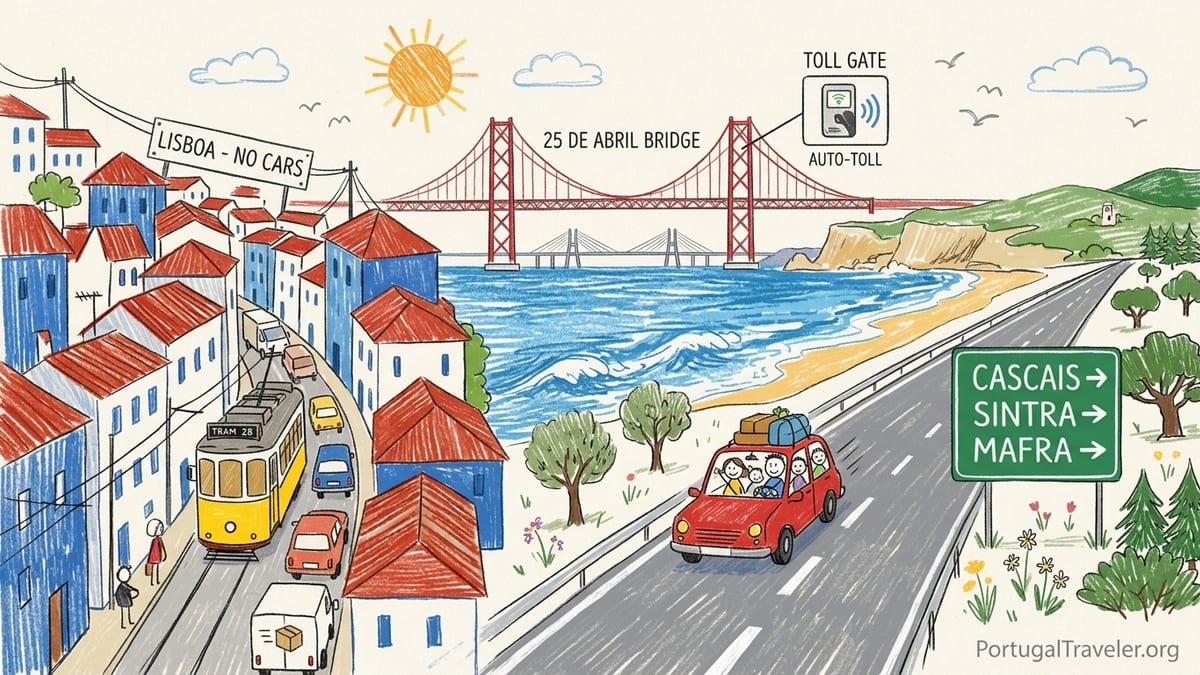
Leaving Lisbon: When the Car Starts to Make Sense
Within Lisbon itself, a car is more trouble than help. The historic core around Baixa, Alfama and Bairro Alto is compact, hilly and packed with narrow, one-way streets. Parking in central districts is mostly in paid, time-limited zones, and garages in areas such as Chiado or Avenida da Liberdade often charge by the hour at rates that add up quickly for a full day. Traffic jams around rush hours, especially on major avenues and access roads like the 25 de Abril Bridge approaches, can make short distances feel long. For anyone based in a central hotel or apartment, the metro, trams and ride-hailing options cover daily needs better than a rental car.
The car begins to earn its keep the moment you decide to leave Lisbon and string together several regional stops in a single day. That shift happens as soon as you cross the city’s perimeter and reach the ring of motorways such as the A5 towards Cascais, the A8 and A9 towards Mafra and Ericeira, or the A2 and A12 towards the Setúbal Peninsula and Arrábida. Distances between these hubs are short enough that you can realistically combine two or even three in one day if you are driving, while public transport connections often funnel you back through Lisbon, adding transfers and waiting time.
On my own trip, I deliberately picked up the rental car only on the morning I planned to leave Lisbon for the coast. Collecting it at a downtown office near Marquês de Pombal allowed me to drive directly onto the A5 without wrestling through the tight lanes closer to the river. This timing also meant I avoided paying for several days of unnecessary parking while simply sightseeing in the city. For many travelers, delaying the pickup in this way is one of the easiest ways to keep the benefits of a car while sidestepping its main urban headaches.
The moment you roll out towards the suburbs, road quality is generally high. Portuguese motorways and national roads in this region are well surfaced and clearly signposted, with frequent fuel stations and service areas. The catch is that many of the most convenient routes are on tolled expressways. These tolls vary by distance and section, and for a short regional loop they will not dominate your budget, but they are an ongoing cost you feel more sharply if you take many short hops. In my case, I opted for a car equipped with an electronic toll device registered to the rental, which allowed me to use both traditional toll plazas and the newer electronic-toll-only sections without stopping.
Lisbon to Cascais and the Coast: Comparing Car and Train
The drive from Lisbon to Cascais is both straightforward and revealing. You can follow the scenic coastal N6 road, which starts near Belém and runs along the Tagus estuary out to the ocean, or dive onto the A5 motorway for a faster but less atmospheric journey. With a car, the temptation is to mix both: take the marginal road past Algés and Oeiras, stopping for a coffee overlooking the water, then switch to the A5 to avoid slower traffic through built-up stretches. On a weekday afternoon, I found the A5 fluid but busy near Lisbon, thinning out as it approached Cascais.
Despite how pleasant that drive can be, Cascais is one of the clearest examples where you do not need a car at all if it is your only regional destination. The urban train from Lisbon Cais do Sodré station runs frequently along the same coastline, taking roughly 40 minutes to reach Cascais and stopping in seaside suburbs that many visitors might never otherwise see. Trains continue into the late evening, which means you can linger for sunset at Boca do Inferno or along the marina without worrying about driving back in the dark or navigating rush-hour congestion.
If you do choose to drive to Cascais, parking becomes the key variable. The historic core near the main beach and old town is lined with narrow streets often filled with both residents’ cars and visitors’, especially in summer and on sunny weekends. During my visit, I quickly realized it was far easier to leave the car in one of the larger car parks slightly outside the center and walk in. The distance from these peripheral lots to the waterfront is short, and the trade-off in stress is significant. Trying to inch towards a curbside space near the main square costs time and frays nerves.
Beyond Cascais town, however, the car begins to justify itself again. Heading west towards the wild stretch around Guincho Beach, the landscape opens into dunes and low scrub with the Atlantic pounding behind it. Buses do reach this area, but they run less frequently than the urban train to Cascais and require attention to timetables and stops. Having the car meant I could pull into smaller parking areas overlooking the surf, linger at viewpoints that caught my eye and move on when I was ready, without mentally checking the clock for the next bus.
Sintra’s Palaces: When Driving Becomes a Burden
Sintra sits in the hills northwest of Lisbon and is one of the most famous day trips in Portugal. From a distance, it seems like a perfect candidate for a road trip. The reality on the ground is more complicated. The historic center, squeezed between hill slopes, is wrapped in very narrow streets, tight corners and steep gradients that leave little room for error, especially in a larger rental car. During my visit, even on what locals described as a quieter day, traffic in the old town moved slowly, with temporary delays as delivery vehicles maneuvered and tour buses negotiated turns.
I drove from Lisbon towards Sintra along the A37 and then followed signs into the historic center, but very quickly understood why so many travelers and locals advise parking outside the oldest streets. Public parking areas on the outskirts, including ones near the modern part of town and on the approach roads, offer a far less stressful alternative. From these lots, it is simple to either walk down into the historic core or transfer onto local buses that climb further up to landmarks like the Pena Palace and Moorish Castle. In my own case, the final approach to Pena by car felt more like a series of problem-solving exercises than a leisurely drive.
Sintra is also one of the clearest places where public transport competes strongly with the car. Trains from Lisbon’s Rossio station to Sintra run regularly and take under an hour. Once there, a network of local buses and tuk-tuks connects the main sights. The combination of train and local transport removes two of the most stressful variables for drivers: finding a suitable parking spot and threading through one-way systems under time pressure. After one particularly slow crawl behind a tour coach on a narrow uphill bend, I found myself wishing I had left the car at a station near Lisbon and arrived by rail instead.
That said, the car did create flexibility at the edges of the Sintra visit. After leaving the hills, I was able to drive straight towards the western coastline without looping back through Lisbon. For travelers who want to combine the palaces of Sintra with sunset at a beach town further north on the same day, this east-west freedom is something trains and buses struggle to match. The key lesson, though, is to separate the decision to have a car in the region from the decision to drive it right into the narrowest historic streets.
Mafra and Ericeira: Where the Car Comes Into Its Own
North of Sintra, the drive to Mafra reveals one of the most satisfying aspects of having a car in the Lisbon region: the ability to string together inland and coastal destinations without detouring back to the capital. I left the Sintra area on secondary roads that soon joined more substantial routes towards Mafra, passing through a patchwork of small towns and rural landscapes. Arriving at Mafra’s monumental palace and basilica, the change in atmosphere from the forested slopes of Sintra was striking. Parking in Mafra felt almost relaxing by comparison, with larger open-air lots around the palace that accommodated visitors without the tight constraints of hill towns.
Public transport exists between Lisbon and Mafra, mainly through bus services that depart from city terminals and stop in several communities along the way. However, when you want to continue from Mafra to Ericeira on the coast, you encounter the limits of these routes. It is certainly possible to do, but you often need to align separate bus schedules or accept longer overall travel times. With the car, the drive from Mafra to Ericeira becomes a simple and scenic half-hour journey, first through undulating countryside and then descending towards the Atlantic.
Ericeira itself is a compact surf town perched on cliffs with a network of streets fanning back from the water. Traffic within the center can be busy at weekends and in the surfing high season, but I found parking to be manageable provided I avoided trying to stop directly on the seafront. Several parking areas just behind the old town gave easy walking access to the main square, restaurants and coastal viewpoints. From that base, driving north or south to individual beaches along the coastline felt like the sort of freedom I had rented the car for in the first place.
This is a stretch where relying entirely on buses begins to feel limiting. While some of the larger beaches near Ericeira are connected to town, the smaller coves and viewpoints along the coast can become awkward to reach without a vehicle. With the car, I could follow minor roads to viewpoints marked informally by pull-offs and a few other parked cars, rather than being bound to official stops. That flexibility came with responsibility too: some of the narrowest rural lanes demand slow speeds, patience with farm traffic and care when passing pedestrians and cyclists.
Over the Bridge: Caparica and Arrábida by Car
South of the Tagus River, the pattern of benefits and drawbacks repeats in slightly different form. Crossing the 25 de Abril Bridge or the Vasco da Gama Bridge is a moment that can look intimidating on a map but felt straightforward in practice. Both bridges have tolls in the direction into Lisbon and multiple lanes of traffic. Approaching at non-peak hours, I found the traffic steady but not overwhelming. With an electronic toll device in the car, I passed under the toll gantries without stopping, and the charge was later billed through the rental company.
Costa da Caparica, a long stretch of sandy beach facing the Atlantic, is one of the easiest places to reach by car once on the south side of the river. The road network funnels you directly towards the seafront, and parking areas line sections of the beach-front. In high season, the lots closest to the main town fill quickly, but driving a short distance further down the coast usually reveals additional spaces near individual beach bars and access paths. A car here means you can choose between the livelier central zone and quieter stretches further along, adjusting to wind conditions and crowds on the day.
Arrábida Natural Park, farther south near Setúbal, showcases both the joy of driving in Portugal and the constraints that authorities rightly place on vehicle access. The roads that twist along the cliffs between beaches such as Figueirinha, Galápos and Portinho da Arrábida offer spectacular views across turquoise water and rugged limestone slopes. On the day I drove them, the weather was clear and the visibility long, but the curves were sharp and some sections lacked wide shoulders. It was a route that rewarded unhurried driving and frequent pauses at official viewpoints.
Seasonal restrictions on private vehicle access to some of Arrábida’s most popular beaches are an important factor for drivers. At busy times of year, local rules often limit car access to certain zones, replacing it with shuttle services from designated parking areas further away. The exact timings and details of these measures are updated regularly, which means travelers should check current information before assuming that every cove can be reached directly by rental car. In my case, visiting outside the absolute peak meant I could drive closer to the coastline, but signs still indicated controlled access periods and parked vehicles were concentrated in marked bays rather than scattered along the roadside.
Traffic, Tolls and the Hidden Costs of Convenience
Across the entire loop around Lisbon, from Cascais and Sintra to Mafra, Ericeira, Caparica and Arrábida, the car offered clear convenience at the cost of several less visible burdens. Fuel prices along the route were broadly similar from station to station, with service areas on major roads sometimes charging slightly more than independent stations on secondary roads. Tolls, while not individually dramatic on short segments, collectively formed a recurring line on the travel budget. Each crossing of a major bridge, each faster motorway hop around Lisbon, added a small additional cost that slowly accumulated over several days of driving.
Traffic was a variable that changed character throughout the trip. Around Lisbon itself, morning and evening rush hours thickened flows on motorways and major access roads, occasionally creating slow-moving queues, especially near bridge approaches and major interchanges. Near touristic hot spots like Sintra and Cascais on sunny weekends, traffic took on a different tone, with more vehicles circling for parking spots and slower progress through central streets. By contrast, segments between Mafra and Ericeira or some inland approaches to Arrábida felt much calmer, with light flows that allowed for consistent speeds and relaxed driving.
One hidden cost of driving that stood out was mental energy. Navigating unfamiliar one-way systems, reading road signs in a second language, interpreting parking regulations and adapting to local driving habits all required attention. After a few days, I noticed the extra fatigue this created compared with a day where I took a direct train and simply walked or used local buses. Having the car increased my freedom to improvise, but it also placed a constant small demand on focus that public transport days did not.
An additional layer was the responsibility of parking overnight. When staying in smaller towns like Ericeira or near Caparica, I had to think about where the car would sleep as much as where I would. Some accommodations provided on-site parking or nearby arrangements, which removed a lot of stress. Others were in historic centers where overnight parking meant leaving the car in public lots a few minutes’ walk away. These choices were manageable, but they reminded me that a car is not only a means to move during the day, it is also an object you must look after every night.
Where I Wished for Public Transport Instead
Looking back on the journey, several segments stand out where I would have preferred to leave the car behind. Sintra is the clearest. The combination of narrow streets, the popularity of its palaces and viewpoints, and the limited parking near some attractions made driving feel like the least efficient option. A train from Lisbon followed by local buses or rides would have allowed me to focus on the scenery and architecture rather than on angles of approach and parking constraints.
Cascais town itself falls into a similar, if milder, category. Because the train from Lisbon is frequent and relatively quick, and the town center is highly walkable, the car there was more of an optional extra than a necessity. On the day I drove into Cascais, I spent almost as long deciding where to leave the car and walking back from the parking lot as I would have spent strolling from the train station. If Cascais had been my only stop beyond Lisbon, I would not have bothered with a rental at all.
Even within Lisbon, there were moments when the car’s presence shaped my choices in ways that public transport would not have. Knowing I had the vehicle waiting encouraged me to time my city visits around driving schedules, such as returning to pick it up from parking before evening charges increased. On days when I committed to leaving the car parked and relied on trams, elevators and walking instead, the rhythm of exploration felt more natural to the city and less dictated by meters and garages.
Finally, some sections of motorway around Lisbon during peak periods turned what should have been simple transfers into tedious crawls. Arriving back into the city late on a weekday afternoon from Arrábida, I encountered slow-moving traffic approaching river crossings that stretched the journey beyond its expected duration. Had I chosen instead to drop the car earlier and return by train from a station south of the river, I would have traded that bumper-to-bumper experience for a more predictable schedule, even if it required an extra connection.
Where the Car Truly Unlocked the Region
Balancing those frustrations were days when the car delivered exactly what I hoped from a regional road trip. The Mafra and Ericeira combination is perhaps the best example. Being able to leave Sintra’s hills, visit Mafra’s monumental complex at my own pace, then continue directly to Ericeira for a late afternoon by the ocean felt like a stitchwork only the flexibility of a car could provide in a single day. Public transport could link those dots, but stitching them together in that order would have been less straightforward and more time-bound.
The same applied to exploring the less central parts of Costa da Caparica and Arrábida. With the car, I could follow intuition rather than strictly timetabled routes, diverting to quieter stretches of sand if the main areas felt crowded or windy, and continuing along the coast until a particular viewpoint or parking area looked right. On one day south of Lisbon, I adjusted plans three times based on changes in cloud cover and wind direction, something that would have been harder if I were tied to fixed bus departures and return times.
The real power of the car was not only in reaching marquee destinations like Sintra or Cascais, but in the spaces between them. Small roadside cafés, farm stands selling local produce and unmarked cliff-top pull-offs became part of the tapestry of the journey. These unscripted stops did not appear in guidebooks or on transit maps, but they shaped my memory of the region as much as the palaces and beaches did. Driving allowed me to translate curiosity into action almost immediately.
However, that same freedom carried a caveat. It required steady attention to responsible parking and road use. Some minor roads near popular coastal viewpoints showed signs of wear, and informal parking on verges risked damaging vegetation or creating obstacles for emergency vehicles. The lesson was clear: the value the car added to my experience depended on how respectfully I used it, choosing designated parking areas even when an unofficial spot looked closer, and keeping speeds modest on narrow or scenic roads.
The Takeaway
By the end of my circuit from Lisbon through Cascais, Sintra, Mafra, Ericeira, Costa da Caparica and Arrábida, my opinion of driving in the region had become more nuanced. A car is not an automatic upgrade for every traveler or every route. Instead, it is a tool whose value shifts depending on the specific combination of city streets, coastlines and countryside you plan to explore.
If your main goal is to visit Cascais and Sintra from Lisbon on separate days, with ample time at each, public transport offers a calmer, more sustainable and often cheaper way to do it. Trains and local buses handle the heavy lifting, while you focus on viewpoints and gardens rather than traffic and parking. The car becomes harder to justify when your route is essentially linear and focused on well-connected hubs.
The car comes into its own when you want to connect those hubs in inventive ways, weaving from inland monument to surf town to clifftop park without retracing your steps. It shines when your schedule benefits from being fluid, such as chasing sunshine along the coast or adjusting the order of stops on the fly. For these multi-stop, cross-regional days, driving can turn the Lisbon area into a compact patchwork, all within reach from a single base in the capital.
The best compromise for many travelers is to think of the car as a regional extension rather than a constant companion. Spend your first days in Lisbon on foot, by tram and by train, then collect a rental only when you are ready to break away to places like Mafra, Ericeira, Caparica and Arrábida. When you do, plan your route to avoid driving deep into the tightest historic centers and instead pair park-and-walk habits with scenic secondary roads. Used this way, the car enhances the Lisbon region rather than fighting it.
FAQ
Q1. Do I need a car to visit Cascais from Lisbon?
For Cascais alone, a car is not necessary. Regular trains connect Lisbon’s Cais do Sodré station to Cascais in under an hour, and the town center is easily explored on foot from the station.
Q2. Is it worth driving to Sintra instead of taking the train?
Driving to Sintra can be more stressful than helpful due to narrow roads and limited parking in the historic area. Many visitors find that taking the train from Lisbon and using local buses or other services to reach the palaces is more relaxing.
Q3. When does a rental car add the most value in the Lisbon region?
A rental car adds most value when you plan to combine several regional destinations in a single trip, such as linking Sintra, Mafra, Ericeira, Costa da Caparica and Arrábida without returning to Lisbon between each stop.
Q4. Are toll roads unavoidable when driving around Lisbon?
Many of the fastest routes involve toll roads, especially major bridges and motorways. It is often possible to use slower, toll-free alternatives, but they usually increase travel time and involve more complex navigation.
Q5. How difficult is parking in coastal towns like Ericeira and Caparica?
Parking in Ericeira and Costa da Caparica can be busy in peak season and on sunny weekends, but it is usually manageable if you are prepared to use larger lots slightly away from the seafront and walk a short distance.
Q6. Should I keep a car while staying in central Lisbon?
Keeping a car while based in central Lisbon is often not worthwhile. Parking is limited and paid, traffic can be heavy, and the city’s public transport network covers most areas visitors want to see.
Q7. Is it easy to cross the 25 de Abril or Vasco da Gama bridges by car?
Crossing these bridges is straightforward in normal conditions, though traffic can slow at peak times. Both bridges use tolls for traffic heading into Lisbon, and many rental cars include electronic toll systems.
Q8. How do seasonal restrictions in Arrábida affect drivers?
During busy periods, authorities often limit private vehicle access to some Arrábida beaches and use shuttle services from designated parking areas. Restrictions and details change, so it is important to check current rules before driving into the park.
Q9. Can I reach Mafra and Ericeira by public transport from Lisbon?
Yes, bus services connect Lisbon to Mafra and Ericeira, but combining both in one flexible day without careful timetable planning can be challenging. A car makes the link between the two towns more straightforward.
Q10. What is the best strategy for using a rental car around Lisbon?
A practical strategy is to explore Lisbon itself without a car, then rent one when you are ready to visit regional destinations. Use the car mainly for inter-town travel, park outside dense historic centers, and rely on walking or local transport for the final approach.