


I landed at Faro Airport with a 40-litre backpack, a phone full of transport apps and one self-imposed rule: no rental car for a week in the Algarve. Instead, I would rely on the newly electrified Algarve Line, the regional Vamus buses, the local urban networks and my own two feet to see how realistic a car-free trip really is in Portugal’s most famously car-heavy beach region.
Touchdown in Faro: First Test of the No-Car Plan
My first test came minutes after landing at Faro Airport. The terminal sits roughly 6 kilometers outside Faro, so every visitor has the same choice set: taxi or rideshare from the arrivals rank, the urban bus into town, or one of the Vamus regional services that now include an Aerobus line linking to several coastal resorts. I wanted to see how painless the public option really was after a morning flight, so I followed the blue “Bus” signs out of arrivals and walked the two minutes to the stop opposite the terminal.
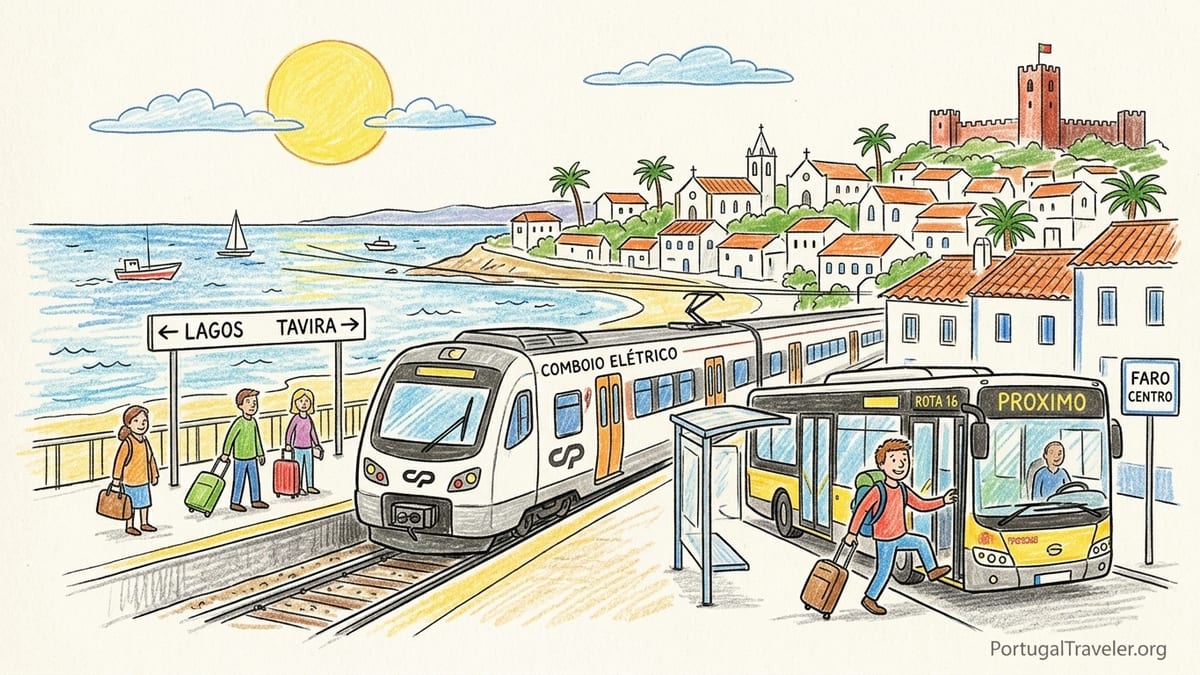
For the airport-to-city link, I used the Proximo urban bus operated on route 16 into Faro’s central bus station. The stop has a simple shelter and a printed timetable, and the bus that arrived was a low-floor city bus with enough space near the front for luggage. I paid the driver in cash, a few euros for the roughly 20-minute ride into town, and grabbed a seat in the middle with my backpack wedged between my knees. At late-morning on a weekday, the bus was half full, mostly airport staff and a handful of tourists dragging wheeled suitcases.
The Proximo bus drops you on the edge of Faro’s compact center, only a few minutes’ walk from both the Vamus bus terminal and Faro railway station. This proximity matters. With a suitcase you can walk between bus and train in under five minutes on level pavements, and that set the tone for the week: once you are in the bigger towns, the public-transport hubs are reasonably central and manageable on foot. Had I taken a taxi, I would have been slightly faster and more comfortable, but I would also have missed this first, reassuring proof that the local buses are usable even when jet-lagged and carrying luggage.
From the bus station I walked across to the CP ticket office at Faro railway station. The Algarve Line is now fully electrified between Lagos and Vila Real de Santo António, and from July 2026 CP increased regional services by around 18 percent, with direct electric trains along the entire corridor. In practice, that means roughly hourly trains between Vila Real de Santo António and Faro, and about every two hours between Faro and Lagos, with extras at peak times. I queued behind half a dozen people and bought a regional ticket to Lagos on the spot with a debit card, for a price in the area of 10 euros. There was no need to reserve and no seat assignment, which kept things pleasantly simple.
First Ride on the New Electric Algarve Line
I boarded a mid-afternoon regional train from Faro toward Lagos, one of the new electric sets now replacing the old diesel units. The train pulled in on time with wide doors, a level step and space at each carriage end for luggage and bikes. With my backpack I could walk the aisle easily, and I took a window seat in a 2+2 configuration. The interior felt closer to a modern commuter train than a long-distance service: simple seats, overhead racks and large windows framing the coastal plains and low hills of the Algarve.
The journey to Lagos takes around an hour and three-quarters, depending on how many stops you catch. The Algarve Line is not a high-speed railway; it hugs inland settlements just north of the N125 road and the A22 toll motorway, pausing at a string of stations from Loulé and Albufeira-Ferreiras to Silves and Portimão. The trade-off is clear as soon as you look at the map. A car on the A22 can hop between these towns in bursts of 20 or 30 minutes, while the train is steady but slower, particularly if you happen to board one of the all-stops services.
What the train does offer is predictability. For most of the week, my regional trains left close to their advertised time and the journey felt relaxed. I could read, watch the scenery or simply decompress from the airport. Ticket inspection was routine and quick, and announcements were made in Portuguese and English. The main compromise was flexibility. On the stretch between Faro and Lagos there are only so many departures in an afternoon or evening, and missing one can mean a wait of an hour or more. On my first day I arrived at Faro station about 40 minutes before the next westbound train, enough time to grab a coffee at the café opposite the station. With a rental car I would already have been halfway to Albufeira by the time the train finally rolled out.
Arriving in Lagos underlined one of the quiet strengths of the rail network for car-free travelers. The station is just over the river from the marina and about a 10-to-15-minute walk from the old town, entirely on paved, step-free routes. I crossed the pedestrian bridge with my backpack and was checking in to my guesthouse by early evening. There was no need to navigate parking, no tolls to worry about, and no interaction with rental counters. As long as your accommodation is relatively central, arriving by train works very well.
Using Lagos as a Car-Free Base
I chose Lagos as my first base precisely because it combines a walkable historic center with solid public-transport connections. Within town, the local “A Onda” buses loop through residential districts, the marina and the main beaches, while the Vamus regional buses call at the central bus station only a short walk from the railway. That meant most everyday trips were either entirely on foot or a single short bus ride away.
To test how realistic beach-hopping is without a car, I headed to Praia Dona Ana and Praia do Camilo on my second day. From my guesthouse near the old town walls it took about 20 minutes on foot to reach Dona Ana, via pavements and low hills. I carried only a daypack and a towel, which was fine; rolling luggage would be awkward on the slopes and stairs. Later, to get from town out to the long stretch of Meia Praia, I used an A Onda bus from near the marina. I bought a ticket directly from the driver for a few euros, sat down among locals heading to work and got off near a beachfront café after about 10 minutes. Walking back at sunset along the sand and then over the pedestrian bridge into town felt easy and safe.
The first cracks in the car-free ideal appeared when I tried to be more spontaneous. I had hoped to combine a lazy brunch in town with a late-afternoon visit to Sagres at the far western tip. Sagres is served by Vamus buses from Lagos, but the timetable is thin compared with the coastal resorts. On the day I checked, there were only a handful of departures and the last bus back to Lagos left early in the evening, shortly after dinner time. I realized that if I went, I would have to cut my meal short and watch the clock during sunset at the Fortaleza de Sagres. With a car, that drive along the EN125 and back on the A22 after dark would be straightforward. On public transport, I decided it was not worth the stress and stayed closer to base.
Evenings in Lagos, however, were where car-free living shone. The old town is compact and largely traffic-calmed, with restaurants, bars and the waterfront all in easy walking distance. After a glass of vinho verde with dinner, I could stroll home without thinking about driving or parking. Taxis lined up in several central spots if needed, and a short ride back to my guesthouse would have been inexpensive. I never once opened a rideshare app in Lagos; my feet and the occasional bus were enough.
Crossing the Region by Train and Bus
Midweek I switched base from Lagos to Tavira in the east, to see how the fully electrified line functions as a spine for longer movements. I took a mid-morning regional train from Lagos, changed at Faro and continued to Tavira. Thanks to the new timetable, some services now run directly across the whole Lagos to Vila Real de Santo António corridor without forcing a change at Faro, but the departure that suited my schedule still required a cross-platform transfer. Waiting times were manageable: about 20 minutes in Faro, enough to grab a snack but not so long that the day felt wasted sitting on a bench.
Fares on the regional trains remain good value. A west-to-east hop such as Lagos to Tavira via Faro cost me somewhere a little over 10 euros, bought on the day at the station. There was no surcharge for buying close to departure time, and no penalty for making a simple change in Faro. The biggest inconvenience was not price but the need to align my movements with the fixed timetable. To leave Lagos after a leisurely breakfast and arrive in Tavira by mid-afternoon meant accepting an arrival in Tavira station that was still a fair walk from the historic center.
Tavira’s station lies around a kilometer from the old town, a 10-to-15-minute walk along mostly flat streets, though in the summer heat that distance feels more significant with luggage. I carried my backpack and was fine, but watching other travelers drag wheeled suitcases along uneven pavements and across small intersections reinforced a simple truth. Without a car, you either pack light or you pay for taxis between stations and accommodation. I could have easily summoned a taxi from the rank outside Tavira station and spent about the cost of a short urban ride, but I wanted to see how the walk felt. In cooler seasons it is a pleasant stroll. In high summer, some visitors will find it tiring, especially families with children.
From Tavira, the regional railway and Vamus buses together unlock much of the eastern Algarve. A short train ride takes you to Vila Real de Santo António near the Spanish border, while Vamus buses run to seaside villages and inland towns off the rail line. I used a Vamus service to get down to Cabanas de Tavira, a low-rise resort behind a lagoon, then the small local boat to the barrier island beaches. Tickets for the bus could be bought from the driver, and the ride from Tavira town took less than 15 minutes. This was one of the moments where public transport pleasantly exceeded expectations. The connection between train, bus and boat felt almost seamless and made a day at an island beach perfectly achievable without a car.
When Public Transport Starts to Strain
The limits of the car-free experiment showed up most clearly on the days I tried to combine inland and coastal sights. I wanted to visit Silves, the former Moorish capital with its red-brick castle, and then continue to one of the dramatic cliff-backed beaches near Lagoa on the same day. On paper, Silves is a rail stop on the Algarve Line and Lagoa is served by regional buses, so in theory it should be simple. In practice, the Silves station stands over a kilometer outside town and the bus hub at Lagoa is also inland, with the beaches another local bus ride away.
I took the regional train from Lagos to Silves, got off at the small Silves station and then walked around 20 minutes into town along the roadside. With a backpack and comfortable shoes it was manageable, but this is not a stroll many beach-focused visitors will relish, particularly in strong sun. I spent a few hours exploring the castle and old lanes, then checked the bus times onward toward Lagoa and the coast. This is where the combination of infrequent services and indirect routes made the day feel constrained. Coordinating a return walk back to Silves station, a westbound train, a connection to a bus in Lagoa and then another local coastal bus was possible, but the margins were tight. Missing one element could have stranded me inland or forced an expensive taxi back toward my base.
On that day I chose the easier option and returned straight to Lagos by train, accepting that I would skip the beaches near Carvoeiro and Benagil entirely on this trip. With a car, the very same loop would be straightforward: drive from Lagos to Silves on the A22, continue to Lagoa and then drop down to several beaches in a single afternoon, with flexibility to chase a patch of shade or a quieter cove. By contrast, relying on buses and trains discouraged that kind of multi-stop spontaneity. It nudged my trip toward a slower rhythm, which some travelers will welcome and others will find frustrating.
Evenings illustrated another pressure point. Once you leave the bigger towns like Lagos, Portimão, Albufeira and Faro, public transport frequencies drop noticeably at night. In smaller resort villages and inland towns, the last Vamus buses can be early, often in the early or mid-evening rather than late at night. More than once I cut a dinner short or skipped a second drink to make sure I was back at a bus stop with time to spare. When I misjudged it in Tavira and missed a local bus back from the Cabanas area, I walked nearly half an hour along quiet roads rather than calling a taxi. It was safe and uneventful, but it drove home how dependent you become on clock-watching without a car.
Taxis, Rideshare and the Price of Flexibility
Strictly speaking, my rule for the week was “no rental car,” not “no motor vehicle,” so I allowed myself to use taxis and rideshare when public transport simply would not join the dots. I relied on this option on two occasions, both tied to beaches that are awkward by bus. One was an early-morning ride from Tavira to Praia do Barril, part of the Tavira Island barrier system. There are buses and a tourist train involved if you go entirely by public means, but the departures did not align well with sunrise. I wanted to be on the wooden bridge before the heat built. A pre-booked taxi from Tavira’s center to the Barril parking area took about 15 minutes and cost roughly the same as two or three local bus tickets combined. At the end of the day I returned by bus, but that one taxi broadened what was realistically possible in a short stay.
The second time was near Lagos, where I wanted to catch sunset at Ponta da Piedade after a lazy afternoon in town. There are local buses that pass near the headland, but the last ones back toward the center are not particularly late, and in any case the final stretch to the cliffs is on foot. I walked out in the late afternoon, watching the headlands glow in the golden light, then called a taxi from a hotel reception for the ride back into town after dark. That short ride removed the need to navigate unlit paths back to the main roads and spared my knees the downhill walk.
Across the week, I found that combining public transport with the occasional taxi was the most realistic balance for a car-free Algarve trip that still included some less accessible beaches. Using taxis as a targeted tool rather than a default replaced the flexibility a rental car would have given me, but in a more selective and budget-conscious way. The cost of three or four taxi rides over a week came in well below what a week of rental, fuel, tolls and parking would have been in high season.
If you are staying in major towns, taxis and licensed app-based rides can usually be found without difficulty. Faro, Lagos, Portimão, Albufeira and Tavira all have visible taxi ranks near their bus and train stations. In smaller places, you may need to call a local number or ask your guesthouse to arrange a ride. That dependency on local knowledge is another difference from simply having your own keys and a parking space waiting outside.
What a Car Would Change, Town by Town
By the end of the week, the comparison with a hypothetical rental car had become very specific. Between Faro, Lagos, Portimão, Albufeira, Olhão, Tavira and Vila Real de Santo António, the electrified Algarve Line and the Vamus network now form a genuinely functional backbone. If your itinerary is mostly about moving between these larger centers, a car would add convenience and save some time, but it would not fundamentally change what you could see. A train every hour or two along the main corridor is enough to support linear travel, and local buses or walking pick up much of the slack inside town.
The gap appears when you look at beaches and inland spots that sit off that spine. Places like Benagil, Marinha, certain coves around Carvoeiro, or rural restaurants inland from Loulé remain meaningfully easier with a car. Reaching them without one tends to involve a combination of regional bus to an inland hub, a connecting local bus if available, and then walking along main roads for 20 minutes or more. That is fine for a dedicated day trip, less so for casual, late-afternoon whims. A car also changes how you manage heat and crowds. On busy days I watched drivers retreat to their vehicles, turn on the air conditioning and head to another beach along the A22. I, by contrast, arranged my departures around fixed bus times and sometimes stayed put even when a place felt full simply because leaving would have cost most of the afternoon.
Parking and stress are the main counterweights. In popular towns such as Lagos and Albufeira, summer parking near the center or beaches can be tight, with drivers circling for spaces on medium-hot evenings while I walked straight past. In Faro’s old town, narrow cobbled streets discourage casual driving, and staying car-free there felt liberating. There is also the question of tolls on the A22 motorway that runs along the Algarve. While not eye-watering, they are an extra layer of logistics and cost, particularly for foreign visitors using rental-company toll systems. Public transport, by contrast, stays at a flat, predictable fare.
For town-to-town travel, the biggest advantage of a car is freedom from timetables. I could imagine a different version of my trip where, after coffee in Lagos, I spontaneously decided to divert inland to Monchique for mountain views and then dropped down to Alvor for dinner, something that is awkward or impossible on public transport in a single day. The car would also have offered peace of mind on late returns; no last bus to miss, no half-hour walks along dark roads back to a guesthouse. To some travelers that security alone will be worth the extra cost and hassle.
The Takeaway: Who Can Skip the Rental Car?
After a week of living by the timetables, I ended up with three clear verdicts for different types of Algarve traveler. The first is the easiest. If you are staying in one main base such as Lagos, Faro, Tavira, Portimão or a walkable part of Albufeira, and you are content with a mix of local beaches, old-town wandering and a couple of structured day trips, the fully electrified Algarve Line plus Vamus buses absolutely make a car-free trip viable. You will spend some time checking schedules and you will walk more than drivers do, but you will also avoid parking headaches and can fully relax over dinner without thinking about driving.
The second case is someone like me on this trip, moving across several towns in a week. Here the answer is more nuanced. The direct electric trains from Lagos to Vila Real de Santo António have made linear journeys across the region significantly smoother, and regional services are now frequent enough that you can hop along the coast without burning whole days in transit. However, the distance between some stations and historic centers, plus the need to align check-out times with fixed departures, can make travel days feel regimented. For this style of trip, I would still recommend going car-free if you enjoy slow travel and are comfortable with some planning. If you like to improvise as you go, a car may better match your personality.
The third verdict concerns travelers who dream of remote beaches and spontaneous inland detours. For them, a rental car remains a powerful tool. The bus and train network in the Algarve has improved and now covers the main coastal corridor well, but it still does not put every cove and valley within easy reach. You can stitch together a car-free version of that kind of exploratory trip using a mix of Vamus routes, local buses, the Algarve Line and a handful of taxis, yet you will trade a fair amount of time and mental bandwidth for the privilege. If your heart is set on chasing hidden beaches and mountain viewpoints at odd hours, then at least part of your itinerary is likely to be happier with keys in your pocket.
For me, the week without a car in the Algarve was both workable and revealing. I saw enough of the coast to feel the region’s rhythm, and I discovered that the new electric trains and regional buses are surprisingly capable when you work with their strengths instead of fighting their limits. I also came away with a stronger sense of what a car really buys in a place like this. It is not only speed. It is the option to let whim, rather than a timetable, decide where you watch the sun go down.
FAQ
Q1. Is it realistic to visit the Algarve without renting a car?
Yes, if you base yourself in a larger town such as Lagos, Faro, Tavira, Portimão or a central area of Albufeira, use the electrified Algarve Line for town-to-town travel, and accept that some remoter beaches and villages will either require longer bus journeys, taxis or will remain out of reach.
Q2. How frequent are the trains on the Algarve Line after electrification?
Regional trains generally run about every hour between Vila Real de Santo António and Faro and about every two hours between Faro and Lagos, with more services at peak times. Direct electric trains now cover the full Lagos to Vila Real de Santo António corridor, but you still need to check the timetable carefully, especially for evening departures.
Q3. Can I buy train tickets on the day, or do I need to book ahead?
For regional services on the Algarve Line you can normally buy tickets on the day at station ticket offices or machines, and reservations are not required. Long-distance Alfa Pendular or Intercidades trains from Lisbon to Faro are different and benefit from advance purchase, but once you are within the Algarve the regional segment is simple to arrange shortly before departure.
Q4. How close are Algarve train stations to the town centers?
It varies by town. In Lagos and Faro the stations are an easy 5-to-15-minute walk from the historic centers and waterfronts. In Tavira the walk is closer to a kilometer, and in Silves the station is more than a kilometer outside town, which can feel long in summer heat. In some cases travelers choose a short taxi ride rather than walking with heavy luggage.
Q5. What is the Vamus bus network, and how useful is it for tourists?
Vamus is the regional bus network connecting Algarve towns and resorts, supplementing municipal urban buses in places like Lagos, Faro, Portimão, Albufeira and Tavira. For visitors it is particularly helpful for reaching destinations off the rail line, such as Sagres, Cabanas de Tavira or certain inland villages. Buses are broadly reliable in the main season, but frequencies drop in the evening and on some routes you may see only a few services per day.
Q6. How do I get from Faro Airport to other Algarve towns without a car?
From the airport you can take the Proximo urban bus into Faro’s central station area, then transfer to regional trains or Vamus buses for towns such as Lagos, Portimão, Albufeira, Olhão or Tavira. There are also Aerobus-style Vamus routes linking the airport directly or semi-directly to some resorts. Taxis and app-based rides are widely available at the airport if you prefer a direct trip to your base.
Q7. Is it easy to reach beaches by public transport?
Many town beaches and those near larger centers are quite accessible by walking or local buses, for example in Lagos, Faro and Tavira. However, some of the famous cliff-backed beaches around Lagoa and Carvoeiro, such as Benagil or Praia da Marinha, are significantly easier to reach by car. Getting to those without driving often means combining a regional bus with a local bus or taxi and then walking a noticeable distance.
Q8. What about traveling at night without a car?
In bigger towns, evenings are reasonably well served, but late-night public transport across the region is limited. Last regional buses on many routes leave in the early or mid-evening, and train frequencies fall after dinner time. If you plan to stay out late away from your base, it is sensible to budget for a taxi back or to choose restaurants and bars within walking distance of your accommodation.
Q9. How much luggage is practical if I am using only trains and buses?
Traveling with one medium suitcase or backpack is manageable, especially as most trains and many buses have low floors or luggage spaces. Problems arise when dragging multiple large suitcases between stations and town centers, or along hot, uneven pavements. Packing lighter or using a backpack-style bag makes station-to-hotel walks much more comfortable, and for heavier loads it can be worth using a short taxi ride at each end.
Q10. Who should definitely consider renting a car in the Algarve?
Travelers who want to visit scattered coves, remote beaches, rural restaurants and inland hill towns in a single trip, or who strongly value spontaneity and dislike planning around timetables, will likely be happier with a rental car. Families with small children or mobility issues may also appreciate the door-to-door convenience. For visitors mainly focused on a single town and nearby beaches, public transport combined with walking and occasional taxis is usually enough.