


I planned my last Algarve trip like a puzzle: 9 nights, 3 different bases, one small rental car, and a long wish list that mixed quiet beaches, walkable towns and easy day trips. I ended up splitting my time between Lagos in the western Algarve, Albufeira in the central resort belt, and Tavira in the east. In each place I stayed at least three nights, so I had time to feel the rhythm of the town rather than just tick it off. By the end, I knew exactly which areas I would return to, which ones I would only use as a hub, and how many times I would realistically move on a future trip.
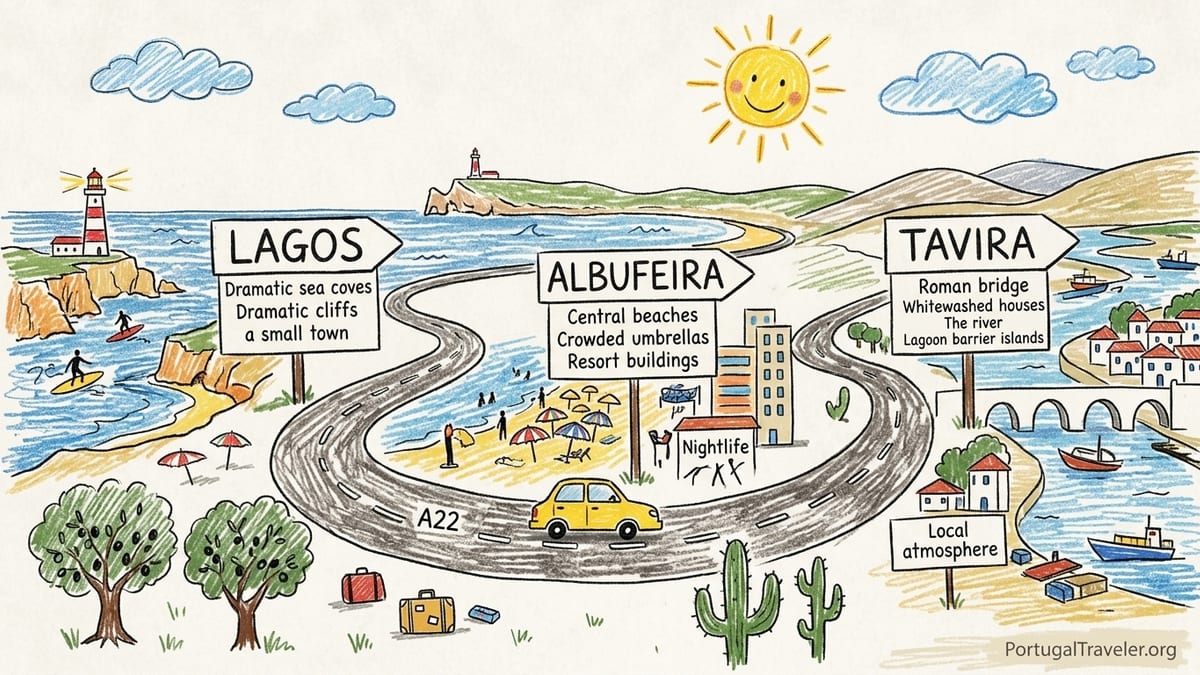
How I Structured My Algarve Bases (And What I Would Change)
On this trip I booked 9 nights in the Algarve and divided them into three bases: 3 nights in Lagos, 3 nights in the Albufeira area and 3 nights in Tavira. I traveled in shoulder season, when accommodation prices were moderate and roads were busy but not gridlocked. I rented a small car directly at Faro Airport, which shaped many of my decisions about where to stay and how practical each base felt once I arrived.
My original logic was simple. Lagos seemed perfect for the dramatic coves and the wild west coast. Albufeira put me close to the central beaches and major attractions. Tavira promised a slower, more local feel and access to the lagoon islands in the east. On a map that looked efficient, but on the ground I discovered that each move, even a short one, cost most of a half day once packing, check-out, driving and check-in were counted.
By the end of the trip I had no regrets about seeing three very different sides of the Algarve. However, if I were planning for most travelers, I would say that two bases are usually enough for a 9 to 10 night stay. Three moves worked because I enjoy comparing places, but it did mean fewer lazy mornings and more time dealing with luggage and parking than I really wanted on a beach holiday.
The experience also clarified what kind of traveler benefits from each major area. Lagos rewarded people who like a real town feel and do not mind driving to explore. The central strip around Albufeira suited those who want resort facilities and do not mind crowds and nightlife. Tavira was ideal for walkers, food lovers and anyone who cares more about atmosphere than ticking off famous sights. With that context, it becomes easier to answer the real question: which part of the Algarve makes sense as your base, rather than simply which hotel has the nicest pool.
Staying in the Western Algarve: Lagos and the Wild Coast
My western base was Lagos, a compact town that manages to feel both historic and firmly on the tourist map. I chose it over smaller villages like Burgau or Salema because I wanted a walkable center with plenty of restaurants, easy parking options just outside the walled old town and reasonable public transport. From Faro Airport, the drive to Lagos took me around one hour on the A22 toll motorway in light traffic, a straightforward route with clear signage and service areas along the way.
In Lagos I stayed in a small guesthouse a few minutes from the old town walls, with free street parking in the surrounding residential streets. Parking in the historic core itself was limited and often busy by late morning, but I could usually find a space within a 5 to 10 minute walk of the center. From my base it took me around 20 minutes on foot to reach Praia Dona Ana, one of Lagos’s iconic coves, and about 30 minutes to walk out to Ponta da Piedade along coastal paths and local streets. For days when I did not want to walk back uphill, short local taxi rides were easy to arrange at reasonable prices.
Lagos worked well for day trips. Driving to Sagres on the southwestern tip and the nearby surf beaches like Praia do Tonel took me about 35 to 40 minutes. The roads were in good condition and traffic flowed smoothly outside the busiest summer weeks. Reaching west coast beaches such as Arrifana or Monte Clérigo took a similar time. For a car-free option, Lagos train station sits right by the marina and has direct services east along the coast to Portimão, Albufeira (via Albufeira-Ferreiras station with a short taxi connection) and Faro. Travel times were slower than driving but still practical for patient travelers.
Evenings in Lagos had a lively, casual feel. The old town offered a dense cluster of small restaurants, wine bars and ice cream shops. Noise levels rose in the later hours, especially in streets closer to the main bar lanes, but the sound dropped noticeably once I crossed the walls into the residential streets where I stayed. This made Lagos feel like a good compromise base for couples or friends who want choice at night without committing to the full-on party atmosphere associated with some central Algarve resorts.
From this stay I would recommend the western Algarve, anchored on Lagos, to travelers who prioritize scenery, variety of beaches and the option to reach the wild Sagres coast. It suited a first visit if you are comfortable driving, couples who like evenings out without full-scale nightlife, and surfers who want to combine sessions on the west coast with more sheltered swimming coves around town. Without a car, Lagos still works, but you will be limited to the local beaches, boat tours and train-linked towns. Anyone wanting regular quick hops between beaches and viewpoints will appreciate having their own wheels here.
The Central Resort Belt: Convenience, Crowds and Nightlife
My central base was in the Albufeira area, a decision I made mainly for convenience. On the map, Albufeira sits roughly halfway between Lagos and Tavira, and within short drives of many well-known central beaches. The transfer from Lagos to my accommodation near Albufeira took around 45 minutes by car using a mixture of the A22 motorway and local roads, and the onward drive from Albufeira to Tavira later in the trip took just under one hour in light traffic.
In Albufeira I chose a mid-range apartment-hotel on the hillside above the old town, about a 15-minute walk from the main beach and restaurant-lined streets. The property had its own parking, which I came to value more than the pool or the view. In peak hours, finding on-street parking near the beach was difficult, and some central streets were either restricted or so busy that driving through them was stressful. From my base I could walk to the old town and beach, but I preferred to leave the car in the hotel garage unless I was heading further along the coast.
Beach access from this base was mixed. On foot I could easily reach the broad town beach, with its promenade and dense line of bars and casual restaurants. For more photogenic coves such as Praia da Coelha or Praia de São Rafael I needed the car and about 15 to 20 minutes of driving, plus time to secure a parking spot close enough to carry gear down. The reward was quieter sand and more dramatic cliffs than the busy town beach, but it never felt as relaxing as leaving the car once and walking everywhere, the way I could in parts of Lagos and Tavira.
In the evenings Albufeira split into two clear personalities. The old town around the main square offered family-friendly restaurants, live music and a steady buzz that went on late but did not feel intimidating. A short taxi or bus ride away, the “Strip” area along Avenida Sá Carneiro had concentrated nightlife with louder bars, clubs and a more intense party scene. I visited for an evening out of curiosity and was glad I was not staying directly on that stretch if I wanted sleep. Anyone looking for late nights and busy bars would likely prefer to base themselves closer to this area instead.
The central resort belt overall felt designed for travelers who want maximum facilities and do not mind sharing them with many others. It made practical sense for families who value pool complexes, kids’ clubs and all-inclusive packages, or for groups of friends who put nightlife and social atmosphere high on their list. For a first visit without a car, staying close to the beach and old town in Albufeira could work, as local buses, tours and taxis cover many popular outings. For my own style, I appreciated the convenience but did not feel as connected to the landscape as in the west or to the local rhythm I found in the east.
Eastern Algarve: Tavira and the Lagoon Islands
For my eastern base I chose Tavira, a small town straddling the river with Roman bridge views and whitewashed houses that give it a distinctly different character from central resort towns. Driving from Albufeira to Tavira along the A22 took me just under one hour, with clear exits and service signs. This section of the coast is closer to Spain, and the atmosphere reflects that softer, more low-key edge of the Algarve.
I stayed in a guesthouse within an easy 10-minute walk of Tavira’s main square and riverfront. Parking here was simpler than in Lagos or Albufeira. I could usually find a place on residential streets within a few minutes’ walk, and I quickly learned which areas filled first and which remained free later into the day. Once parked, I often left the car untouched for a full 24 hours, because Tavira itself is pleasant and compact enough to explore entirely on foot.
Beach access from Tavira works differently to the cliff-backed coves further west. Here the beaches sit on barrier islands in the Ria Formosa lagoon, reached by short ferry rides or, from some points along the coast, miniature tourist trains. From the town center, I walked about 15 minutes to the ferry pier that serves Ilha de Tavira. The boat ride was relaxed, crossing the lagoon in roughly 10 to 15 minutes depending on the service. On the island, a short sandy path led to a long, wide beach where it was easy to find quieter stretches by walking away from the main arrival zone.
Evenings in Tavira were notably quieter than in Albufeira and somewhat more restrained than in Lagos. The focus here was on dinner, conversation and strolling the cobbled streets rather than late-night bars. I found a broad choice of small restaurants, many with outdoor seating in courtyards or on pavements. While there were a few bars open late, the overall tone suited couples, slow travelers and anyone who values local atmosphere over organized entertainment. Noise levels dropped quickly once the restaurants emptied, and sleeping with windows open was rarely an issue.
Eastern Algarve around Tavira struck me as well suited to travelers without a car who are comfortable walking and using ferries or trains. Tavira’s train station connects along the line to Faro and Vila Real de Santo António, making day trips possible to other towns on the same rail corridor. That said, having a car gave me the freedom to visit smaller spots like Cabanas de Tavira and other access points into the Ria Formosa where parking close to the waterfront was often manageable outside peak weeks. For anyone planning a quieter holiday, with long beach days on spacious sands rather than a different cove every morning, this side of the Algarve is an appealing base.
Trying an Inland Stay: Quieter Nights and Day-Trip Flexibility
Although most of my nights were by the coast, I added a brief inland stay on a previous Algarve visit that shaped my thinking on bases. That time I spent two nights in a rural guesthouse in the hills north of Loulé, roughly a 25 to 30 minute drive from the nearest beaches and about 20 minutes from Loulé itself. The final approach involved narrow country lanes, olive trees and occasional steep sections, so arriving before dark was important for comfort and navigation.
The inland base delivered exactly what I had hoped for in terms of peace. Nights were genuinely quiet, with only the sounds of insects and the occasional dog. The star visibility was noticeably better than along the lit-up coast. Parking, of course, was not an issue. I could leave the car just outside my accommodation, pack it at my own pace and never worry about city center restrictions or competing for a spot near the beach.
However, the trade-off became clear within a day. To reach the coast for swimming or coastal walks, I had to commit to at least an hour’s round-trip drive each time, sometimes more when traffic built up on routes toward the major resort areas. Spontaneous evening strolls in town were replaced by carefully planned outings, because I did not want to negotiate the narrow roads back late at night after a full dinner and wine. Effectively, the car was not just helpful but absolutely essential for everything beyond sitting by the pool and walking the local tracks.
An inland base suits a specific type of traveler. It works best for those who prioritize tranquility, do not mind driving every day and perhaps have already experienced the coast on previous trips. It can also suit longer stays where the accommodation itself, whether a farmhouse, boutique retreat or villa, is part of the holiday. For a first-time visitor who wants to get to know the Algarve’s beaches and towns, I would only recommend an inland base if combined with at least one coastal base to keep drive times manageable and allow for car-free evenings.
Getting Around: Driving, Parking and Going Car-Free
Across the trip my small rental car gave me flexibility that noticeably changed how each base felt. In western and central Algarve I used the A22 toll motorway for medium-length hops, such as Lagos to Albufeira, which generally kept driving times under an hour. Local roads closer to beaches involved more roundabouts, lower speed limits and occasional slow traffic behind delivery vehicles, especially at busy times of day. Signage to major resorts and beaches was clear, and I rarely needed to rely on navigation once I had driven a route once.
Parking was a recurring theme. Lagos and Tavira had manageable parking situations provided I avoided trying to drive into the narrowest historic streets. Albufeira and some central beach areas required more patience. In the central belt, I learned to arrive at popular beaches either earlier in the morning or later in the afternoon to avoid circling for a space. In contrast, evenings in Tavira or in the residential streets around Lagos’s old town were usually more forgiving, and I could often park within a few minutes’ walk of where I wanted to be.
For travelers who prefer not to drive, my time on the ground showed that a car-free Algarve trip is possible if you choose your base carefully. Lagos and Tavira both have train stations within walking distance of their centers, allowing day trips to other towns on the same line. Local buses also connect to nearby beaches and villages, although schedules may be less frequent outside high season. In Albufeira, staying within walking distance of the beach and old town makes it easier to rely on local buses, taxis and organized excursions for day trips inland or along the coast.
Where a car becomes almost essential is in inland stays and for those who want frequent short hops between smaller coves and viewpoints in the western and central areas. On days when I left the car parked, such as in Tavira while shuttling only between town and the ferry, I appreciated how much more restful the day felt. That experience reinforced my view that for a one-week stay, choosing at least one base where you can happily go car-free for a day or two is just as important as being near any one famous beach.
Which Base Suits Which Traveler?
After staying in and moving between these areas, certain patterns emerged in terms of who seems happiest in each base. Lagos felt best suited to travelers who want a blend of town and nature. First-time visitors who value dramatic scenery, couples looking for varied but not overwhelming nightlife and surfers targeting the west coast all seemed well matched here. It also suits those comfortable driving, because while you can enjoy Lagos itself without a car, the most rewarding day trips easily accessible from there often involve a drive of 30 to 45 minutes.
The central resort belt around Albufeira aligned more with travelers who see their accommodation as a full-service hub. Families with children, multi-generational groups and friends celebrating events appeared to appreciate the large pools, kids’ facilities and dining choices that big resorts provide. The nightlife district offered an outlet for those who wanted loud, late evenings. For a first visit, this area can be appealing for travelers who feel reassured by international-style services and prefer not to think too much about logistics once they arrive, especially if they opt for airport transfers and organized tours instead of a rental car.
Tavira and the eastern Algarve clearly favored slower travelers. Couples taking longer holidays, remote workers and older travelers made up much of the crowd during my stay. They were rewarded with spacious beaches reached by ferry, a walkable town center and a calmer, more Portuguese-feeling environment. Rail connections support car-free travel along the eastern stretch of coast, and the evenings lend themselves more to lingering over dinner than to bar-hopping.
Inland stays, based on my earlier experience near Loulé, are more niche. They appeal to those who have perhaps already visited the Algarve’s main coastal towns and now want a base that feels rooted in the countryside rather than in tourism. Photographers, hikers and readers who are happy spending whole days within the grounds of their accommodation fit this mold. For them, the drive to the coast becomes an occasional outing rather than a daily expectation. For most first-time visitors, though, I would still look to the coastal bases first.
The Takeaway: How Many Bases I Would Use Next Time
Having tested three coastal bases on one trip and an inland stay on another, I would adjust my strategy for future visits. For a typical 9 to 10 night stay, I would now choose two bases instead of three. On a first or second visit, I would split time between a western base such as Lagos and an eastern base around Tavira. That combination offers cliff-backed coves and wild Atlantic stretches on one side, and wide lagoon beaches and quieter evenings on the other, without needing to move every few days.
In that scenario, I might spend 5 nights in Lagos and 4 nights in Tavira. From Lagos, I would revisit Ponta da Piedade, take a day to explore the Sagres headland and choose one or two favorite local beaches to return to instead of trying a new one every day. In Tavira, I would alternate between ferry trips to the island beaches and unhurried days in town, with perhaps a rail trip to another eastern town if I felt restless. This rhythm would preserve the sense of variety I enjoyed without turning the holiday into a sequence of check-ins and check-outs.
If I were traveling with children or a larger group that values resort facilities, I might instead choose a single well-located central base near Albufeira for the full duration, accepting that I would make longer day trips to the west or east on only one or two days. In that case, minimizing moves would outweigh the appeal of sampling multiple towns. For travelers who prioritize nightlife, staying within walking distance of the main evening areas in the central belt would make more sense than my hillside compromise.
The essential lesson for me was that in the Algarve, the right base depends less on any one must-see sight and more on your daily rhythm. If you picture early swims and quiet dinners, the eastern Algarve or a carefully chosen spot in the west will likely suit you. If you imagine pool days, busy promenades and structured activities, the central resort belt is the natural choice. Once you are clear on that picture, choosing between Lagos, Albufeira, Tavira or an inland retreat becomes a matter of fine-tuning rather than guesswork.
FAQ
Q1. Is Lagos or Albufeira better as a first-time base in the Algarve?
Lagos works better if you want scenery, a historic town and access to the west coast, while Albufeira suits those who prioritize resort facilities and nightlife.
Q2. Do I need a car to enjoy the Algarve properly?
A car gives you more flexibility, especially in the west and inland, but you can manage without one by basing in Lagos, Tavira or central Albufeira and using trains, buses and taxis.
Q3. How long does it take to drive from Faro Airport to Lagos, Albufeira and Tavira?
In light traffic, it is roughly one hour to Lagos, around 35 to 40 minutes to Albufeira and just under an hour to Tavira using the A22 motorway.
Q4. Which Algarve base is best for a quiet holiday?
The eastern Algarve around Tavira and some inland guesthouses north of towns like Loulé offer the quietest stays, with calmer evenings and less concentrated nightlife.
Q5. Where should I stay if I want good nightlife but also a beach?
Staying near Albufeira’s old town or within reach of the Strip gives you busy nightlife and easy beach access, though it comes with more noise and crowds.
Q6. Is Tavira a good base for families?
Tavira works well for families who prefer space and calmer beaches, especially with older children who enjoy ferry rides and long sandy shores rather than built-up resort complexes.
Q7. Are inland stays practical if I want to visit the beach every day?
They are possible but involve daily drives of 25 to 40 minutes each way, so they suit guests who are comfortable driving and do not mind longer outings for each beach visit.
Q8. How many bases should I choose for a one-week trip to the Algarve?
For about seven nights, one or two bases are usually enough. More than two can make the holiday feel fragmented with too much time spent moving.
Q9. Which area is best for surfers?
Staying in or near Lagos works well for surfers, as it gives access to both south coast spots and the more exposed west coast beaches around Sagres within short drives.
Q10. Can I rely on public transport to move between bases?
Yes, trains and regional buses link key towns like Lagos, Albufeira and Tavira, but services can be slower and less frequent, so allow extra time and check schedules in advance.