

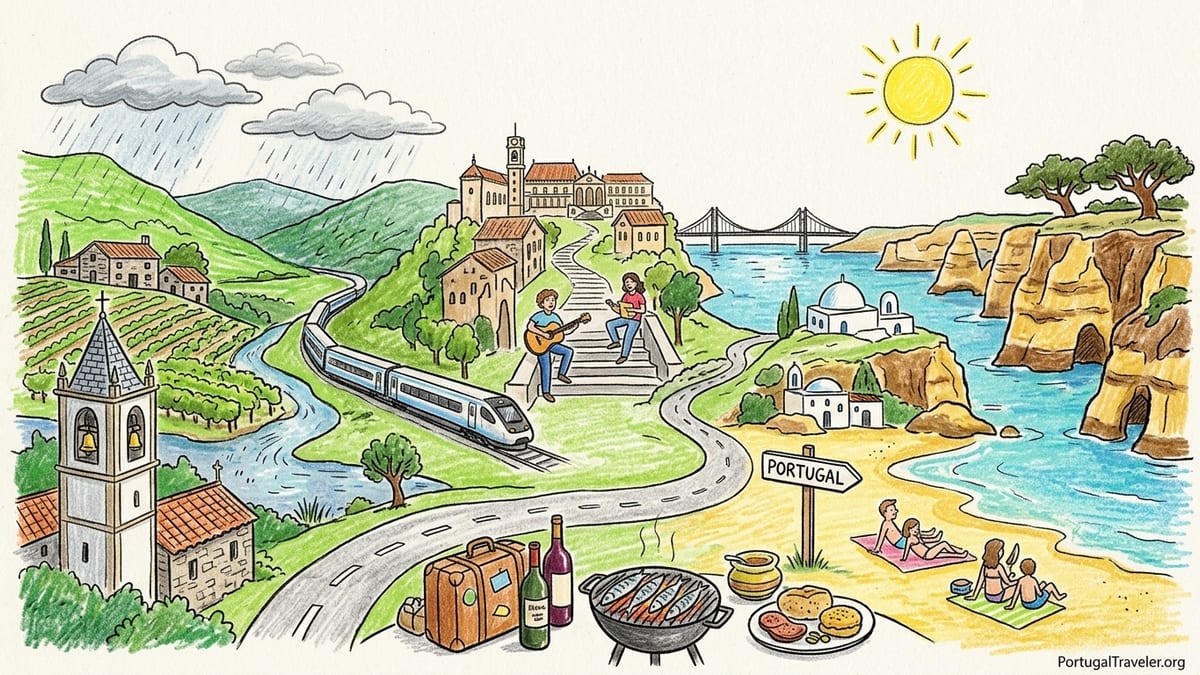
On one long trip across Portugal, I took trains, buses and rental cars from the rainy hills of Minho to the sunburned cliffs of the Algarve, with several weeks based in the country’s quieter central belt in between. By the time I left, I stopped thinking of “Portugal” as a single destination. Instead, it felt like three overlapping personalities: a cool, green, work-hard north; a lived-in, layered center; and a languid, beach-framed south. None of them were better or worse. They simply changed the mood of my days in very distinct ways.
The Overall Atmosphere: Three Moods in One Country
Arriving in the north felt like stepping into the older, more introverted soul of Portugal. In Braga and Guimarães I was surrounded by church bells, granite facades and conversations that seemed to happen half in the street, half inside. Bars were busy, but evenings still felt like they belonged to residents first and visitors second. In Viana do Castelo I watched families meet on the riverfront after work, kids in school uniforms eating ice creams in the drizzle. Even in Porto, which receives heavy tourism now, the underlying mood struck me as pragmatic and a little serious, shaped by a climate that stays relatively cool and damp for much of the year compared with the rest of the country, and a long tradition of industry and commerce tied to the Douro and the Atlantic.
Central Portugal felt softer and more balanced. In Coimbra, the university town between Porto and Lisbon, I sensed a more academic and slightly bohemian air, with students playing guitar on the steps of the Sé Velha at night and older locals staking out the same café tables each morning. Further inland in Tomar and the villages of the Ribatejo, the pace dropped and conversations stretched, yet I never had the sense that life had been rearranged primarily around visitors. When I eventually reached Lisbon, the atmosphere shifted again to something cosmopolitan and international, but still grounded in the rhythms of ferries crossing the Tagus, commuters on the metro and families grocery shopping at big chains like Pingo Doce and Continente alongside neighborhood markets.
The south, for me, was about light and loosened shoulders. Once I crossed into the Alentejo coast and later the Algarve, the days felt longer in more ways than just the sunshine. In Lagos and Tavira, breakfast happened later, beach days slid into sunset drinks on wide terraces, and restaurant staff were more accustomed to handling English and German as first languages. According to recent sunshine data compiled from long term climate records, Faro averages more than 3,000 hours of sun per year, noticeably more than Porto, which helps explain why the region feels geared to outdoor living nearly year round. In small towns like Vila Nova de Milfontes on the Alentejo coast, that translated into evening promenades, families pushing strollers by the river and a “we will get to it tomorrow” attitude that could be either relaxing or maddening depending on your travel style.
As a traveler trying to decide where to spend limited time, I found it useful to think of the north as the place to feel plugged into local, working cities, the center as a bridge between everyday Portugal and its grandest historical layers, and the south as the part where the climate and seascapes start to dictate the rhythm more than the clock.
Scenery and Landscapes: Green Hills, Rolling Heartland, Sunburned South
In the north, the first thing that struck me was how green everything looked. On the train line that runs from Porto up through Minho toward Viana do Castelo, I spent long stretches looking out at vine-covered hills, stone farmhouses and mist clinging to church towers. Rainfall here is higher than in central and southern Portugal, and it shows in the lushness of the countryside. On a damp October day walking part of a Camino trail near Ponte de Lima, my boots sank into soft, mossy ground and I passed terraced fields that looked almost Galician. The Atlantic is never far away, but it often appeared as a steel gray strip with white breakers under low clouds, not the turquoise brochures promise further south.
Central Portugal looked more varied but less immediately dramatic. Around Coimbra and Leiria the hills were gentler, patched with eucalyptus and pine plantations, farmland and river valleys. A drive from Coimbra down to Nazaré took me through stretches that, if it were not for the tiled villages and occasional castle silhouette, could have been rural inland Spain. Yet the center is also where I felt some of the strongest contrasts in a single day. One morning I watched massive winter waves crash below the lighthouse in Nazaré, famous with surfers for the canyon that funnels swell into record breaking surf, and that same afternoon I was walking through quiet vineyards near Batalha under a low golden sun, listening to nothing but birds and the crunch of gravel.
The south changed almost as soon as I crossed into the Alentejo region on the A2 motorway. The greens faded into warm browns and dusty yellows, broken up by cork oak trees and long, straight roads shimmering in the heat. Even in early May, inland Alentejo already felt hot in the afternoon, and locals warned me that July can see long stretches of very high temperatures away from the coast. When I reached the Algarve, the landscape tightened into steep cliffs, smaller patches of farmland and a ribbon of resort towns along the coast. I remember arriving in Lagos in the late afternoon and heading straight to the cliff path above Praia Dona Ana, where the eroded rock formations and bright water felt worlds away from the river mouth beaches in Minho. Both were beautiful, but in completely different keys.
If you are choosing where to base yourself, I would summarize it this way: travel north for green, Atlantic-facing Portugal, the center for a cross section of hills, rivers and mid sized cities, and the south if you want almost guaranteed blue skies and that interplay of ochre cliffs and blue sea that lands on so many magazine covers.
Food and Wine: Hearty North, Everyday Center, Sea and Sun in the South
I ate very well in every region, but the tone of the food shifted as clearly as the scenery. In the north, my most memorable meals were hearty and sauce rich. In Porto, a waiter in a no frills spot near Campanhã station convinced me to try a half portion of francesinha, the city’s famous sandwich layered with several meats, cheese and a beer based sauce, which arrived with enough fries to feed two. A few days later in Braga I found myself at a small family restaurant that brought out a clay dish of rojões, northern style pork with chestnuts, and a jug of red Vinho Verde produced just up the road. The cool, lightly fizzy wine made sense in a region that sees more rain and milder summer highs than the Algarve or Lisbon, and it paired perfectly with the richer, meat focused cooking.
In central Portugal, meals felt more balanced between land and sea. In Coimbra I leaned heavily into grilled fish at neighborhood places where the day’s catch was chalked on a board at the door, often at around 12 to 15 euros for a plate of dourada or robalo with potatoes and salad. Inland in Tomar, meat reappeared more often in the form of grilled pork and stews, but portions tended to be a bit lighter than in the north, and menus were more likely to include salads and vegetable sides without asking. House wine by the glass was reliably inexpensive in the center, often under 3 euros in small town restaurants when I visited, and staff were keen to talk about bottles from Dão and Bairrada, central regions that produce both reds and sparkling wines.
Further south the food on my plate reflected both the climate and the tourism economy. On the Alentejo coast, I ate some of the best seafood of my trip in Sines and Vila Nova de Milfontes, where simple grilled sardines, clams in garlic and coriander and açorda de marisco, a thick bread and shellfish stew, dominated menus. Prices here were still moderate, closer to what I paid in the center. Once I reached the central Algarve, though, I saw a visible jump in certain restaurant prices, especially along busy strips in towns like Albufeira and Lagos. In the marina area of Lagos, for example, main dishes at heavily tourist oriented restaurants were frequently in the 18 to 25 euro range, compared with 10 to 15 euros for comparable dishes at more local feeling places a few blocks inland.
Wine in the south told its own story. On a hot June evening in Tavira, a glass of chilled white from the Algarve region itself tasted almost Mediterranean, fuller and more sun ripened than the leaner Vinho Verde I had in Minho. Given that Faro and Lisbon both record significantly more annual sunshine hours than Porto, it made intuitive sense that white wines from south of the Tagus felt more about ripe stone fruit than about acidity. For a traveler, the real difference is this: in the north and center I gravitated to hearty, often meat centered comfort food and cooler climate wines, while in the south I found myself chasing seafood, grilled dishes and cold drinks that fit evenings spent outside.
Weather and When I Liked Each Region Best
Portugal is not large, but the climate spread between north and south is bigger than it looks on a map. On my trip I experienced everything from cool drizzle to borderline beach weather in the space of a week, simply by moving regions. In October in Porto, I needed a light jacket and an umbrella almost every day, and locals told me that the city can see many wet days between November and March. Long term climate summaries back this up, with Porto receiving noticeably more rainfall and fewer sunshine hours per year than Lisbon or Faro. I never felt cold enough to be uncomfortable in a heated apartment, but it would not have been my first choice for a winter sun break.
In central Portugal, the transitional nature of the climate revealed itself day by day. In spring in Coimbra I started mornings in a sweater, but by early afternoon I was comfortable in shirtsleeves sitting at an outdoor café. Wet spells did come through, yet they rarely lasted all week as they sometimes do in the far north. The Atlantic influence still kept summer highs milder near the coast compared with inland Spain, especially when a breeze picked up along beaches like Figueira da Foz. For sightseeing heavy days in Lisbon, the shoulder months of April, May, late September and October felt almost ideal, with long daylight, relatively mild temperatures and more manageable crowds than peak summer.
When I turned south, the thermometer leapt ahead of the calendar. In early May in the Alentejo interior, my car’s dashboard regularly read afternoon temperatures over 30 degrees Celsius, and shopkeepers in towns like Beja were already talking about preparing for the intense July and August heat. On the Algarve coast, the air felt less oppressive thanks to the Atlantic, but the sun was noticeably stronger. Climate data show Faro averaging summer highs several degrees above Porto, combined with many more clear days. Standing on the clifftops near Carvoeiro in June, I understood why local tourism officials push shoulder seasons so strongly. It was already hot enough that a midday hike felt punishing, yet the main beach in town was still far from the sardine tin scenes it sees in August.
If I were planning another trip, I would personally choose the north between late April and June or in September, the center almost year round except mid summer inland, and the south in late spring or early autumn when the sea is warm enough for swimming but the sun has not yet made the afternoons oppressive. For a winter escape, I would skip the far north almost entirely and split time between Lisbon and the Algarve, where even in January outdoor lunches in the sun are fairly common on wind sheltered terraces.
Getting Around, Distances and Where I Felt Most Mobile
One of the things that made this north center south comparison possible on a single trip was Portugal’s rail and road network. The main north south spine connects Porto, Coimbra, Lisbon and Faro with long distance Intercidades and Alfa Pendular trains operated by CP, the national rail company. When I last checked, a standard Intercidades ticket from Lisbon to Faro was listed at just over 29 euros in second class if bought close to departure, while promotional fares on faster Alfa Pendular trains along the Lisbon Porto Faro axis could drop to under 11 euros when booked at least several days ahead online. That price range gives a sense of how economically you can cross whole regions, especially if you plan your dates in advance.
In the north, I found the combination of intercity and regional trains particularly helpful. Porto’s Campanhã station gave me access not only southbound services but also local trains to Braga, Guimarães and Viana do Castelo, which made it easy to base myself in the city and take day trips into very different northern environments without a car. Urban trains around Porto and the integrated metro and bus system meant I rarely needed taxis inside the city. However, once I tried to reach smaller coastal villages or inland hiking areas, the limitations of public transport appeared quickly and a rental car became far more practical.
Central Portugal felt like the sweet spot between train coverage and road trip flexibility. The line linking Porto, Coimbra and Lisbon is frequent and straightforward, and smaller cities like Aveiro, Figueira da Foz and Leiria are all reachable by regional trains or buses without too much stress. For a few days I used Coimbra as a base, hopping on regional trains that cost under 10 euros for short hops to nearby towns. When I wanted to explore castle dotted hills and rural monasteries beyond public transport, I rented a small car for a few days in Coimbra and found the major roads well maintained and clearly signed. Driving on the A1 motorway between the north and Lisbon came with tolls, with a full Porto to Lisbon run typically costing in the mid twenties in euros for a small car, but collection was simple with a Via Verde device in the windshield that my rental agency preinstalled.
The south put more pressure on having my own wheels. The long linear strip of the Algarve has a regional train line and buses that link main towns such as Lagos, Portimão, Albufeira and Faro, and I used that train to move between bases without issues. Once I wanted to visit more remote coves or inland villages, though, services thinned out. Many locals and fellow travelers I spoke to agreed that the Alentejo interior and much of the Algarve are best experienced by car, especially outside peak summer when bus schedules reduce. Tolls on some southern roads have been adjusted in recent years and sections like the A22 across the Algarve have shifted from paid to free for drivers, which reduced my overall toll costs significantly, but a Via Verde equipped rental still proved useful for the remaining tolled stretches between Lisbon and the south.
From a traveler’s perspective, I felt the north and center were easier for car free travelers who are content to focus on cities and larger towns, while the south rewarded renting a car for at least part of the trip in order to reach the quieter beaches and inland landscapes that give the region its character.
Beaches, Cities, Countryside and the Pace of Daily Life
My beach experiences changed dramatically as I moved through the country. In the north, beaches like Matosinhos near Porto and Cabedelo near Viana do Castelo felt like serious Atlantic spots, with colder water, strong surf and a mix of wetsuit clad surfers and local families who seemed more interested in walking the promenade than swimming. Even on warm days in late spring, most people stuck to the sand and cafés. The wind and waves were invigorating but did not invite long, lazy swims in the way southern beaches do.
In central Portugal, coastal towns like Figueira da Foz and Nazaré offered wide sandy stretches that felt less internationally known than the Algarve but were clearly beloved by domestic visitors. On a September afternoon in Figueira, I watched retirees play cards under striped cabanas, teenagers practicing surf and kids building sand forts, all under softer sunlight than I found later in the south. Inland countryside around Coimbra, Tomar and Alcobaça moved at a measured tempo. Farmers worked small plots, older residents sat outside cafés in the late morning, and the main squares filled gently in the evenings without the sense of clockwork tourist turnover I felt in some Algarve resort strips.
The south is where the classic beach image that many people associate with Portugal really crystallized for me. The Lagos coastline, with beaches like Praia do Camilo and Meia Praia, combined steep stairs down to compact coves, boat tours weaving through grottoes, and beach bars that stayed open late into warm nights. The water was still the Atlantic but felt several degrees warmer, especially by late summer, and crowds included a heavy mix of international tourists, seasonal workers and long term expats. Further east in Tavira and along the Ria Formosa, the atmosphere softened again into sandbank islands, shallow lagoons and fishing villages that reminded me that the Algarve is still, underneath it all, a working region tied closely to the sea.
Taking cities and countryside together, I would describe the north as busy, historic and sometimes work first, the center as a blend of university energy, mid sized city life and rural calm, and the south as increasingly oriented around leisure the closer you get to the coast. That affected my own pace. In the north, I packed more churches, museums and urban walks into each day. In the center I lingered over coffee and spent more time in small town squares. In the south, my schedule revolved around tides, sunset times and how much heat I could tolerate at midday.
Accommodation, Costs and Where I Would Linger Next Time
Accommodation followed the same pattern of variation. In the north, I consistently found good value in city center guesthouses and smaller hotels. In Braga and Guimarães, well reviewed double rooms in restored townhouses with breakfast were often priced in the range of 70 to 100 euros per night when I searched outside the absolute peak of August. In Porto itself, prices crept higher in the most touristed Ribeira and Clérigos areas, but looking a little further toward residential neighborhoods or staying on the Gaia side of the river opened up more affordable options. Many of these places seemed designed with domestic weekenders and business travelers in mind, with substantial breakfasts and practical features like desks.
Central Portugal gave me some of my most atmospheric and best value stays. In Coimbra I rented a simple one bedroom apartment just below the university hill for a nightly price similar to a midrange hotel room, which allowed me to shop at local supermarkets and cook some meals, reducing restaurant spending. Smaller central towns such as Tomar and Alcobaça had family run guesthouses in historic buildings where double rooms commonly fell below 80 euros per night even in pleasant seasons. In these areas, I rarely felt that prices had detached from local incomes, which meant I could slow down and stay longer without burning through my budget.
The south, especially the central Algarve, was a different story. In Lagos in June, I found that central hotels and apartments that would have been under 100 euros per night in many northern or central towns were frequently 150 euros or more, and beachside resorts ran far higher. Owners and staff confirmed that July and August bring substantial surges, with coastal stays booking out well in advance and commanding some of the highest nightly rates in the country. On the Alentejo coast outside the main Algarve bubble, however, prices dropped back into a more comfortable range, and rural stays in converted farmhouses offered large rooms and pools at prices similar to or even lower than those I paid in Porto.
Looking back, if I were to repeat a similar length trip, I would likely spend more nights in the center and north and choose the south more selectively. I would still want several days on the Algarve coast, but I would book them outside peak season and balance them with time in Alentejo villages and on less famous beaches. In the north, I felt I barely scratched the surface of Minho and Trás os Montes, regions that rewarded slower exploration. The center, with its mix of campus life, monasteries, river towns and manageable distances, felt like the place where I could easily rent a flat for a month and simply live, dipping into both the north and south for shorter excursions.
The Takeaway
By the end of my trip, “Portugal” had become, in my mind, three overlapping travels rather than one. The north gave me granite streets, rain polished church squares, dense city life and a sense of living history rooted in industry, religion and the river. The center offered a spectrum of experiences, from student packed hilltops in Coimbra to quiet cloisters in Alcobaça and windy beaches in Nazaré, all threaded together by train lines and midrange prices that made experimentation easy. The south handed me abundant sun, warmer seas, dramatic cliffs and an economy oriented more overtly toward leisure, particularly along the Algarve strip.
For a first timer with ten to fourteen days, I would suggest thinking less about choosing a single region and more about assigning each one a job. Let the north deepen your sense of Portuguese culture and day to day life, the center show you the country’s historical layers and manageable small cities, and the south give you the sea air, light and slower mornings that many travelers crave. How you divide your time will depend on whether you want more museums or more beach bars, more green hills or more orange cliffs, more evenings in university squares or more sunsets over the Atlantic.
On my own next visit, I will likely linger longer in central Portugal, using a base like Coimbra or a town in the Ribatejo to fan out on day trips, then book shorter, carefully chosen windows in the far north and the far south based on the season. Rather than chasing one “best” region, the real pleasure for me lies in crossing their invisible borders and feeling the country shift under my feet.
FAQ
Q1. If I only have one week, should I focus on the north, center or south of Portugal?
With a week I would choose two regions at most. For city life and culture, combine the north and center. For sun and beaches with a taste of urban life, pair the center and south.
Q2. Is it realistic to visit all three regions without renting a car?
Yes, if you focus on major cities and towns linked by trains and buses such as Porto, Coimbra, Lisbon and Faro. For rural areas, especially in the south, a car is much more practical.
Q3. Which region of Portugal is best for beaches?
The south has the warmest water and most famous beaches, especially in the Algarve, but central coastal areas like Figueira da Foz and Nazaré are excellent for a quieter feel.
Q4. Where will I find the lowest accommodation prices overall?
In my experience, smaller cities and towns in the north and center tended to have better value than the most touristed parts of the Algarve or central Lisbon.
Q5. How should I time my trip to match each region’s weather?
Late spring and early autumn suit all regions. Winter favors Lisbon and the south, while the north is at its best from late April to October if you want to avoid long wet spells.
Q6. Is the food very different between northern, central and southern Portugal?
Core dishes overlap, but the north leans more to hearty meat and stews, the center balances land and sea, and the south highlights seafood and lighter meals that fit the warmer climate.
Q7. Which part of Portugal feels least touristy?
Many inland areas of the center and parts of the northern countryside felt the least shaped by foreign tourism, especially away from major cities and coastlines.
Q8. Are train tickets between regions expensive?
Standard intercity fares can reach several dozen euros for long north south routes, but booking advance promotional tickets online often reduces costs significantly.
Q9. Is it easy to visit smaller villages using only public transport?
In the north and center, some villages are reachable by regional trains and buses, but schedules can be limited. In the south, many rural spots are hard to reach without a car.
Q10. Where would you personally spend more time on a return trip?
I would plan a longer stay in central Portugal, use it as a base for day trips, and then add shorter targeted visits to the far north and the Algarve depending on the season.