


I arrived in the Algarve with eight full days, a rental car waiting at Faro Airport and an optimistic list that zigzagged from Tavira to Sagres. On paper, it looked efficient: see the eastern lagoons, the central cliffs, the western wild coast, plus a Benagil cave tour, two historic towns, one winery and at least one "secret" beach per day. In reality, I spent too long on the EN125 stuck behind trucks, underestimated how much time vanishes into parking and long lunches, and changed hotels so often that I felt like a courier rather than a traveler. This guide is what I wish I had read before that trip: not a rigid, hour-by-hour plan, but a realistic way to divide 3, 5 or 7 days in the Algarve based on distances, driving times and how it actually feels on the ground.
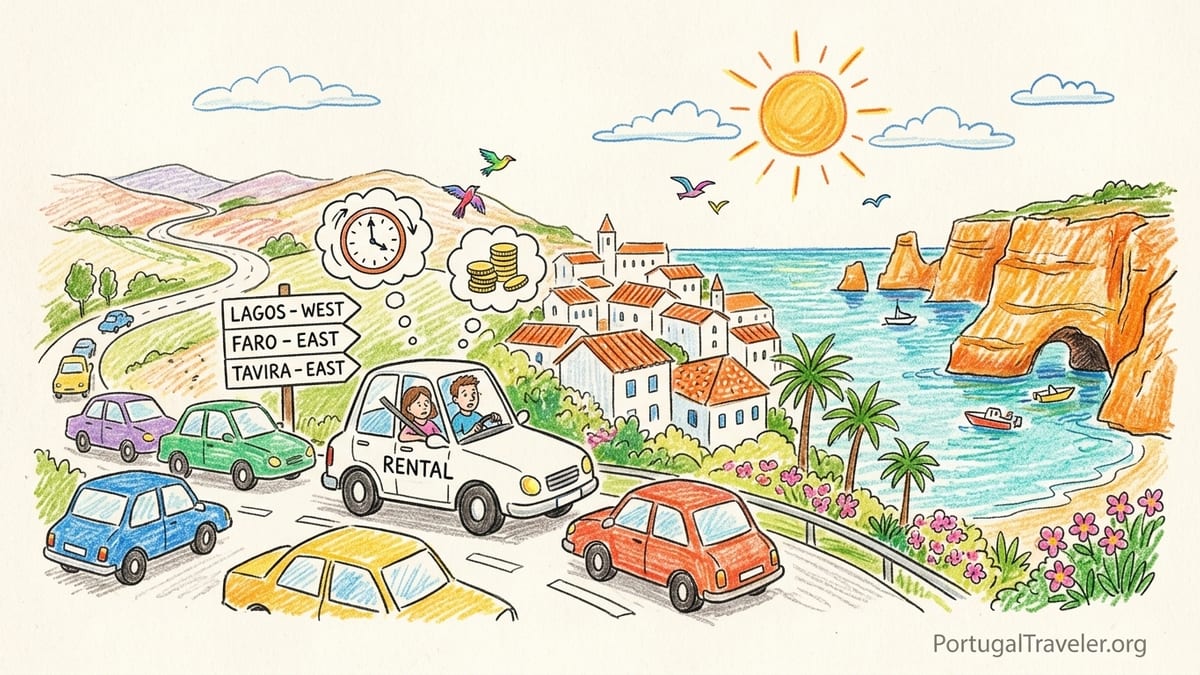
What Went Wrong On My First Algarve Route
My original plan started and ended at Faro, like most trips that use the region’s main airport. I booked a compact rental car, collected the keys in the terminal and headed straight west on the A22, the motorway that runs across the Algarve from Lagos to the Spanish border. Since 1 January 2025 that motorway has been toll free, which makes it the fastest way to cross the region without worrying about electronic gantries or post office payments. Even with the easy driving, I still misjudged how much time I would spend on the road versus actually being on the beach or in town.
In eight days I booked six different hotels: two nights in Tavira, one in Faro, two in Carvoeiro, two in Lagos and one in Sagres. The distances did not look intimidating. Faro to Tavira is about 30 to 40 minutes by car. Faro to Carvoeiro is roughly 50 minutes. Lagos to Sagres is around 35 to 40 minutes on quiet roads. On a map that seems like nothing. On a warm August day, when you add checking in, finding parking in old towns, carrying luggage through alleys and pausing for a much-needed espresso, these short hops eat half a day.
Beach hopping also became more repetitive than I expected. I tried to see Praia da Marinha, Benagil, Praia do Carvalho and Algar Seco near Carvoeiro in a single day, thinking it would be a pleasant progression of viewpoints and swims. In practice, I spent more time circling for a parking place above the cliffs than actually on the sand. By midday, paid parking near Carvoeiro and Benagil was already close to full, with prices generally around 1 euro per hour in town car parks, and the heat made every walk from the car feel longer. After the third viewpoint over orange cliffs and turquoise water, my notes read simply “Beautiful, but could have stayed longer in just one spot.”
Lunch and activity timings were another blind spot. A Benagil cave boat tour from Carvoeiro or Portimão typically lasts 1.5 to 2.5 hours and costs roughly 30 to 45 euros per adult for a standard small-boat trip, with higher prices for yacht charters or combined dolphin-spotting tours. I assumed I could squeeze a mid-morning tour in between a sunrise hike and an afternoon drive to Lagos. In reality, you arrive 30 minutes before departure, queue for check-in, wait for the boat, change clothes afterward and then look for lunch. A “two-hour” activity turned into nearly four. This pattern repeated with a sunset trip to Cabo de São Vicente near Sagres, where the drive from Lagos takes about 40 minutes each way. By the time I got back to town, I had energy for a simple dinner and nothing else.
Understanding Algarve Distances and Travel Logistics
To plan time well, it helps to translate the Algarve’s geography into practical travel decisions. The region stretches roughly 150 kilometers from Lagos in the west to Vila Real de Santo António on the Spanish border. The A22 motorway links these points in a shallow inland arc; the older EN125 main road follows closer to the coast and passes through many town roundabouts. With the A22 now toll free, the motorway is usually the better choice for longer hops, saving 20 to 40 minutes on legs such as Faro to Lagos compared with sticking to the EN125.
On my trip, the drive from Faro Airport to Lagos via the A22 took about 1 hour and 10 minutes in light traffic. Lagos to Sagres, which you cover on secondary roads after leaving the motorway, took around 40 minutes. Lagos to the Benagil and Praia da Marinha area, using the A22 and then local roads, took roughly 40 minutes as well. Eastbound, Faro to Tavira was an easy 30 to 40 minutes. These times roughly match what both local guides and mapping apps suggest, but what matters more for planning an itinerary is how easily these segments stack within a day.
The other big factor is parking. In high summer, towns like Lagos, Albufeira and Tavira fill their central car parks by late morning. Central underground car parks close to historic quarters often charge around 1 euro per hour. Smaller cliff-top lots at viewpoints such as Algar Seco or near Benagil can be free but have limited spaces, so arriving before 10:00 feels almost mandatory if you do not want to circle for 20 minutes in the sun. Over a week, I lost at least half a day of my trip simply to the combined effect of searching for spaces, walking in and out of car parks and queuing at payment machines.
Public transport is useful for some travelers, but it shapes your choices differently. The Algarve railway, the Linha do Algarve, runs between Lagos at the western end and Vila Real de Santo António in the east. A through journey from Lagos to Vila Real de Santo António takes around 2.5 hours with changes, at a fare in the region of 15 to 25 euros depending on class and time of booking. This makes the train a pleasant way to move between a few main hubs such as Lagos, Portimão, Albufeira-Ferreiras, Faro and Tavira. However, many of the most photogenic beaches and cliffs sit several kilometers from the nearest station or bus stop, so you either walk in the heat or rely on taxis and rideshares. For a short trip of 3 to 5 days, that extra complexity can eat into exploration time.
How to Think About a 3-Day Algarve Stay
If I had only three days in the Algarve, I would not try to see the entire coast. On my longer trip, I attempted to do exactly that in the first half: Faro to Tavira on day one, Tavira to Carvoeiro and Benagil on day two, Carvoeiro to Lagos on day three. Each day involved at least an hour of driving plus hotel check-outs, and I felt constantly in transit. For three days, the better trade-off is to choose a single base or at most one split of two nights and one night in neighboring areas.
A realistic three-day framework could look like this. Fly or arrive into Faro, pick up your car at the airport and drive either west to Lagos or east to Tavira. Each direction gives a different flavor. Lagos offers immediate access to the dramatic sandstone cliffs of Ponta da Piedade, beaches like Praia Dona Ana and quick day trips to Sagres. Tavira offers low-slung white buildings, a calmer historic center, access to the Ria Formosa lagoon and ferry boats to Ilha de Tavira. Both towns have enough restaurants and bars to fill two relaxed evenings without you needing a car after dark.
With three days, I would now recommend a maximum of one full-day excursion that goes more than 45 minutes away by car. From Lagos, that might be a Benagil cave tour from Portimão or Carvoeiro, which involves a 30 to 40 minute drive each way plus 3 to 4 hours wrapped around the boat tour itself. From Tavira, that might be a half-day in Faro’s Old Town combined with a ferry trip into the Ria Formosa. The rest of the time should lean toward slow enjoyment of your base: one mostly beach-focused day and one day split between town wandering and a short coastal walk at sunrise or sunset.
In terms of numbers, a sane three-day plan keeps driving to perhaps 1.5 to 2 hours per day at most, includes a single hotel or apartment, and splits your time roughly as one day on beaches, one day in towns and one day that mixes a boat or cave tour with a relaxed evening meal. That feels modest on paper but rich in practice, especially in high season when queues for activities, restaurants and parking grow longer. The biggest discipline is learning to say no, to accept that you will not see both the eastern lagoons and the far western cliffs on the same short trip, and to save specific destinations such as Sagres or Tavira for a future return.
Making the Most of 5 Days: Introducing Variety Without Burnout
With five days, the Algarve opens up a little. You can experience both the central cliffs and either the eastern lagoons or the western wild coast, but there are still trade-offs. On my own eight-day circuit, the middle five days ended up being the most satisfying because I spent two nights each in Carvoeiro and Lagos, with only one quick hotel change in between. If I were redesigning a five-day trip today, I would copy that pattern but simplify the route.
One option is to divide your stay between the central coast and either Lagos or Tavira. For example, you might spend two nights near Carvoeiro or Lagoa to access Praia da Marinha, Benagil and Algar Seco, followed by three nights in Lagos. From Carvoeiro, an early start lets you park above Praia da Marinha, walk a section of the cliff path and join a late-morning boat or kayak trip into the caves. Lunch at a simple beach restaurant or cafe on the cliffs, followed by an afternoon swim at a single favorite beach, is usually enough activity. The next day, the short drive to Lagos gives you time to settle into a new hotel and explore the old town by late afternoon.
Five days is also the first itinerary length where renting a car feels fully worthwhile even if you are not an enthusiastic driver. The flexibility to leave a busy central beach and retreat to a quieter spot within 20 minutes can change the tone of a hot afternoon. It also makes it easier to handle practical tasks like grocery runs if you rent an apartment. On the cost side, summer car rentals booked in advance often fall in the 300 to 400 euro range for a week with basic insurance from major brands, so a five-day hire may run around 200 to 300 euros before fuel. That is not insignificant, but shared between two or three travelers it usually compares favorably to repeated taxi or rideshare trips between spread-out beaches and towns.
The key risk with five days is turning every day into a new highlight reel. It is tempting to allocate a morning for Ponta da Piedade, a midday sprint to a Benagil cave tour, an afternoon dip at Praia da Marinha and a sunset at Cabo de São Vicente, all in a single marathon. On my own trip, the one day that approached this pattern left me too tired to enjoy dinner. A healthier five-day structure builds in at least one quieter day near each base, limits long drives to alternate days and accepts that you will not visit every famous viewpoint.
Seven Days: Slowing Down or Adding a Second Base
Seven days in the Algarve sound like permission to see everything, but if you fill all seven with heavy driving and constant hotel changes, you will finish more exhausted than when you started. My eight-day route tried to skim from Tavira to Sagres with only a few pauses of two nights in one place. If I could rewind, I would still keep two bases but stay longer in each and trim the edges of the map.
With a week, one practical approach is to choose two bases that represent different sides of the region. For example, spend three nights in Tavira or nearby Cabanas in the east, followed by four nights in Lagos or a village close by in the west. From Tavira, there is time to wander the old streets, take ferries out to Ilha de Tavira for long, flat beaches and perhaps visit Olhão and Faro’s old town as day trips. From Lagos, you can mix lazy mornings on Praia Dona Ana or Meia Praia with a day trip to Sagres and Cabo de São Vicente, and another to the Benagil and Praia da Marinha stretch.
This kind of week usually involves two hotel or apartment changes in total, perhaps three if you add a single night near Faro at the beginning or end to match awkward flight times. Average daily driving time can stay under two hours if you cluster sights smartly. For example, you might combine Ponta da Piedade, a Lagos old-town lunch and an afternoon on Meia Praia into one day with very short drives. Another day could package Sagres, Cabo de São Vicente and a wild west-coast beach like Praia do Amado into a single loop from Lagos, with around 1.5 hours of driving in total.
Seven days also make it easier to include one or two organized activities without the sense of sacrificing something else. A full-day catamaran cruise along the central coast from Lagos or Albufeira, often priced somewhere around 50 to 80 euros per adult including lunch and swimming stops, feels luxurious when it occupies only one of seven days. The same goes for a small-group dolphin-watching tour or a guided kayak trip into sea caves. These experiences almost always take longer than the brochure suggests once you include check-in, safety briefings and transfers, so sprinkling them across a week rather than compressing them into a short stay keeps your schedule breathable.
Balancing Beaches, Towns, Nature and Activities
Looking back at my notes, what I regret most is not individual choices like “Lagos versus Tavira” but the overall balance. I devoted too many hours to cliffside viewpoints and not enough to slow evenings in town squares. For a satisfying Algarve itinerary, it helps to think in four simple categories: beach time, town time, nature walks or viewpoints and organized activities on water or land.
On my eight-day trip, roughly half my days leaned heavily toward beach and viewpoint hopping, often with three or four different stops. That produced a nice spread of photographs but a diluted experience of each place. If I were redesigning those days, I would aim for one primary beach per day with perhaps a secondary short stop nearby. Around Lagos, that might mean a morning swim at Praia Dona Ana followed by an hour-long walk along the cliffs at Ponta da Piedade in late afternoon, rather than trying to slot in multiple small beaches as separate destinations.
Town time deserves a conscious allocation, particularly if you enjoy food and local culture. Tavira, Lagos, Faro and even compact towns like Silves each warrant at least one unhurried evening. That means arriving by late afternoon, parking once and not moving the car until the next morning. On my trip, the one evening I fully dedicated to Tavira, with an early riverside drink, a long dinner and a slow stroll over the Roman bridge, lingers in my memory more than yet another spectacular but rushed cliff view.
Activities sit on top of this base. A Benagil cave excursion, a Ria Formosa boat safari, a surf lesson near Sagres or a winery visit inland from Lagoa are all appealing, but each effectively consumes half a day. A balanced week might include two to three such activities, a five-day trip perhaps one or two and a three-day visit exactly one, chosen for something you cannot experience easily elsewhere. For example, if you live far from the ocean, a dolphin-watching cruise may feel more special than another clifftop hike you could approximate at home.
Practical Time Budgets and Hotel Change Strategy
One of the biggest lessons from my Algarve circuit was the hidden time cost of moving beds. Every hotel change involved at least an hour of packing, check-out, driving and check-in, not counting the extra stress of finding somewhere to leave the car near narrow old streets. Over eight days with six different stays, that meant I unconsciously devoted the equivalent of almost a full day just to logistics.
For a 3-day trip, I now strongly recommend choosing a single base. This could be Lagos if you want the combination of beaches, nightlife and easy day trips, or Tavira if you prefer a quieter, more traditional town and flatter beaches reached by short ferry rides. With one base, daily routines like breakfast spots, parking locations and sunset viewpoints become familiar, which lowers mental load and lets you focus on enjoying the scenery.
On a 5-day itinerary, you can justify one move. For example, you might spend the first two nights in Tavira and the remaining three in Lagos, using the transfer day itself as a mini road trip with a lunch stop in Faro’s old town or at a central beach village. With only one hotel change, you still keep the logistics manageable while accessing a broader slice of the coast.
In a 7-day plan, I suggest limiting yourself to two or at most three accommodation bases. A sample pattern would be three nights in Tavira, three in Lagos and one in Faro if needed to catch an early flight. Another option is a countryside stay near Monchique or Silves in the middle of the week to reset between eastern and western segments. The number that matters is not simply nights per town but total check-ins; once that figure rises above three in a week, the trip begins to feel fragmented.
The Takeaway: How I Would Now Divide 3, 5 and 7 Days
After driving most of the Algarve, missing a few exit signs and watching too many sunsets from car parks rather than terraces, my own revised time allocation looks simpler and more focused. Instead of chasing every scenic viewpoint, I would use the motorway when needed, accept that I cannot see everything and give each base town time to breathe.
With 3 days, I would pick Lagos as a single base if I wanted cliffs and dramatic beaches, or Tavira if I wanted calmer waters and traditional streets. I would plan one major outing more than 30 to 40 minutes away, such as a Benagil cave tour or a Ria Formosa boat trip, and otherwise spend my time walking, swimming and lingering over meals. Driving would stay under 2 hours per day and there would be zero hotel changes.
With 5 days, I would split between two bases, such as 2 nights in Tavira and 3 in Lagos, or 2 in Carvoeiro and 3 in Lagos. I would allocate roughly two days mostly on beaches, one to two days exploring towns and one to two organized activities on the water. Long drives would happen on alternate days, and I would make peace with skipping either the far eastern or far western edge if weather or energy dipped.
With 7 days, I would still resist the urge to notch every name on the map. A week divided between Tavira and Lagos, with perhaps a final night near Faro Airport, offers enough time to see the eastern lagoons, central cliffs and western wild coast without living in the car. I would aim for two or three hotel changes at most, keep daily driving under two hours and choose three or four headline experiences that matter personally, whether that is a Benagil cave tour, a surf lesson near Sagres, a catamaran day along the central coast or a long afternoon on Ilha de Tavira. The Algarve rewards repeat visits, so the most sustainable itinerary is not the one that covers the most ground but the one that makes you want to come back.
FAQ
Q1. Is a rental car essential for a 3-day Algarve trip?
For three days focused on a single town like Lagos or Tavira, you can manage without a car by using trains, buses and taxis, but having a car gives you far more flexibility for short beach hops and reaching viewpoints that are not well served by public transport.
Q2. How much driving per day feels reasonable in the Algarve?
Most travelers find that keeping driving to 1.5 to 2 hours per day or less makes the trip feel like a holiday rather than a road marathon, especially in high season when parking and traffic add extra time to each journey.
Q3. How many hotel changes are ideal for 5 to 7 days?
For five days, one hotel change is usually enough to add variety without constant packing; for seven days, two or at most three bases strike a good balance between seeing different areas and avoiding logistics fatigue.
Q4. Are Benagil cave tours worth the time on a short stay?
Yes, but they effectively take half a day once you include check-in, waiting, the tour itself and lunch, so on a 3-day trip it is wise to treat a Benagil excursion as your main activity for that day rather than trying to stack multiple big sights around it.
Q5. Where should I base myself if I want nightlife as well as beaches?
Lagos and Albufeira both offer a mix of lively bars, restaurants and easy access to beaches; for a first visit, Lagos often feels more balanced, with a compact historic center and several beaches within a short walk or quick drive.
Q6. Is it realistic to visit both Tavira and Sagres on a 3-day trip?
It is technically possible by car, but the distance between the far east and far west of the Algarve means you would spend much of your time driving, so it makes more sense to focus on one side and leave the other for a future visit.
Q7. How crowded are Algarve beaches in summer?
In July and August, popular beaches near Lagos, Albufeira and Carvoeiro can feel very busy from late morning onward, so early starts, using the A22 for faster access and accepting that you may only comfortably visit one or two main beaches per day help keep the experience enjoyable.
Q8. Can I rely on trains and buses for a 7-day visit?
You can see the main towns using the Algarve railway and regional buses over a week, but reaching certain coves, cliffs and west-coast surf beaches will still require taxis or rideshares, which can become costly compared with sharing the price of a rental car.
Q9. How should I split time between beaches and towns?
For most travelers, a pleasant balance over 5 to 7 days is spending about half the days primarily on beaches, a couple of afternoons or evenings dedicated to town exploration and two or three half-days on boat trips, hikes or other organized activities.
Q10. What is the biggest planning mistake people make with Algarve itineraries?
The most common mistake is trying to cover the entire coast in too few days, which leads to too much time on the road, too many hotel changes and rushed stops, rather than accepting some limits and giving each chosen base town at least two nights.